This article contains advertising. Our booking links are routed through a partner that adds commission tracking automatically, so if you book through one we earn a commission from the provider, at no extra cost to you. It never affects what we recommend. Affiliate disclosure
It is twenty to three in the morning, the aircraft has parked at a remote stand, and the bus carrying you to the terminal is full of people who have all realised at the same moment that they do not know whether they need a visa sticker, where to buy one, or which of the forty men waving at them in the arrivals hall is their driver. Cairo International Airport is not difficult, but it is unfamiliar in a very specific way, and nearly every problem travellers have here comes from not knowing the sequence in advance. This cairo international airport guide exists so that you are the one person on that bus who does.
This is our hub page for everything to do with CAI: the three terminals and how to tell which one you are using, what happens between the aircraft door and the kerb, the airport side of the visa process, how to get into the city, money and SIM cards, what departure day looks like, and what you can realistically do with a layover, a night between flights or a lounge pass. Where a topic needs more depth, we link to a dedicated guide. Facts and prices were checked in September 2026; the Egyptian pound has been repriced several times in recent years, so treat any figure as the right order of magnitude rather than a quotation.
Cairo airport at a glance
| Question | Short answer (Sept 2026) |
|---|---|
| Airport code | CAI |
| Where it is | Heliopolis, on the north-eastern edge of the city, about 15 km from the central business district |
| Passenger terminals | Three (1, 2 and 3), plus a Seasonal Flight Terminal used in pilgrimage seasons |
| Home airline | EgyptAir, a Star Alliance member, based in Terminal 3 |
| Traffic | About 31 million passengers in 2025, which puts it among the busiest airports in Africa |
| Open | 24 hours; many long-haul flights arrive and leave overnight |
| Between terminals | Automated people mover linking Terminal 1 with Terminals 2 and 3; an airbridge between Terminals 2 and 3; shuttle buses |
| Metro | None to the terminals yet; a Line 3 airport link is still being prepared |
| Visa on arrival | USD 30 for eligible nationalities since March 2026 — a paper sticker from the bank counters, or a USD 36 digital QR code bought online or at kiosks |
| Time to downtown | 30–60 minutes by road, far longer at rush hour |
| Time to the pyramids | Roughly 60–90 minutes by road |
| Arrive for departure | Three hours before an international flight |
| Sleep options | Sleep pods in all three terminals since 2025; Le Méridien linked to Terminal 3 by a bridge |
The three terminals, and why it matters which one you use
Cairo’s terminals are not three piers of one building. Terminal 1 is a separate building some distance from the other two, and turning up at the wrong one on departure day can cost you half an hour you do not have. Which terminal you use depends on your airline, and occasionally on your route, so check your booking rather than assuming.
Terminal 3: EgyptAir’s home
Opened in April 2009, Terminal 3 is the largest and newest of the three and the hub for EgyptAir’s domestic and international flights, shared with many of its Star Alliance partners. If you are flying EgyptAir to Luxor, Aswan, Sharm el-Sheikh or Hurghada, or connecting onto EgyptAir from a long-haul flight, this is almost certainly your terminal. It is a big, bright building with long walks between gates, so allow time.
Terminal 2: the renovated neighbour
Terminal 2 first opened in the 1980s, spent four years being rebuilt and reopened in September 2016 with its gates doubled from seven to fourteen. It works as an integrated complex with Terminal 3, joined to it by an airbridge, and handles a large share of the foreign airlines that serve Cairo. For most transit passengers the practical point is that a connection between Terminals 2 and 3 can often be made without leaving the building complex.
Terminal 1: the original
Terminal 1 opened in 1963 and has been extended and renovated several times since. It is the oldest and most dated of the three, spread across several halls, and it sits apart from Terminals 2 and 3. Airlines move between terminals from time to time and published airline-by-terminal lists online are often out of date, so the only reliable source is your own booking or your airline’s app on the day.
The Seasonal Flight Terminal
Opened in 2011 to take pressure off the main terminals during the Hajj and Umrah seasons, the Seasonal Flight Terminal handles pilgrimage traffic to Saudi Arabia. Most leisure travellers will never set foot in it; if your flight to Jeddah or Medina is in pilgrimage season, check whether it has been moved here.
Moving between terminals
An automated people mover links Terminal 1 with Terminals 2 and 3, the AirMall and the multi-storey car park, and there are shuttle buses as well. Terminals 2 and 3 are joined by an airbridge. None of this is fast when you add in walking, waiting and re-screening, so if your onward flight leaves from a different terminal, treat the connection as a journey in its own right rather than a stroll.
| How to check your terminal | How reliable? |
|---|---|
| Your e-ticket or booking confirmation | Good, but can change after booking |
| Your airline’s app or online check-in on the day | The best single source |
| The airport’s own flight information | Good for same-day changes |
| Your hotel or driver | Often right, sometimes a guess — confirm yourself |
| A list on a travel website | Frequently out of date |
Arriving at Cairo: the sequence from aircraft to kerb
Arrivals at Cairo follow the same order every time. Knowing it in advance is most of the battle.
- Off the aircraft. Either by airbridge straight into the terminal, or by bus from a remote stand — common for overnight arrivals and busy periods.
- Visa, if you need one on arrival. Before you reach passport control, you will find the bank counters selling paper visa stickers and, since August 2026, self-service kiosks selling the digital QR visa. If you already have a QR code or an e-Visa, have it ready on your phone or on paper and walk straight past.
- Passport control. Queue at the desks for foreign passports. The officer will check the visa, stamp you in, and occasionally ask where you are staying — have the name of your hotel ready.
- Baggage reclaim. Screens show the belt for your flight. Luggage trolleys are available, and porters will offer to help; they expect a tip if you accept.
- Customs. Most visitors walk through without declaring anything, but bags are often put through an X-ray machine on the way out. Drones are the classic problem: they need a permit in Egypt and are routinely confiscated at the airport. Leave yours at home.
- The arrivals hall. ATMs, bank exchange booths, mobile-phone kiosks, official transport desks, hotel and tour-company reps with name boards — and a lot of unofficial taxi drivers.
What slows arrivals down
The two bottlenecks are the visa booths and passport control, and both are worst when several wide-body flights land within half an hour of each other, which happens most nights between about midnight and five. An arrival that takes twenty-five minutes on a quiet afternoon can take well over an hour in that window. Things that make it worse: arriving without a visa plan, joining the passport queue before you have a visa, and not having your accommodation address to hand. Things that make it better: an e-Visa arranged before you fly, or the digital visa-on-arrival QR code bought online in the week before you land, either of which lets you skip the visa queue entirely.
The arrivals hall: who to talk to and who to ignore
You will be approached before you have finished reading the signs. Men offering “taxi, taxi”, men who say they work for the airport, men who offer to carry your bag to the car park. Some are genuine, most are touts, and the rule is simple: do not agree a ride with anyone who approaches you. Use a pre-booked transfer whose driver is holding your name, one of the official transport desks with posted prices, or a ride-hailing app from the designated pickup area. Everything else is a negotiation you are going to lose after a long flight. Our guide to scams and staying safe in Cairo covers the arrivals-hall tricks in more detail.
Visa on arrival: the airport part
Whether you can get a visa on arrival depends on your passport, and that question — along with the e-Visa route, which works for most nationalities — belongs to our full guide to Egypt visa requirements. What matters at the airport is the physical process.
For eligible nationalities, including US and UK citizens, the single-entry tourist visa on arrival has cost USD 30 since 1 March 2026 and allows a stay of up to 30 days. There are now three ways to get it at Cairo. Since August 2026 the airport has been piloting a digital version: a QR code that costs USD 36 (the USD 30 fee plus a USD 6 service charge), paid by card, which you can buy online in the week before you travel or at self-service kiosks in the arrivals halls. The traditional paper sticker is still sold at the bank counters before passport control during the pilot; cash has always been the usual way to pay there, and clean, undamaged US dollar notes are the safest. Whichever you choose, have your visa before you join the passport queue.
The honest advice is to arrive with your visa already sorted: an e-Visa if your nationality allows it, or the digital QR code bought online in the week before you fly. On a busy night either can save you half an hour of queueing. Nationalities that are not eligible for a visa on arrival should arrange a visa before travelling; do not rely on reports of exceptions.
Getting into Cairo from the airport
The airport is in Heliopolis, on the opposite side of the city from Giza, which surprises people who expect the pyramids to be a short hop. In light traffic you can reach downtown in half an hour; in the evening rush the same drive can take well over an hour, and the pyramids are further again. The full comparison of transfers, with current prices and step-by-step instructions for each, is in our guide to getting from Cairo airport into the city. The short version:
| Option | Relative cost | Best for | Watch out for |
|---|---|---|---|
| Pre-booked private transfer | Highest | First-timers, night arrivals, families, anyone going to Giza | Confirm the terminal and your flight number with the company |
| Uber or Careem | Low | Travellers with data or a local SIM, going to downtown, Zamalek or Heliopolis | Use the designated pickup area; drivers sometimes cancel |
| Official airport taxi or limousine desk | Moderate, fixed | Anyone without data who wants a set price | Agree the price at the desk, not in the car |
| Airport and public buses | Very low | Light packers on a tight budget | Slow, crowded, and hard with big bags |
| Metro | — | Not an option yet | No metro reaches the terminals; the Line 3 airport link is still in preparation |
Our view: if you land at night, have a lot of luggage, are travelling with children or are heading to Giza, book a transfer before you fly. For a daytime arrival into central Cairo, a ride-hailing app is cheap and straightforward once you have data; our guide to using Uber and Careem in Cairo explains how pickups work.
| From CAI to | Light traffic | Rush hour |
|---|---|---|
| Heliopolis hotels | 10–20 min | 20–40 min |
| Downtown and Tahrir | 30–40 min | 60 min or more |
| Zamalek | 35–45 min | 60 min or more |
| Giza, the pyramids and the GEM | 60–70 min | 90 min or more |
Money, SIM cards and staying connected
The arrivals halls have ATMs and bank exchange booths, and they are a reasonable place to get enough Egyptian pounds for your first day or two — the transfer, tips, water and a meal. Porters, drivers and hotel staff all work on small cash tips, so it is worth breaking a large note early; our guide to tipping and baksheesh gives sensible amounts. For how exchange rates, cards and ATMs work in the rest of Egypt, see our guide to money and currency in Cairo.
The main Egyptian mobile networks have kiosks in the arrivals area selling tourist SIM cards and data packages. You need your passport, and registration takes a few minutes. Airport packages are convenient rather than cheap, but a working data connection the moment you walk out of the terminal is worth a lot in Cairo: it unlocks ride-hailing, maps and messages to your hotel. If you want the cheapest deal, buy a small package at the airport and top up in town. Our Cairo SIM card and internet guide compares the networks and the eSIM alternatives.
Departing from Cairo: how early, and what to expect
Get to the airport three hours before an international flight and two before a domestic one. That sounds cautious until you see the order of events:
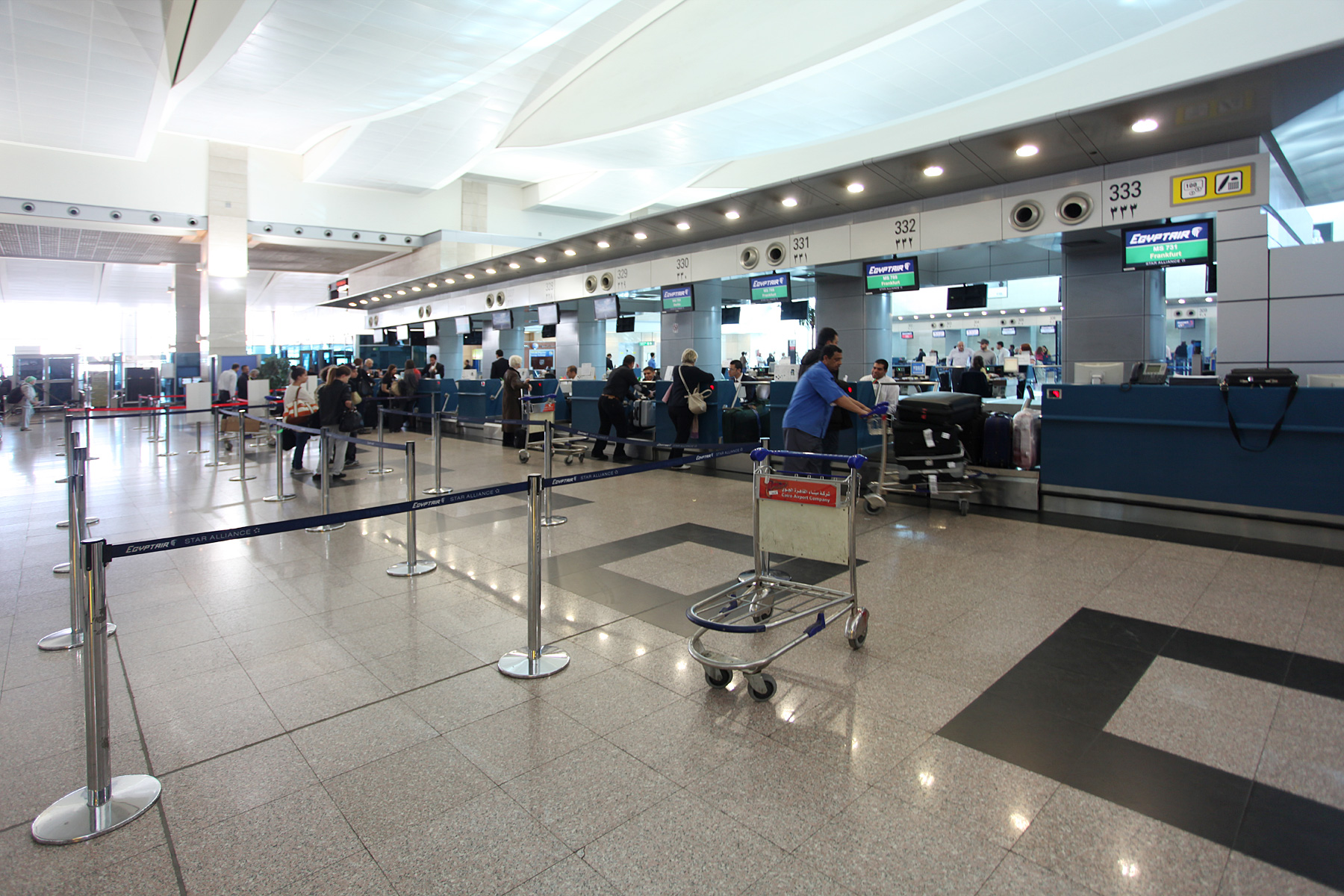
- Security at the terminal entrance. Your bags are scanned before you are allowed into the building. Friends and family generally cannot come in to see you off, so say goodbye at the kerb.
- Check-in and bag drop. Queues can be long for the evening wave of long-haul departures.
- Passport control. Exit immigration for foreign passports.
- Security again. A second screening before the gates. Keep liquids and electronics easy to reach.
Build in extra time for the drive, too. The traffic to Heliopolis at rush hour can turn a thirty-minute journey into an hour and a half, and the approach roads to the terminals can back up at peak times. The practical rule for Cairo is to add at least an hour to whatever your map app says if you are travelling between about 15:00 and 20:00 on a weekday.
Shopping at the airport is limited and prices are high compared with town. Buy spices, cotton, papyrus and perfume oils in the city, where you can compare, and treat the airport shops as a last resort for forgotten gifts.
Flying on within Egypt
For many visitors CAI is not the end of the journey but a change of planes: on to Luxor or Aswan for the temples, or to Sharm el-Sheikh or Hurghada for the Red Sea. EgyptAir’s domestic network runs from Terminal 3, and private carriers such as Air Cairo and Nile Air fly some of the same routes. The flights are short — about seventy-five minutes to Luxor, around an hour and a half to Aswan and about an hour to Sharm el-Sheikh — and delays of more than a couple of hours are rare.
Three practical points. First, if you are connecting from an international arrival to a domestic flight, you will normally clear immigration in Cairo, so leave yourself generous time and check with your airline whether your bags are checked through or need collecting and re-checking. Second, arrive two hours before a domestic departure; the same terminal-door security applies. Third, compare the flight with the train before you book. To Luxor and Aswan the sleeper train saves a hotel night and travels while you sleep, but it is noisy, stops roughly every hour and can run hours late, and the flight is often cheaper than a sleeper berth. The common answer is to take the train one way and fly the other. There is no train at all to Sharm el-Sheikh or Hurghada, so for the Red Sea the choice is between a short flight and a long bus ride.
Layovers: what you can realistically do
Cairo is one of the few major transit airports where the world’s most famous monuments are within reach of a layover. That is exciting and dangerous in equal measure, because the pyramids are on the far side of a very congested city. A rough guide by length of layover:
| Layover | Realistic plan | Verdict |
|---|---|---|
| Under 6 hours | Stay airside. Eat, rest, find a lounge or a sleep pod | Leaving the airport is not worth the risk |
| 6–9 hours | Stay airside, or leave only for somewhere close, such as the Baron Empain Palace in Heliopolis | Possible with a visa and a driver; the pyramids are too far |
| 9–12 hours | A pyramids or Grand Egyptian Museum dash with a pre-booked driver or tour | Doable if you are back three hours before departure |
| Over 12 hours, or overnight | Giza and the GEM, or a night in a hotel and a morning at the pyramids | The layover Cairo is best at |
The rule that keeps people from missing flights: be back at the airport about three hours before departure. Build the day backwards from your boarding time — driving, the queue at the terminal door, check-in, exit immigration and gate security — and whatever is left is your sightseeing time. Remember that leaving the airport means going through arrivals, which means a visa if your nationality needs one, and possibly collecting and re-checking your bags. For a close-to-the-airport outing, the Belgian baron’s Hindu-inspired mansion in Heliopolis is a genuinely strange and memorable hour; our guide to the Baron Empain Palace covers it. For a longer layover, start with our guides to visiting the Pyramids of Giza and the Grand Egyptian Museum, which sit two kilometres apart, and remember that museum tickets are sold online only, in timed slots.
Honest verdict: most layover tours sold online are well run, but a few will cheerfully take a booking that cannot physically get you back in time. If an operator does not ask for your departure time and build the day around it, book someone else.
Sleeping at or near the airport
Since 2025, sleep pods — small private cabins with a bed that you rent by the hour — have been available in all three terminals, which makes a long overnight connection far more bearable than it used to be. For a proper bed, the Le Méridien Cairo Airport hotel is connected directly to Terminal 3 by a link bridge, which is as close as a real hotel gets to the gate. Beyond that, there is a cluster of hotels in Heliopolis and along the airport roads, many with airport shuttles, and staying in Heliopolis for a first or last night makes sense if you are arriving late or leaving early. For the rest of the city, see our overview of where to stay in Cairo.
Sleeping on the terminal benches is possible, and people do it, but CAI is not a comfortable airport for it: announcements run through the night, lighting stays bright and seating is designed to discourage lying down. If your connection is overnight and you do not need to leave the airport, a pod is money well spent.
Lounges
EgyptAir runs its own lounges in Terminal 3 for its business-class passengers and eligible Star Alliance frequent flyers, and other airlines have their own arrangements for premium passengers. Across the terminals there are also lounges that sell entry at the door or accept membership cards such as Priority Pass, although which lounges are included, in which terminal, and for how long, changes more often than the lounge operators’ websites suggest. Check the current listing in your card’s app before you rely on it, and note that some card lounges restrict access at peak times.
Is a paid lounge worth it at Cairo? For a connection of four hours or more, usually yes: seating is limited at busy gates, food outlets airside are expensive, and a shower after an overnight flight makes a real difference. For a short connection, no — you will spend most of the time walking to the gate.
Food, shopping and facilities
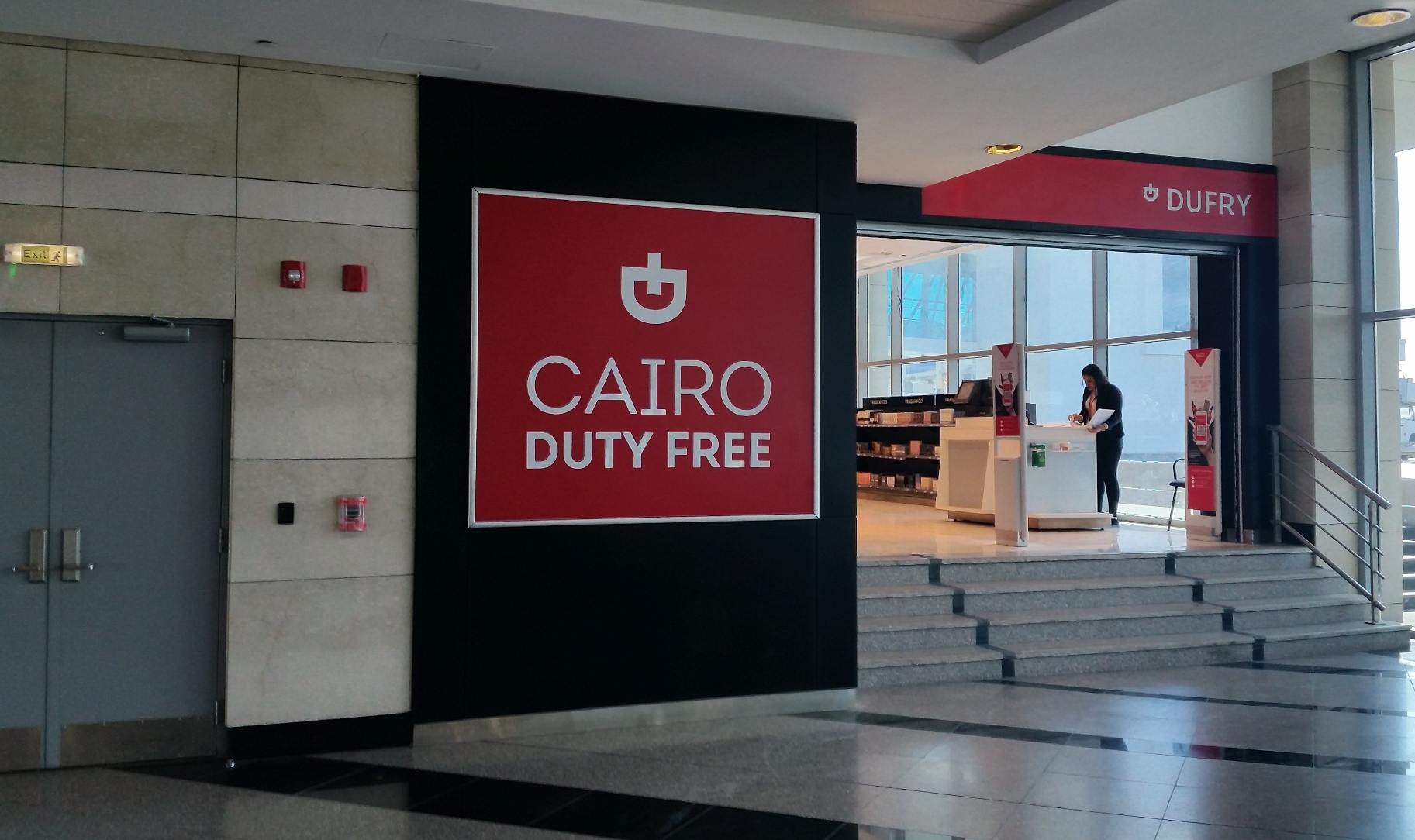
All three terminals have cafés and fast-food outlets on both sides of security, with Terminal 3’s being the most extensive. Prices are airport prices, much higher than in the city, and choices thin out in the small hours. There are duty-free shops in the departure areas, pharmacies, prayer rooms, baby-changing facilities and medical points, and wheelchair assistance can be requested through your airline; for more on getting around Cairo with limited mobility, see our Cairo accessibility guide.
Other airports serving Cairo
Almost every international visitor flies into CAI, but two other airports carry the Cairo name, and it is worth checking your ticket carefully.
- Sphinx International Airport, west of Giza, is much closer to the pyramids and the Grand Egyptian Museum than CAI is. It handles a small number of routes, mainly low-cost and charter flights. If your flight uses it, your first-day logistics change completely — in your favour, if you are staying in Giza.
- Capital International Airport, near the New Administrative Capital east of the city, handles very few flights and is a long way from anywhere most visitors want to be.
Looking further ahead, a fourth terminal at CAI has been proposed, with a capacity of at least 30 million passengers a year and an opening date that planners have put as early as 2030, but it remains in the planning stage.
Our honest verdict on Cairo airport
Terminal 3 is a perfectly good modern airport: clean, well signed in English and Arabic, and efficient for most of the day. The problems at CAI are not really about the buildings. They are the queues at the visa booths and passport control when several long-haul flights land together in the small hours, the gauntlet of unofficial drivers in the arrivals hall, the separation of Terminal 1 from the other two, and above all the traffic between the airport and the rest of Cairo, which turns every departure into a calculation.
Every one of those problems is solved by preparation rather than luck. With an e-Visa, a booked transfer or a working ride-hailing app, your terminal confirmed and three hours in hand for departure, CAI is an unremarkable airport — which, for a first-time visitor arriving in one of the world’s most intense cities, is exactly what you want it to be.
Mistakes that cost travellers time at CAI
- Going to the wrong terminal. Terminal 1 is a separate building. Check your airline’s app on the day.
- Arriving at the airport with two hours to spare for a long-haul flight. The security check at the terminal door and the evening check-in queues regularly eat most of that.
- Arriving without a visa plan. Buy the digital QR code or an e-Visa in advance, or carry clean US dollars for the paper sticker.
- Agreeing a taxi with someone who approached you. Use a pre-booked driver, an official desk or an app.
- Leaving the airport on a short layover. The pyramids are on the other side of the city. Under about nine hours, stay put.
- Packing a drone. It will almost certainly be confiscated at customs without a permit.
- Believing there is a metro to the airport. Not yet. Some older guides say otherwise.
- Changing every dollar at the airport before you know your budget. Change enough for a day or two and use ATMs in town for the rest.
Before you fly
The shortest path through CAI starts at home: sort your visa in advance if you can — an e-Visa, or the digital visa-on-arrival QR code in the week before you fly — book your transfer or install a ride-hailing app, note your terminal, carry some clean US dollars as a fallback, and put your hotel’s address somewhere you can show it without a signal. Our Cairo travel checklist covers the rest of the preparation, and our guide to getting around Cairo picks up where the airport leaves off.
Frequently asked questions
Which terminal does EgyptAir use at Cairo?
Terminal 3, for both domestic and international flights, shared with many of its Star Alliance partners. Terminals 2 and 3 are joined by an airbridge and work as one complex, so connections between them are relatively easy. Always confirm the terminal in the EgyptAir app or your booking on the day, because allocations occasionally change.
Is there a metro from Cairo airport to the city?
Not yet. No metro line reaches the terminals as of September 2026. An extension of Line 3 from Heliopolis to the airport, about nine kilometres with seven new stations, is being prepared, but until it opens your choices are a pre-booked transfer, a ride-hailing app, an official taxi or a bus.
How far is Cairo airport from the pyramids?
The airport is in Heliopolis, on the north-eastern edge of Cairo, and the pyramids are at Giza on the south-western side, so the drive crosses the whole city. Allow roughly 60–90 minutes in reasonable traffic, and considerably longer at rush hour. If you are staying near the pyramids and landing at night, a pre-booked transfer is the least stressful option.
How early should I get to Cairo airport for my flight?
Three hours before an international flight and two hours before a domestic one. There is a security check at the terminal entrance before check-in, then exit immigration and a second security screening before the gates, and the evening long-haul departures create long queues. Add at least an hour to the drive if you are travelling in the weekday afternoon rush.
Can I get a visa on arrival at Cairo airport?
If your nationality is eligible, yes. US and UK citizens, among others, can get a single-entry tourist visa on arrival, which has cost USD 30 since March 2026. At Cairo you can buy it as a paper sticker at the bank counters before passport control, traditionally paid in cash, or as a USD 36 digital QR code, paid by card, online or at the kiosks in the arrivals halls. Eligible travellers can also get an e-Visa before they fly.
Can you sleep at Cairo airport?
Yes. Sleep pods have been available in all three terminals since 2025, rented by the hour, and the Le Méridien Cairo Airport hotel is linked to Terminal 3 by a bridge. Sleeping on the benches is possible but uncomfortable, with bright lights and announcements through the night.
Can I leave Cairo airport during a layover?
Yes, if you have a visa or are eligible for one on arrival, and if you have time. As a rule of thumb, you need nine hours or more to see the pyramids safely, because they are 60–90 minutes away and you should be back at the airport about three hours before departure. On shorter layovers, stay airside.
Is Cairo airport open 24 hours?
Yes. CAI operates around the clock, and many long-haul flights arrive and depart between midnight and dawn. Cafés, exchange booths and SIM kiosks are thinner on the ground at night, but the essentials — ATMs, transport desks and some food outlets — stay open.
The terminal question has more to it than a table can show: which airlines really use which building, how confident anyone can be about it, and what a connection between Terminal 1 and the other two actually involves. Our detailed guide to Cairo airport’s three terminals goes through each one.
The full arithmetic for leaving the airport — how much of a layover the airport itself eats, the free 96-hour transit visa for passengers on Egyptian airlines, and what happens to your checked bags — is in our Cairo airport layover guide.
Choosing who takes you to the pyramids matters as much as the length of your layover. We explain what private and all-inclusive tours cost, what they include, and the return-cutoff rule a good operator plans around, in our guide to Cairo layover tours.
There are only sixteen sleep pods across the three terminals, and the Le Méridien’s bridge to Terminal 3 is landside, so it needs a visa. We compare every option for a night at or near the airport — pods, lounges, the benches, shuttle hotels and Heliopolis — in our guide to sleeping at Cairo airport.
For the full line-up — the CAC and Ahlein lounges in each terminal, EgyptAir’s Alioth, Almeisan and Gienah lounges in Terminal 3, walk-up prices of around USD 38–50 and which cards get you in — see our guide to Cairo airport lounges.
The visa-on-arrival process now has three routes at Cairo — a digital QR code bought before you fly, the kiosks in the arrivals halls, or the paper sticker at the bank counters — with different prices and payment rules for each. Our Egypt visa on arrival guide for Cairo airport takes you through each step.
Each step of arriving — passport control, baggage reclaim, the customs rules on drones, cash and phones, and how to handle the taxi offers in the arrivals hall — is covered in detail in our guide to Cairo airport arrivals.
Leaving takes longer than arriving. Cairo screens departing passengers at the terminal door as well as after passport control, and the drive from Giza can take two and a half hours at rush hour. Check-in cut-offs, drive times from each part of the city, duty free and the VAT refund are all covered in our step-by-step departures guide.
Related Cairo Guides
- First time in Cairo: essential planning tips
- Taking taxis in Cairo
- Travel insurance for Cairo
- The best neighbourhoods to stay in
Photo Credits
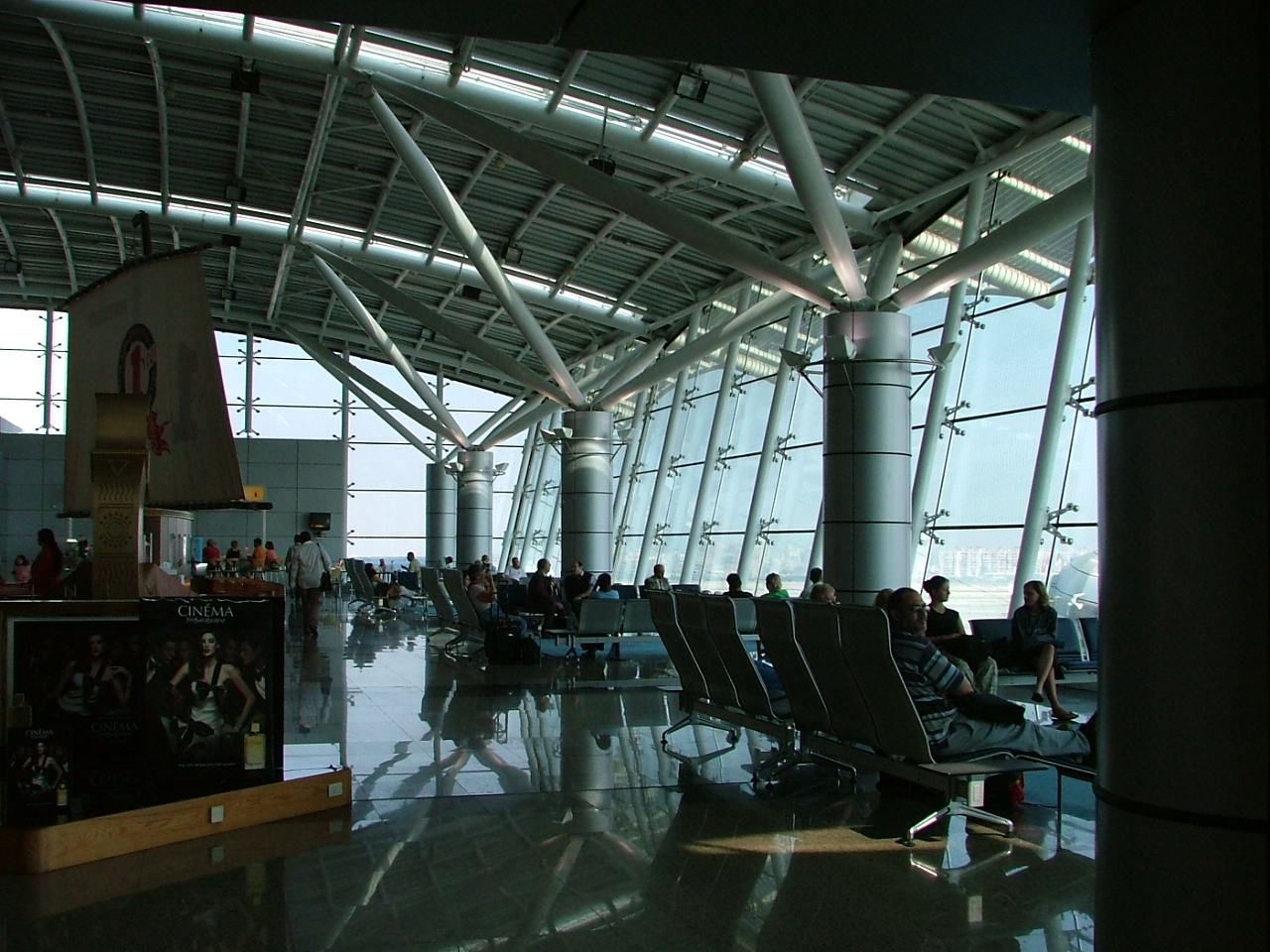
Terminal 1 departure lounge, Cairo International Airport: photo by Beebah, via Wikimedia Commons (CC BY-SA 3.0).
EgyptAir check-in counters in Terminal 3: photo by Roland Unger, via Wikimedia Commons (CC BY-SA 3.0).
Cairo Duty Free in Terminal 2: photo by Amsguc, via Wikimedia Commons (CC BY-SA 4.0).
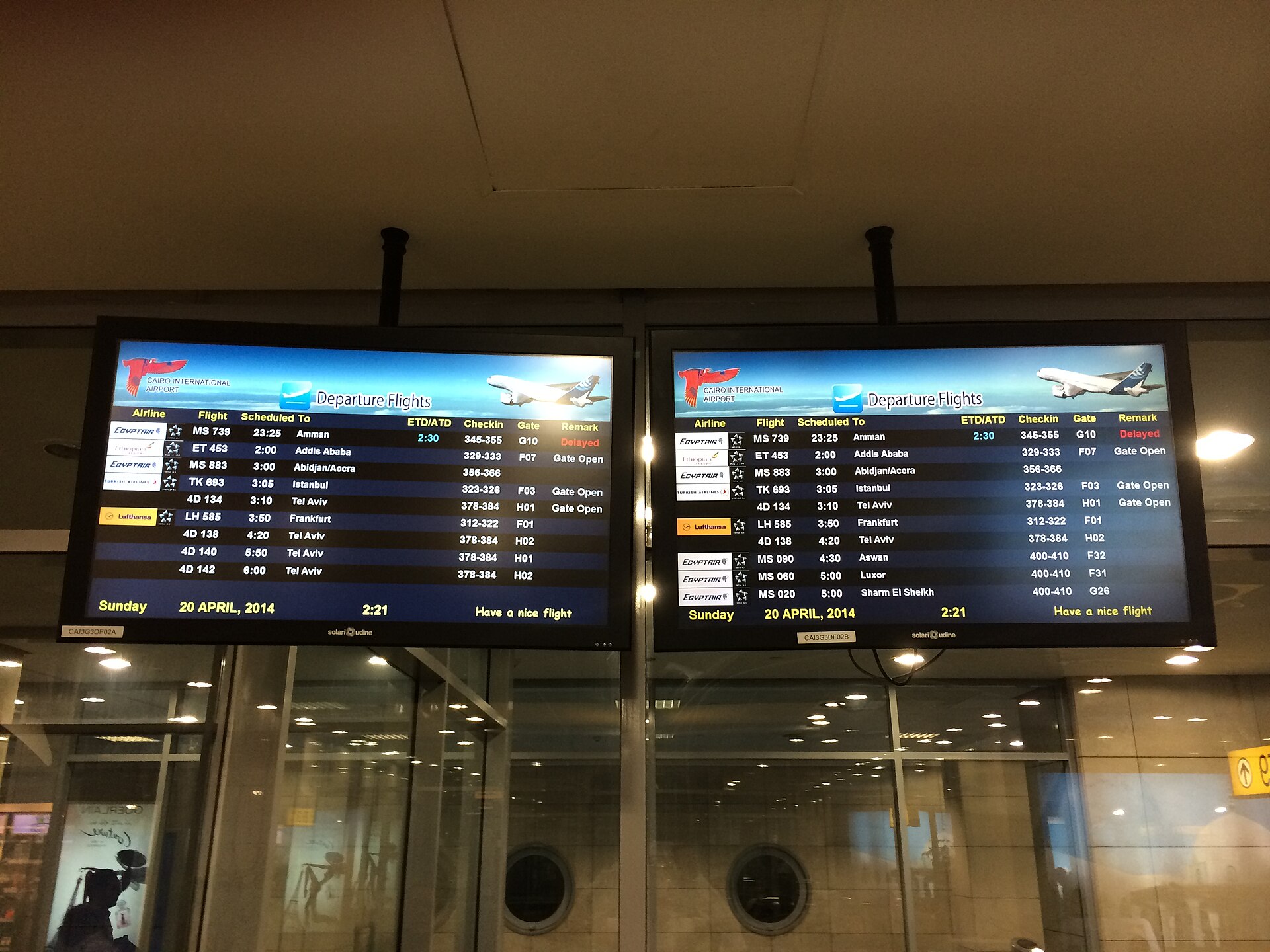
Departures screens at Cairo International Airport: photo by Eassa, via Wikimedia Commons (CC BY-SA 3.0).
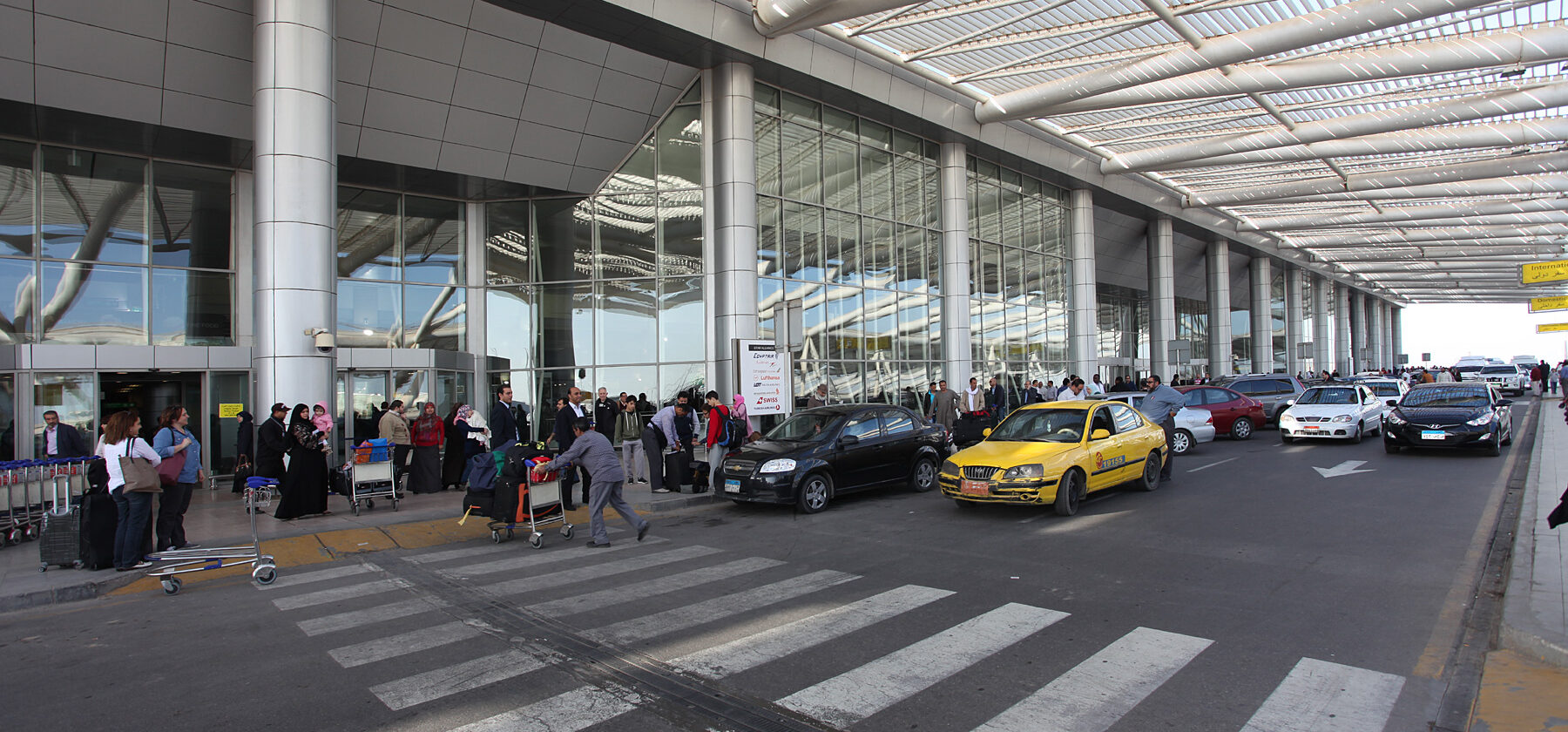
Terminal 3 kerbside (featured image): photo by Roland Unger, via Wikimedia Commons (CC BY-SA 3.0).