This article contains advertising. Our booking links are routed through a partner that adds commission tracking automatically, so if you book through one we earn a commission from the provider, at no extra cost to you. It never affects what we recommend. Affiliate disclosure
Most airports screen you once. Cairo starts before you are properly inside: at the terminal door your passport and booking are checked and your bags are screened, all before you have seen a check-in desk. After passport control you go through it all again, and on some flights there is one more look at the gate. None of it is difficult. It does take time, though, and the people who miss flights out of Cairo rarely lose them inside the terminal. They lose them on the Ring Road. Cairo airport departures go smoothly for anyone who works backwards from the boarding time, and this guide is laid out in that order.
We go through the whole departure in sequence: when to leave your hotel, which is the part most people get wrong; the screening at the terminal door; check-in and bag drop; exit passport control; the main security check and the gate; and then what to do with any time left over — duty free, food, lounges, and a VAT refund that is harder to claim in Cairo than the shop signs suggest. Landing has its own guide to what happens after you land in Cairo. Rules and prices were checked in September and October 2026. The Egyptian pound has been repriced several times in recent years, so read the prices as the right order of magnitude rather than to the pound.
Departures at a glance
| Stage | What to know |
|---|---|
| Hotel to terminal | Depends almost entirely on where you start and when |
| Terminal door screening | Have your passport and booking ready at the entrance |
| Check-in and bag drop | EgyptAir closes its counters 60 minutes before an international departure; other airlines set their own cut-offs |
| Exit passport control | Boarding pass tucked inside your passport |
| Main security | Liquids in 100 ml containers; laptops may need to come out |
| Gate | Be there when boarding opens; some flights add a final check |
The terminal stages are the least of your worries. The drive from Giza at rush hour can take longer than everything inside the terminal put together. Our rule is to be at the terminal door three hours before an international flight and two hours before a domestic one, and to add another half hour in the late-night departure waves, the days around the Eid holidays and the pilgrimage seasons.
What departure day costs
| Item | Typical cost (autumn 2026) | Notes |
|---|---|---|
| Uber or Careem from central Cairo | EGP 200–300 (USD 4–6) | More from Giza and the western suburbs; surge pricing at peaks |
| Porter at the kerb | EGP 20–50 (under USD 1) a bag | Agree before they lift anything, or use a free trolley yourself |
| Departure tax | None to pay | Airport and government charges are already in your ticket |
| Walk-in lounge | USD 38–50 | Airside; time limits and what is served vary by lounge |
| Sleep pod in the terminal | About USD 10 an hour | Sixteen units across the three terminals |
| VAT refund | Refund of Egypt’s 14% VAT | Minimum purchases EGP 1,500 (about USD 31); see the Cairo catch below |
How early to get to Cairo airport
The terminal is not the hard part of leaving Cairo. Getting to it is. Cairo International sits about 15 km north-east of the city centre, out past Heliopolis. From Heliopolis it is a short hop. From a hotel facing the pyramids it is a journey right across the city, often on the Ring Road, and the Ring Road at the wrong hour is a car park.
Airline check-in counters at Cairo typically open about three hours before an international departure. Each airline sets its own closing time: EgyptAir shuts its counters 60 minutes before international flights, and your booking or your airline’s website gives the deadline for any other carrier and for domestic flights. Do not treat the cut-off as a target. If you plan to reach the counter two hours before departure, it will never decide whether you fly.
Drive times from where you are staying
The table puts each area in order of how far the drive to the terminals is by car or ride-hailing app. Traffic decides the actual time. A single accident on the 6th of October Bridge or the Ring Road can double a journey, so check a ride-hailing app’s estimate for the hour you will travel and leave a generous margin on top of it.
| Starting point | The drive to the terminals |
|---|---|
| Heliopolis, Nasr City | Shortest: the airport’s own side of the city |
| New Cairo, Fifth Settlement | Medium, from the east |
| Downtown, Zamalek, Garden City | Medium, through the centre |
| Maadi | Medium to long, from the south |
| Giza, the pyramids area | Long: right across the city |
| Sheikh Zayed, 6th of October | Longest: from the far west |
Cairo’s traffic has a rhythm you can plan around. Weekday mornings are heavy from roughly half past seven until after ten; the afternoon and early-evening crush, when schools, offices and shoppers all move at once, often runs well past six; and Thursday evening, the start of the Egyptian weekend, is among the worst of the week. Friday morning is the quietest the city ever gets, and the small hours are reliably clear. If your flight is at 2 a.m., the road will be easy. If it is at 8 p.m. on a Thursday and you are staying near the pyramids, set off at three in the afternoon and accept that you may have a long wait at the gate.
The busy times inside the terminal
Most of the time the queues inside are manageable. They lengthen sharply in a few predictable periods:
- Late-night departure waves. Many long-haul and Gulf flights leave between late evening and dawn, and several often leave close together, so the screening lanes and passport desks fill at the same time.
- The Eid holidays and the end of Ramadan. Egyptians who work abroad fly home and then back again, often with a lot of luggage, and check-in queues reflect it.
- Pilgrimage seasons. Hajj and the busiest Umrah months bring large groups. Many pilgrim flights use the Seasonal Flight Terminal, but the surrounding roads and car parks feel it too.
- Christmas, New Year and Egyptian school holidays. Tourist numbers peak over the festive season, and family travel rises in the summer and mid-year breaks.
Getting to the terminal
Most visitors leave by car. Uber and Careem both work well for the airport run. Reported fares from central Cairo in 2026 are EGP 200–300 (about USD 4–6), with more from Giza and surge pricing at peak times. Our guide to using Uber and Careem in Cairo covers how to book and pay. A hotel car costs more and takes care of everything, and for a very early flight it is worth having one booked the evening before rather than waiting for an app to find you a driver at 3 a.m. There is still no metro to the terminals: the planned airport link on Line 3 has not opened. Every option is compared in our guide to Cairo airport transfers.
Whichever you choose, tell the driver your terminal number, not just “the airport”. Terminal 1 is a separate building some distance from Terminals 2 and 3, which stand side by side. If you are dropped at the wrong one, the people mover will take you across, but it costs you time you may not have. Your booking or the airline’s app tells you which terminal you need, and our guide to Cairo’s three airport terminals explains how the airlines are split between them.
Step 1: the terminal door
The first checkpoint is the door itself. At Cairo, departures halls are for passengers only. Friends and family who drove you say goodbye on the kerb, so have your farewells before you join the line. Have your passport and your booking for that day ready at the entrance, printed or on your phone, and expect security staff to check them and screen your bags.
It is quick when the hall is quiet and slow when three coachloads arrive at once, which is one reason the three-hour rule exists. Keep your passport and booking in a pocket rather than at the bottom of a bag, take coins and keys out of your pockets before you reach the scanner, and lift your heavy cases onto the belt yourself if no one offers to help.
Porters and trolleys
Trolleys are available at the kerb. Porters will often pick up your bags before you have decided whether you want them to, and they expect a tip. EGP 20–50 a bag is the going rate (well under a dollar each), and the right time to agree on it is before anyone touches your luggage, not after it has been carried twenty metres. If you would rather manage alone, a firm and friendly “la, shukran” (no, thank you) is enough. Our guide to tipping and baksheesh in Cairo covers what is fair for porters, drivers and everyone else.
What the door screening is looking for
Mostly what any airport looks for, plus a few things that are particular to Egypt:
- Antiquities. Genuine antiquities cannot be exported. Replicas are fine, but a convincing stone or alabaster statue can still draw questions, so keep the shop receipt with it. The receipt settles the question quickly.
- Shells, coral and anything from the reefs. If you have been down to the Red Sea, leave the shells and coral there. Taking them out of the country is not allowed, and they are confiscated when found.
- Large amounts of cash. Foreign currency above USD 10,000 has to be declared when you arrive. If you are leaving with sums anywhere near that, ask customs before you check in rather than at the gate.
- Drones. These are banned without permits, as covered in the arrivals guide. If you somehow have one, it is a conversation you want over with long before boarding.
Step 2: check-in and bag drop
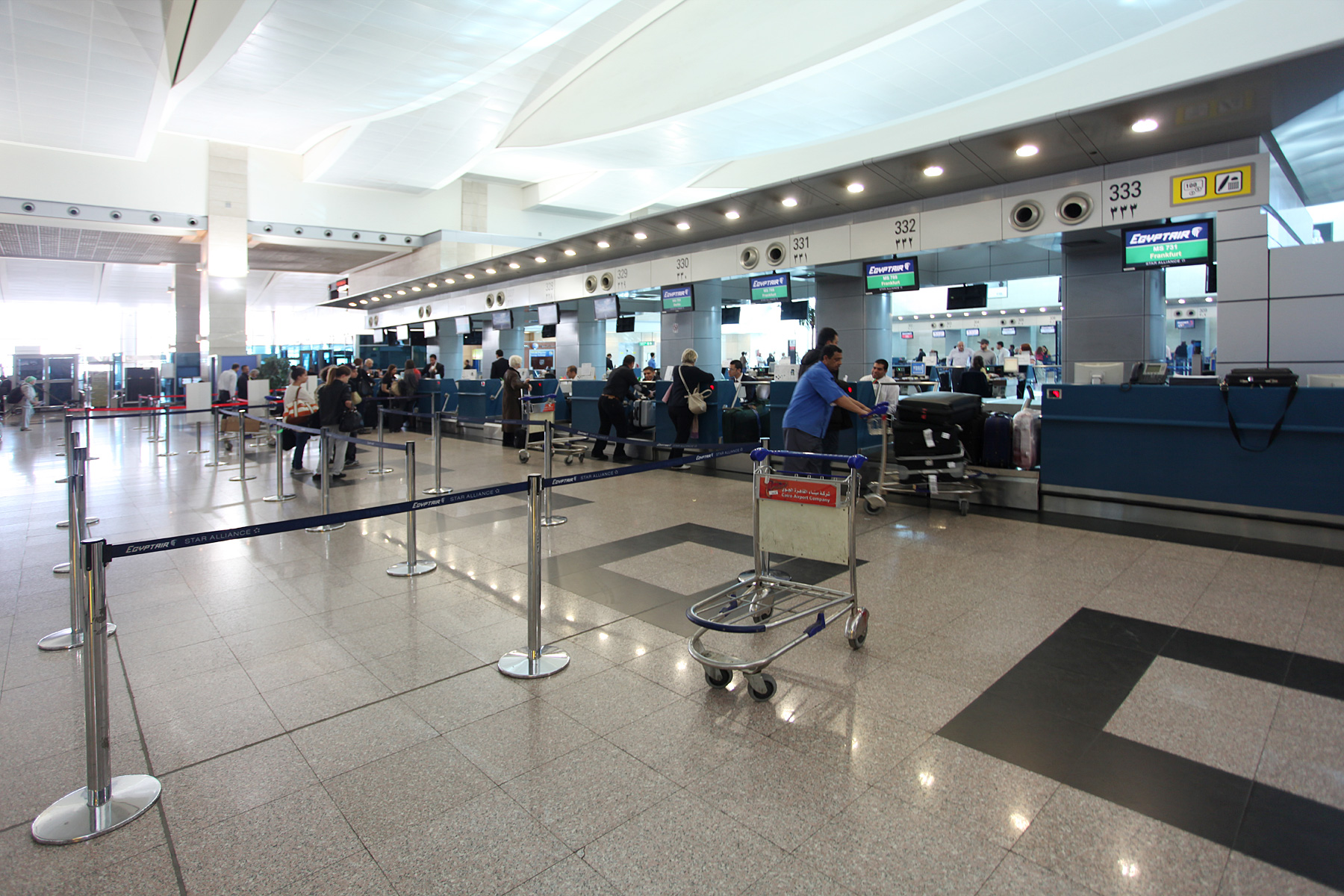
Once you are past the door, find your airline’s zone on the screens and join the queue. Check-in itself is unremarkable: passport, bags on the scale, boarding pass. A few habits make it easier.
- Check in online if your airline allows it. It does not let you skip the door screening or bag drop. What it does is lock in your seat, and on a busy night bag-drop queues are usually shorter than full check-in queues.
- Weigh your bags at the hotel. Two weeks of cotton towels, spice bags and a brass lamp add more than people expect, and excess-baggage charges at the counter are steep. Most hotels will lend you a luggage scale if you ask.
- Batteries go in the cabin. Power banks, spare lithium batteries and e-cigarettes must travel in your hand luggage, never in a checked bag. More and more airlines also ban using power banks during the flight, so check your airline’s current rule.
- Read your boarding pass before you walk away. It shows the boarding time, which matters more than the departure time, and sometimes a gate. Gates change, so check the screens again once you are airside.
If you are flying on separate tickets, for example a cheap flight to Europe followed by a separate long-haul ticket home, your bags will not be checked through. Our guide to Cairo layovers explains what that means at the other end, and how much time a self-transfer at Cairo really needs.
Step 3: exit passport control
From check-in, follow the signs for departures and passport control. Queue at the desks for foreign passports, hand over your passport with the boarding pass tucked inside, and wait while the officer checks your visa and stamps you out. It is usually brief. Couples and families can normally approach the desk together.
Paper departure cards are being phased out. From 11 April 2026, Egypt began replacing the paper passport-control cards at Cairo International Airport with a digital system, starting with Egyptian travellers. If an airline agent or officer gives you a card, fill it in before you reach the front of the queue. Keep a pen in your pocket on departure day for exactly this reason.
The officer is also checking that you have not overstayed. A standard tourist visa allows thirty days, and an overstay means questions and probably a fine. If you are anywhere near your limit, check your dates well before flight day; the passport desk is the wrong place to discover a problem. Do not take photos anywhere around passport control or the security lanes. Photographing security areas in Egypt causes trouble out of all proportion to the picture, as our guide to photography rules in Cairo explains.
Step 4: the main security check
The second full screening comes after passport control. Depending on the terminal and the part of it your flight leaves from, it is a central checkpoint just past the passport desks or a check at the entrance to your gate area. Either way, it works much like any other international airport.

- Liquids: containers of 100 ml or less, in a single clear resealable bag of about a litre. Medicines and baby food in reasonable quantities are allowed outside the limit, but expect them to be checked.
- Electronics: laptops and large devices may need to come out of your bag and go in a tray of their own. Phones, coins and belts go in a tray too.
- Water: finish or empty your bottle before the scanner. Plenty of shops airside sell water, though at airport prices.
- Women travellers are normally searched by female officers, often in a separate curtained booth beside the arch. It is routine, not a sign that something is wrong.
The last check at the gate
In some parts of the airport and on some routes there is one more check at the gate: a look at your passport and boarding pass at least, and sometimes another bag search. This is the main reason not to linger at duty free until the final call. Aim to be at your gate when boarding opens, typically 40 to 60 minutes before departure, rather than when the gate closes.
Duty-free liquids on a connection
Duty-free spirits and perfume bought airside in Cairo are fine on your flight. If you change planes somewhere else and go through security again, they may not be. Ask the shop to seal them in a tamper-evident bag with the receipt inside, keep the bag closed until you reach your final destination, and expect that some airports will still confiscate anything over 100 ml. If you are connecting through a strict hub, buy at your final airport instead.
Help with mobility, families and anyone who needs more time
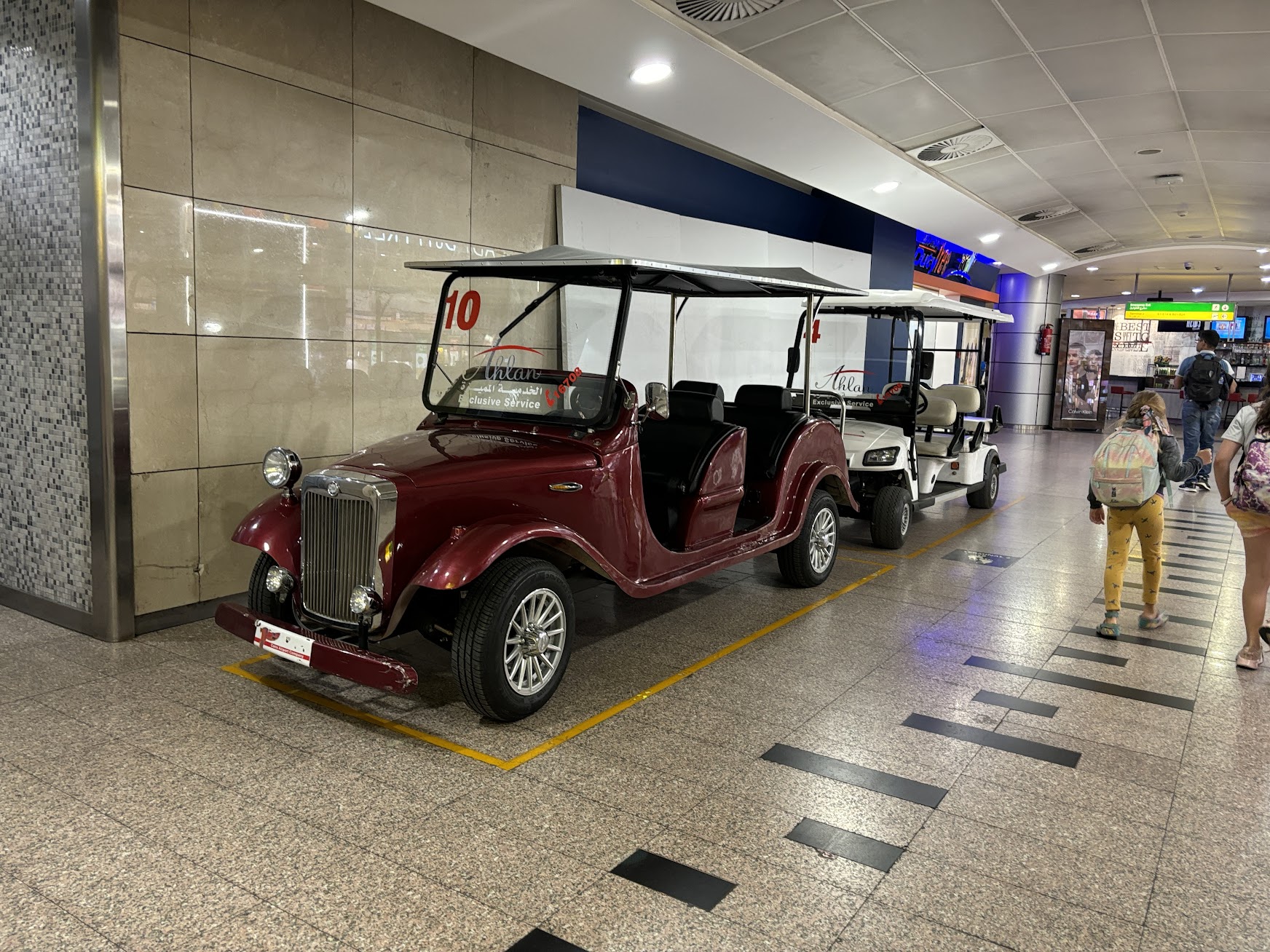
Cairo’s terminals involve a lot of walking, Terminal 3 especially, where the gates sit at the far ends of long glass corridors. If you or anyone you are travelling with uses a wheelchair or will struggle with the distances, request assistance through your airline when you book, and check how much notice it asks for. Booking ahead is what puts a wheelchair and an escort at the check-in counter rather than leaving you to ask on the day.
Paid meet-and-assist services also operate at the airport. Staff walk you through check-in, passport control and security, sometimes with fast-track lanes and a buggy ride to the gate. They are sold through hotels, tour operators and the providers’ own websites, prices vary a lot, and they are worth considering for older travellers, families with small children and anyone on a very tight connection. Our accessibility guide to Cairo covers the rest of the city with the same practical eye.
For families, a few specifics help. Every child travels on their own passport with their own visa. Pushchairs can usually go to the aircraft door, but check with your airline. Baby food and milk your child needs during the flight are allowed above 100 ml. And children who have just spent two weeks in the sun get tired in long queues, so the extra half hour you allowed will be appreciated.
Duty free at Cairo airport
Terminal 3 has duty-free shops; if you are flying from another terminal, check what is open there before you plan to shop. Prices are generally shown in US dollars and cards are widely accepted.
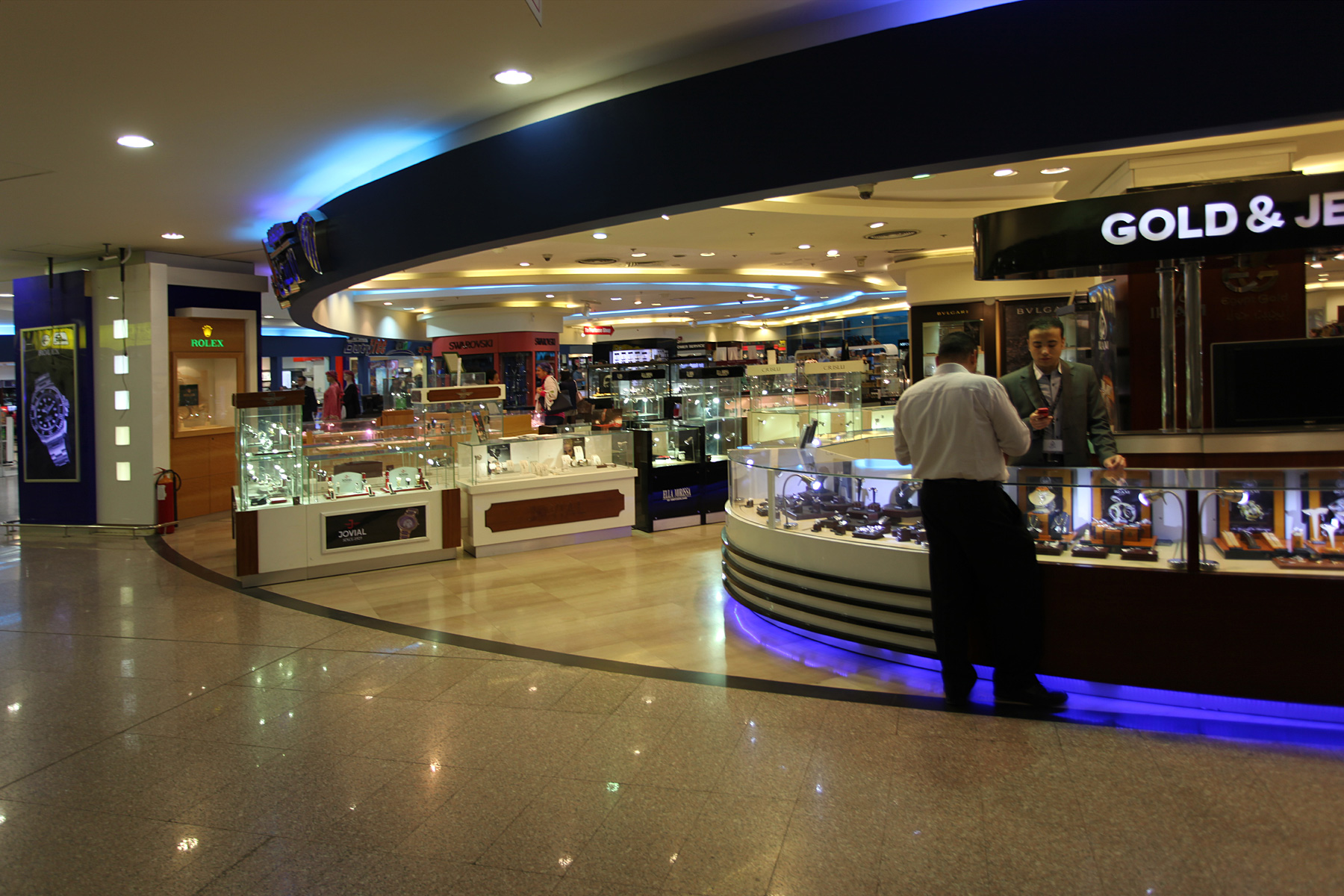
Our honest verdict: duty free is good for the things duty free is always good for, and poor value for Egyptian goods. Spirits and tobacco can be good buys, and international perfume brands are priced much as at any big airport. For Egyptian cotton, spices, perfume oils, papyrus, brass and silver, you will nearly always pay more at the airport than in the city, with less choice and no chance to bargain. If you still have a gift list on your last day, use the afternoon in town and our guide to the best souvenirs to buy in Cairo, not the departure lounge.
Arrivals is the other way round. Egypt’s arrivals duty free lets visitors buy alcohol within 48 hours of entering the country, and it is where most long-stay visitors stock up, since imported spirits in the city are heavily taxed. That is covered in the arrivals guide linked at the top.
Leftover Egyptian pounds
Spend small notes on coffee and snacks airside before you go, and remember that airport cafés charge airport prices. Changing larger sums back into dollars or euros is possible at the bank counters, but it depends on what currency the counter has, and some counters ask for your original exchange receipts. Better to stop drawing cash two or three days before you leave, so that you don’t end up with a pile of notes to sell back at a poor rate. Our guide to changing money in Cairo covers rates and receipts in more detail.
VAT refunds: how Egypt’s scheme works, and the Cairo catch
Egypt has a VAT refund scheme for foreign visitors, run by the Egyptian Tax Authority. On paper it works much like a European tax-free scheme:
- You must be a non-resident visitor staying no more than three months.
- Your purchases must total at least EGP 1,500 (about USD 31).
- Buy only in shops that display a “VAT Refund” sign, and make sure you receive an electronic receipt with your passport number on it.
- Before you fly, present the goods, the receipts and your passport at the VAT refund office at the airport, leaving plenty of time.
- The refund is paid in foreign currency to your own foreign bank card, not in cash.
The catch is where you can claim it. The scheme was launched at Sharm el-Sheikh airport for visitors to the COP27 climate summit in 2022, and the Egyptian Tax Authority’s tax refund page sets out the airport procedure. Treat a refund on leaving Cairo as a bonus, not part of the price. Before you buy something expensive on the strength of a “tax-free” sign, ask the shop where and how the refund can be claimed when you leave from Cairo. If there turns out to be a desk, keep the goods in your hand luggage or go to the desk before you check your bags, because you will be asked to show what you bought.
Domestic departures: Luxor, Aswan, Hurghada and Sharm el-Sheikh
EgyptAir’s domestic flights leave from Terminal 3, the same building as its international services. The process is shorter: door screening, check-in, security and the gate, with no exit passport control. Do carry your passport itself, though, not a copy: foreign visitors are routinely asked for it at check-in and again at the gate on domestic flights.
Two hours before departure is comfortable on a normal day, and two and a half in the peak holiday weeks. The flights themselves are short, and delays of more than a couple of hours are rare on these routes, which is one reason many travellers take the sleeper train one way and fly the other. Our seven-day Egypt itinerary shows how the domestic flights fit into a week.
Time to kill airside: food, lounges and somewhere to sit
Once you are through security, the choices depend on the terminal. Terminal 3 has food and drink outlets as well as shops. Terminal 2 is smaller and newer inside. Terminal 1 is the oldest of the three. Prices airside are noticeably higher than in town. Expect to pay several times the city price for a coffee and a sandwich, and set your expectations accordingly.
If you have more than an hour or two, a lounge is the more comfortable option. Cairo’s independent lounges are open around the clock, accept Priority Pass and sell walk-in access for roughly USD 38–50, with time limits that vary from lounge to lounge. Some of the T3 lounges admit passengers on international flights only. Our guide to Cairo airport lounges goes through each one terminal by terminal. Prayer rooms are found in the terminals and several lounges, and smoking is limited to designated areas.
On the other hand, if your flight leaves at dawn and the hotel checkout was at noon the day before, the airport’s handful of sleep and hotel pods, the Le Méridien linked to Terminal 3 by a pedestrian bridge and the other airport hotels are all options; ask the Le Méridien before you book whether you can reach it without passing immigration. They are compared in our guide to sleeping at Cairo airport.
Six mistakes that cost people flights from Cairo
- Leaving the pyramids at rush hour. An 8 p.m. flight and a 5 p.m. departure from a Giza hotel is the classic mistake. On a weekday it can take two and a half hours to reach the terminal, and in heavy traffic there is no shortcut.
- Going to the wrong terminal. Terminal 1 is a separate building from Terminals 2 and 3. The people mover will get you across, but not quickly enough if you are already late.
- Treating the counter cut-off as a target. If the counter closes 60 minutes before departure and you arrive 65 minutes before, you are relying on the door queue being empty. It often isn’t.
- Packing a power bank in checked luggage. It will be found, your name will be called, and you will be taken back to open the bag. That costs twenty minutes at the worst possible moment.
- Buying something expensive for the “tax-free” refund. Unless the shop can tell you exactly where to claim it in Cairo, don’t count on the money.
- Accepting unofficial “help” through the queues. Occasionally someone offers to walk you past the line for a tip. It is rarely faster than queueing, it creates an awkward conversation about money at the end, and it is not the same thing as the airport’s official meet-and-assist services, which you book in advance.
Departure-day checklist
- Terminal number confirmed from your booking or the airline’s app, and given to your driver.
- Departure time from the hotel worked out from the drive-time table above, with a margin for Thursday evenings and the late-night waves.
- Passport, printed or saved booking, and a pen in an outside pocket.
- Bags weighed; power banks, spare batteries and e-cigarettes in your hand luggage.
- Liquids in 100 ml containers in one clear bag; your water bottle empty.
- Receipts kept for any statues or replicas, and for VAT-refund purchases if you plan to try.
- Small notes ready for a porter, and most of your remaining pounds spent.
- Wheelchair or meet-and-assist service requested when you booked, within the notice your airline asks for, if you need it.
Frequently asked questions
How early should I get to Cairo airport for an international flight?
Be at the terminal door three hours before departure, and three and a half in the late-night waves or around the Eid holidays. Work out when to leave your hotel from that, not from the flight time. From Giza at rush hour that can mean setting off five hours before you fly.
When does check-in close at Cairo airport?
It depends on the airline. EgyptAir closes its airport counters 60 minutes before international departures, and other carriers publish their own deadlines on their websites. Check yours, and plan to be at the counter two hours before departure so the cut-off never matters.
Can family or friends come into the terminal to see me off?
No. The departures halls at Cairo are for passengers only, and an officer at the door checks for a booking before anyone goes in. Say your goodbyes on the kerb.
Is there a departure tax or departure card when leaving Egypt?
There is no departure tax to pay at the airport, because the charges are already included in your ticket. Paper passport-control cards are being replaced by a digital system at Cairo, which began with Egyptian travellers in April 2026. If you are handed a card anyway, fill it in before the passport desk.
Can I claim a VAT refund at Cairo airport?
Egypt’s scheme refunds the 14% VAT on purchases of EGP 1,500 or more made in participating shops, with an electronic receipt showing your passport number. It began at Sharm el-Sheikh airport, so before you buy, ask the shop how a claim works when you leave from Cairo, and treat any refund as a bonus.
Is duty free at Cairo airport worth it?
For spirits, tobacco and international perfume, it can be. For Egyptian souvenirs, cotton and spices, the city is almost always cheaper and has far more choice.
How long does security take at Cairo airport?
It varies with how many flights are leaving at once. The door screening and the main checkpoint are separate queues, and both are slowest in the late-night departure waves. Some flights add a final check at the gate, so be there when boarding opens.
Can I change my leftover Egyptian pounds at the airport?
Usually, at the bank counters, but rates are poor and some counters ask for your original exchange receipts. It is better to spend down your cash in the last couple of days and keep only small notes for tips and an airside coffee.
Leftover pounds are easiest to deal with before you join the passport queue, while the bank counters are still on your side of the barrier. Our guide to SIM cards, ATMs and currency exchange at Cairo airport explains why to stop drawing cash a few days before you fly, and what to have with you if you want to change money back.
Related Cairo Guides
- Cairo International Airport (CAI): The Complete Traveler Guide
- Cairo Airport Terminals 1, 2 and 3: Which One Are You In?
- Cairo Airport Lounges: Access, Priority Pass and Reviews
- Cairo Airport Arrivals: What Happens After You Land
- Cairo Airport Transfer Options: Getting to the City
- Egypt Visa on Arrival at Cairo Airport, Step by Step
- Cairo Safety Tips and Scam Awareness
Photo Credits
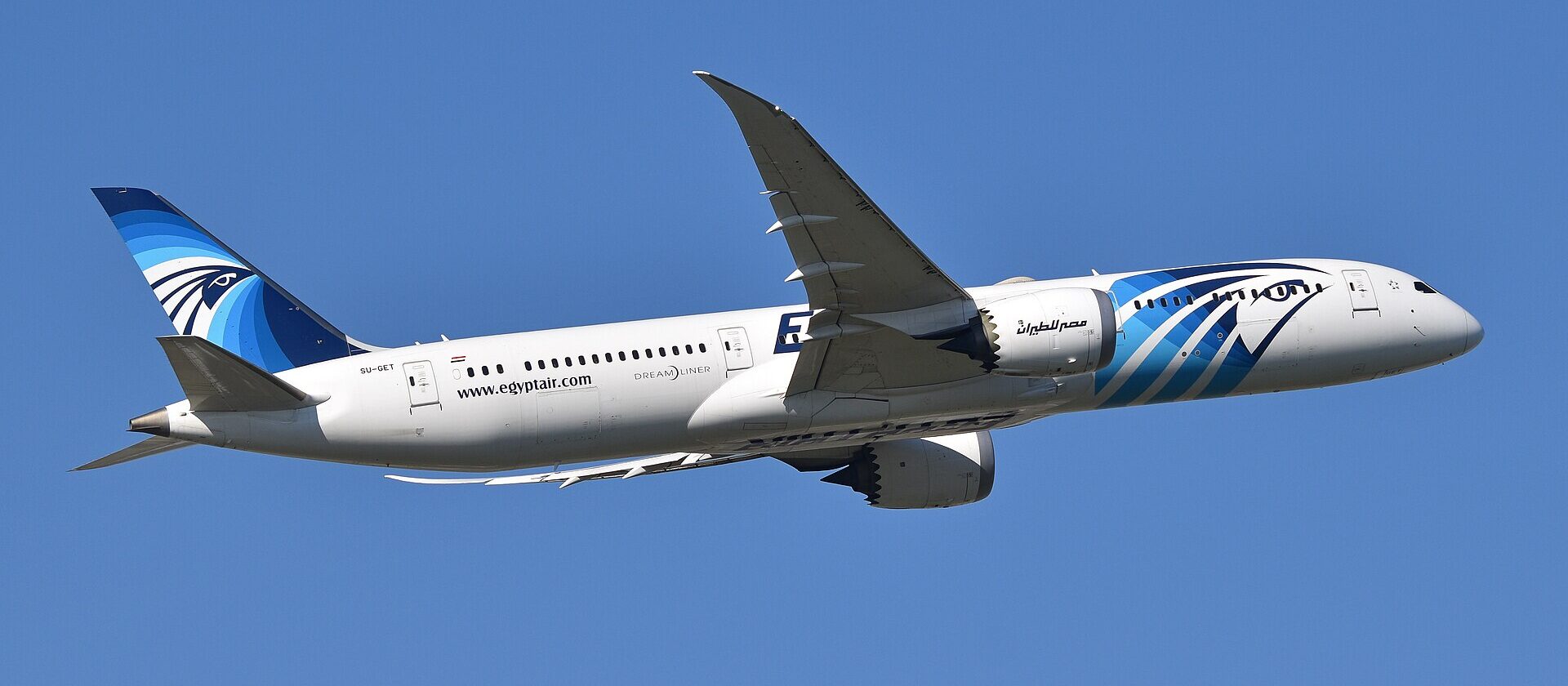
EgyptAir Boeing 787-9 Dreamliner climbing after take-off (featured image): photo by Alan Wilson from Peterborough, Cambs, UK, via Wikimedia Commons (CC BY-SA 2.0).
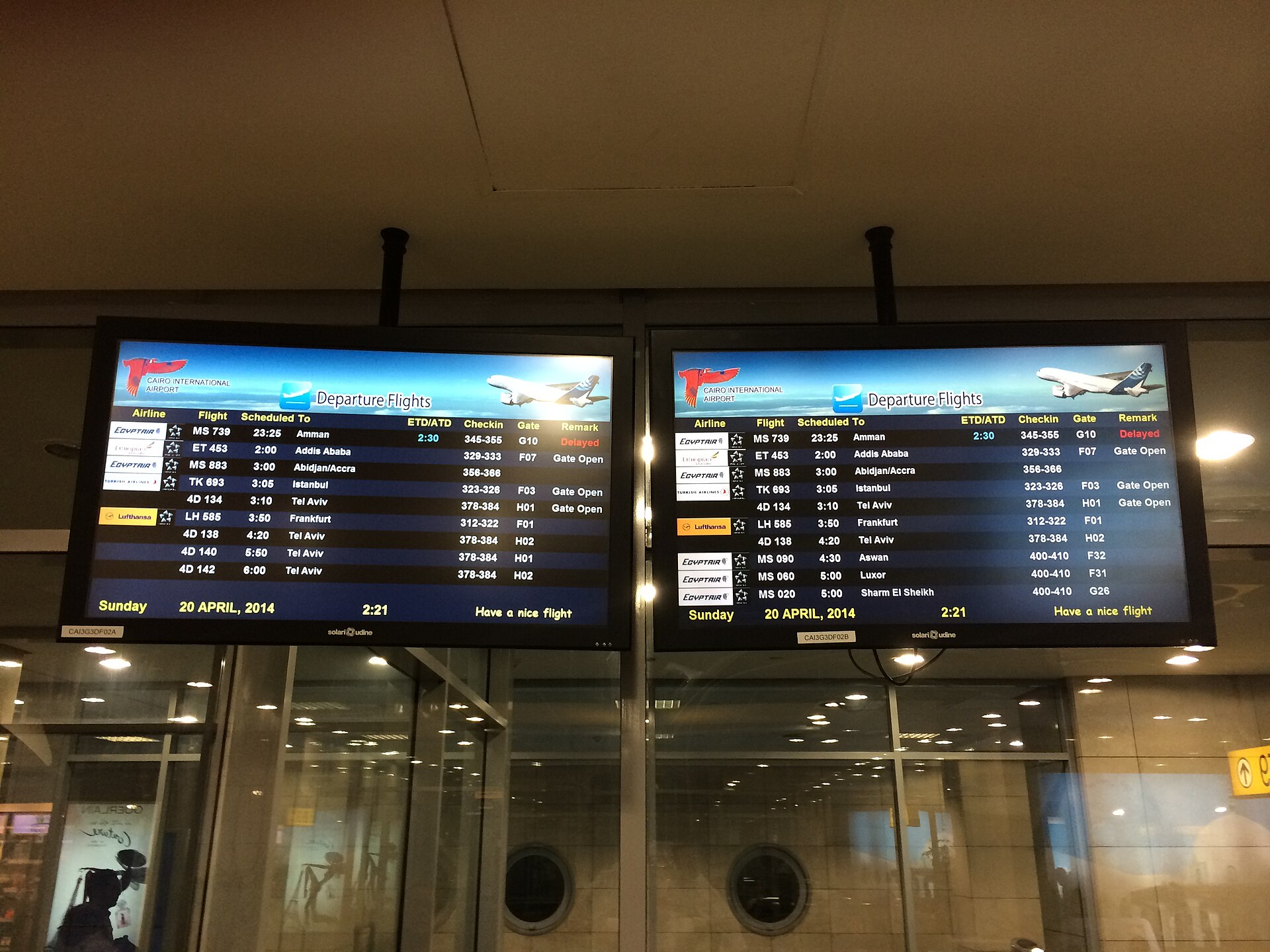
Departures screens at Cairo International Airport: photo by Eassa, via Wikimedia Commons (CC BY-SA 3.0).
Check-in counters in Terminal 3: photo by Roland Unger, via Wikimedia Commons (CC BY-SA 3.0).
Refillable travel bottles: photo by Tara Winstead / Pexels.
Assistance buggies inside Cairo Airport: photo by AmyAbroad, via Wikimedia Commons (CC BY-SA 4.0).
Duty-free shops airside in Terminal 3: photo by Roland Unger, via Wikimedia Commons (CC BY-SA 3.0).