This article contains advertising. Our booking links are routed through a partner that adds commission tracking automatically, so if you book through one we earn a commission from the provider, at no extra cost to you. It never affects what we recommend. Affiliate disclosure
Yes, the Egyptian Museum at Tahrir Square is still worth a visit in 2026 — even now that the Grand Egyptian Museum has the Tutankhamun gold and the royal mummies have moved to Fustat. The 1902 pink palace on Tahrir holds a staggering reserve collection, costs about 550 EGP (~$11), and sits right in downtown. It is the deep cut to GEM’s blockbuster.
Here’s the honest picture for this year. The headline pieces left. King Tut’s complete tomb collection is now out at the new museum by the pyramids, the twenty-two royal mummies went to the National Museum of Egyptian Civilization back in the 2021 Pharaohs’ Golden Parade, and Khufu’s solar boat is at Giza too. So why go? Because what remains is still one of the largest concentrations of ancient Egyptian objects anywhere on earth, the building itself is a heritage monument worth the ticket, and you can walk here from half the hotels downtown. This is the full Egyptian Museum at Tahrir Square guide for 2026 — what stayed, what moved, and whether you should do both museums.
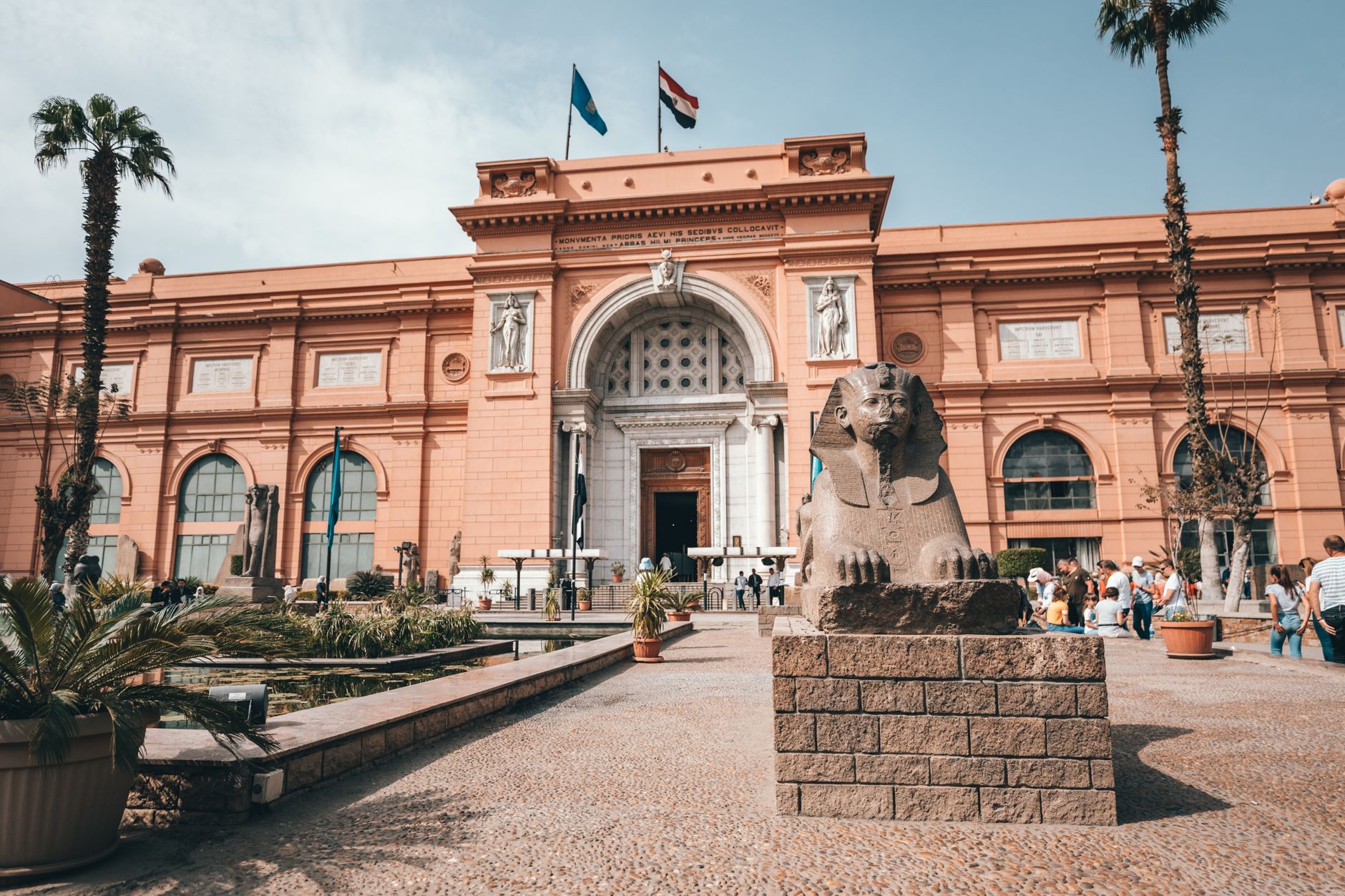
What the Egyptian Museum at Tahrir Square is now
For more than a century this was simply the Egyptian museum — the one every guidebook, every school textbook, every documentary meant. The salmon-pink building on the north edge of Tahrir Square opened in 1902, designed by the French architect Marcel Dourgnon, and it housed Tutankhamun’s treasures from the moment Howard Carter’s finds arrived in the 1920s. For generations, that gold mask in a slightly tired glass case on the upper floor was the climax of any Cairo trip.
That era ended in November 2025, when the Grand Egyptian Museum finally opened at Giza and took the full Tut collection with it. The Tahrir museum did not close, though. It is being repositioned as Egypt’s great historical and reference museum — the place that tells the longer story, with the reserve collections and the eras the GEM doesn’t dwell on. Think of GEM as the polished greatest-hits album and Tahrir as the back catalogue: messier, denser, and genuinely rewarding if you care about the depth rather than just the famous tracks.
If you’re mapping out which museums to hit on your trip, our complete Cairo museums guide lays out how Tahrir, the GEM, the Coptic and Islamic museums and the Citadel fit together so you don’t double up or burn a day backtracking.
What’s still here (and what moved out)
This is the part most people get wrong, so plan around it. A few marquee items left; thousands stayed. Don’t show up expecting the gold mask, and don’t write the place off either.
| Still at Tahrir | Moved elsewhere |
|---|---|
| The Narmer Palette (unification of Egypt, ~3100 BCE) | Tutankhamun’s complete tomb collection → GEM, Giza |
| Old Kingdom masterpieces: Khafre in diorite, the Seated Scribe, Rahotep and Nofret | The 22 royal mummies → NMEC, Fustat |
| Pre-dynastic, Middle Kingdom and Late Period galleries | Khufu’s Solar Boat → GEM, Giza |
| Amarna-period material (some Akhenaten and Nefertiti pieces) | Many colossal statues → GEM |
| Greco-Roman and Coptic sections, plus the library and archives | Some Greco-Roman items → NMEC |
The single best reason to come is the Old Kingdom sculpture. The diorite statue of Khafre with the Horus falcon wrapped behind his head, the painted limestone of Rahotep and Nofret with their startlingly alive inlaid eyes, the Seated Scribe — these are the textbook images of Egyptian art, and they’re still here, often with barely anyone standing in front of them. The Narmer Palette, arguably the oldest historical document on the planet, sits in the pre-dynastic gallery. None of these moved.
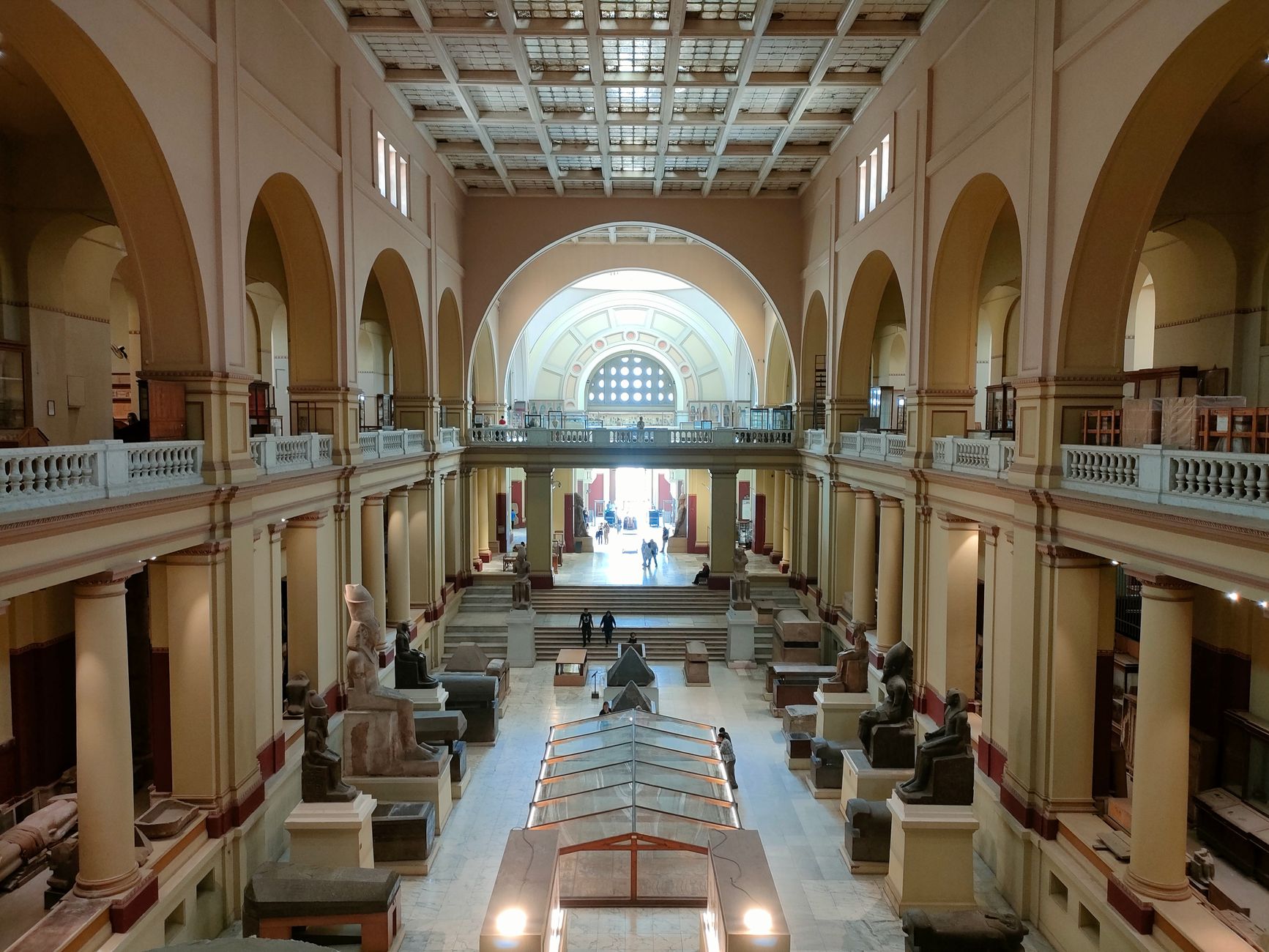
The building is half the point
People rave about the GEM’s architecture, and fairly so — but the Tahrir museum is the opposite kind of pleasure. You walk into a soaring Belle Époque atrium under a domed skylight, surrounded by stone galleries, vintage wooden vitrines and hand-typed labels that have outlived several governments. It feels like a museum about museums. The light is warm, the ceilings are enormous, and there’s an atmosphere here that a climate-controlled glass box at Giza simply can’t manufacture.
An ongoing renovation is gradually modernising the displays — better lighting, new labelling, some thematic re-hangs replacing the old strict chronology, and improved accessibility. It’s being done in phases, so the odd gallery may be roped off when you visit; no firm completion date has been announced. The upside for now is that the slightly faded, old-school character is still largely intact. If you’ve ever wanted to see what a grand early-20th-century museum actually felt like, come before the refit finishes.
Tickets, hours and how to pay
As of 2026, a foreign adult ticket runs about 550 EGP (roughly $11) — a notable bump from a couple of years ago, but still well under half what you’ll pay at the GEM, and a fraction of the combined-ticket prices out there. Students with a valid ISIC card pay around half. Kids five and under are free. A photo permit for your phone or camera is a small extra on top.
| Ticket | Approx. price (2026) |
|---|---|
| Foreign adult | ~550 EGP (~$11) |
| Student (with ISIC) | ~275 EGP |
| Child under 6 | Free |
| Photography permit | Small extra fee |
The museum is open daily, roughly 9am to 4pm, with the ticket window closing about an hour before (usually around 3pm) — so don’t roll up at 3:30 expecting to get in. One practical 2026 note that trips a lot of people up: Egypt’s state monuments and museums have largely gone card-only at the ticket counters. Bring a Visa or Mastercard. If you only have cash, you may be stuck, so carry a working card as your primary payment and treat cash as backup, not the other way round. Prices do drift, so confirm the current figure on the official egymonuments.gov.eg site before you go.
Bring the student card as well, if you have one, because the discount applies here and right across the greatest-hits circuit, adding up to well over 2,000 EGP. Our notes on student rates in Cairo explain which cards get accepted and where they are refused.
How long to spend, and the Tahrir Square context
You don’t need a full day here anymore — that calculus changed when the big-ticket items left. Budget it like this:
- Quick hit: 1.5 hours — Old Kingdom statues, the Narmer Palette, the atrium, done.
- Standard visit: 2 to 3 hours — add the Middle Kingdom, Amarna and Late Period galleries.
- Proper deep dive: around 4 hours — for genuine Egyptophiles who want the reserve collections and the quiet side rooms.
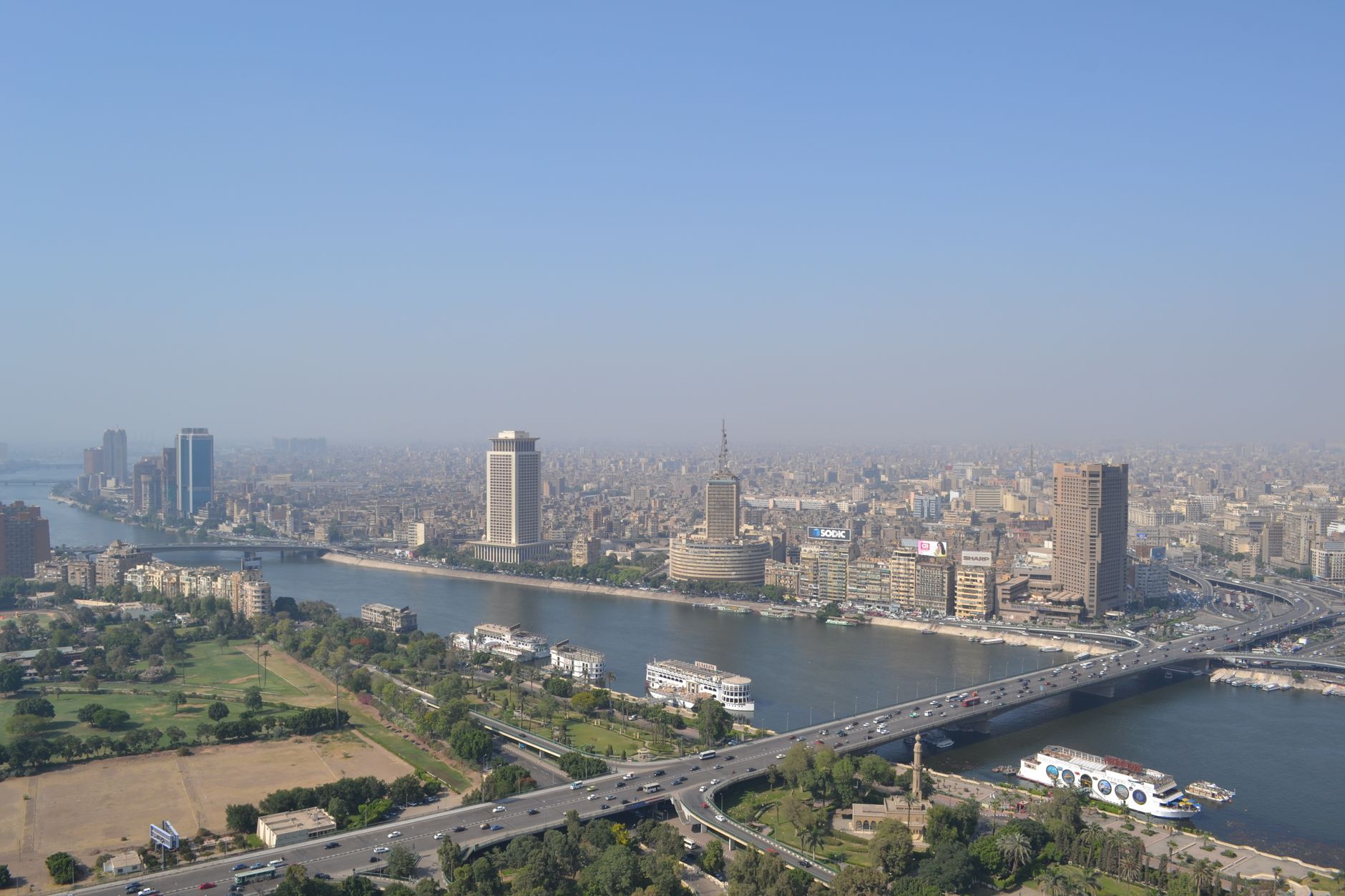
The location is the museum’s other big advantage. It sits on Tahrir Square itself, the civic heart of downtown Cairo and the square the world watched in 2011. The Sadat metro station (Line 1) surfaces right underneath it, and an Uber or Careem from anywhere in the city is cheap and painless. From the downtown hotels — the Nile Ritz-Carlton is next door, the Steigenberger and the Kempinski are a short walk — you can stroll over. If you’re still working out where to base yourself, our guide to how Cairo actually works covers the practical rhythm of getting around downtown, tipping the guards, and dressing for museums and mosques.
Since even the four-hour version of this visit still leaves you an afternoon, the usual move is to cross town to Salah Salem and spend it on the ramparts of Saladin’s hilltop fortress above the city.
Tahrir or GEM — or both?
The question I get most. Here’s my straight answer: if it’s your first time in Cairo and you have the days, do both — they’re not interchangeable. The GEM is the must-see for the famous objects, the full Tutankhamun collection, the colossal Ramesses in the atrium, and the sheer spectacle. The Tahrir museum is for everything underneath that: the Old Kingdom, the pre-dynastic foundations, the density of objects, and the historic building. They cover different eras and different moods. Our Grand Egyptian Museum guide for 2026 walks through tickets, what’s on display and how to time a visit out at Giza.
If you’re tight on time and have already done the GEM, you can skip Tahrir without guilt — unless you love early sculpture or old buildings, in which case keep it. And if budget is the deciding factor, Tahrir is the better value of the two by a wide margin and far easier to reach without a trip out to the pyramids.
Two more pairings worth knowing. The Tahrir museum slots neatly into a downtown Belle Époque walking morning — combine it with the old cafés and architecture nearby; our things to do in Cairo guide has more on that downtown circuit. For a heavier history day, do Coptic Cairo in the morning and Tahrir in the afternoon. If you’d rather see Islamic and Christian Cairo’s own collections, the Museum of Islamic Art and the Coptic Museum are both worth a separate slot.
Practical tips from the floor
- Research before you go. Since some pieces moved, check the GEM’s inventory if there’s something specific you’re chasing — you don’t want to hunt for the gold mask here.
- Consider a licensed Egyptologist guide. The labelling is patchy in older galleries; a good guide turns a row of statues into a story. Agree the fee up front.
- Friday morning is quietest. Local crowds thin out around midday prayers, so a late-morning Friday or an early weekday beats the weekend.
- No flash, ever. A photo permit covers stills, but flash is banned to protect the ancient pigments, and tripods are restricted. Phone shots are fine.
- Bring water and pace yourself. It’s air-conditioned but it’s a lot of walking on hard stone floors. Comfortable shoes.
- Leave time for the building. Don’t just chase objects — sit in the atrium for ten minutes and take in the room.
Rules tighten the moment your camera turns from objects in a case towards people, police buildings or bridges. Our rundown of Cairo photography etiquette covers where permits are required, what counts as professional gear, and the sites where a phone is the only safe option.
Frequently asked questions
Is the Egyptian Museum at Tahrir Square still open in 2026?
Yes, fully open and operating daily, roughly 9am to 4pm. It stayed open after the GEM launched. Some galleries may close briefly during renovation phases, so it’s worth checking the day before if you’re set on a specific section.
Is Tutankhamun’s collection still at the Tahrir museum?
No. The complete Tutankhamun tomb collection, including the gold mask, is now at the Grand Egyptian Museum near the Giza pyramids. If Tut is your priority, go to the GEM.
Where are the royal mummies now?
At the National Museum of Egyptian Civilization (NMEC) in Fustat, where they were moved during the 2021 Pharaohs’ Golden Parade. They are no longer at Tahrir.
How much is a ticket and can I pay in cash?
About 550 EGP (~$11) for a foreign adult in 2026, roughly half-price for ISIC students. Note that Egypt’s monuments have largely gone card-only at the counters, so bring a Visa or Mastercard rather than relying on cash.
Should I visit both the Tahrir museum and the GEM?
For a first trip with time to spare, yes — they’re complementary. The GEM has the famous artefacts and the spectacle; Tahrir has the Old Kingdom masterpieces, the depth and the historic building. If you’re short on time and have done the GEM, Tahrir is skippable unless you love early sculpture.
Can I still see the Narmer Palette here?
Yes. The Narmer Palette is among the major pieces that stayed, in the pre-dynastic gallery — one of the genuine highlights of the surviving collection.
The bottom line
The Tahrir museum is no longer the climax of a Cairo trip — the GEM took that crown in 2025. But it’s still a serious, rewarding stop: the Old Kingdom sculpture is world-class, the Narmer Palette is a once-in-a-lifetime object, and the 1902 building is a monument in its own right. Give it two to three hours, pair it with a downtown walk or Coptic Cairo, and treat it as the historical counterweight to GEM’s spectacle. For the wider plan, head back to our Cairo museums guide and build the rest of your cultural days from there.
It is worth saying plainly what left this building. The Tutankhamun material — the mask, the shrines, the chariots, all five thousand-odd objects — moved out to Giza when the new museum opened, and the royal mummies went to NMEC in Fustat. Tahrir kept the depth rather than the headlines. If you are deciding between the two, or fitting both into a trip, read our guide to visiting the Grand Egyptian Museum alongside this one; between them they should settle which building gets your morning.
Still weighing this building against the newer one out at Giza? The two are not really competing for the same visitor. One has the Tutankhamun collection, the solar boat and the air conditioning; this one has 120,000 objects, the Old Kingdom sculpture, a third of the ticket price and a metro station underneath it. Our side-by-side comparison of the two museums works through the prices, the collections and the logistics, and says plainly which one deserves your day if you only get one.
For the material that left this building, the destination is worth knowing in detail. The tomb assemblage is now displayed at Giza as a single find, in roughly the order Carter cleared it, and it runs to more than five thousand objects rather than the selection that used to fill two rooms here. Our guide to the Tutankhamun galleries at the Grand Egyptian Museum sets out what is on show and how long to allow for it.
The mummies that left this building went to Fustat rather than Giza, and they are considerably better presented for it — individual climate-controlled cases in a darkened hall reached down a ramp, with the CT and DNA findings explained alongside. It is a short metro ride from here and included in a standard ticket rather than charged as an extra. Our guide to the National Museum of Egyptian Civilization covers the hall and the rest of the collection.