This article contains advertising. Our booking links are routed through a partner that adds commission tracking automatically, so if you book through one we earn a commission from the provider, at no extra cost to you. It never affects what we recommend. Affiliate disclosure
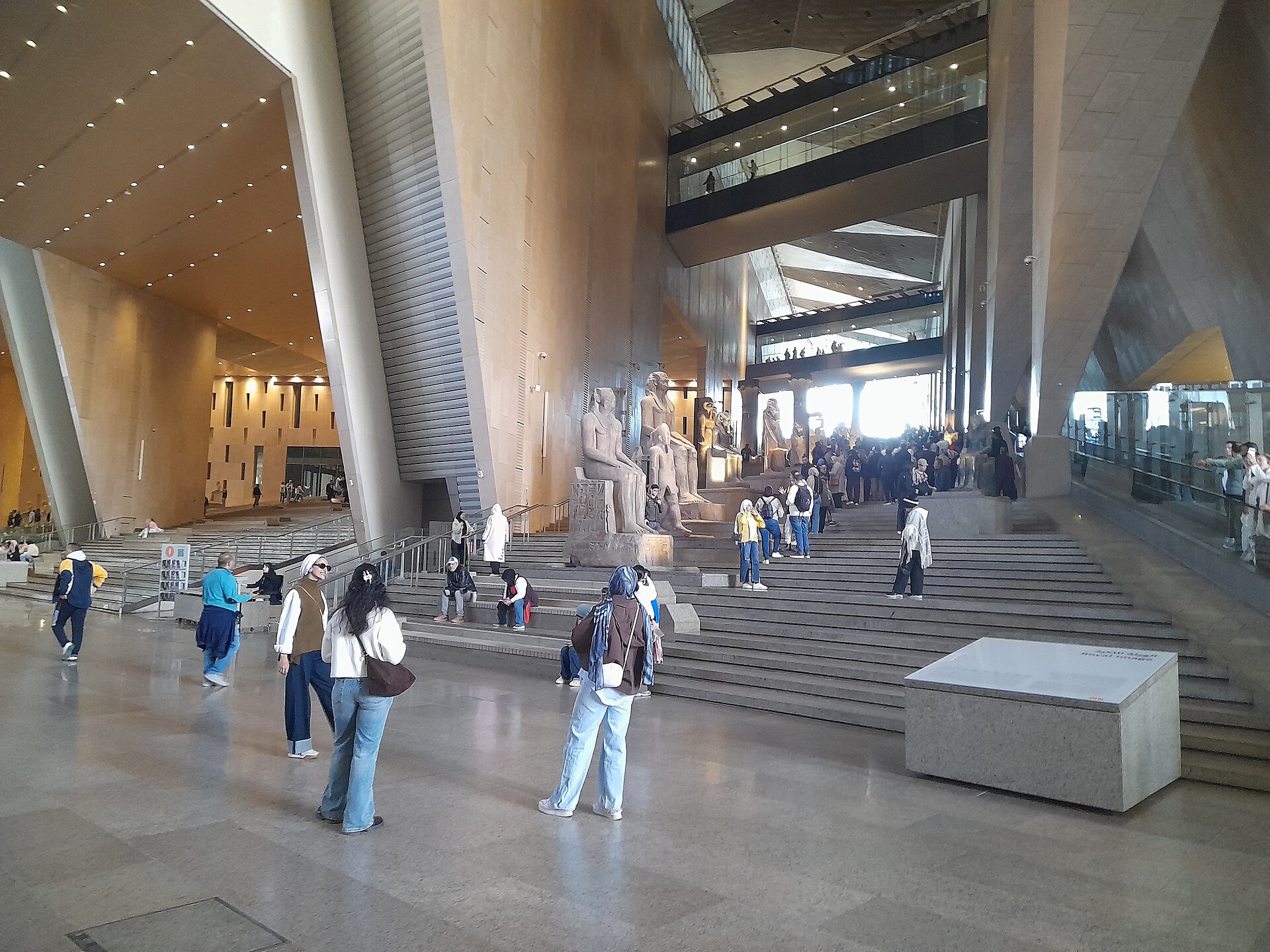
The first thing a seven-year-old does in the Grand Hall is not look at the eleven-metre statue of Ramses II. It is run. The floor is polished stone, it stretches away for what feels like a hundred metres, and the ceiling is so far up that the whole space reads as permission. Then the child reaches the bottom of the Grand Staircase, looks up at sixty-odd colossal figures rising away in tiers, and stops dead. That pause — the running, then the stopping — is the entire case for visiting the grand egyptian museum with kids, and it is why this museum works for families in a way that the old Tahrir building never quite managed.
This guide covers the practical side of a family visit: what tickets actually cost for a family of four, whether pushchairs work (they do, better than you would expect), a two-hour route that finishes before anyone melts down, where the toilets and the food are, what children genuinely stop for, and the honest answer to whether you should try to add the pyramids on the same day. Prices were checked in September 2026; treat them as the right order of magnitude rather than a quotation, because the Egyptian pound has moved a great deal in the last few years and museum tariffs have moved with it. For everything that is not specifically about children — general galleries, opening hours, the full artefact list — start with the complete Grand Egyptian Museum visitor guide and come back here for the family logistics.
What a family visit costs at a glance
The under-six rule is the single most useful fact for families, and it is generous. Toddlers and preschoolers are free, and the child rate covers a much wider band than most museums allow — it runs to twenty-five, so teenagers and university-age siblings still pay half.
| Ticket | Price (checked Sept 2026) | Notes |
|---|---|---|
| Foreign adult | EGP 1,450 (~USD 30) | Timed entry slot, booked online |
| Foreign child or student, 6–25 | ~EGP 730 (~USD 15) | Bring photo ID or a student card |
| Under 6 | Free | Still needs a slot booking in most cases |
| Egyptian national adult | ~EGP 200 (~USD 4) | National ID required |
| Family of four (2 adults, 2 children 6–12) | ~EGP 4,360 (~USD 90) | Two adults plus two child tickets |
| Family of four (2 adults, 2 under-6s) | ~EGP 2,900 (~USD 60) | Children free |
| GEM Children’s Museum | Separate ticket | Not included in general admission |
| Lockers and cloakroom | Free | Near the main entrance |
| Parking | Paid, limited | Fills fast at weekends |
Note that a family of four with two small children pays roughly sixty dollars for the morning — less than a single mid-range Cairo restaurant meal for the same group. The museum is not the expensive part of your day. Getting there and eating on site are. The tickets and booking guide covers the mechanics of the online portal, which is the only way to buy — on-site sales are suspended, and turning up at the gate with four excited children and no booking is the worst possible version of this day.
Is the museum actually good for children? An honest age-by-age answer
Mostly yes, but the honest answer varies enormously by age, and anyone who tells you a museum is “great for all ages” has not taken a two-year-old to one.
Under three
Bring them, but bring them for the building, not the collection. A toddler will not engage with a granite sarcophagus. What they will engage with is the scale of the Grand Hall, the water feature, the light, the escalators and the sheer number of other people. Keep the visit to ninety minutes, keep them in a pushchair for most of it, and accept that you are essentially visiting an enormous, air-conditioned, architecturally spectacular indoor space that happens to contain the treasures of ancient Egypt. That is a perfectly good reason to go. It is not a reason to buy a guided tour.
Three to five
The sweet spot for the building and the wrong age for the labels. Preschoolers respond strongly to animals — and Egyptian art is full of them. Falcons, cats, jackals, cobras, hippos, baboons, crocodiles. Turn the whole visit into an animal hunt and you will get a genuinely happy hour out of a four-year-old. They will also love the boat. Khufu’s solar boat is a real, enormous, four-and-a-half-thousand-year-old wooden ship, and “a very old boat that a king was buried with” is a sentence a four-year-old can hold onto.
Six to nine
This is the age the museum was, in effect, designed for. Six-to-nines have usually met mummies, pyramids and Tutankhamun somewhere — school, a book, a cartoon — and arrive with a mental checklist. The Tutankhamun galleries deliver on that checklist harder than anything else in Egypt: the golden mask, the nested shrines, the chariots, the sandals, the board games, the folding camp bed. Children of this age also cope well with two hours of walking if you break it with a snack. Expect a lot of questions about whether the king is inside the coffin. He is not — that is worth pre-loading before you go, because it disappoints some children badly if it lands as a surprise. Tutankhamun’s actual mummy is still in his tomb in the Valley of the Kings at Luxor. His possessions are here.
Ten to thirteen
Old enough to read the labels and young enough to still find the mummification material thrilling rather than gruesome. This is where the museum can genuinely produce the “I want to be an archaeologist” moment. Give them the map, let them navigate, and let them set the order. A ten-year-old with a job is a ten-year-old who does not complain.
Teenagers
Highly variable and largely a function of whether they have any prior interest. A teenager who likes history will happily give the museum four hours. A teenager who does not will give you ninety minutes of increasingly pointed sighing. The pragmatic move is to negotiate before you arrive: two hours in the museum, then something they have chosen. The gardens and the terrace with the pyramid view are usually enough of a payoff. It is a genuinely striking view, and it photographs well, which matters more than adults like to admit.
Pushchairs, lifts and the Grand Staircase problem
This is the question we get asked most, and the answer is better than at almost any other major Egyptian site: yes, pushchairs work here, and they work well.
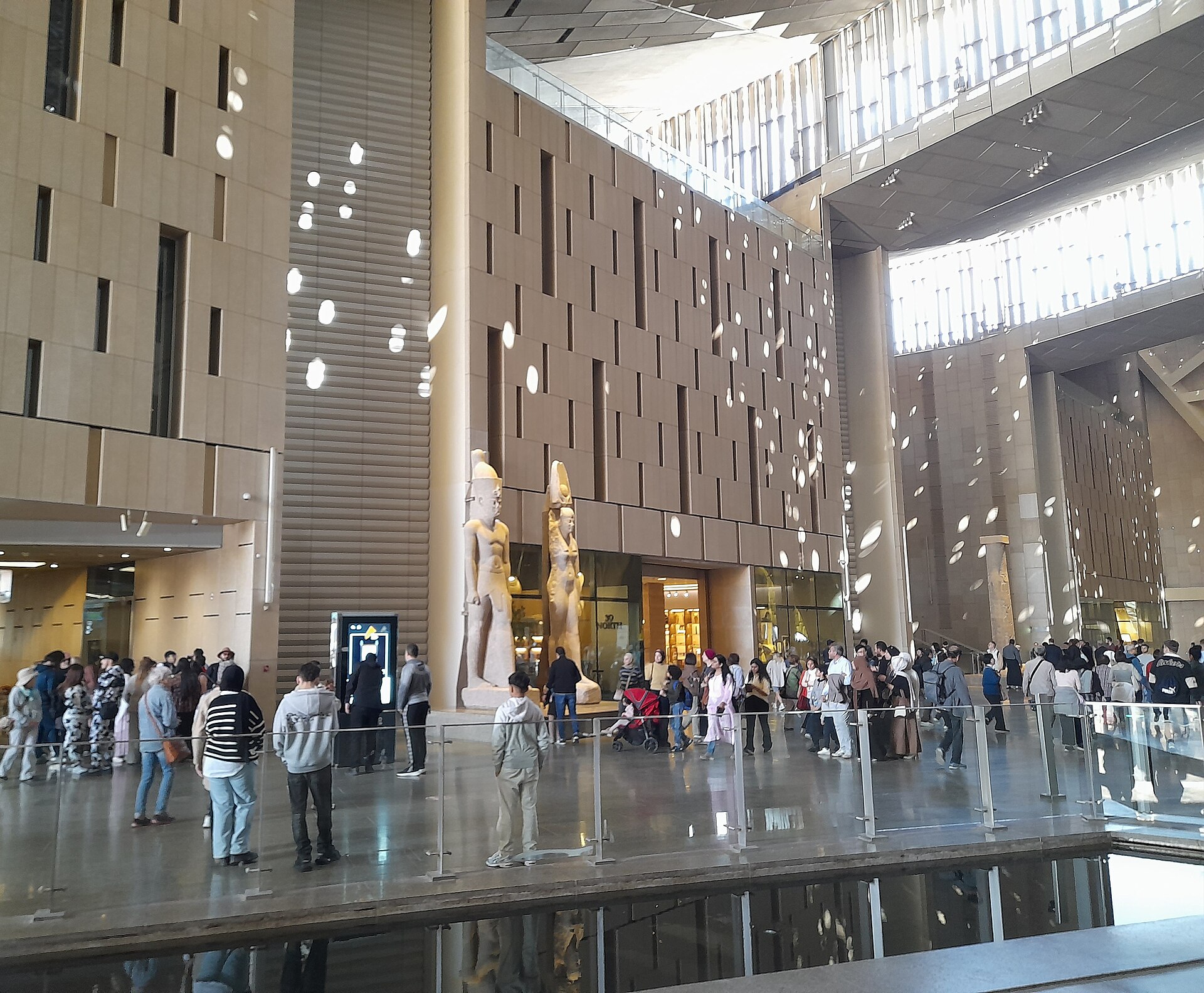
The museum’s own services list includes stroller-friendly pathways and baby-changing spaces, and the building backs that up. Accessible paths run throughout, with lifts and ramps at every level change. Floors are flat, smooth polished stone throughout the public areas — no cobbles, no thresholds, no gravel. After a morning at Giza, where a pushchair is close to useless on sand and broken limestone, the contrast is startling.
The staircase is optional
The Grand Staircase is the museum’s signature: six storeys of steps climbing past dozens of colossal statues towards a window that frames the pyramids at the top. It is also, for anyone with a pushchair, a bad idea. You do not have to climb it. There are escalators alongside and lifts serving every level, so you can ride up, walk the galleries at the top, and come back down the staircase on foot if you want the full effect without the ascent. Families routinely do it in exactly that order, and it is the better order anyway — you see the statues face-on coming down rather than craning up at them.
Where to leave things
Free lockers are available near the entrance, and there are cloakrooms too. Use them. A family that has been to the pyramids in the morning is usually carrying hats, water, sun cream, a change of clothes and a bag of snacks, none of which needs to come round the galleries. Keep the water and one snack; put the rest in a locker. Mobile charging stations exist on site, which is a small thing that becomes a large thing at hour three of a day when the eight-year-old has been taking photographs of every single cat statue.
There is also an on-site clinic and first-aid support, a prayer room, an ATM and Wi-Fi in the public areas. It is a comprehensively equipped modern building, and for families used to improvising at Egyptian heritage sites that takes some adjusting to. If accessibility is a concern beyond pushchairs, the wider Cairo accessibility guide covers how the GEM compares with the rest of the city, which is favourably.
The GEM Children’s Museum
There is a dedicated Children’s Museum inside the complex, organised around six themed areas with hands-on activities, interactive games and staff trained to run them. It is a genuinely good facility and it is aimed squarely at primary-age children who are not going to get much out of a display case.
Two practical points. First, it is a separate ticket — it is not included in general admission, and you should assume you are buying it in addition to your family’s entry tickets. Second, published pricing for it is not reliably available on any page we can verify, and the museum’s own site blocks automated checks, so we are not going to invent a number. Check it at the point of booking, and check whether your slot for the main galleries and your slot for the Children’s Museum overlap, because they are separately timed.
Is it worth it? For a family with children roughly five to ten who are going to spend three hours or more on site, yes. For a family doing a fast ninety-minute pass through the highlights before heading to the pyramids, no — you will not have time to use it properly, and half-using it is worse than skipping it.
A two-hour route that ends before the meltdown
The museum holds around a hundred thousand objects. A thorough adult visit is five or six hours. With small children, plan two, and treat anything beyond that as a bonus. Here is the sequence that works, in order.
- 0:00 — Grand Hall. Let them run. Ten minutes of unstructured movement at the start buys you an hour of cooperation later. Ramses II is right there and needs no explanation beyond “he was a king and he was very keen on statues of himself.”
- 0:10 — Escalator up, not the staircase. Ride to the top. Children enjoy the escalator more than the climb and you arrive with legs intact.
- 0:20 — The pyramid window. At the head of the staircase the building frames the Giza plateau through glass. Do this early, while attention is fresh, and take the family photograph here rather than at the end.
- 0:35 — Tutankhamun galleries. The headline act. Go straight for the mask and the gold; do not attempt the chronological route. Twenty-five minutes of high-density spectacle. See the Tutankhamun galleries walkthrough for what to point out.
- 1:05 — Snack and toilet stop. Non-negotiable. Build it in rather than letting it happen to you.
- 1:25 — Khufu’s boat. A real ship, buried beside the Great Pyramid, reassembled from over a thousand pieces of cedar. This lands well with almost every age.
- 1:45 — Main galleries, animal hunt version. Do not try to cover them. Pick one direction, walk it, and count cats, falcons and hippos.
- 2:00 — Gardens and out. Finish outside, in daylight, with space to move. Ending in a gallery is how you get a tantrum in a gallery.
If your children are older and holding up well, the natural extension is another hour in the main galleries and the Children’s Museum, which takes you to a comfortable three-and-a-half-hour visit. Our separate guide to how long to spend at the museum breaks the timings down for adult visitors, and the honest translation for families is: take the adult estimate and halve it.
What children actually stop for
After enough visits you notice that the objects adults photograph and the objects children stare at are almost entirely different sets. The ones that reliably work:
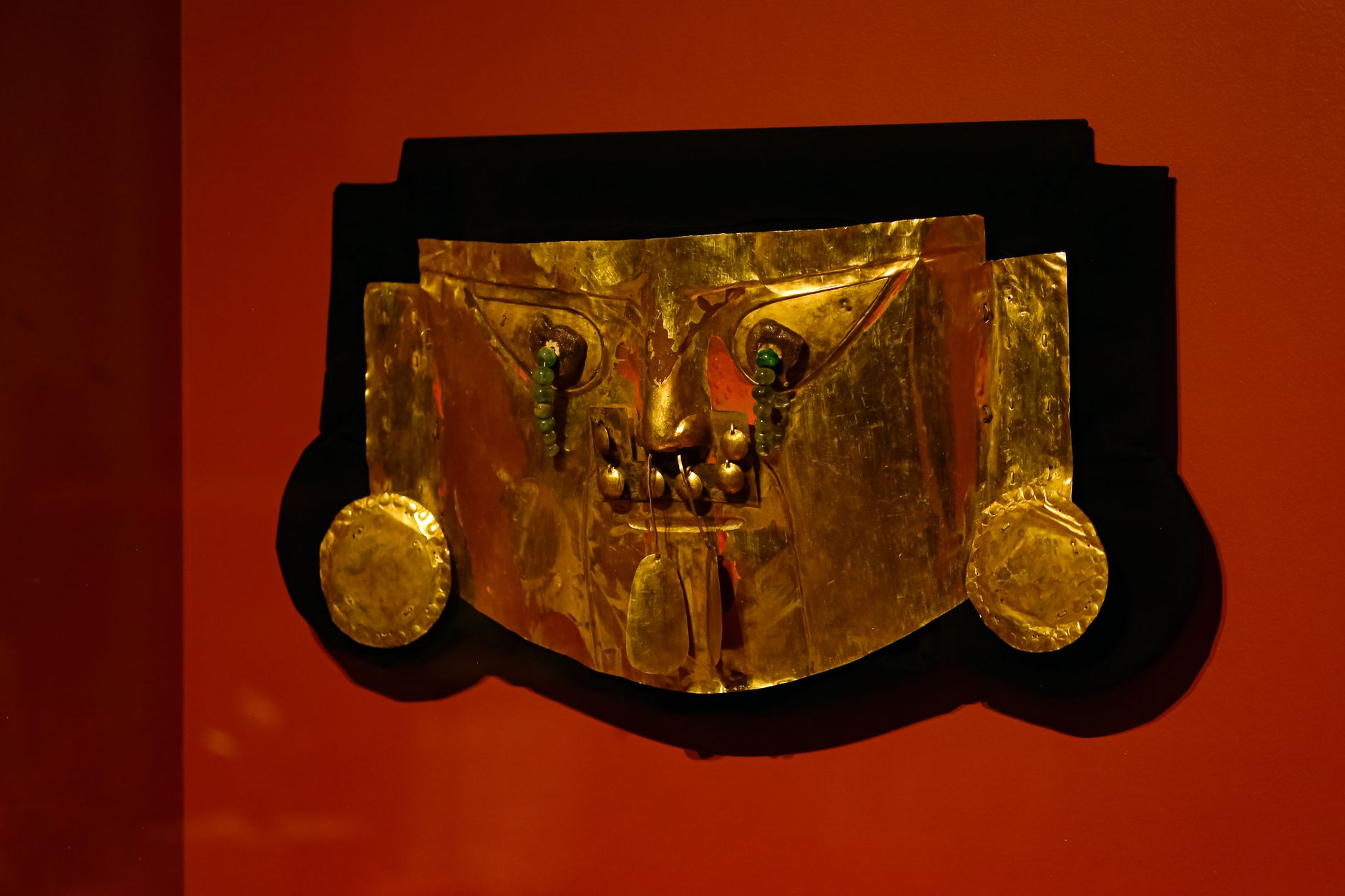
- Anything gold. No further analysis required.
- The chariots. Real vehicles, recognisably vehicles, with wheels. Children who cannot be persuaded to care about a stela will stand in front of a chariot for five minutes.
- The board games. Senet boards make the point that ancient Egyptians were bored on wet afternoons too, which is a more effective history lesson than any label.
- Animal figures. Cats above all, then falcons, baboons, hippos and the odd crocodile.
- The boat. Scale does the work.
- Colossal statues. Anything bigger than a bus.
- The escalators and the water. Yes, really. Budget for it and stop fighting it.
What does not work: rows of similar objects behind glass, anything requiring reading to be interesting, and — for children under about eight — coffins, which they either find frightening or find boring, rarely anything between.
Food, toilets and the meltdown-management chapter
There are restaurants, cafés and retail across the complex, and the general standard is high by Egyptian museum standards, which is a low bar cleared comfortably. It is not cheap. A family lunch on site will cost meaningfully more than the equivalent meal in Giza town or central Cairo, and the queues at peak lunchtime — roughly 12:30 to 14:00 — are long enough to eat into your visit.
Two strategies work. Either eat early, at about 11:30, before the rush and before anyone is hungry enough to be unreasonable about it; or bring snacks and hold lunch until after the visit. Sealed water, biscuits and fruit in a small bag are fine to carry. Tap water is not recommended for drinking anywhere in Egypt, so buy bottled and buy more than you think you need — the building is air-conditioned but the walk from the car park is not. There is more detail in the guide to the museum’s restaurants, shops and facilities.
Toilets are modern, clean and well distributed, with baby-changing spaces. This sounds like faint praise. It is not. Anyone who has changed a nappy at a major Egyptian archaeological site will understand exactly how much of a relief this is.
Timing: crowds, naps and the two evenings
Opening hours run from 08:30 for the complex, with galleries open 09:00 to 18:00 on Sunday, Monday, Tuesday, Thursday and Friday. On Wednesday and Saturday the complex stays open until 22:00 and the galleries until 21:00. Last entry is one hour before the galleries close.
For families, three timing rules matter.
- Take the first slot of the day. The 09:00 entry is the quietest hour the museum has, small children are at their best in the morning, and you will be out by 11:30 with the afternoon free.
- Those Wednesday and Saturday evenings are underused. An 18:00 entry on a late-opening day is a genuinely good option for families with children who nap in the afternoon — the museum is quieter, the light through the alabaster facade is at its best, and nobody is overheated.
- Avoid Friday late morning and Saturday midday. These are the local family peaks. The museum absorbs crowds well because of its scale, but the Tutankhamun galleries are the one genuine bottleneck, and with a pushchair in a slow-moving crowd the experience degrades quickly.
The opening hours and best-time guide has the full week laid out, including how the schedule shifts during Ramadan.
Adding the pyramids: the honest verdict
The GEM sits minutes from the Giza plateau, and every tour operator in Cairo will happily sell you both in one day. With children, this is where families most often overreach.
Can it be done? Yes, if your children are roughly nine or older, if you start at the pyramids at 08:00 while it is cool, and if you treat the museum as a two-hour afternoon visit rather than a thorough one. That is a long, hot, genuinely tiring day, and it will be the day everyone remembers, for better or worse.
Should it be done with a five-year-old? No. Giza in the sun is hard on small children — there is minimal shade, the ground is bad for pushchairs, and the camel and horse touts at the gate are persistent in a way that wears down adults, let alone children. Do the pyramids one morning and the museum the next. If your schedule genuinely allows only one day in Giza, split it across two half-days with a hotel rest in between, or accept that you are doing one properly and the other badly.
We have written the combined day up in detail in the museum and the pyramids in one day, and the pyramid-specific family advice — shade, touts, which side to enter from — lives in visiting the pyramids of Giza with kids.
Getting there with children in tow
The museum is at Giza, on the desert edge near the pyramids, which means it is a fair way from central Cairo — reckon on forty-five minutes to well over an hour from Zamalek or downtown depending on traffic, and Cairo traffic is not a thing you can plan around with any confidence.
With children, a car is the right answer. Ride-hailing through Uber or Careem is straightforward, metered, and removes the negotiation that makes street taxis stressful with a family. Book the outbound trip for well before your slot — an hour’s buffer is not paranoid here. The one caveat is child seats, which ride-hailing in Cairo does not reliably provide; families travelling with a baby often bring a lightweight seat from home for exactly this reason.
The metro does not serve the museum directly and the connecting journey involves a bus or a taxi at the far end, which with small children is more trouble than the saving justifies. Full options, including the shuttle arrangements, are in getting to the Grand Egyptian Museum from Cairo.
What to bring, and what to leave
- Bring: sealed bottled water, a light snack, a fully charged phone, photo ID for anyone claiming the 6–25 rate, a light layer for the air conditioning, and your booking confirmation saved offline.
- Bring if you have one: a lightweight, folding pushchair. Full-size travel systems are fine in the building but a nuisance in a taxi boot.
- Leave in the locker: everything else. Hats, sun cream, the pyramid-morning bag.
- Do not bother with: a tripod, which is not permitted, or a printed guidebook, which nobody reads while managing children.
What is not worth your money
A few honest deletions, because a family budget is finite.
The full guided tour, for under-tens. A professional Egyptologist is excellent value for an adult visit and largely wasted on a six-year-old who wants to look at gold and then leave. The guide will pitch to the adults, the children will fidget, and you will spend the hour managing rather than listening. Consider a guide for the pyramids, where context genuinely transforms a pile of stone, and go unguided here.
Multi-museum combination packages. Several operators bundle the GEM with the Egyptian Museum at Tahrir and the National Museum of Egyptian Civilization in one day. Three museums in a day is a lot for a committed adult and an act of optimism with children. Pick one, or two on separate days.
Any tout offering tickets outside the building. On-site sales are suspended and everything legitimate is booked online through the official portal. Anyone selling entry in the car park is selling you a problem.
Arriving without a booked slot and hoping. It is a timed-entry museum. This is the mistake that ruins family visits, and it is entirely avoidable.
Frequently asked questions
Is the Grand Egyptian Museum suitable for toddlers?
Yes, with realistic expectations. Under-sixes enter free, pushchairs work well on the flat stone floors, lifts serve every level and baby-changing facilities are available. A toddler will engage with the scale of the building rather than the collection, so plan around ninety minutes and treat it as an air-conditioned space with extraordinary things in it rather than a museum visit in the conventional sense.
Do children need their own ticket?
Under-sixes are free but generally still need to be included in the booking so the timed slot accounts for them. Children and students aged six to twenty-five pay roughly half the adult rate — about EGP 730 (~USD 15) as of September 2026 — and should carry photo ID or a student card, because the rate is checked at the gate.
How long should a family plan to stay?
Two hours with children under about eight, three to four hours with older children, and up to five if you are adding the Children’s Museum and eating on site. Adults visiting alone routinely spend five or six hours; do not use that figure to plan a family day.
Is the Children’s Museum included in the ticket?
No. It is a separately ticketed space within the complex, with its own timed entry. Add it at the point of booking rather than assuming you can join on the day.
Can we see the mummy of Tutankhamun here?
No, and this catches out a great many families. Tutankhamun’s treasures — the golden mask, the shrines, the chariots, thousands of objects — are at the GEM. His mummy remains in his tomb in the Valley of the Kings at Luxor. The twenty-two royal mummies of other pharaohs, including Ramses II, are at the National Museum of Egyptian Civilization in Fustat, on the other side of Cairo. Explain this before you arrive rather than at the display case.
Are pushchairs allowed inside?
Yes. The museum lists stroller-friendly pathways among its services, and in practice the building handles them better than almost any other major site in Egypt. Use the escalators and lifts rather than the Grand Staircase.
Is there anywhere to eat that suits children?
There are restaurants and cafés across the complex with a range of formats, including quicker counter-service options. Prices are noticeably above street level. Eating at around 11:30 avoids both the queue and the peak-hunger window.
Can we do the pyramids and the museum in one day with children?
With children of nine and over, yes, starting at Giza early and treating the museum as a two-hour afternoon stop. With children under about seven, we would not — split it across two days, or accept that one of the two will be rushed.
If the museum is one day of a longer family trip, the order matters. We put it the morning after the pyramids, so children arrive having already stood at the foot of the Great Pyramid and then find Khufu’s boat and the view from the top of the Grand Staircase waiting for them. The full sequence is in our day-by-day Cairo plan for families.
Related Cairo Guides
- Grand Egyptian Museum: the complete visitor guide
- Grand Egyptian Museum tickets and prices: how to book online
- How long to spend at the Grand Egyptian Museum
- Travel options from the city centre
- Restaurants, shops and facilities at the museum
- The Tutankhamun galleries: what you will see
- Opening hours and the best time to visit
- Museum and pyramids on a single day
- Giza with children: shade, touts and timing
- Cairo with kids: the wider family travel guide
- Accessible travel across the city
Photo Credits
Grand Hall and Grand Staircase, Grand Egyptian Museum: photo by Amr F.Nagy, via Wikimedia Commons (Public domain).
Museum atrium with visitors and pushchair: photo by Amr F.Nagy, via Wikimedia Commons (Public domain).