This article contains advertising. Our booking links are routed through a partner that adds commission tracking automatically, so if you book through one we earn a commission from the provider, at no extra cost to you. It never affects what we recommend. Affiliate disclosure
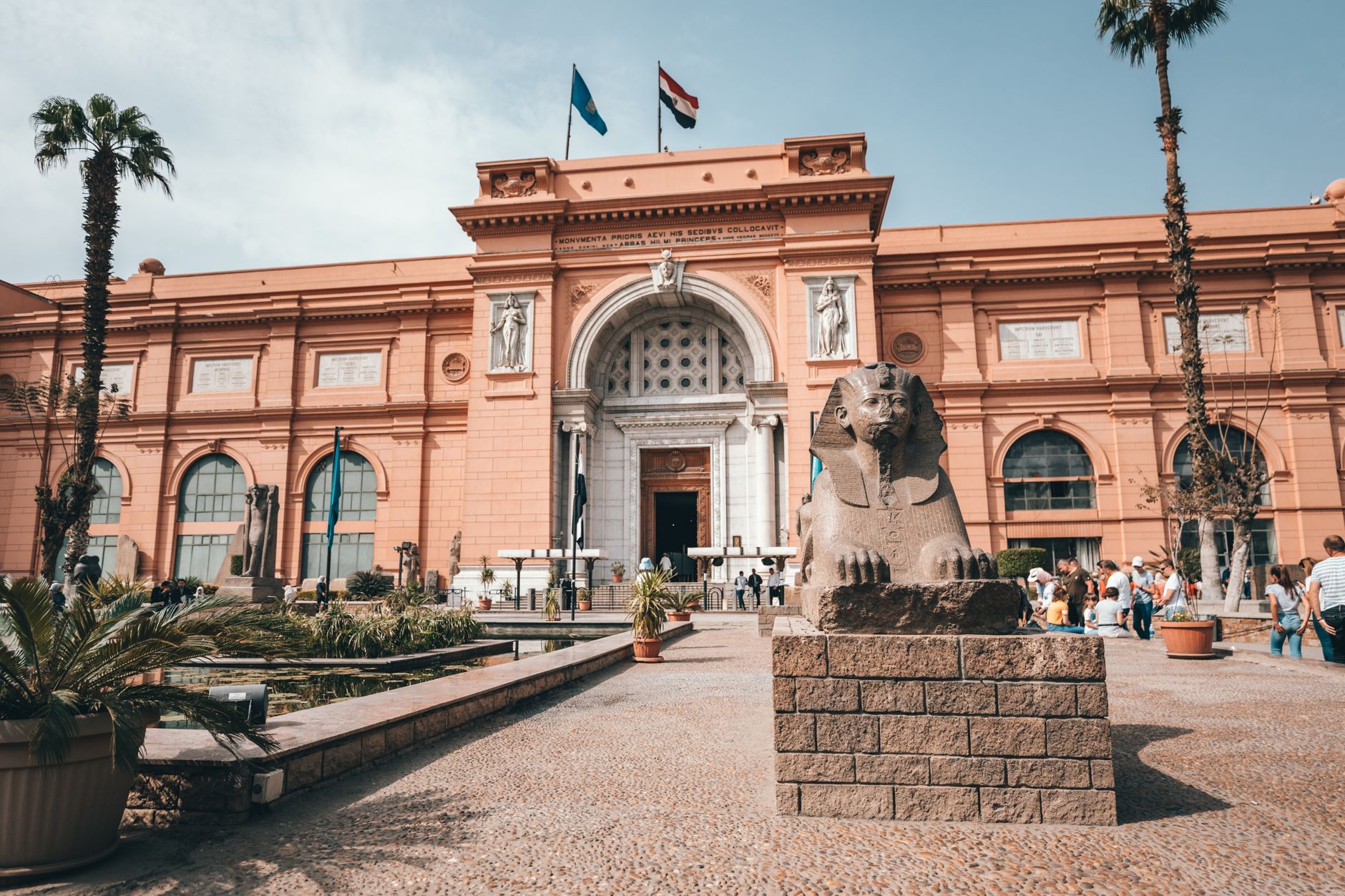
Two buildings, twenty kilometres apart, and between them most of what survives of ancient Egypt. One is a 1902 palace on a downtown square where the labels are typed on cards and the light comes through dusty clerestory windows. The other is a vast wedge of stone on the desert edge at Giza with a staircase that ends in a window onto the pyramids. Grand Egyptian Museum vs Egyptian Museum at Tahrir is now the first real decision anyone planning a Cairo trip has to make, and the honest answer depends less on the collections than on how many days you have.
This page is about that choice specifically. It compares what each holds since the great redistribution of 2021–2025, what each costs, how each feels to walk around, and which one suits which kind of traveller. Prices were checked in September 2026 and move with the pound, so treat them as the right order of magnitude.
The short answer
If you have one museum day, go to Giza. The Tutankhamun collection, Khufu’s solar boat, the building itself and the comfort make it the stronger single experience by a clear margin, and it is not a close call.
If you have two museum days, do both — and do them in that order. Tahrir rewards a second visit in a way it cannot reward a first, because once you have seen the headline objects out at Giza you stop looking for them downtown and start noticing what is actually there.
If you are travelling with someone who does not much like museums, one visit to the newer building will do more for them than three hours in the older one. Say so kindly and book the Giza slot.
Side by side
| Grand Egyptian Museum | Egyptian Museum, Tahrir | |
|---|---|---|
| Where | Giza, ~2 km from the pyramids | Downtown Cairo, on Tahrir Square |
| Opened | Fully November 2025 | 1902 |
| Foreign adult | EGP 1,450–1,590 (~USD 30–33) | ~EGP 550 (~USD 11) |
| Booking | Online only, timed slot, no walk-ups | Buy at the door |
| Headline holdings | Complete Tutankhamun collection, Khufu’s boat | Old and Middle Kingdom depth, Amarna, Yuya and Thuya |
| Objects | Around 100,000 | Some 120,000 |
| Time to allow | 3–4 hours minimum | 2–3 hours |
| Comfort | Air-conditioned, step-free, lifts throughout | Warm in summer, stairs, uneven going |
| Labelling | Bilingual, contextual, recent | Patchy, some of it decades old |
| Getting there | Ride-hail, 45–90 min from downtown | Metro to Sadat, or walk from most central hotels |
Prices checked September 2026. The most striking number in that table is the ticket: the newer museum costs roughly three times the older one. Whether that is good value is a question about what you want from a day, and we come back to it below.
What each one actually holds now
The collections were substantially rearranged between 2021 and 2025, and a great deal of what is written about both museums predates that. Here is the current position.
What moved to the Grand Egyptian Museum
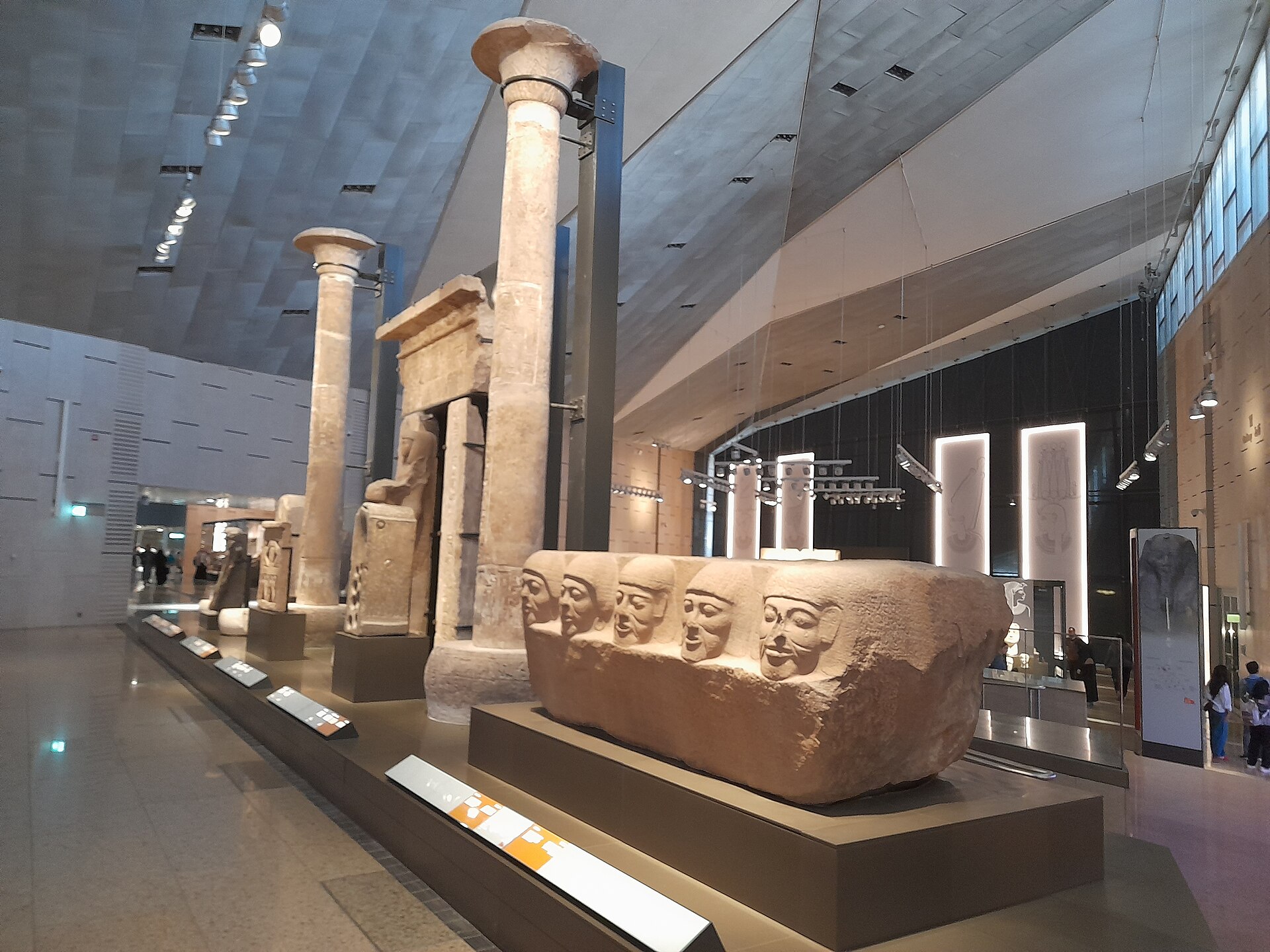
The entire Tutankhamun assemblage — the golden mask, the nested shrines, the chariots, the furniture, the jewellery, upwards of five thousand objects. At Tahrir perhaps a third of it was on show, packed into two rooms. At Giza it is displayed as a single find, more or less in the order Howard Carter emptied the tomb, which changes the whole meaning of the thing.
Khufu’s solar boat also moved, from its shed beside the Great Pyramid into a purpose-built hall at the museum. Add a large body of material from Tahrir’s basements and from storerooms around the country that had never been publicly displayed at all.
What went to Fustat instead
The twenty-two royal mummies — Ramses II, Seti I, Hatshepsut and the rest — did not go to Giza. They went to the National Museum of Egyptian Civilization in Fustat, in the 2021 procession through the streets that made the international news. That is a third museum, in a third part of the city.
And the fact that undoes more itineraries than any other: Tutankhamun’s own mummy is in none of the three. It has never left Luxor. It lies in tomb KV62 in the Valley of the Kings, in a climate-controlled case, and no amount of museum-going in Cairo will get you to it.
What Tahrir kept
More than you would think from the way the move was reported. Around 120,000 items remain, and the strength of the surviving collection is precisely the material that never made headlines: Old Kingdom sculpture of extraordinary quality, the Middle Kingdom, the Amarna period, the astonishing intact tomb goods of Yuya and Thuya, room after room of coffins, stelae, papyri and everyday objects.
What Tahrir lost was the crowd-pulling gold. What it kept was the depth. If you are the sort of visitor who reads labels, that trade is far less painful than it sounds — and our full guide to the Tahrir museum goes through what is worth seeking out there now.
How they feel to walk around
This is the difference that no inventory of holdings captures, and for most visitors it matters more than the object list.
The newer building
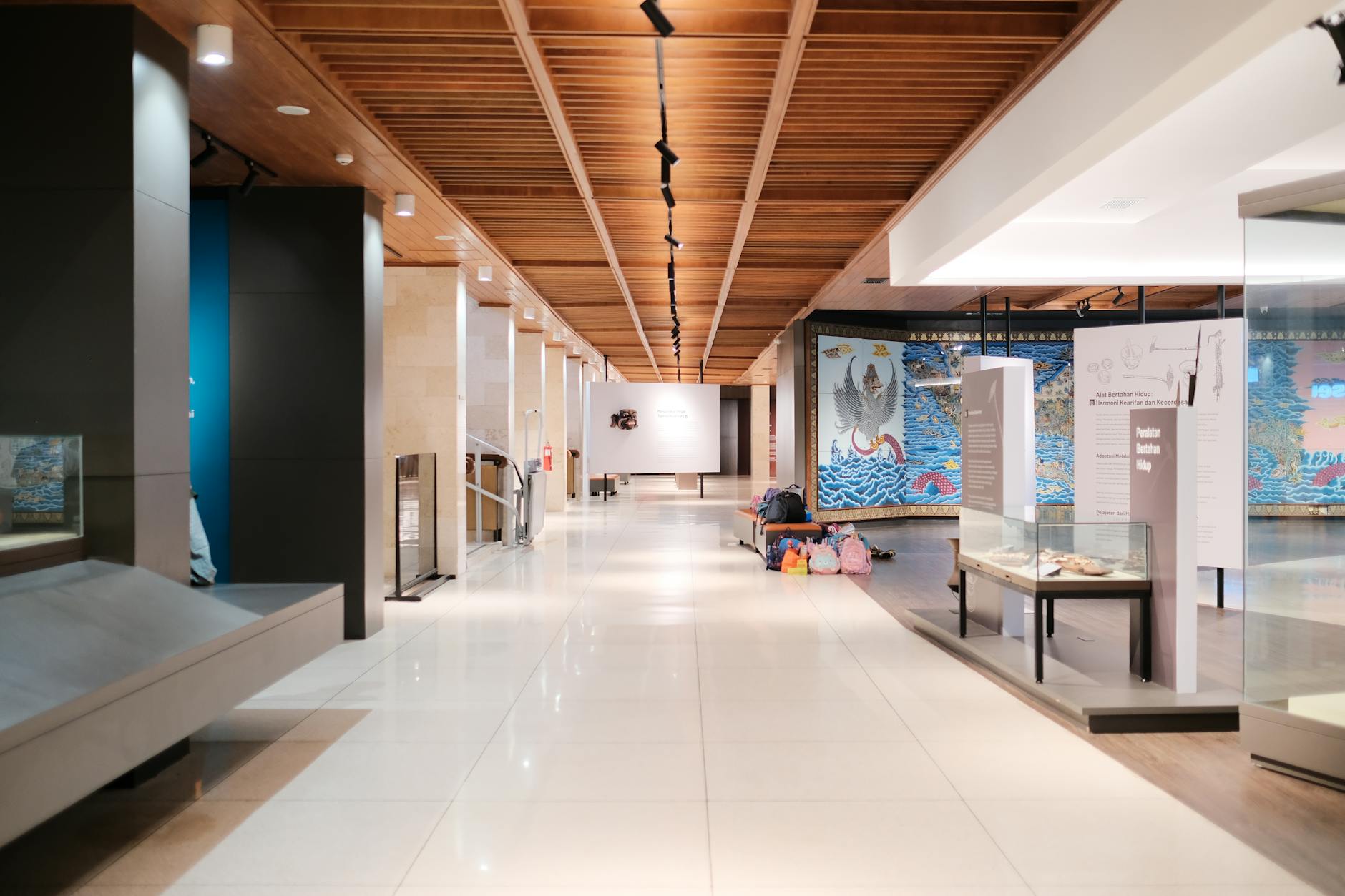
Giza is designed. The site slopes fifty metres and the architecture uses the slope, so you climb through the museum past a staircase lined with statuary that gets progressively later as you rise. It is air-conditioned, level, well lit, and legible: you can tell where you are and what you are looking at. Wide ramps and lifts reach every floor. There are places to sit, a decent shop and somewhere to eat.
The cost of all that design is a certain smoothness. Everything has been curated, spaced and explained, and some visitors find the result more like a very good international museum that happens to be in Egypt than like Egypt itself.
The older building
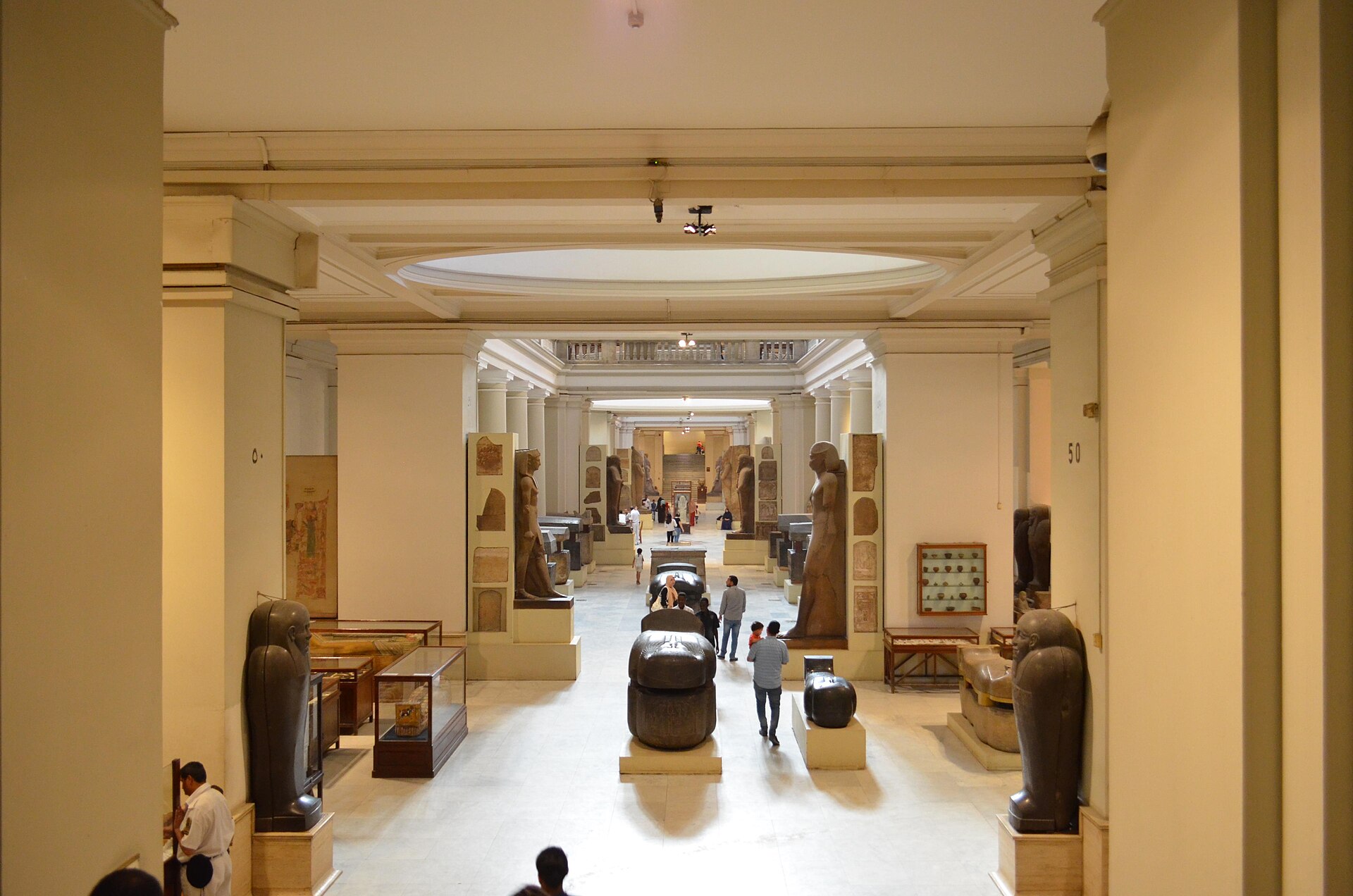
Tahrir is not designed, or rather it was designed in 1899 for a collection a fifth of the size it now holds. Objects stand three deep. Statues line corridors because there is nowhere else for them. Some cases still carry handwritten cards; some objects carry no label worth the name. In summer it is genuinely hot upstairs.
And it is wonderful, in a way that is hard to argue for on paper. The building is a nineteenth-century museum of a type that has been renovated out of existence nearly everywhere else — a place where you turn a corner and find something extraordinary in a wooden case with a typed card, unheralded. Renovations have improved the ground floor considerably in recent years without spoiling that character.
The money
At around EGP 1,450–1,590 against roughly EGP 550, the Giza ticket costs close to three times the Tahrir one. For a family of four that is a difference of several thousand pounds in one afternoon.
Is the newer museum three times better? Not in any measurable sense — but it is three or four times larger, holds the objects most people came to Egypt to see, and is the only one of the two you could comfortably spend a full day in. The reasonable framing is not value per object but whether you would rather have one strong day or two moderate ones.
There is one clean budget answer. If cost is the deciding factor and you can only justify one paid museum, Tahrir at EGP 550 plus a metro fare is the cheapest serious museum day in Cairo, and you will still see world-class material. You will simply not see Tutankhamun. Booking mechanics for the more expensive of the two are covered in our guide to GEM ticket tiers and online booking, including the reseller sites to avoid.
Logistics: the underrated deciding factor
Where you are staying may settle this for you more decisively than any argument about collections.
Tahrir sits on the square it is named for. Sadat metro station is underneath it, most downtown and Garden City hotels are a walk away, and Zamalek is one bridge distant. You can go on a whim, spend two hours, and be somewhere else for lunch. Our guide to using the Cairo metro covers the one line and one station you need.
The Grand Egyptian Museum is a commitment. From downtown it is forty-five to ninety minutes each way depending on the Ring Road, at EGP 250–400 (~USD 5–8) a trip by ride-hail, and it requires a timed slot booked in advance. You cannot do it on a whim, and you should not try to squeeze it into a half day with something else across town. The practicalities of that journey are in our notes on the run out to Giza.
The corollary is a genuinely useful planning rule: pair the Giza museum with the pyramids, and pair Tahrir with downtown. Trying to combine one of each in a single day means crossing the city twice and enjoying neither.
Which one suits you
Choose the Grand Egyptian Museum if…
- You are here for Tutankhamun. This is not a preference, it is a fact about where the objects are.
- You have one museum day. The stronger single experience, comfortably.
- You are visiting the pyramids anyway. Two kilometres apart; a natural pairing.
- Mobility matters. Step-free throughout, lifts everywhere, wheelchairs available. Tahrir is stairs and uneven floors.
- You have children. A Children’s Museum, room to move, buggy-friendly, and the Tutankhamun material holds young attention far better than statuary rows.
- It is July. One building is air-conditioned throughout. The other is not.
Choose the Egyptian Museum at Tahrir if…
- You are short on time or based downtown. Two hours, no booking, walkable from half the city’s hotels.
- You are on a budget. A third of the price, and still a serious collection.
- You already know some Egyptology. The Old and Middle Kingdom material rewards knowledge in a way the newer displays, aimed at a general audience, do not.
- You like old museums. If the phrase “nineteenth-century museum” makes you happy rather than impatient, this is one of the last great ones.
- You are combining it with downtown. Islamic Cairo, the Nile corniche, the downtown cafés — Tahrir slots into that day naturally.
Doing both, properly
If you have the days, this is the sequence that works.
- Day one: Giza. Pyramids at opening for three hours, lunch, then the museum on an afternoon slot. A long day, and the right order — doing the galleries first strands you at an exposed desert site in the afternoon heat.
- Day two or later: downtown. Tahrir in the morning while you are fresh, two or three hours, then lunch downtown and something else nearby in the afternoon.
Leaving a day between them helps more than you would expect. Two enormous Egyptian collections back to back produces a state in which sarcophagi stop registering as individual objects, which is a waste of both tickets. Our thoughts on how long Cairo actually needs set out where these fit in a three-, five- or seven-day trip.
Should you add NMEC and the royal mummies as a third museum? Only if you have five days or more, and only if mummies specifically interest you. It is a genuinely good museum and it is also a third crosstown journey.
Where the third museum fits
Any honest comparison of these two has to admit there is a third party to the argument, because a great deal of what people expect to find at either building is actually in Fustat.
The National Museum of Egyptian Civilization does something neither of the others attempts: it runs the whole span, prehistoric through Pharaonic, Greco-Roman, Coptic, Islamic and into the modern era, rather than stopping where the pharaohs do. Its headline draw is the Royal Mummies Hall, where twenty-two mummified kings and queens are displayed individually in low light — a considerably more sober and better-judged presentation than the old arrangement at Tahrir.
It is not a substitute for either of the two museums compared here, and it should not be the first one you visit. But it settles the argument for one specific kind of traveller: if what you actually want is to stand in front of Ramses II himself rather than his statue, no amount of choosing between Giza and Tahrir will get you there. Fustat will.
A two-hour route for each
Most visitors underestimate both buildings and then run out of time in the wrong place. If two hours is genuinely all you have, here is where to spend it.
Two hours at Giza
Uncomfortable, but survivable. Walk the Grand Hall and take the staircase slowly — fifteen minutes, because it is one of the best things in the museum and everybody skips it thinking the real exhibits are elsewhere. Go straight to the Tutankhamun galleries and give them a full hour while you are fresh. Spend twenty minutes on the Khufu boat. Accept that you will not see the twelve main galleries at all, and do not try; a hurried lap of them will leave you with nothing except sore feet.
Two hours at Tahrir
Two hours is close to the natural length of a Tahrir visit rather than a compromise. Start on the ground floor with the Old Kingdom sculpture, which is the strongest thing in the building and the reason to come. Work along the main hall — it is arranged roughly chronologically as you move away from the entrance. Then go upstairs for Yuya and Thuya, whose near-intact tomb goods are the closest thing Tahrir still has to the Tutankhamun experience, and for the Amarna material. Leave the rest. Nobody sees all of Tahrir and nobody should try.
What each does better
Tahrir wins on
- Density. More objects per room than anywhere, which is chaotic and also thrilling.
- Old Kingdom sculpture. The Fourth and Fifth Dynasty material is exceptional and largely stayed put.
- Atmosphere. Wooden cases, high windows, marble floors, the smell of an old museum.
- Price and access. A third of the cost, no booking, on the metro.
- Serendipity. You will find things nobody told you about. That does not really happen at Giza, where everything has been placed.
Giza wins on
- Tutankhamun, entire. The single strongest reason to choose it.
- Khufu’s boat. A 4,600-year-old sewn cedar vessel, in its own building.
- The building. Worth the ticket in its own right, which is not a thing you can say about many museums.
- Interpretation. Bilingual, well written, aimed at someone who does not already know the dynasties.
- Comfort and accessibility. Air conditioning, lifts, seating, food, step-free routes.
- The pyramid view. The window at the top of the staircase is the best thing any museum in Egypt has done with a piece of glass.
Crowds, and when each is bearable
The two buildings crowd differently, which is worth knowing because it can flip the decision on a given day.
Giza is capacity-controlled by timed slot, so it never becomes genuinely unpleasant — but the Tutankhamun galleries concentrate everybody in the same rooms regardless, and mid-morning between about 10:30 and 12:30 is when tour groups and cruise-passenger coaches arrive together. The earliest slot of the day is markedly quieter, and the late openings on Wednesday and Saturday are the most underused thing the museum offers.
Tahrir has no such control, and the difference between a good and a bad visit there is almost entirely about timing. It fills with school parties and organised groups from mid-morning onward, and because the main hall is a single space with objects packed into it, forty extra people register immediately. Arrive when it opens and you will have the Old Kingdom rooms close to yourself. Arrive at eleven and you will be queueing behind a guide with a microphone.
Friday and Saturday are the Egyptian weekend and both museums are busier with domestic visitors — which is a good thing to see and a slow thing to walk through. If your schedule is flexible, a weekday morning at either is worth rearranging other plans for.
The honest verdict
The newer museum is the better museum, and anyone telling you otherwise is being sentimental. It has the objects, the space, the explanation and the comfort, and it has arranged the greatest single archaeological find of the twentieth century in a way that finally does it justice.
But the older one has not been reduced to a consolation prize, and the widespread suggestion that it has been “emptied” is simply wrong. It holds 120,000 objects. It is a third of the price. It is a fifteen-minute walk from most downtown hotels. And it offers something the Giza building, by its nature, cannot: the experience of a collection that overflows its container, where nobody has decided in advance what you ought to notice.
Do both if you can. Choose Giza if you cannot. And if a guidebook printed before 2025 tells you to go downtown for the golden mask, put it down. For the wider landscape of what else is worth a morning, our survey of Cairo’s museums covers the smaller collections that get overlooked entirely in this argument.
Frequently asked questions
Is the Egyptian Museum at Tahrir still open?
Yes, fully open and still holding around 120,000 objects. Reports of its closure are wrong; what happened was that specific collections moved out to two other museums.
Where is the golden mask of Tutankhamun now?
At the Grand Egyptian Museum in Giza, along with the complete tomb assemblage of more than five thousand objects. It left Tahrir when the new galleries opened.
Where are the royal mummies?
At the National Museum of Egyptian Civilization in Fustat, which is a third museum in a third part of Cairo. Twenty-two of them, moved there in 2021.
Can I see both museums in one day?
Technically yes; we would not. They are on opposite sides of the city, the Giza visit needs three to four hours and a booked slot, and doing both means two long crosstown journeys plus museum fatigue that will spoil the second one.
Which is better for children?
Giza, without much doubt. There is a dedicated Children’s Museum, room to move, step-free routes for buggies, and the chariots and board games from Tutankhamun’s tomb hold attention. Tahrir’s density and stairs are hard work with small children.
Which is cheaper?
Tahrir, at roughly EGP 550 against EGP 1,450–1,590 for a foreign adult at Giza — about a third of the price, plus a metro fare rather than a long ride-hail.
Do I need to book Tahrir in advance?
No. Buy at the door. That is one of its real advantages: it absorbs a spare morning with no planning at all, which the Giza museum cannot.
If I only see one, which should it be?
The Grand Egyptian Museum, unless budget or a downtown-only trip decides otherwise. It has the Tutankhamun collection, the boat, the building and the comfort.
Is the old museum worth it after seeing the new one?
Yes, and arguably it is better in that order. Once you are not hunting for the famous pieces, the Old Kingdom sculpture and the sheer accumulation of ordinary objects come into focus.
Anyone who saw the Tutankhamun material at Tahrir before the move should know that they have not, in any meaningful sense, seen it. Roughly three-quarters of the find was never on public display there, and what is at Giza now is the tomb entire — the sticks and sandals and folded linen alongside the gold. Our guide to what the Tutankhamun galleries actually contain explains why that changes the experience rather than just enlarging it.
There is a third answer to this question that most itineraries never consider, and for some visitors it is the right one. The royal mummies — Ramses II, Seti I, Hatshepsut and nineteen others — are at neither of the museums compared here; they are in Fustat, at a museum that is cheaper than the GEM, easier to reach than either, and on the metro. Our guide to the National Museum of Egyptian Civilization and the Royal Mummies Hall makes the case for it.
Related Cairo Guides
- Grand Egyptian Museum: the complete visitor guide
- GEM tickets, prices and online booking
- Why the new museum took thirty years to open
- Museum of Islamic Art: the overlooked one
- Using the Cairo metro
- How many days to spend in Cairo
Photo Credits
Egyptian Museum main hall at Tahrir: photo by Amr.fouad, via Wikimedia Commons (CC BY-SA 4.0).
Grand Egyptian Museum main galleries: photo by Amr F.Nagy, via Wikimedia Commons (Public domain).