This article contains advertising. Our booking links are routed through a partner that adds commission tracking automatically, so if you book through one we earn a commission from the provider, at no extra cost to you. It never affects what we recommend. Affiliate disclosure
Four hours into a visit, most people’s questions stop being about the Eighteenth Dynasty and start being about where to sit down. The good news about Grand Egyptian Museum restaurants and the rest of the facilities is that they exist, they are inside the paid zone, and you can leave the galleries to use them and come back. The less good news is the pricing, which is set for a museum in a capital city rather than for Egypt.
This page covers what there is to eat and what it costs, whether the shop is worth your money, where the lockers and prayer rooms are, how the accessibility actually works, and the practical things nobody mentions until you need them. Prices were checked in September 2026 and should be read as the right order of magnitude rather than a menu.
The commercial area, and why its location matters
The food, cafés and shop sit off the Grand Hall, inside the ticketed zone. That is a small design decision with a large practical consequence: your ticket covers re-entry to the galleries after you have eaten, so a proper break in the middle of a long visit costs you nothing but time.
It matters because the alternative is bleak. The area immediately outside the complex is a road, a car park and desert edge — there is no strip of cafés opposite the way there is at most European museums, and nothing within walking distance worth crossing a car park for. Whatever you eat, you eat here or you eat before you come.
What it costs to eat
| Item | EGP | USD |
|---|---|---|
| Coffee | 90–160 | ~2–3 |
| Coffee and a pastry | 150–250 | ~3–5 |
| Sandwich or light lunch | 200–350 | ~4–7 |
| Main course, sit-down restaurant | 350–600 | ~7–12 |
| Bottled water | 40–70 | ~1 |
| Lunch for a family of four | 1,200–2,000 | ~25–42 |
Prices checked September 2026. For context: the same coffee costs EGP 40–60 in Dokki and the same plate of food EGP 120–200 in a neighbourhood restaurant downtown. You are paying roughly two to three times the city rate, which is normal museum economics anywhere in the world and still a shock if you have spent a week eating koshari for a pound.
The honest verdict: the food is decent, the setting is good, and none of it is a destination. If you are watching a budget, eat properly before you arrive and buy one coffee inside. If you are not, a sit-down lunch in the middle of a five-hour visit is money well spent, because the alternative is grinding through the second half tired and irritable.
What is actually on offer
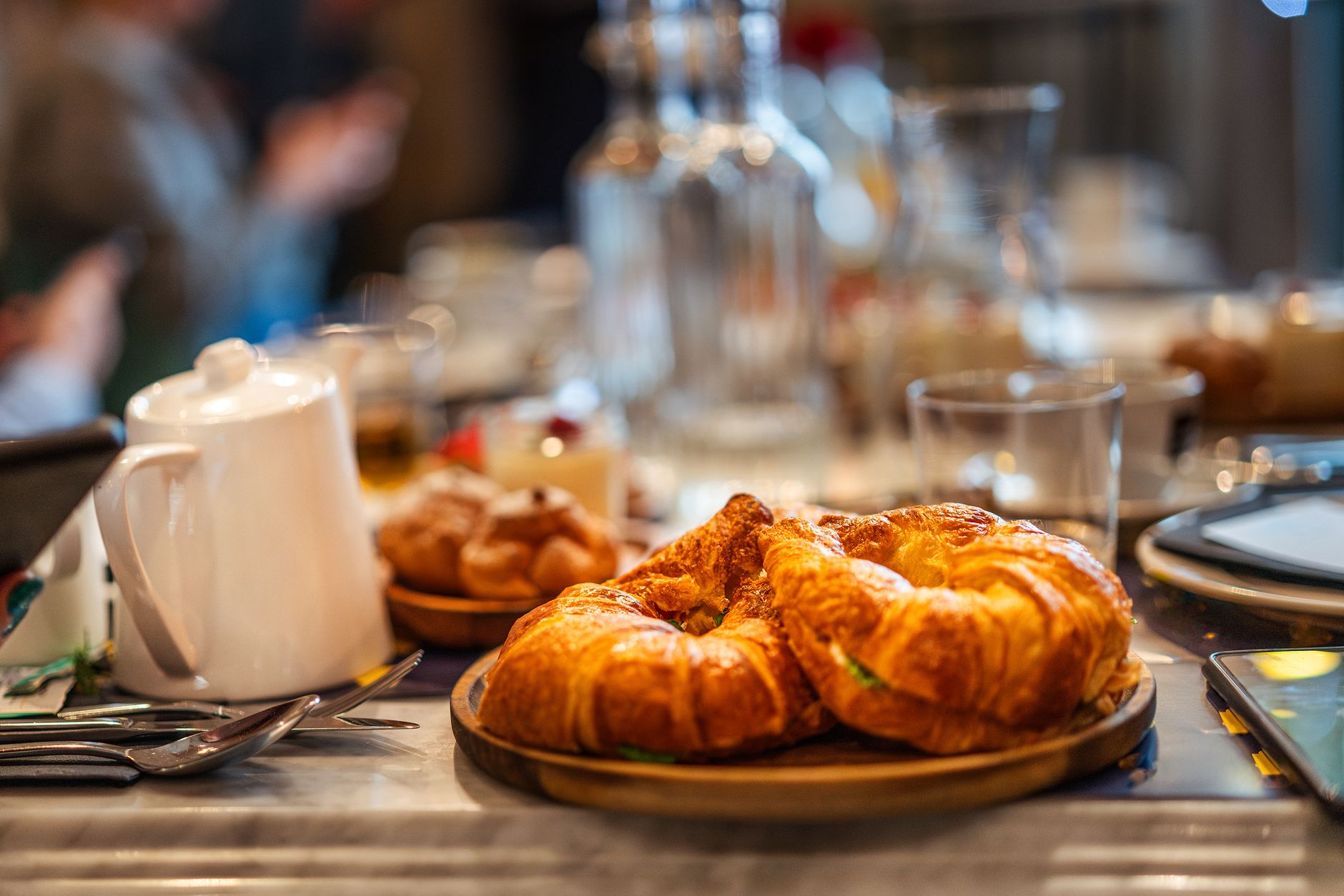
The spread runs from quick counters to a proper restaurant, with cafés on the upper levels. Specific outlets have changed since opening and will change again, so rather than naming brands that may not survive the year, here is the shape of it.
- Quick counters for coffee, pastries, sandwiches and cold drinks. Fastest option, and the right choice if you are on a three-hour visit and do not want to lose forty minutes.
- A sit-down restaurant with a terrace. Table service, a proper menu, and views out towards the plateau. This is where to go if you are making a day of it.
- Cafés on the upper levels, useful because they let you break without walking all the way back down to the Grand Hall.
- A mix of Egyptian and international dishes. You will find local food, and you will also find the pasta-and-burger register that large museums default to worldwide.
Dietary requirements
Vegetarians are fine — Egyptian food is unusually accommodating, and dishes built on pulses, rice and vegetables are standard rather than an afterthought. Vegans will find less, though the same base ingredients mean something can usually be assembled; ask rather than assuming. All food served is halal, which is the default across Egypt. Gluten-free is the hardest ask and worth flagging clearly at the counter. Our guide to eating plant-based in Cairo covers the vocabulary that helps.
Bringing your own
You can bring a sealed bottle of water and that is worth doing — buy it outside at a third of the price. Bringing a full picnic is not really practical: bags go through security, large ones go into lockers, and there is nowhere obvious to sit and eat your own food. A few snacks in a small bag for children is a different matter and passes without comment.
The shop, which is genuinely good
This surprises people who have been ground down by souvenir sellers elsewhere in Egypt. The museum shop is well curated, the reproductions are licensed and properly made, the books are serious rather than coffee-table filler, and the prices — while high by Egyptian standards — are fixed, transparent and not the opening position in a negotiation.
What is worth buying: the exhibition catalogues and academic titles, which are hard to find elsewhere; the licensed jewellery reproductions, which are made to a standard the bazaar generally is not; and the smaller printed things, which travel well and cost little.
What is not: the generic tourist tat that any shop of this size accumulates, and anything you could buy at Khan el-Khalili for a fifth of the price if you enjoy haggling. Our guide to souvenirs worth buying in Cairo sets out where the museum shop beats the market and where it does not.
One firm recommendation. If anybody has tried to sell you papyrus on the road to the plateau — at an “institute”, with a demonstration and a certificate — buy your papyrus here instead. What is sold roadside is very often painted banana leaf, and the shop is one of the few places in Giza where what you are buying is what it says it is. Our guide to telling real papyrus from the alternatives explains how the trick works.
Bags, lockers and security
Security screening is universal at Egyptian sites and the museum is no exception. Bags go through a scanner on the way in, and it is quick.
- Lockers and a bag drop sit near the entrance. Large bags and backpacks go in; a small day bag or handbag comes through with you.
- Do this before you start walking. The distance from the entrance to the galleries is long and mostly uphill, and carrying a large bag up it is a self-inflicted problem.
- Tripods and selfie sticks are the usual casualties. Assume they will not come in.
- Buggies and prams are fine and the building is genuinely designed for them.
Accessibility, where the museum is an outlier
This deserves emphasis because it is the single biggest practical difference between the Grand Egyptian Museum and almost everything else worth seeing in Egypt.
The building is step-free throughout. Lifts reach every level. The ramps are wide and properly graded rather than token. Wheelchairs are available at the entrance. Surfaces are polished stone rather than sand, rubble and worn temple steps, and there is seating at reasonable intervals rather than nowhere at all.
If you have been reading about Egyptian sightseeing with a wheelchair, a walking stick or a knee that objects, you will know how rare all of that is. The pyramids, the Citadel, Islamic Cairo and Saqqara range from difficult to effectively impossible. This is the one major attraction you can plan around with confidence, and it changes what a trip can include.
Two caveats worth knowing. The distances are long even when they are level, so budget more time and more rest stops than the floor plan suggests. And the Grand Staircase has a lift alternative — the sculpture sequence is not lost, but you will want to know that before you arrive at the bottom of it.
Prayer rooms, toilets and the small stuff
- Prayer rooms are provided on site, as at most major Egyptian public buildings.
- Toilets are frequent, modern and clean — and, unusually for Egypt, generally without an attendant expecting a coin. If someone does hand you paper, small notes are the courteous answer; our explainer on baksheesh covers the wider etiquette.
- Baby-changing facilities are available, which is not something you can assume elsewhere in the country.
- Drinking water. Do not drink from taps anywhere in Egypt. Sealed bottles only, here and everywhere — see our notes on staying well in Cairo.
- First aid is available on site; ask any member of staff.
- Cloakroom for coats is rarely needed given the climate, but the bag drop handles it in winter.
Wi-Fi, phones and power
There is Wi-Fi in the public areas. It is reasonable in the Grand Hall and the commercial area, and patchy once you are deep in the galleries — which is normal for a building with this much stone in it.
Egyptian mobile data is generally reliable and cheap, and a local SIM is worth having for a trip of any length rather than for this visit specifically. What matters here is that your entry QR code should be a screenshot rather than something you need to fetch from an email in the plaza. Our guide to SIM cards and getting online in Cairo covers the operators and the airport counters.
Charging points are limited, as in most museums. Bring a power bank if you are planning a long day, particularly if you are photographing a great deal — the low light in the Tutankhamun galleries makes phones work harder than usual.
Facilities for children
Better than anywhere else in Cairo, which is worth saying plainly to anyone dreading a museum with a six-year-old.
There is a dedicated Children’s Museum — a genuine facility with its own space and programming rather than a corner with colouring sheets. The building is buggy-friendly and step-free. Baby-changing exists. There is room to move without anyone worrying about a child near an object, and the food outlets have things children will actually eat.
The practical shape that works with young children is to plan the food break as a fixed point rather than an afterthought, and to treat two and a half to three hours as the ceiling. Our guide to Cairo with children covers how this fits into a wider family trip.
Where to eat instead, if you would rather not
Given the pricing, it is fair to ask what the alternatives are. There are three, and only two of them are any good.
Eat before you come
The best option for anyone on a budget, and easy if you are staying in the city. A proper Egyptian breakfast — ful, taameya, eggs, bread — costs a fraction of a museum sandwich and will carry you through four hours of galleries without a mid-morning collapse. If you are heading out early for the pyramids first, this is the plan anyway.
Eat in Giza afterwards
There is decent eating around the plateau approach and in Giza town proper, at ordinary Cairo prices rather than museum ones. It requires a short car journey and a bit of willingness to walk into a place with no English menu, which is generally rewarded. Our roundup of where to eat cheaply and well in Cairo covers the kind of place worth looking for.
The one that does not work
Planning to nip out of the complex for lunch and come back. There is nothing within walking distance, the walk itself is a car park and a road in full sun, and you will spend more on two short car journeys than the price difference saves. If you are inside and hungry, eat inside.
Timing your break
Where the food stop sits in your visit matters more than what you eat, and most people get it wrong by leaving it too late.
The common pattern is to push on through the galleries, hit a wall somewhere in hour four, and then eat as a recovery measure on the way out. By that point the break is not improving anything — the visit is over and you are simply tired in a chair.
The better shape is to break after the Tutankhamun galleries and before the twelve main halls. You will have done the emotionally demanding part while fresh, and you will come back to the chronological material with attention rather than duty. Twenty minutes and a coffee is enough; an hour is only necessary if you are committing to a full day.
For families the break is not optional and should be treated as a fixed appointment rather than something to fit in. Our breakdown of how long each part of the museum takes builds the food stop into each of its suggested routes.
What is not worth paying for
The full sit-down lunch on a short visit. If you have three hours or fewer, a table service meal eats a quarter of your time and adds nothing to the museum. Counter coffee and a pastry does the same job in ten minutes.
Bottled water bought inside. Two to three times the outside price for exactly the same sealed bottle. Buy a couple on the way and carry them.
Souvenirs you have not thought about. The shop is good and it is also positioned exactly where tired people with a credit card end up. Nothing there is going anywhere; if you are unsure, leave it.
Any “audio guide” bought from someone outside the complex. The labelling inside is strong enough to carry a visit unaided, and anything sold to you in the car park is not the museum’s.
A note on the building itself as a facility
It is worth saying that the comfort here is not incidental — it is a large part of what the ticket buys, and it changes how you should plan a day around it.
The galleries are air-conditioned throughout, which in a Cairo July is not a luxury but the difference between a good afternoon and a bad one. The lighting is designed rather than improvised. The circulation is generous enough that even at the mid-morning peak you are not shuffling. And the whole thing is on one site with food, toilets, seating and shade, which sounds unremarkable until you have spent a morning at Saqqara.
The practical upshot for a summer trip: this is the building to schedule for the middle of the day, and the plateau is the thing to do at first light. Our guide to opening hours and the best times to visit works through that in detail.
Frequently asked questions
Can I pay by card, or do I need cash?
Cards work in the restaurants and the shop without difficulty, and international cards are accepted as a matter of course. Cash is still worth carrying in small notes for incidentals — a coin for an attendant, a bottle bought at a counter, a tip left on a table. If you are paying by card and offered conversion into your home currency at the terminal, decline it: the rate applied at the point of sale is reliably worse than your own bank’s.
Are there restaurants inside the museum?
Yes — quick counters, cafés on the upper levels and a sit-down restaurant with a terrace, all within the ticketed zone so you can eat and return to the galleries.
How much does food cost?
Roughly EGP 150–250 for coffee and a pastry, EGP 350–600 for a main course, and EGP 1,200–2,000 for a family lunch. That is two to three times what the same food costs in the city.
Can I bring my own food and drink?
A sealed bottle of water and a few snacks, yes, and the water is worth bringing. A full picnic is impractical — bags are screened, large ones go into lockers, and there is no obvious place to eat your own food.
Is there a gift shop and is it any good?
Yes, and it is genuinely well run — licensed reproductions, serious books, fixed prices. Expensive by Egyptian standards, but honest, which is not universal in Giza.
Are there lockers for bags?
Yes, near the entrance, along with a bag drop. Use them before you start the long uphill walk to the galleries rather than after.
Is the museum wheelchair accessible?
Thoroughly — step-free throughout, lifts to every level, wide ramps, wheelchairs available at the entrance and level surfaces. It is the most accessible major site in Egypt by a distance.
Are there prayer rooms?
Yes, provided on site, as at most major Egyptian public buildings. Ask any member of staff if you cannot find the nearest one; the complex is large enough that signage does not always catch you where you happen to be standing.
Is there Wi-Fi?
Yes in the public areas, and it is patchier in the galleries themselves. Screenshot your ticket QR code rather than relying on fetching an email inside.
Are the toilets clean?
Yes, modern and frequent, and generally without an attendant expecting a tip — which makes them an outlier among Egyptian tourist sites.
Is it suitable for babies and toddlers?
Yes. It is buggy-friendly and step-free, baby-changing is available, there is a Children’s Museum, and the food outlets serve things small children will eat.
Related Cairo Guides
- Grand Egyptian Museum: the complete visitor guide
- Opening hours and the best time to visit
- How long to allow at the museum
- The best souvenirs to bring home
- Real papyrus versus the tourist version
- Family travel in Cairo/a>
- Tipping and baksheesh in Egypt
Photo Credits
Café table: photo by Jakub Zerdzicki, via Pexels.
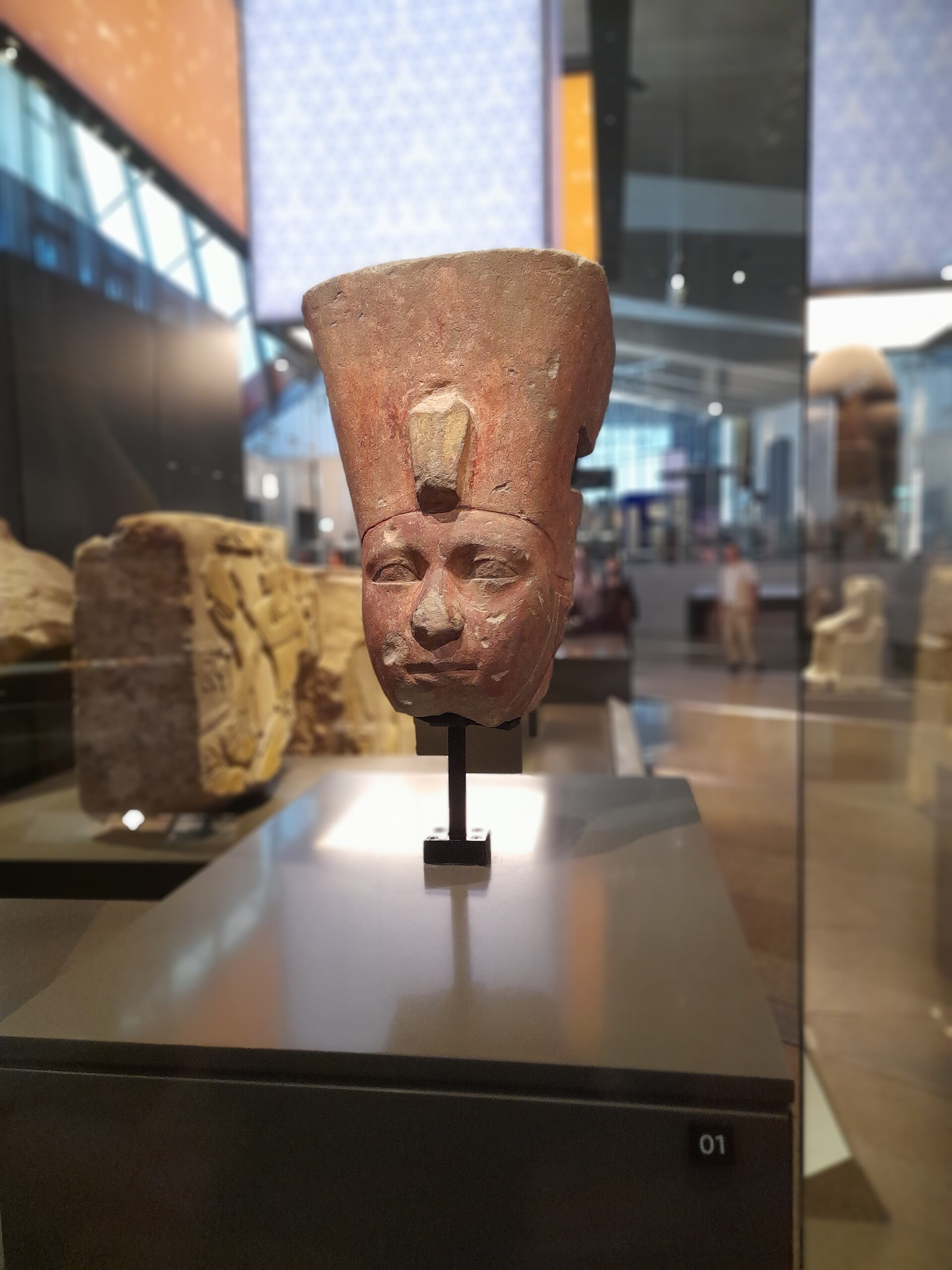
Limestone royal head in the galleries: photo by Amr F.Nagy, via Wikimedia Commons (Public domain).