This article contains advertising. Our booking links are routed through a partner that adds commission tracking automatically, so if you book through one we earn a commission from the provider, at no extra cost to you. It never affects what we recommend. Affiliate disclosure
The Coptic Museum holds the largest collection of Egyptian Christian art in the world — more than 16,000 objects — and it sits inside the walls of the Roman Fortress of Babylon in Old Cairo, a two-minute walk from the Hanging Church. Foreign adults pay around 280 EGP (about $6), it’s open daily 9am to 5pm, and you’ll want roughly 1.5 to 2 hours.
I’ll be honest: most visitors skip this place, and most visitors are wrong to. After you’ve done the Pyramids and stood in front of Tutankhamun’s mask, the Coptic Museum is where Egypt’s story keeps going — into the centuries when this was a Christian country, before Islam, when monks were carving crosses out of the same limestone the Pharaohs used for ankhs. This Coptic Museum Cairo guide covers exactly what to look for inside, how to fold it into a half-day in Coptic Cairo with the Hanging Church and the Babylon Fortress, and the small practical things nobody tells you. For the wider picture of the city’s collections, this article sits under our complete guide to Cairo’s museums.

Coptic Museum tickets and hours in 2026
Tickets are sold at the entrance and the price depends on your nationality. As of mid-2026 the foreign adult rate is around 280 EGP (roughly $6), with the foreign student rate about half that if you carry a valid ISIC card. Egyptians and Arab nationals pay a small fraction of that. Children under six get in free, and so do Egyptian/Arab seniors over 60 and visitors with disabilities.
| Visitor | Approx. price (2026) |
|---|---|
| Foreign adult | ~280 EGP (~$6) |
| Foreign student (ISIC) | ~140 EGP (~$3) |
| Child under 6 | Free |
One thing that trips people up in 2026: Egypt’s state monuments and museums have largely gone card-only at the ticket window. Bring a Visa or Mastercard. If your card is fussy with overseas transactions, have a backup, because the kiosk won’t take a fistful of pound notes the way it used to.
Opening hours are 9am to 5pm daily, with the ticket office shutting about an hour before the doors. During Ramadan the museum closes earlier, usually around 3pm, so check before you go. Prices and times do shift; the official Ministry of Tourism and Antiquities page at egymonuments.gov.eg is the source I’d trust over any third-party listing.
What is the Coptic Museum, and why it matters
The museum was founded in 1910 by Marcus Simaika Pasha, a Coptic aristocrat who was tired of watching Egypt’s Christian heritage get overlooked and, in some cases, sold off. He gathered icons, manuscripts, textiles and carved stone into a single collection and built it a home right in the middle of the old Christian quarter. The collection now spans roughly the 3rd to the 19th centuries, with the strongest material from the early Christian and late antique periods.
“Copt” simply means Egyptian — it comes from the Greek word for the country. Coptic Christianity traces itself to Saint Mark, who is said to have brought the faith to Alexandria in the 1st century. So this isn’t a niche side-story. For several hundred years, before the Arab conquest in the 7th century, Egypt was overwhelmingly Christian, and the art in this building is what that civilisation left behind. If you’ve only seen Egypt through a Pharaonic lens, an hour here genuinely reshapes the timeline.
What to see inside the Coptic Museum
The building is organised over two wings around quiet courtyards, and you can wander it without a plan and still enjoy it. But these are the things I’d make sure you don’t walk past.
The Nag Hammadi Library
This is the headline, and rightly so. In 1945, farmers digging for fertiliser near the town of Nag Hammadi in Upper Egypt turned up a sealed jar containing thirteen leather-bound papyrus codices. Inside were Gnostic Christian texts — including the Gospel of Thomas — written in Coptic and dating to roughly the 4th century. They rewrote a chunk of what scholars thought they knew about early Christianity. Standing in front of pages that predate the printing of any modern Bible by well over a thousand years is a strange, quiet thrill. Don’t rush this room.
Coptic textiles
Egypt’s dry climate preserved fabric that would have rotted anywhere else, and the museum’s textile collection is one of the best in existence. You’ll see linen tapestries and tunic panels woven with saints, vines, animals and geometric borders. Look closely and you can watch Pharaonic and Greco-Roman motifs sliding into Christian ones over the centuries.
Coptic icons and frescoes
The icons are warmer and more folk-like than the austere Byzantine or Russian Orthodox styles — big eyes, frontal faces, bold outlines. There are images of Saint Mark and the desert father Saint Macarius among many others. Several frescoes were lifted from monastery walls to save them, and they bring colour into the galleries: deep reds, ochres and gold.
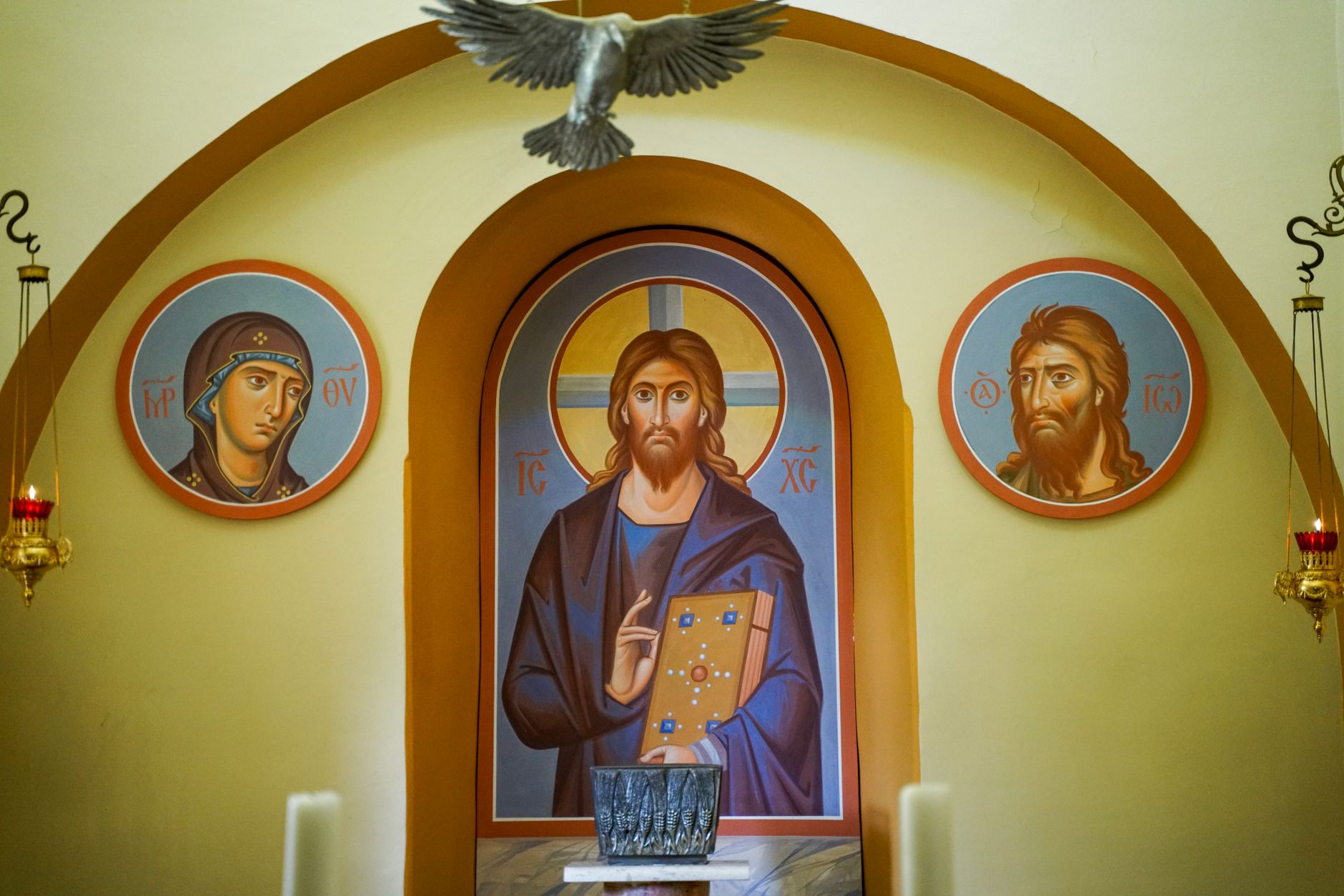
Carved stone, wood and the building itself
The limestone and wooden capitals are where the fusion is most obvious — an ankh reworked into a cross, a falcon becoming an eagle, a lotus turning into a floral cross. And don’t treat the building as a neutral box. The mashrabiya screens, inlaid ceilings and arcaded courtyards are themselves part of the visit; the old wing in particular feels like walking through a grand Coptic house.
What makes Coptic art so distinctive
Coptic art is what you get when Christianity lands on top of three thousand years of Pharaonic visual language and a layer of Greek and Roman taste. A few things to watch for as you go round:
- Egyptian symbols, Christian meanings: the ankh, the sign of life, becomes the cross; floral and animal motifs carry new significance.
- Hellenistic bones: draped figures, mosaic techniques and classical proportions sit underneath the Christian subject matter.
- Bold geometry and colour: strong patterns and a warm palette of reds, golds and earth tones, rather than cool Byzantine formality.
- A human, folk-art warmth: the saints feel approachable rather than remote.
It’s a style that exists nowhere else, and once your eye is tuned to it you’ll start spotting it in churches across the country.
How long to spend, and how it compares
Budget 1.5 to 2 hours for the museum itself. An hour is enough if you’re tight on time and head straight for the Nag Hammadi codices, textiles and icons. Give it 2.5 hours if you read every label. It’s far smaller and calmer than the big Pharaonic institutions, which is part of its charm — you won’t be fighting tour groups for sightlines.
People often ask how it stacks up against the others. It doesn’t compete; it complements. The Grand Egyptian Museum out at Giza and the historic Egyptian Museum on Tahrir Square tell the Pharaonic story on an epic scale. The Coptic Museum picks up the centuries those collections largely skip. If your trip leans toward Cairo’s later history, pair it with the Museum of Islamic Art to round out the post-Pharaonic chapters of Egyptian art in a single day.
How to get to the Coptic Museum
The museum sits in Coptic Cairo (also called Old Cairo), wrapped inside what survives of the Roman Fortress of Babylon. Getting there is easy:
- Metro: the simplest way. Take Line 1 to Mar Girgis station — the entrance to the whole Coptic complex is right outside it. The metro is cheap, fast, and skips the traffic.
- Uber or Careem: usually 15-25 minutes from downtown depending on traffic, and worth it if you’re not near a Line 1 stop. Agree nothing with street taxis; just use the app.
- On foot once you arrive: the Hanging Church, the Church of Saints Sergius and Bacchus, the Ben Ezra Synagogue and the fortress remains are all within a few minutes’ walk of each other.
If you’re still working out how to move around the city in general, our guide to things to do in Cairo places this neighbourhood in the wider map of what’s worth your time.

Combining the Coptic Museum with Coptic Cairo
Honestly, you shouldn’t visit the museum in isolation. It’s the centrepiece of one of Cairo’s most rewarding half-days, and the whole district is compact and walkable. Here’s the loop I’d do:
- Arrive at Mar Girgis station (or step out of your Uber there).
- Start at the Hanging Church (Saint Virgin Mary, or Al-Muallaqa) — built over a gatehouse of the Babylon Fortress, hence the name. Open 9am to 5pm, free to enter.
- Spend your two hours in the Coptic Museum.
- Walk down to the Church of Saints Sergius and Bacchus, traditionally linked to the Holy Family’s time in Egypt.
- Step into the Ben Ezra Synagogue, a reminder that this quarter was Jewish as well as Christian.
- Look at the surviving towers of the Fortress of Babylon on your way through.
- Finish with lunch in Old Cairo, or hop two metro stops down to leafy Maadi for a sit-down meal.
It’s a genuine highlight of any trip, and a guided version adds a lot of context. The quarter is small enough to cover on foot, and it slots neatly into a wider day of things to do in Cairo if you’ve got the energy after.
That half-day loop gives you Coptic Cairo at its most curated, so if you want the living, working version of the same faith, the Zabbaleen quarter below the Mokattam cliffs and its cave churches cut into the limestone make an obvious next morning.
Photography, dress and other practicalities
Photography is generally allowed inside without flash — smartphone shots are fine — but tripods are restricted, so leave the gear at the hotel. Flash is off-limits to protect the fragile textiles and pigments.
On clothing: the museum sits in a working religious district with active churches, so dress modestly. Covered shoulders and knees keep you respectful and let you step into the surrounding churches without a problem. Wear closed, comfortable shoes — the lanes are cobbled and uneven — and bring a light layer, because the galleries are air-conditioned. Coptic Cairo runs on its own rhythms; for the social do’s and don’ts across the city, our guide to Cairo culture and etiquette is worth a skim before you go.
Tips for visiting
- Go in the morning, on a weekday, for the quietest galleries. Fridays can also be calm.
- Sunday mornings bring Coptic worship in the nearby churches — atmospheric if you’d like to witness a living tradition, busier if you wouldn’t.
- Coptic Christmas falls on 7 January; the district is at its most vivid then, but also its most crowded. Plan accordingly.
- A licensed Coptic Cairo guide is the single best add-on here — the iconography and history open right up with someone explaining it.
- Allow roughly two hours for the museum and another two for the surrounding churches if you want to do the area justice.
Frequently asked questions
How much does the Coptic Museum cost in 2026?
Around 280 EGP (about $6) for foreign adults, roughly half that for foreign students with an ISIC card, and free for children under six. Bring a card — the ticket window is largely cashless now.
What are the opening hours?
9am to 5pm daily, with the ticket office closing about an hour earlier. Hours are shorter during Ramadan, usually until around 3pm.
What is the most famous thing in the museum?
The Nag Hammadi Library — thirteen 4th-century codices of early Christian Gnostic texts, including the Gospel of Thomas, found near Nag Hammadi in 1945.
How do I get there?
Take Metro Line 1 to Mar Girgis station; the entrance is right outside. An Uber or Careem from downtown takes about 15-25 minutes.
How long should I spend?
About 1.5 to 2 hours for the museum, plus another couple of hours if you’re combining it with the Hanging Church and the rest of Coptic Cairo.
Can I take photos inside?
Yes — no flash and no tripods, but handheld smartphone and camera photos are fine.
Is it suitable for children?
It works well for curious kids from about seven up; the icons, codices and stories give them plenty to latch onto, and it’s far calmer than the big museums.
Pulling it together
The Coptic Museum is one of those stops that quietly outperforms expectations: the world’s finest collection of Coptic Christian art, the extraordinary Nag Hammadi codices, and a building that’s a pleasure to walk through, all set inside an ancient Roman fortress. Give it 1.5 to 2 hours, wrap it into a half-day with the Hanging Church and the churches around it, and you’ll leave with a far fuller sense of Egypt’s layered past than most travellers ever pick up.
Keep planning with our complete Cairo museums guide, and if your trip skews historical, the Museum of Islamic Art makes a natural companion to a Coptic Cairo morning.
One addition turns this into a properly shaped half-day rather than a single stop. The National Museum of Egyptian Civilization sits minutes away in Fustat, holds the twenty-two royal mummies, and runs the whole span of Egyptian history from prehistory through the Coptic and Islamic centuries to the present — which makes it an unusually good companion to the churches rather than a repetition of them. Our guide to NMEC and the Royal Mummies Hall has the prices and hours.
Coptic Cairo works best as a metro morning: Line 1 to Mar Girgis, the Hanging Church while the light is still coming through the east windows, then the museum, then Fustat for the royal mummies. That is how the third day runs in our three days in Cairo itinerary.