This article contains advertising. Our booking links are routed through a partner that adds commission tracking automatically, so if you book through one we earn a commission from the provider, at no extra cost to you. It never affects what we recommend. Affiliate disclosure
The cheapest magic in Cairo costs about 400 EGP and lasts an hour. You walk down to the Corniche near sunset, haggle with a felucca captain, kick off your shoes, and let a 5,000-year-old sailboat drift you out into the middle of the Nile while the call to prayer rolls across the water from a hundred minarets at once. No engine, no soundtrack, no upsell. That single hour beats most of the things tourists pay ten times as much for.
That said, the river gives you a lot more than feluccas. The full range of Cairo Nile river experiences runs from that budget sail right up to dinner cruises with belly dancers, sunset sails with a drink in hand, multi-day luxury dahabiyas down in Upper Egypt, and a long riverside promenade you can walk for free. Some of it is genuinely special. Some of it is a tourist trap with a buffet. This guide ranks the lot honestly: what each thing costs in 2026, where to board, the best time of day, what’s worth your money, and what to skip.
The quick verdict: ranking the Nile experiences
If you only do one thing on the water, do a sunset felucca. If you have a couple of evenings, add a Corniche walk and a meal at a Nile-view restaurant. The dinner cruise is fun if you go in with the right expectations. The dahabiya is a separate, bigger commitment that happens down south, not in Cairo. Here’s how I’d rank them by value:
| Experience | Rough 2026 cost | Best for | Worth it? |
|---|---|---|---|
| Sunset felucca sail | ~400–500 EGP per boat (1 hr), split among the group | Everyone. The signature Cairo moment. | Absolutely — best value on the river |
| Corniche walk + street food | Free (snacks a few EGP) | Slow evenings, people-watching | Yes — costs nothing, feels like real Cairo |
| Nile-view dinner or café | ~400–800 EGP per person | A relaxed meal with a view | Yes, if you pick the right spot |
| Dinner cruise with show | ~$45–80 per person (≈1,800–3,200 EGP) | Groups, first-timers, a fun night out | Depends — some are great, some are tacky |
| Luxury dahabiya (Upper Egypt) | ~$300–800 per person per night, 3–5 nights | A trip-defining splurge | Yes if budget allows — but it’s not in Cairo |
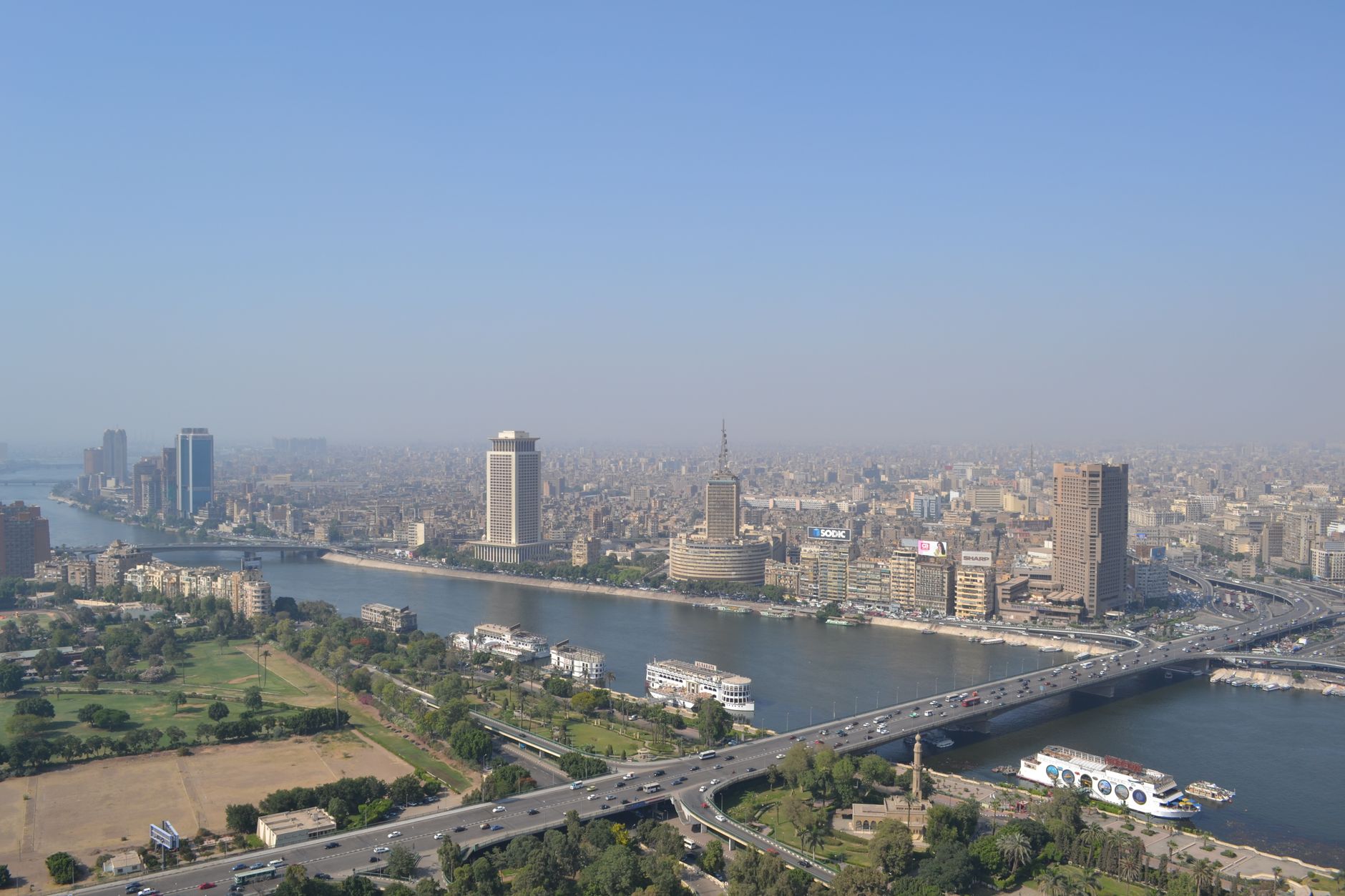
A quick orientation before we get into each one. The Nile runs north straight through the middle of Cairo, splitting around two islands: Gezira (whose northern half is the leafy Zamalek district) and Roda, just south of it. The eastern bank is traced by the Corniche El Nile, the riverside boulevard where most of the action — boats, cafés, evening strollers — happens. Get those four words in your head — Corniche, Gezira, Zamalek, Roda — and the rest of this falls into place.
Felucca sailing: the cheap magic
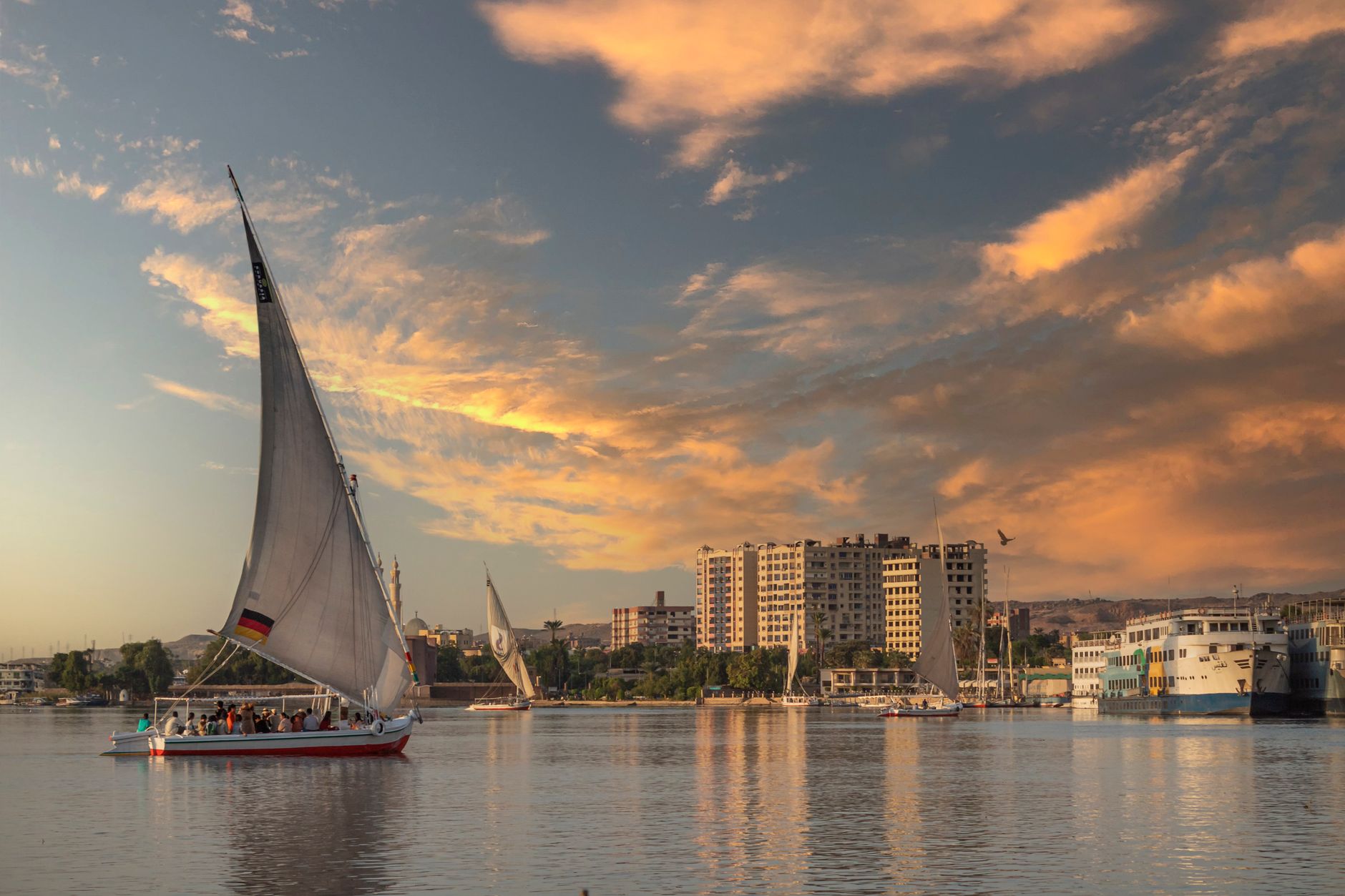
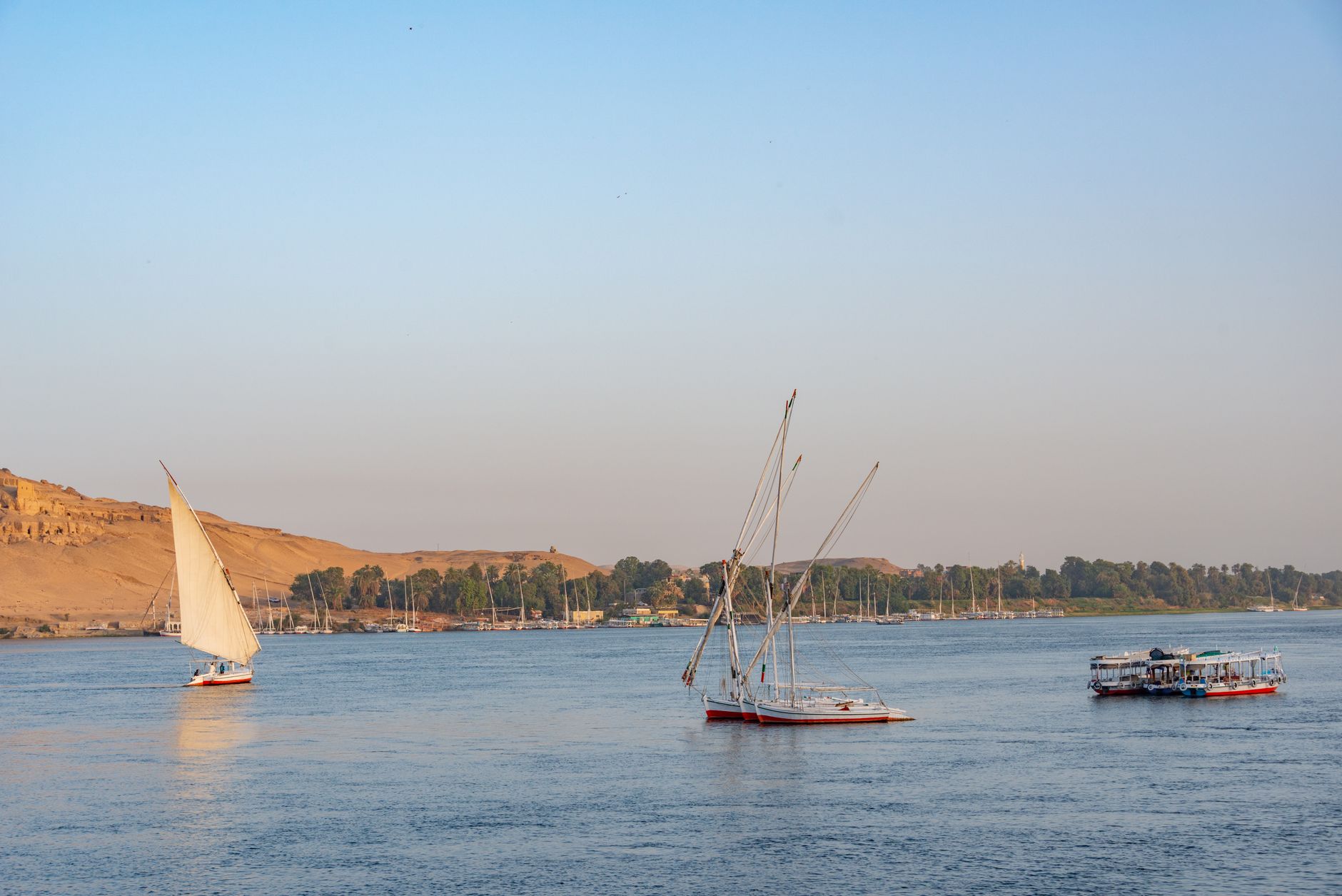
A felucca is the wooden sailboat you’ve seen in every photo of the Nile — wide flat hull, one tall mast, a big triangular lateen sail, and a deck strewn with cushions. They run on wind alone, which means no diesel fumes, no engine drone, just the creak of rigging and water against the hull. Most take six to ten people, so they suit couples, families, or a small group splitting the cost. These boats predate the pyramids as a design, and an hour on one is the closest you’ll get to seeing the river the way Egyptians have for thousands of years.
Where to board in Cairo
Feluccas cluster at a handful of docks along the Corniche, and you’ll usually hear the captains before you see them. The most reliable spots:
- Garden City — the stretch near the Four Seasons Nile Plaza and the Semiramis InterContinental, just south of the Qasr El Nil bridge. Convenient if you’re staying downtown.
- Zamalek / southern Gezira — near the Cairo Marriott and around the Sofitel El Gezira at the island’s southern tip, with views in both directions along the river.
- Roda Island — near the old Le Méridien area, handy if you’re in the south of the city.
- Maadi — a quieter, more local set of docks further south, away from the tourist crush.
The dock at the foot of the Qasr El Nil bridge is the easiest to find for most visitors. You can negotiate straight with a captain on the bank — that’s the cheapest route — or book ahead through your hotel or a platform like GetYourGuide or Viator for fixed pricing and sometimes a guide or snacks thrown in. Booking ahead costs more but removes the haggling if that’s not your thing.
What it actually costs in 2026
This is where being on the ground saves you real money. Negotiated directly at the dock, a one-hour sail runs roughly 400–500 EGP for the whole boat — not per person — which works out to just a few dollars each once you split it among a group. A two-hour sail naturally costs more. Sunset slots command a premium, and fairly so.
Book the identical boat through a hotel concierge or a packaged tour, though, and you’re looking at 800–1,200 EGP per hour, or around $15–40 per person if it includes hotel pickup and a drink or light meal. The boat and the river are exactly the same. You’re paying for the convenience and the middleman’s cut. For the best deal, round up a few people and negotiate a private boat directly — and always settle the price and the duration before you step aboard. (More on the haggling game below.)
The best time of day, no contest
Go at golden hour, the stretch before sunset. The flat midday glare softens into warm amber, the minarets and glass towers light up, and then — if your timing’s right — the sun drops behind the skyline just as the evening call to prayer starts up across the water from every direction. It’s the single most atmospheric hour in Cairo. Aim to be on the boat around 4–5 PM in winter, 5–6 PM in summer.
Morning sails are cooler and the water’s calmer, but the light is flat and the magic isn’t there. Midday in summer is a hard no — most feluccas have little to no shade and the heat on open water is brutal. If you can only sail at midday, wait for a cooler month.
What to bring
Pack light. Sunglasses and sunscreen for an afternoon sail, a light jacket or scarf because the breeze on the water gets cool once the sun goes, a charged phone or camera, and a bottle of water. Plenty of people bring their own snacks or a small picnic — captains rarely mind, and some sell tea and soft drinks aboard for a few EGP. Skip anything bulky or precious that could get splashed, and wear shoes you can slip off, because you’ll board barefoot.
Haggling is the whole skill here, and it helps to know the going hourly rate before a captain names one. Our closer look at hiring a felucca in Cairo covers the Corniche launch points, how long an hour actually feels on the water, and whether sunset justifies the premium.
Some of those same wooden boats do a second job. Crews will take you out to fish for tilapia and Nile perch for roughly $20–80, and a morning spent angling on the river gets its own breakdown of gear, timing and etiquette.
Nile dinner cruises: fun night out or floating tourist trap?
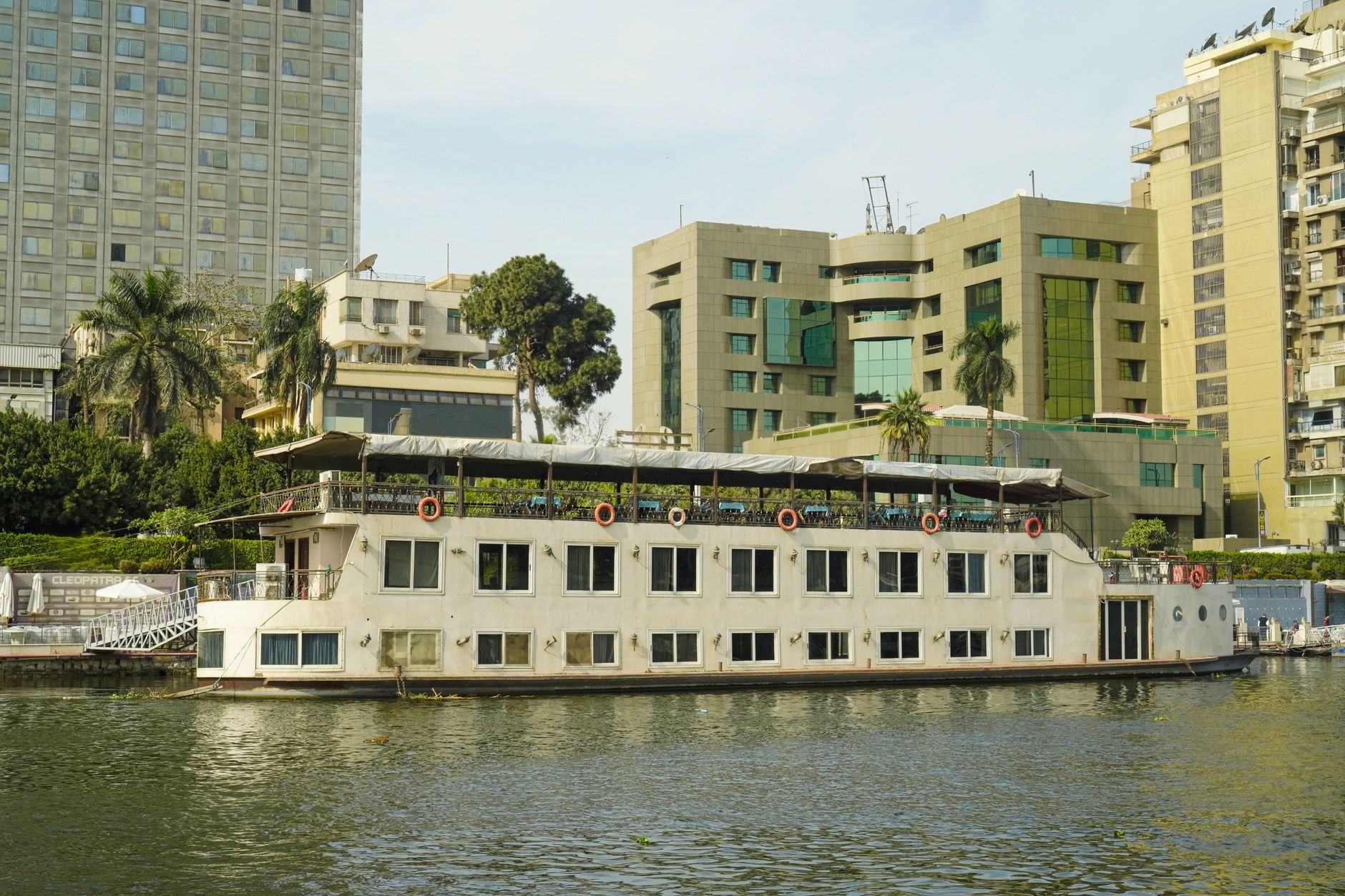
Dinner cruises are the most heavily marketed thing on the river, and they split opinion more than anything else here. Done right, it’s a genuinely fun evening — a buffet, live music, a belly dancer, a whirling Tanoura performer, and Cairo’s lit-up skyline gliding past glass walls. Done wrong, it’s a packed 300-seat barge, a lukewarm buffet, and a show that feels like it’s on a loop. Both versions exist, often at similar prices, so the trick is knowing which boat you’re getting on.
Standard versus premium
The big multi-deck boats carry 100–300 guests, run a buffet of Egyptian and international dishes, and pack in the full entertainment lineup: oriental band, belly dancer, and a Tanoura show where a performer spins nonstop in a layered, light-up skirt. They sail a two-to-three-hour loop between the central bridges, usually departing 7–8 PM. These are the crowd-pleasers and the ones most likely to feel touristy if you land on a mediocre operator.
Premium cruises run smaller, more elegant boats with proper sit-down service, better food, and fewer people. A few luxury hotels run their own boats with kitchens to match. If a calm, good-quality dinner matters more to you than a big show, pay up for the smaller boat — it’s a different evening entirely.
Which operators are worth it
A few names come up again and again, for good reason:
- Nile Maxim — the long-running benchmark, departing near the Cairo Marriott on Zamalek. Reliable service, a polished show, and the one most people mean when they say “the nice dinner cruise.” Priced at the top of the standard range.
- Nile Pharaohs — a fleet of boats across several price points, which makes it flexible for different budgets. Solid, dependable, popular with tour groups.
- Moored floating restaurants — boats like Le Pacha 1901 that stay tied to the bank. You get the Nile-side ambiance and the food without the motion, which is ideal if you’d rather not move or you’re prone to seasickness. Honestly a smart pick for many people.
My take: if you want the spectacle, book a reputable name like Nile Maxim rather than gambling on the cheapest boat at the dock. If you mainly want a nice dinner by the river, a moored restaurant-boat or a proper Nile-view restaurant (see below) will serve you better than any buffet cruise.
What an evening looks like
You board, get a welcome drink, and push off. Dinner comes as a buffet or set menu — expect Egyptian mezze (hummus, baba ghanoush, tahini, salads), grilled meats and seafood, rice and pasta, and a sweet table with kunafa and baklava. The show starts during or after the main course: live music first, then the belly dancer, then the Tanoura. Some boats add an oud player or a DJ for dancing later on. It’s loud, colourful, and aimed squarely at having a good time — not a quiet romantic dinner.
2026 prices, and the open-bar trap
Standard dinner cruises with buffet, show, and the sail land around $45–80 per person — roughly 1,800–3,200 EGP — though you’ll see budget boats advertised from as little as 599 EGP and ultra-premium ones running 2,599 EGP and up. Drinks are almost always extra: soft drinks a hundred-odd EGP, alcohol considerably more depending on the boat. Hotel pickup, where offered, adds about $10–15 per person.
One thing to watch: a cheap cruise advertising an “open bar” often means soft drinks only, with alcohol charged separately at steep prices once you’re aboard. Read the fine print before you book, and assume drinks aren’t included unless it says so explicitly.
Book ahead in peak season (October to April) — the good boats fill up. Booking direct with the operator or through GetYourGuide or Viator usually beats the hotel concierge price, since the concierge adds commission. If you’re weighing this against other ways to spend an evening, our guide to things to do in Cairo lays out what else is on after dark.
If you decide the answer is fun night out, the boats differ enormously, and what you pay depends heavily on whether you book at the dock or through a hotel desk. We compare the dinner boats and what each evening includes, down to what a drink costs on deck.
Sunset cruises: the in-between option
Not ready to commit to a full dinner-and-show evening, but want a bit more than a bare felucca? A sunset cruise splits the difference. Some operators run shorter golden-hour sailings — on a felucca or a small motorboat — with drinks and light snacks but no big show, timed purely to catch the sun going down. Booked through a tour with hotel pickup, these typically run in the $20–35 per person range, and for a lot of couples they hit the sweet spot: the felucca atmosphere, the best light of the day, and someone else handling the logistics.
If you’re confident haggling, you can recreate almost the same thing by negotiating a private sunset felucca at the dock for a fraction of the cost and bringing your own drinks. The tour version just buys you certainty and a pickup.
Timing is what separates a good sunset sail from a mediocre one, and it shifts by an hour or more across the year. Our dedicated evening felucca and sunset cruise guide pins down when to be at the steps, what to pay, and which captains to walk past.
The Corniche: the free Nile experience everyone forgets
You don’t need a boat at all. The Corniche El Nile, the broad boulevard hugging the river’s eastern bank, runs for several kilometres from Old Cairo in the south up through Garden City and downtown toward Zamalek and Dokki — and walking it is one of Cairo’s great free pleasures.
The best stretch is between the Qasr El Nil bridge and the Four Seasons in Garden City, with open views across to Gezira Island and the Cairo Tower. Come late afternoon and into the evening, it fills up with Cairene families, couples on the benches, and vendors selling roasted sweet potatoes, grilled corn, and fresh sugar-cane juice for a handful of EGP. This is the city being itself, no admission charged. Sit on the low wall as the light goes, buy something off a cart, and you’ve had a proper Nile evening for nothing.
The Qasr El Nil bridge itself, with its famous bronze lions at either end, is worth crossing on foot — you’re standing directly over the water as the sky changes, and it’s one of the best free sunset spots in the city.
Fifteen-odd kilometres of riverside boulevard is more than anyone walks in one go, so pick your segment. Which stretches of the Corniche reward walking is settled in our riverside walking guide, which runs from Garden City north through Downtown and past the bridges.
Nile-view dining: where to actually eat by the river
Some of Cairo’s best tables sit right on the water, and a riverside dinner is often a better use of an evening than a buffet cruise. At the higher end, the Four Seasons Nile Plaza has several acclaimed restaurants with floor-to-ceiling river views, and the First Nile Boat — a permanently moored vessel on the Giza side — packs five different restaurants (Asian, Italian, Egyptian and more) onto one boat, each with a waterfront view.
For something more relaxed and affordable, the floating cafés and restaurants strung along the Corniche serve Egyptian food, shisha, and tea right at the water’s edge, usually around 400–800 EGP per person for a full meal with drinks. You get the river, the breeze, and the lights without the price tag of a hotel restaurant. For the full picture on where and what to eat across the city, our run through Cairo’s restaurants and stalls covers everything from street koshary to fine dining, and where the genuinely good kitchens are.
Cairo has dozens of river-facing tables and only a handful where the view and the food both hold up. The longer list of Nile-facing restaurants and cafes ranked by view covers Crimson’s rooftop, the Le Pacha boat, and the cheaper cafes where you nurse a coffee instead.
The islands: Zamalek and Gezira
Cairo’s two main islands give you the river from the inside, and Zamalek in particular is one of the most pleasant neighbourhoods in the city to wander.
Zamalek and southern Gezira
Zamalek occupies the northern half of Gezira Island — ringed by the Nile on every side, full of tree-lined streets, art galleries, boutiques, and good cafés. It’s leafy, walkable, and a world away from the intensity of the mainland. The island’s southern tip near the Cairo Marriott is a prime felucca-launching spot with views up and down the river in both directions. If a river-view base appeals, Zamalek is one of the best places to stay, and our guide to where to stay in Cairo breaks down which neighbourhoods and hotels actually deliver the Nile from your window.
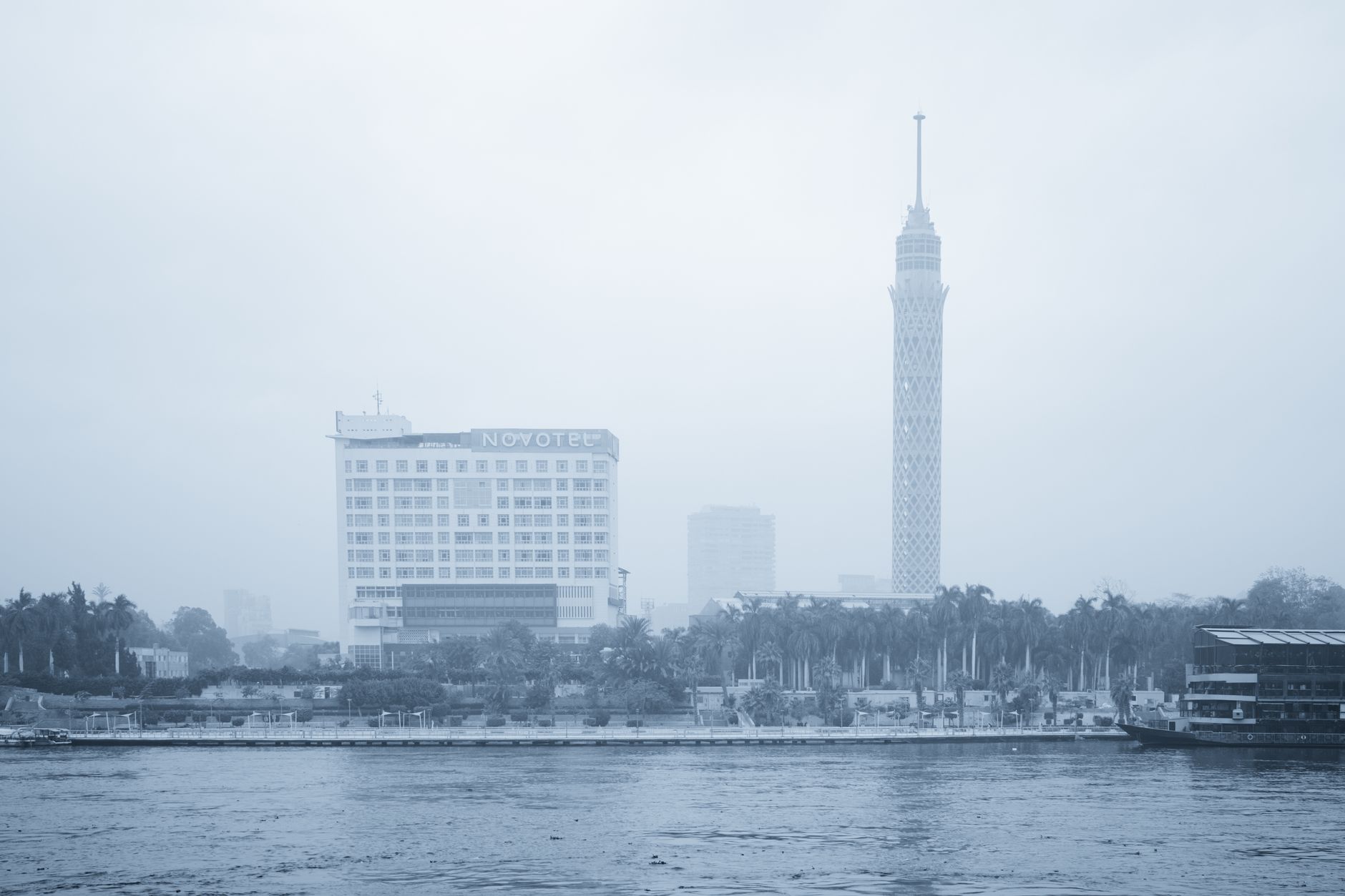
The Cairo Tower, on Gezira, is the landmark to look for from the water. At 187 metres, built in the 1960s in the shape of a pharaonic lotus, it dominates the island’s skyline. It is closed to visitors for development and maintenance works, with no reopening announced, so enjoy it from the river or the Corniche for now.
Roda Island and the Nilometer
South of Gezira, Roda Island holds one of the most historically loaded Nile sites in the city: the Nilometer. Housed in a conical-roofed stone structure at the island’s southern tip and dating to the 9th century, it was used to measure the river’s annual flood. The reading decided everything — whether the year brought abundance or famine, and what taxes would be levied. Entry is a nominal fee (around 60 EGP), and it’s a genuinely fascinating stop. Nearby, the Manial Palace Museum is an early-20th-century royal residence with gardens running down to the water. To weave these into a wider plan, see our things to do in Cairo rundown.
Gezira and Zamalek reward more than the hour most itineraries give them — the galleries, the tree-lined side streets, the club walls you cannot see past. We break down what the two Nile islands are actually like street by street, including where to stay and eat.
Dahabiya sailing: the luxury Nile, but not in Cairo
For the most exclusive Nile experience going, it’s the dahabiya — and you should know up front that it doesn’t sail from Cairo. The word comes from the Arabic for “gold,” after the gilded state barges that once carried Egypt’s rulers. Today’s dahabiyas are restored or purpose-built sailing yachts that recreate the elegance of 19th-century Nile travel, and they ply the calmer stretch in Upper Egypt, roughly between Esna or Luxor and Aswan — not the urban Cairo river.
What makes them special
Unlike the big motorised cruise ships that race between ports on a fixed timetable, dahabiyas sail under wind power and stop at small temples and villages the larger boats can’t reach. With typically six to ten cabins and no more than around 20 guests, the feel is intimate and quiet. Meals are cooked fresh aboard, the pace is deliberately slow, and with no engine the only sounds are wind, water, and birdsong. Travellers routinely call it the highlight of their entire Egypt trip.
Operators and 2026 pricing
Nour El Nil is the name most often held up as the gold standard, running a small fleet of beautifully fitted boats between Esna and Aswan with Egyptologist guides aboard. Other respected options include the Sonesta Amirat and various boutique operators, with new high-end dahabiyas continuing to launch as demand grows. Expect to pay roughly $300–800 per person per night, with most itineraries running three to five nights.
It folds neatly into a Cairo-based trip: fly Cairo to Luxor, sail the dahabiya to Aswan, fly back. Book well ahead for peak season (October to March) — the tiny cabin counts mean the good boats sell out months out. If a longer Egypt itinerary is on the cards, our day trips and excursions guide covers how to extend beyond the city, and our budget and money guide helps you figure out where a splurge like this fits.
Dahabiyas are not the only way to spend properly on this river. Cairo’s own high-end dinner boats start around $80–150 a head while multi-day floating hotels climb into the thousands, and the premium end of Nile cruising is compared operator by operator elsewhere on the site.
Crossing the river: the Nile as transport
The Nile isn’t only for sightseeing — you can use it to get around. The Cairo metro crosses the river, so a short ride over the bridge gives you a free river view in passing. More fun, the Nile Taxi runs speedboat shuttles on a fixed Zamalek–Maadi route, with stations including Garden City, the Sofitel El Gezira, and the Opera House. It’s a quick, breezy way to skip the traffic and see the city from the water at the same time. For how the boats, metro, Uber, and white taxis all fit together, our rundown of the city’s transport options has the details and current fares.
Photographing the Nile
Golden hour — the half hour either side of sunset — is when the river photographs best. The warm light catches the feluccas’ sails, paints the skyline amber and rose, and throws shimmering reflections across the water. Face west from the eastern bank for sunset shots, or shoot from a bridge to get the river running into the distance with boats in the foreground. After the sun’s gone, blue hour brings a deep cobalt sky that plays beautifully against the warm lights of the bridges and the cruise boats — bring a tripod or brace your phone on a wall for the long exposures.
From a felucca, the gentle rocking means you’ll want a faster shutter or steady hands. Shoot the captain working the sail against the sky, the wake behind the boat, the skyline shifting as you drift. One practical warning: don’t photograph bridges’ structural details, military sites, or security personnel along the banks — it can draw official attention you don’t want. Our culture and etiquette guide covers the other unwritten rules worth knowing.
When to go: the river through the year
The season shapes what’s enjoyable on the water.
- Winter (October–March) — peak season and the best weather, 15–25°C, comfortable on the water any time of day. Sunset comes early (around 5–5:30 PM), so plan sails accordingly. Book dinner cruises and dahabiyas well ahead; felucca prices run a touch higher with demand.
- Spring (March–May) — warming up, slightly thinner crowds, lovely light. Watch for the Khamsin, a hot sandy desert wind that can blow up in April and early May, cutting visibility and making sailing unpleasant for a day or two at a time.
- Summer (June–September) — regularly 35°C and up. Keep feluccas to early morning or evening; midday on an unshaded boat is genuinely dangerous heat. Air-conditioned dinner cruises come into their own, and the Corniche only really comes alive after dark as the city shifts nocturnal.
- Ramadan — the riverside turns festive after iftar (the sunset meal). Cafés set up special tents, families pour out along the Corniche, and the hours from roughly 7 to 11 PM are among the liveliest you’ll see the Nile all year. Cruises run but adjust around iftar timing.
The river you see now is a managed one; the annual flood that dictated Egypt’s calendar for millennia ended with the Aswan High Dam. How the Nile shaped Cairo over millennia traces that shift, from the first riverbank settlements to today’s engineered, steady water.
Booking, haggling, and avoiding the usual traps
A few hard-won pointers that’ll save you money and hassle:
- Haggle the felucca, but smartly. At the dock, open at roughly half the asking price and work to a fair middle. Lock in the duration, the route, and whether any drinks are included before you board.
- Set a firm end time. The classic move is a captain agreeing a price, then stretching the trip past the agreed time and expecting more money. Agree the finish up front and hold to it.
- Book cruises direct. Operators’ own sites or GetYourGuide and Viator usually beat the hotel concierge, who tacks on commission. Combination packages (pickup + cruise + show) can be better value than buying each part separately.
- Assume drinks cost extra. On both feluccas and cruises, treat beverages as add-ons unless told otherwise — especially that “open bar.”
- Mind safety on the water. Feluccas don’t always carry life jackets, so ask for them if you or your kids aren’t swimmers. And don’t swim in the urban Nile — the water quality through Cairo isn’t safe for it, whatever you see locals doing.
- Carry cash. Captains and Corniche vendors deal in EGP cash. Airport ATMs give poor rates, so change a little elsewhere and keep small notes for haggling.
The biggest booking trap is conflating two products: a two-hour dinner boat in Cairo and a four-night sailing between Luxor and Aswan share almost nothing but a river, and our comparison of Nile cruise operators separates the two before naming the companies worth paying for.
How to fit the Nile into your Cairo days
Don’t treat the river as a single box to tick — spread it across your trip and let it punctuate the heavier sightseeing. The pattern I’d recommend: a sunset felucca on your first evening to slow down after a day at the pyramids, a Corniche walk and street-food evening another night, a dinner cruise or a Nile-view restaurant on a third, and the Nilometer slotted into an afternoon. The Nile is the thread that ties Cairo together — the pyramids, the Grand Egyptian Museum, Islamic Cairo and the river have all been part of the same story for 5,000 years, and seeing the city from the water reframes everything else. For the overall shape of a trip, start with our complete Cairo travel guide.
Frequently asked questions
How much does a felucca ride cost in Cairo in 2026?
Negotiated directly at the dock, roughly 400–500 EGP per boat for an hour — not per person — which is just a few dollars each split among a group. Booked through a hotel or tour with pickup, expect 800–1,200 EGP per hour or about $15–40 per person. Always agree the price and duration before boarding.
Are Nile dinner cruises worth it, or are they tourist traps?
Both exist. A reputable operator like Nile Maxim gives you a genuinely fun evening — buffet, live music, belly dancing and a Tanoura show with the lit skyline drifting past. The cheapest 300-seat boats can feel packed and tacky. If you want the spectacle, book a known name; if you mainly want a good dinner by the river, a moored restaurant-boat or a proper Nile-view restaurant is the better call.
What’s the best time of day for a felucca?
Golden hour before sunset, hands down — aim to be aboard around 4–5 PM in winter or 5–6 PM in summer. The light is at its best and the evening call to prayer over the water is genuinely memorable. Avoid midday in summer; most feluccas have no shade and the heat is severe.
Where do the boats depart in Cairo?
Main felucca docks line the Corniche in Garden City (near the Four Seasons and Semiramis), at the southern tip of Zamalek/Gezira (near the Marriott and Sofitel El Gezira), on Roda Island, and further south in Maadi. The foot of the Qasr El Nil bridge is the easiest to find. Nile Taxi speedboats run a fixed Zamalek–Maadi route with stops at Garden City, Sofitel El Gezira and the Opera House.
Can I do a Nile cruise from Cairo to Luxor or Aswan?
Not on a single boat from Cairo — the famous multi-day cruises and dahabiyas sail the Upper Egypt stretch between Luxor/Esna and Aswan. The usual approach is to fly Cairo to Luxor, take the cruise or dahabiya down to Aswan, then fly back. Dahabiyas run roughly $300–800 per person per night for three to five nights and book up months ahead in peak season.
How much is a Nile dinner cruise per person?
Standard cruises with buffet and show run about $45–80 per person (roughly 1,800–3,200 EGP), with budget boats from as little as 599 EGP and premium ones above 2,599 EGP. Drinks are almost always extra, and hotel pickup adds around $10–15 per person.
Is it safe to go on the Nile in Cairo?
Yes, for boating. The urban river is calm and captains are experienced. Just ask for life jackets on a felucca if anyone in your group can’t swim, since they aren’t always provided. Don’t swim in the Nile within the city — the water quality there isn’t safe — regardless of what locals do.
What should I wear and bring?
For a felucca: layers (the breeze turns cool at dusk), sunglasses, sunscreen, water, a charged phone, and shoes you can slip off — you board barefoot. For a dinner cruise, smart casual is fine on standard boats; luxury cruises may expect a bit more. Skip heels on any boat. Bring EGP cash for captains, vendors, and haggling.
Go deeper: plan the rest of your trip
The river is one piece of Cairo. These guides cover the rest:
- Complete Guide to Visiting Cairo, Egypt — the master plan for your whole trip.
- Cairo’s headline sights and neighbourhoods — everything beyond the water, day and night.
- Where to Stay in Cairo — the best neighbourhoods and Nile-view hotels.
- Cairo Food Guide — must-try dishes, riverside dining, and street food.
- Getting Around Cairo — metro, ferries, Uber, and white taxis explained.
- Day Trips & Excursions from Cairo — extending your trip, including down the Nile.
- Cairo Budget & Money Guide — what things cost and how to pay.
- Cairo Culture & Etiquette — the local know-how that smooths everything.