This article contains advertising. Our booking links are routed through a partner that adds commission tracking automatically, so if you book through one we earn a commission from the provider, at no extra cost to you. It never affects what we recommend. Affiliate disclosure
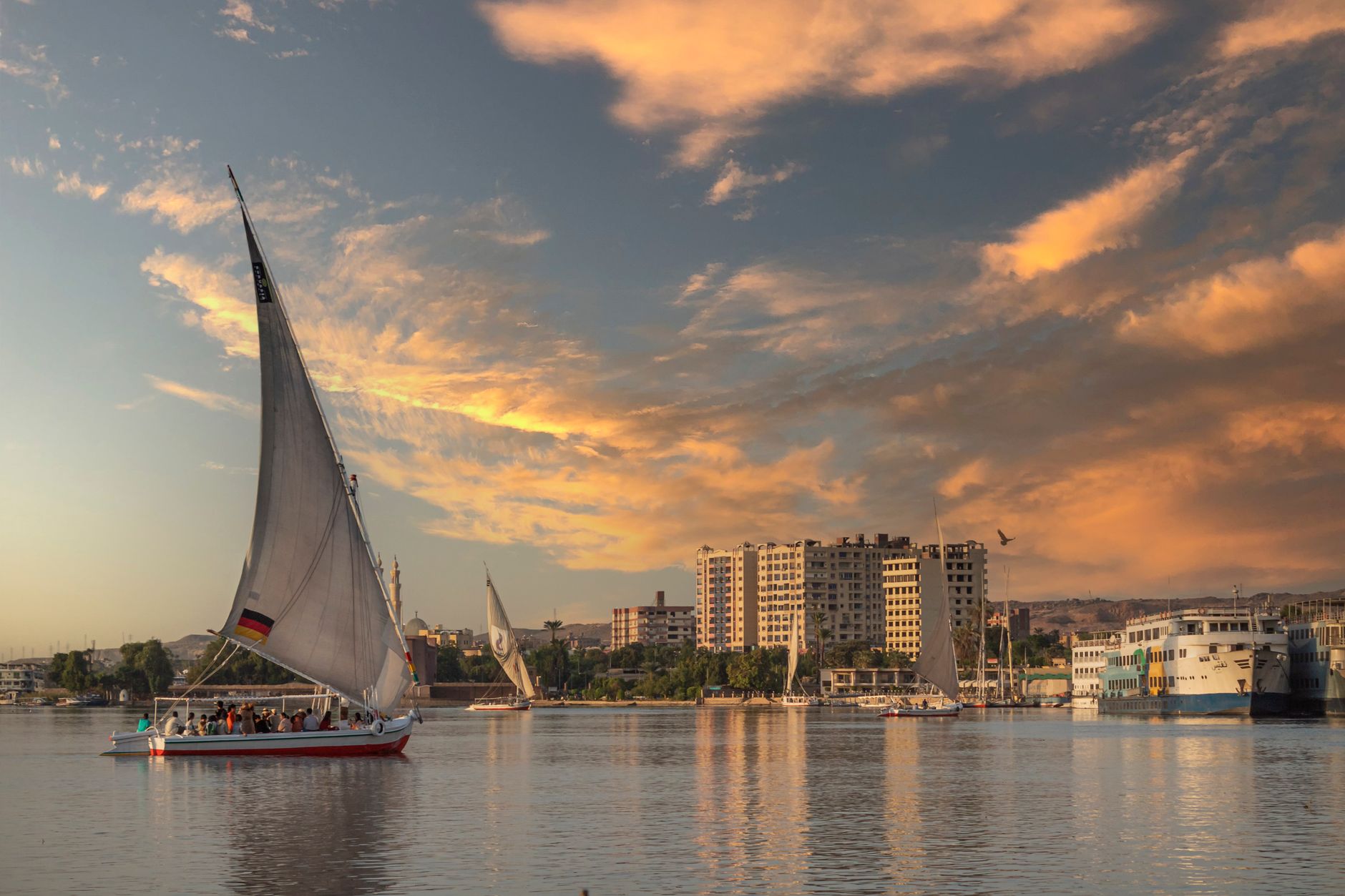
Four hundred pounds. Call it eight dollars. That is what an hour on a felucca costs in Cairo in 2026 — for the whole boat, not per person — and it buys the single best hour available in this city. You walk down the steps off the Corniche about seventy-five minutes before the sun goes, agree a price out loud with a captain, sit on a cushion that has seen better decades, and a lateen sail the size of a bedsheet pulls you off the bank into the middle of the Nile. No engine. No commentary. For the next hour the river does the work while Cairo turns copper, then pink, then black-and-gold, and the call to prayer arrives across the water from every direction at once.
The trouble is that most people get the timing wrong, pay three times what they should, or end up on a diesel boat with a speaker blaring because they turned up at 7pm in December when the sun set at 4:57. This guide fixes all three: sunset and boarding times for every month of 2026, what each type of boat costs and feels like, where to board, how the haggle actually goes, and the two problems nobody warns you about — the windless evening, and the complete absence of a toilet.
The quick verdict: which sunset boat should you actually take
Several different things float past the Corniche at dusk and they are not remotely equivalent. Here is how I would rank them for a first sunset on the river, at roughly 50 EGP to the dollar.
| Option | 2026 cost | Length | Best for | Worth it? |
|---|---|---|---|---|
| Walk-up felucca (sail, no engine) | 400–600 EGP per boat, per hour (≈$8–12) | 1–2 hrs | Almost everyone | Yes — the best-value hour in Cairo, no contest |
| Pre-booked felucca with hotel transfers | $15–37 per person (≈750–1,850 EGP) | 1–2 hrs plus transfers | Nervous hagglers, first evening in town | Yes, if certainty is worth 3–4× the street price |
| Small motorboat | 500–1,200 EGP per boat, per hour (≈$10–24) | 1 hr | Still evenings, groups who want music | Only if there is no wind — the engine kills the silence |
| Private motor yacht charter | From ~$400 per group for 2 hrs (≈20,000 EGP) | 2 hrs | Celebrations, larger groups | Rarely — you are paying 40× for a bathroom and a fridge |
| Dinner cruise leaving at sunset | $41–80 per person (≈2,000–4,000 EGP) | 2–3 hrs | Groups who want dinner and a show | A different product entirely — compared below |
My position: take the walk-up felucca. The gap between the 400 EGP sail and the $400 yacht runs the wrong way, because silence is the product here and the cheapest boat is the only one that delivers it. The one thing a felucca cannot promise is wind, which is the only reason the motorboat stays on the list. Our full survey of what the river offers in Cairo ranks every option on the water; this article covers only the ninety minutes either side of sundown.
Getting the timing right: Cairo sunset times month by month in 2026
This is the part that decides whether the evening works. Cairo sits at 30°N, so sunset swings by more than three hours across the year, from about 4:57pm in early December to 8:02pm at the end of June. Egypt also observes daylight saving again, which shunts the whole evening an hour later between late April and late October. In 2026 the clocks go forward on Friday 24 April and back on Thursday 29 October — the last Friday in April and the last Thursday in October. Turn up on 30 October at the time that worked two days earlier and you will have missed the sun by an hour.
Times are for central Cairo. “Board by” allows seventy-five minutes: long enough to get into the channel, watch the low light build, sit through sunset, and stay for the colour afterwards.
| Month (2026) | Sunset, 1st → last of month | Board by | Notes |
|---|---|---|---|
| January | 5:08pm → 5:33pm | 3:50–4:15pm | Cool on the water after dark; bring a layer |
| February | 5:33pm → 5:55pm | 4:15–4:40pm | Excellent light, few crowds |
| March | 5:56pm → 6:14pm | 4:40–5:00pm | Khamsin dust season starts late in the month |
| April | 6:15pm → 7:33pm | 5:00–6:15pm | Clocks jump forward 24 April |
| May | 7:34pm → 7:53pm | 6:20–6:40pm | Windiest stretch of the year — good for sailing |
| June | 7:53pm → 8:02pm | 6:40–6:45pm | Latest sunsets of the year; hot until 7pm |
| July | 8:02pm → 7:51pm | 6:45–6:35pm | Board late, stay out into the dark |
| August | 7:50pm → 7:21pm | 6:35–6:05pm | Light drops half an hour across the month |
| September | 7:20pm → 6:44pm | 6:05–5:30pm | Air clears, evenings soften — a great month |
| October | 6:42pm → 5:10pm | 5:25–3:55pm | Clocks go back 29 October |
| November | 5:10pm → 4:57pm | 3:55–3:40pm | Sunset before most people finish sightseeing |
| December | 4:57pm → 5:07pm | 3:40–3:50pm | Earliest sunset of the year: 4:56pm on 3 December |
Two consequences. From November to February the sunset sail is an afternoon activity, so plan the day around it rather than bolting it on after Giza. In June and July sunset comes so late that boarding at 6:45pm leaves you on the water in daylight at 8pm — often the most comfortable hour of a Cairo summer day. Read the table alongside our breakdown of Cairo’s climate through the year for the heat and haze picture.
How long the light lasts after sunset
At Cairo’s latitude civil twilight runs 24–28 minutes. In practice: the sun touches the horizon and you get roughly twenty-five more minutes of genuinely photographable colour before the sky flattens, with full dark around fifty minutes after sunset. This is why an hour is enough and ninety minutes is better — the second half is when Cairo Tower lights up and the bridges start glowing, and it is the half most people miss because they booked to be ashore at sunset.
Where to board: the four main felucca moorings
The mooring you choose changes the view more than you would expect. The Nile runs roughly north–south through Cairo, splitting around Gezira island (whose northern half is Zamalek) and Roda below it. The sun sets west, over Giza — so from the eastern bank you are looking across the water into the light, which is what you want.
| Departure point | Getting there | What you see | Feel |
|---|---|---|---|
| Garden City / Corniche El Nile (by the Four Seasons Nile Plaza and Semiramis) | Most central; the dock is a minute’s walk from the Four Seasons | Qasr El Nil bridge, Cairo Tower, the Gezira skyline | Busiest and most tourist-priced, but the classic view |
| Zamalek / southern Gezira (near the Marriott and the island’s southern tip) | Taxi, or a walk from Zamalek’s restaurant streets | Open water both ways, Downtown skyline behind you | Calmer; good for a longer sail |
| Maadi Corniche | Metro to Maadi, then a short walk to the river | Wider, greener, quieter river; palm-lined banks | Most local and least hassled — but no Cairo Tower in frame |
| Giza bank / Dokki side | Handy if you are staying near the pyramids road | You look east — city lights rather than sun | Wrong side for sunset photos; fine for the ride |
First evening and you want the picture everyone recognises? Board in Garden City. Already done the tourist Corniche and want an hour with nobody selling you anything? Maadi. Whichever you pick, drop your taxi pin on the actual steps down to the water rather than on the hotel, because drivers default to the wrong entrance. If you only want to cross the river rather than cruise it, the public ferries in our guide to getting around on the water cost a handful of pounds.
What the golden hour actually looks like from the water
Minutes 0–15. The captain poles you off the bank and hauls the sail. The boat heels, which is alarming for four seconds and then normal. You are still in the shade of the buildings, the light is flat, the traffic is right there, and first-timers usually wonder whether they have made a mistake.
Minutes 15–35. You reach mid-channel and the noise drops away almost completely — the moment the trip justifies itself. The sun is low enough that the river surface goes metallic, feluccas on the far side become silhouettes, and traffic on Qasr El Nil turns into a ribbon of light above you.
Sunset. Downriver to the west, the sun drops behind the Giza plateau. On genuinely clear days — winter, after rain, or in early autumn — you can pick out the pyramids as small grey triangles. Most evenings the haze swallows them, and anyone guaranteeing a pyramid silhouette from central Cairo is selling something.
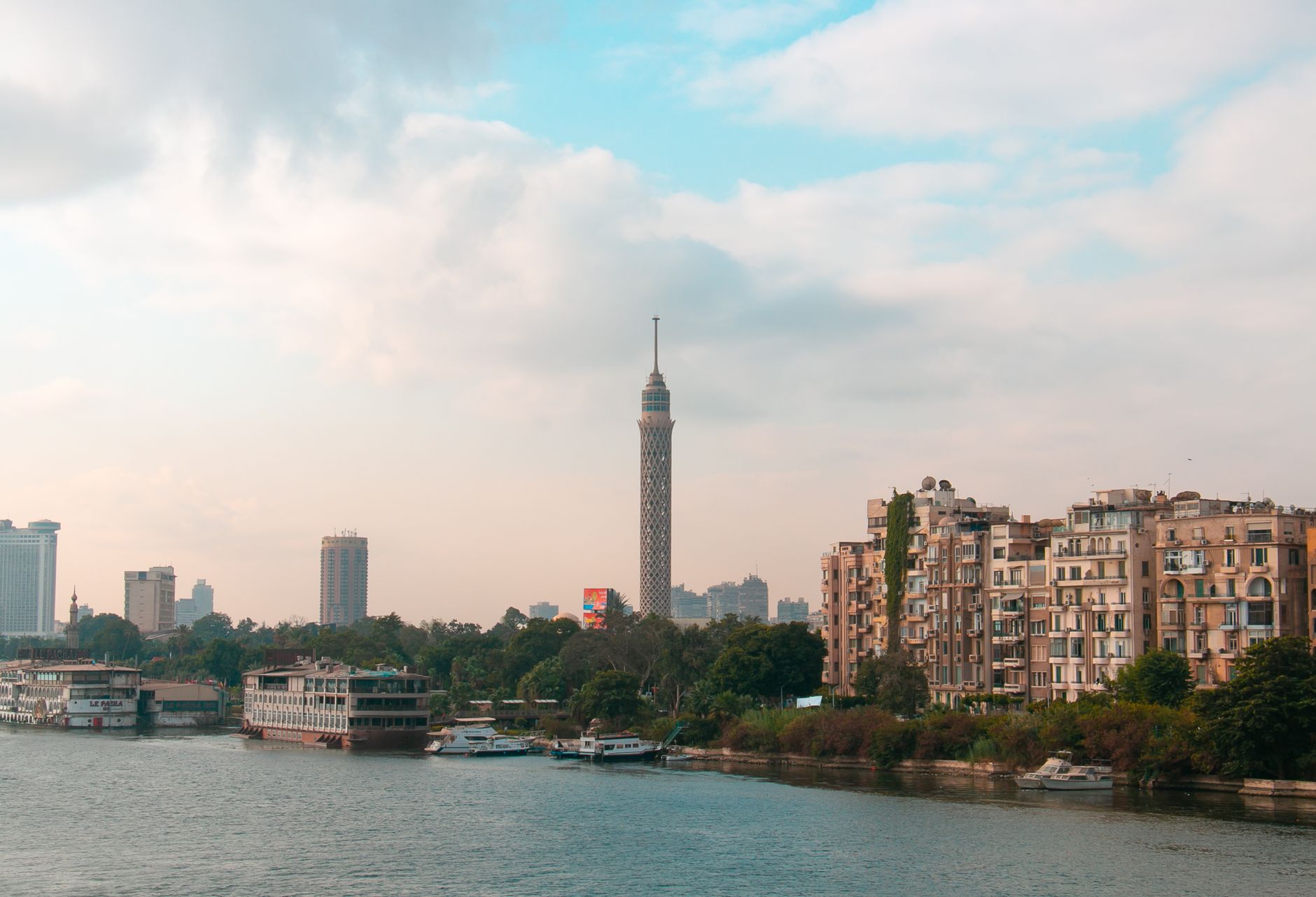
The twenty-five minutes after. The best part. The sky goes to a blue you cannot photograph with your eyes, Cairo Tower switches on and starts its slow colour cycle, and the bridges light one after another. Watching that same sunset from 187 metres up instead of from the water is a fine second evening; our guide to the observation deck on Gezira covers timing and tickets.
The romance and proposal question
People propose on feluccas, and it works. Hire the whole boat so it is genuinely private, tell the captain beforehand (most will happily film on your phone, and a 200–300 EGP tip buys a lot of enthusiasm), and aim for the fifteen minutes just before sunset rather than after, so the light lands on your faces instead of behind them. Bring your own flowers, ice and glasses; nothing is provided. It beats any restaurant in the city, and our roundup of the genuinely romantic corners of Cairo handles the rest of the night.
What it costs, and how the haggle really goes
The most useful sentence in this article: felucca hire is priced per boat, per hour — never per person. Almost every overcharging story starts with a captain quoting a number, the group assuming it covers the boat, and that number being multiplied by four at the end.
- Opening ask to an obvious tourist: 1,000–1,500 EGP per hour, often quoted in dollars or euros
- Fair settled price: 400–600 EGP per boat per hour (≈$8–12) in Garden City and Zamalek
- Maadi and the quieter docks: 300–450 EGP per boat per hour
- Second hour: usually the same rate or slightly less — agree both hours up front
- Captain’s tip: 50–100 EGP for a straightforward hour, more if he has worked hard in light wind
The haggle is quick and good-natured if you run it properly. Ask the price for the boat for one hour, halve whatever comes back, and say it plainly; expect to land near two-thirds of the opening number. Then — the step people skip — repeat the deal out loud before you step aboard: “Five hundred pounds, the whole boat, one hour, back to this dock.” If the captain hesitates on any part of that sentence, walk to the next boat. The same rhythm works citywide, and our guide to bargaining without being unpleasant about it is the longer version.
Carry small notes; nobody on the river takes cards, and a 1,000 EGP note against a 500 EGP fare reliably produces a shortage of change. If the negotiation sounds like more friction than you want on day one, pre-booked felucca trips with hotel pickup run $15–37 per person and remove it entirely — our comparison of the boat operators working the Cairo Nile covers who is reputable and how booking works.
Sunset felucca or dinner cruise: which should you book?
These get confused constantly and they are not the same evening. A sunset felucca is one silent hour on a sailboat for the price of a coffee in Zamalek. A dinner cruise is a two-to-three-hour floating restaurant with a buffet, a belly dancer, a tanoura spinner and a hundred other people, leaving a fixed berth at a fixed time. Both are good. Only one is about the sunset.
- Felucca if you want the light, the quiet and the river itself; if you are two people; if you are on a budget; if you want to be ashore in time for a proper dinner elsewhere.
- Dinner cruise if you are six or more, you want the evening handled in one booking, you like the show, or you are with people who would rather not clamber down concrete steps onto a wooden boat.
- Both if you have a spare evening — roughly $10 and $50, and they barely overlap.
If the dinner-and-show format is what you actually want, our detailed look at the Nile dinner boats and what the buffets are really like compares operators, food and entertainment properly. If the sailing appeals more than the sunset specifically, the wider guide to hiring a traditional sailboat in Cairo covers morning and daytime trips too.
Photographing sunset on the Nile
The good news: this is an easy shot. The river is wide, the foreground uncluttered, and a moving boat hands you a fresh composition every thirty seconds.
Direction and framing
Shoot west, into the sun, from the eastern bank or mid-channel. Every strong frame here is a dark shape against bright water: another felucca’s sail, the arch of a bridge, the captain at the tiller. Cairo Tower on Gezira is the one landmark that reads instantly as Cairo — place it off-centre against the afterglow rather than dead centre against the sun. The bridges (Qasr El Nil, 6th October, 15th May) give you leading lines, and the Downtown towers a jagged skyline edge that works far better in silhouette than in daylight.
Settings and gear
A phone is genuinely fine, with two caveats: tap to expose for the bright sky rather than the boat, or everything blows out, and use the main lens rather than the ultrawide, which shrinks the sun to a dot. On a camera, drop to ISO 100–400, shoot f/11–f/16 for a starburst, and bracket — the range between sun and shaded hull is brutal. Skip the tripod; the deck never stops moving. Once the light goes, brace your elbows on the gunwale and shoot bursts.
Keep shooting for the full twenty-five minutes past sunset. Blue-hour frames with the tower lit and the last orange low on the horizon beat the sunset frames nine times out of ten. For the rest of the city’s angles, our map of where Cairo photographs best and at what hour is organised by district.
Drinks, snacks and what to bring aboard
Nothing is included. No water, no tea, no snacks, no music — the boat is a hull, a sail and some cushions. That is a feature, because it means you bring exactly what you want.
- Drinks: bringing your own is normal and captains do not mind. Beer and wine come from Drinkies outlets and a few shops in Zamalek, Maadi and Downtown. Be discreet at the dock; take everything back off the boat.
- Ice and cups: there is no fridge. Buy a bag of ice and a cheap cooler bag beforehand, or accept warm drinks.
- Snacks: dates, cheese, bread and fruit make an excellent hour. Nothing that needs cutlery.
- A layer: temperatures drop noticeably on the water once the sun goes, especially November to March.
- Small notes for the fare and the tip.
- Insect repellent from May to October — mosquitoes appear at dusk near the banks and vanish in open water.
- A power bank. You will take more photos than you expect.
Leave behind heels and anything you would mind dropping in the Nile.
Safety: what to check before you step aboard
In ordinary conditions a felucca in central Cairo is about as dangerous as a rowing boat on a park lake. But Egypt has a real record of Nile boat accidents, and they follow one pattern: overloaded vessels, unlicensed operators, no life jackets. A private charter sank near Cairo in July 2024 carrying fourteen people when it was licensed for four; five died. Rules tightened after earlier disasters, but enforcement along the tourist Corniche is patchy.
A thirty-second check before you get on:
- Count the people. A typical Cairo felucca carries six to ten comfortably. If twelve are already aboard and the captain is waving you on, walk away.
- Ask to see life jackets. They are usually stuffed under the bench seats rather than worn. A shrug in reply means choose another boat — especially with children, who should wear one whatever the adults do.
- Look at the hull. Standing water, rotten decking, or a sail held together with more knots than cloth all mean move along.
- Board from a proper dock, not by stepping across two other boats in the dark.
- Do not swim. Traffic, currents and water quality all argue against it here.
- Read the wind. If it is gusting hard and the water has whitecaps, the sail is a liability rather than an asset. Postpone.
Otherwise, standard Cairo caution: agree prices first, ignore anyone intercepting you on the Corniche with a “special” offer, and be firmly uninterested in the papyrus shop that somehow forms part of the itinerary. Our rundown of the scams that actually happen in Cairo covers the river-adjacent versions.
Best months for a sunset sail, and the wind picture
- October to April is the sweet spot for comfort: pleasant on the water, the summer haze thinned out, and the best odds of spotting the Giza pyramids after winter rain. The catch is that sunset falls between 4:57pm and 6:15pm, so the sail eats your afternoon rather than your evening.
- February to June is the windiest stretch, averaging around 4 m/s against 3 m/s the rest of the year — exactly what a sail wants. May is arguably the best sailing month of all: reliable breeze and a 7:30–8pm sunset.
- Late March to mid-May carries the khamsin risk — hot, dust-laden Saharan winds that arrive for one to three days, spike the temperature and flatten visibility. A khamsin day is not a sunset day; check the forecast that morning.
- July and August are hot and hazy, but the evening sail is the most comfortable hour of a Cairo summer day: on water, in shade, with a breeze, at 7pm.
- September quietly wins on balance — air clearing, heat easing, sunset still around 7pm, crowds thinner than the winter high season.
If you are still fixing dates, our season-by-season assessment of when to visit Cairo weighs all this against the rest of the city.
What nobody tells you about a sunset felucca
1. On a windless evening you do not sail — you drift. The biggest under-reported risk on the river, and it is not rare. A felucca has no engine, so if the air is dead still — most common on humid summer evenings and in deep-winter calms — the captain poles you fifty metres off the bank and then you sit there gently rotating while the sun sets behind you at an angle you cannot control. Some captains carry a small outboard for exactly this reason, and some operators state outright that the boat may be swapped for a motorboat depending on wind. Two defences: if the flags along the Corniche are limp, so is your sail; and ask the captain straight out whether there is wind tonight.
2. There is no toilet. None. Not a chemical one, not a bucket, nothing, on any felucca, on any length of trip. Over one hour this is minor; over two hours with drinks aboard it becomes the defining feature of your evening. Go before you board — any Corniche hotel lobby will oblige — and moderate the beer accordingly.
3. The trip back is slower than the trip out. Sailing upwind means tacking, so the return leg zigzags. Build that into your hour rather than discovering it at minute fifty-five.
4. “Sunset cruise” on a booking site often means “any time of day”. Plenty of listings sell a generic felucca ride with sunset as one optional slot. Confirm the departure time against the table above rather than trusting the product name.
5. The music question. Some captains produce a Bluetooth speaker unprompted. If you came for silence, say so politely at the start rather than enduring an hour of it out of shyness.
6. Not a great outing for toddlers, unless everyone is calm about a low deck with no railings. Older children love it. Life jackets, always.
7. Tip in cash, at the end, into the captain’s hand. Fifty to a hundred pounds is normal and appreciated; the wider logic of baksheesh in Egypt explains why this is less optional than it might be at home.
Sunset Nile cruise Cairo: frequently asked questions
What time should I board for sunset?
Seventy-five minutes before sunset — enough for fifteen minutes to reach mid-channel, thirty-five minutes of building golden light, the sunset itself, and the twenty-five minutes of blue hour afterwards, which is the best part. Use the month table above rather than guessing: Cairo’s sunset moves from 4:57pm in December to 8:02pm in late June.
How much should a sunset felucca cost in 2026?
Around 400–600 EGP (roughly $8–12) for the whole boat for an hour in Garden City and Zamalek, less in Maadi. The opening ask to tourists is typically 1,000–1,500 EGP. Confirm out loud that the price covers the boat and is not per person. Pre-booked trips with hotel transfers run $15–37 per person.
Can you see the pyramids from the Nile at sunset?
Occasionally. On a genuinely clear evening, usually in winter or after rain, they show as faint grey triangles low on the western horizon. Most evenings the haze hides them completely. Treat a sighting as a bonus and any guarantee as a sales pitch.
What happens if there is no wind?
You drift. A felucca has no engine, so on a still evening you float rather than sail and lose control of your heading. Still peaceful, but not what you paid for. Check the flags on the Corniche before committing; on a dead-calm evening a small motorboat at 500–1,200 EGP an hour is the more honest choice.
Is there a toilet on a felucca?
No. There is no toilet on any felucca in Cairo, on any length of trip. Use a Corniche hotel lobby before boarding, and keep the sail to an hour if that is a concern for anyone in your group.
Can I bring alcohol on board?
Yes. On a private felucca this is normal and captains do not object. Buy beforehand from a Drinkies outlet, bring your own ice and cups, be discreet at the dock, and take your rubbish off the boat. Larger commercial cruise boats have their own bars and their own rules.
Should I book online or just turn up?
Turn up, if you are comfortable negotiating — it is three to four times cheaper and there is never a shortage of boats. Book online if it is your first evening in Egypt, you are with a group who need certainty, or you would rather pay a premium than haggle. Either way, arrive at the boarding time, not the sunset time.
Is a sunset felucca better than a dinner cruise?
For the sunset itself, yes: silence, low light and no engine beat a buffet and a sound system. For a whole evening of food and entertainment with a group, the dinner cruise wins. At roughly $10 and $50, doing both across two evenings is reasonable.
Is it safe?
In normal conditions, yes. The real risks are overloading and unlicensed operators rather than the river itself. Count the passengers, ask to see life jackets, check the hull, and skip it on a rough, gusty evening.
The one thing to book
If you have one free evening in Cairo, spend it on the water. Find the boarding time for your month in the table above, get to the Garden City stretch of the Corniche ninety minutes before the sun goes, settle on five hundred pounds for the boat, and go. Bring cold beer, some dates and a jumper. Say no to the music. Stay out past sunset until Cairo Tower comes on. It costs less than a mediocre lunch and you will remember it longer than the museum — which, given what is in the museums here, is saying something. Carry the evening on with whatever Cairo after dark has on offer.