This article contains advertising. Our booking links are routed through a partner that adds commission tracking automatically, so if you book through one we earn a commission from the provider, at no extra cost to you. It never affects what we recommend. Affiliate disclosure
The honest answer to what Cairo offers after dark: more than you’d guess, and not what the brochures sell. Cairo at night means the Pyramids lit up for the Sound and Light Show, dinner cruises sliding down the Nile, copper-lantern alleys in Khan el-Khalili, century-old beer halls downtown, and rooftop bars in Zamalek with the river glittering below. The catch is knowing which of these is genuinely good and which is a tourist tax.
Here’s the thing nobody tells you before you arrive: evening is when Cairo is at its best. The afternoon heat lifts, the light goes soft and gold, and a city that runs late by nature finally exhales. Cairenes eat dinner at 10 PM as a matter of routine. Cafes and bars stay busy until 2 or 3 in the morning. If you spend your evenings back at the hotel, you’re missing half the trip — and arguably the better half. This is the part of the things to do in Cairo that most visitors underestimate.
The Pyramids Sound and Light Show: go once, sit on the Sphinx side
I’ll be straight with you. The Sound and Light Show at Giza is a little cheesy — a booming voiceover narrates 5,000 years of history while colored floodlights wash over the pyramids and the Sphinx. It’s been running, more or less unchanged, for decades. And yet: it’s the pyramids, at night, with almost nobody around, and that alone is worth the ticket the first time you see it.
The show runs nightly, usually with two or three sittings per evening in different languages. Start times shift with the season — roughly 7 PM in winter, later (8 or 8:30 PM) in summer when the sun sets late. It lasts about 50 minutes to an hour. Tickets run somewhere in the region of 600–900 EGP per person (broadly $15–25 USD) depending on whether you book a basic entry ticket or a package with hotel transfers; tour operators tack on a premium. Check the official schedule before you go, because the language rotation matters — you want the English (or French, Spanish, German, Italian, Japanese, Arabic) sitting, and they don’t run every language every night.
One practical tip: you watch from a terrace facing the Sphinx, with the pyramids behind it, and standard seats aren’t reserved — so arrive 20–30 minutes early for a clear, central spot. Bring a light jacket even in summer; the desert turns cold once the sun’s down. Seen it before? Skip it and have dinner with a pyramid view instead (Khufu’s at the Mena House does exactly that).
Nile dinner cruises: worth it, or worth skipping?
This is the question I get asked most, so let me give you the unvarnished version. Nile dinner cruises split into two completely different experiences, and conflating them is how people end up disappointed.
The big floating-restaurant cruises — Nile Maxim, the Pharaoh boats, and a handful of similar operators — run a two-hour loop with a buffet dinner, a belly-dancing set, a whirling Tannoura performance, and live oud music. They sail mostly from Garden City and Maadi. Expect to pay around $40–80 USD per person depending on the operator and whether drinks are included. Nile Maxim is the one most worth the money: the food is genuinely decent and the boat feels less like a tour-group cattle pen than the cheaper options. The lower-end cruises can feel exactly that — fluorescent-lit, mediocre buffet, an entertainer going through the motions. If you book one, book the better one.
The other option, and the one I’d recommend for most people, is a felucca — the small traditional sailboats. An evening sail runs around 300–500 EGP per hour for a private boat, which split across a couple or group is almost nothing. There’s no dinner and no show; you bring your own snacks and drinks, recline on the cushions, and watch the sun drop behind the city as the lights come on along the Corniche. Quiet, romantic, and the most Cairo thing you can do on the water. Agree the price and duration with the captain before you push off — say it out loud, repeat it back — and you’ll dodge the inevitable “but that was per person” routine at the end.
| Option | Roughly | What you get | My take |
|---|---|---|---|
| Nile Maxim dinner cruise | $50–80 pp | Buffet, belly dance, Tannoura, oud | The dinner cruise to pick if you want one |
| Budget dinner cruise | $40–60 pp | Same format, lower quality | Fine for groups; manage expectations |
| Private felucca sail | ~300–500 EGP/hr (whole boat) | Just the river, your own snacks | Best value, most atmospheric |
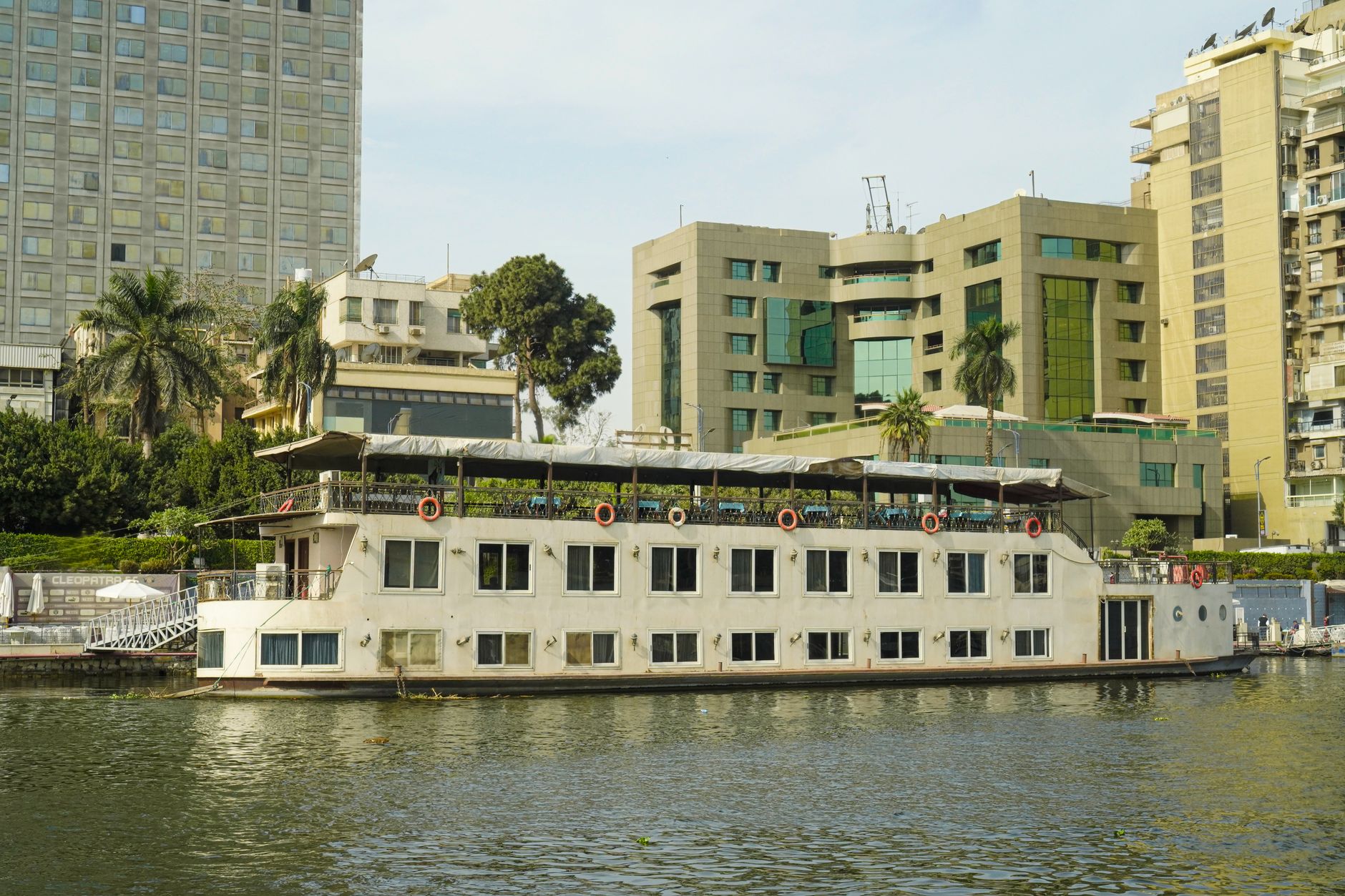
Prices swing hard between the moored boats in Zamalek and the big dinner-and-show operators, and the drinks bill is where an evening quietly doubles. We compare the boats that are actually worth boarding, what a set menu usually includes, and where the extras hide.
Rooftop bars and lounges with a Nile view
Cairo’s rooftop scene is genuinely good, and the views are the selling point — the Nile, the bridges lit up, the Cairo Tower glowing. A few standouts:
- Crimson (Zamalek) — open-air rooftop with arguably the best river view of any bar in the city. Come for sunset cocktails and stay for dinner. Reserve a terrace table on weekends.
- Sequoia (northern tip of Zamalek) — a sprawling waterfront lounge right on the water, with cushioned terraces and shisha. More of a long Mediterranean dinner than a bar, but a lovely place to lose an evening.
- Sky Garden at the Cairo Tower — touristy, yes, but the 360-degree view from the top of the tower is unmatched, and having a drink up there at night is a fair trade for the cliché.
- The big hotel rooftops — the Four Seasons at Nile Plaza, the Sofitel on Gezira island, the Kempinski’s Jazz Bar (live music many nights), and the Birdcage at the Conrad all do polished, pricey, reliable cocktails with a skyline backdrop. Worth it for a special night.
Drinks at these places run higher than the rest of the city — think $8–15 USD for a cocktail at the hotel rooftops, less at Crimson. Still cheaper than London or New York, but not the bargain the old beer halls are.
The old Cairo beer halls and bars (where I’d actually go)
If you want the bars with soul rather than a view, go downtown. These are the places that have been pouring Stella and Sakara — the two ubiquitous Egyptian lagers — for a century, and they’re a world away from the hotel rooftops.
- Cap d’Or (downtown) — a narrow Belle Époque beer hall with a hand-painted ceiling that’s been serving since the early 1900s. Cold beer, a bit of grit, zero pretension. My favorite bar in Cairo.
- El Horreya (downtown) — half traditional coffeehouse, half beer hall, under high ceilings and fluorescent light. People play chess, drink beer, smoke, argue. It is deeply, unmistakably Cairo. Beer at all hours.
- Cairo Cellar (Zamalek, beneath the President Hotel) — a brick-walled basement bar with old posters and a loyal crowd. A genuine institution.
- 30 North Brewery (Zamalek) — local craft beer, which is rarer than you’d think in Egypt, with live music on a regular rotation.
A beer at the old downtown spots costs very little — a fraction of what you’ll pay at a rooftop. These places don’t take cards as a rule, so carry cash. And a word on the law, because it trips people up: drinking in public — on the street, on a bridge, in a park — is illegal in Egypt. Alcohol is fine inside licensed bars, hotels, and restaurants, and you can buy bottles to take back to your room from the Drinkies chain, but keep it indoors and licensed.
Khan el-Khalili and Fishawi’s after dark
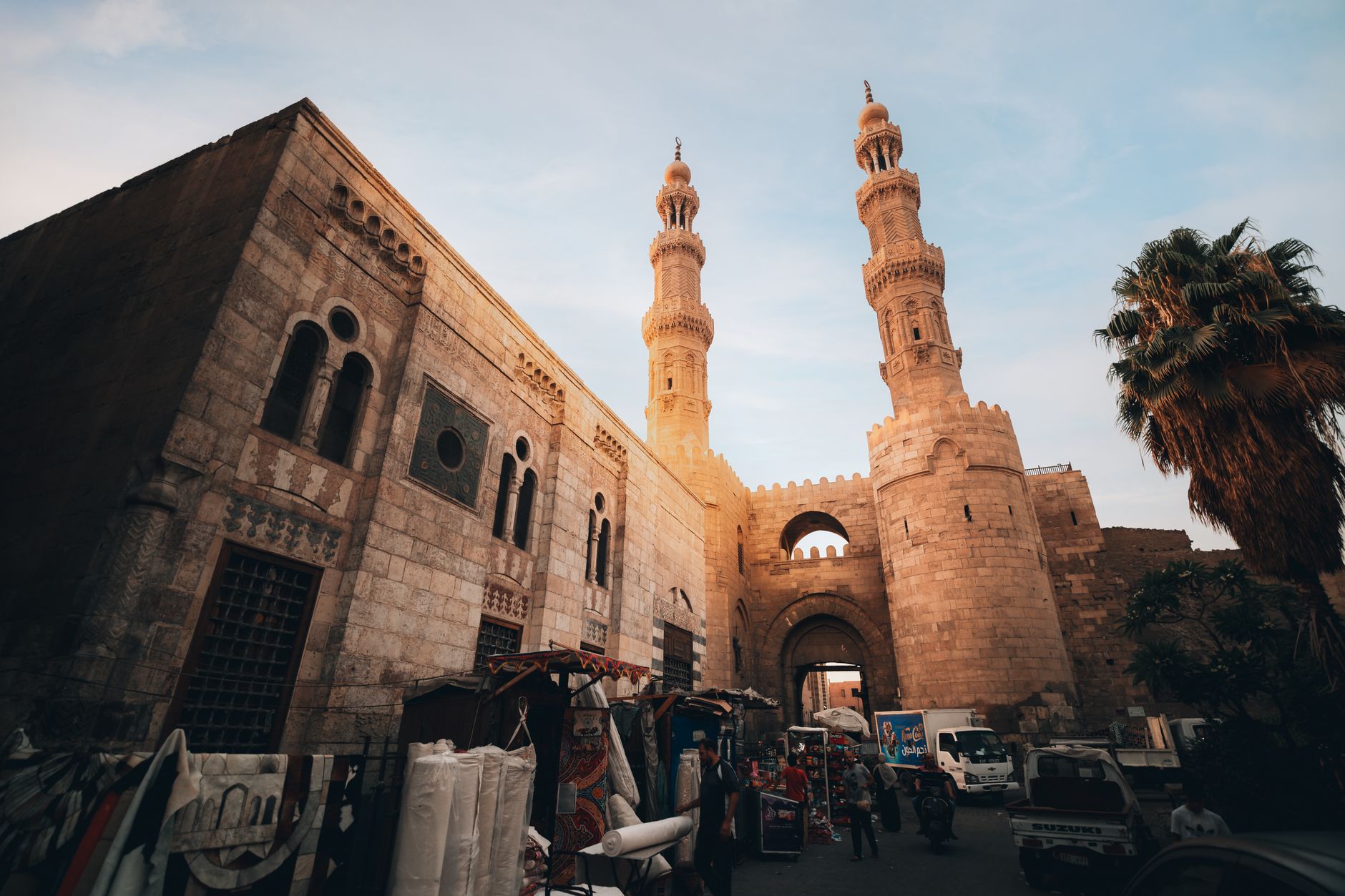
The Khan el-Khalili bazaar is good in the daytime and magical at night. Once the sun’s down, the copper lanterns come on, the call to prayer rolls out from the Al-Hussein Mosque, and oud music drifts out of the cafés. The crowds thin a little, the light is forgiving, and the whole medieval warren feels like a film set. This is one of the best free things you can do in the evening — and if you want more ideas in that vein, our guide to what costs nothing in Cairo has plenty.
The anchor of any Khan el-Khalili night is El Fishawy (Fishawi’s), the café supposedly open continuously since the 1700s — tarnished mirrors, brass tables, a permanent crush of locals and tourists. Order a mint tea or a Turkish coffee, accept the shisha if you fancy it (apple, mint and grape are the usual flavors), and watch the alley go by. It’s touristy and the tea costs more than two streets over, and it doesn’t matter. Around the corner, the Naguib Mahfouz Café — named for the Nobel laureate who set novels in these lanes — is the calmer, pricier sit-down option for actual dinner.
Don’t miss Al-Muizz Street while you’re up here. The medieval corridor of Fatimid and Mamluk monuments runs for about a kilometer and is lit up every night into a glowing open-air museum, pedestrianized and easy to wander. It’s a short walk from the Khan and one of the most atmospheric strolls in the city.
During Ramadan this whole quarter changes gear — lanterns strung across the lanes, cafes packed from iftar until nearly dawn, and a crowd that is overwhelmingly Egyptian rather than touring. If your dates overlap, read how the fasting month reshapes Cairo nights before planning an evening here.
Live music, Sufi dancing, and the Cairo Opera House
Cairo has a real live-music scene, and the centerpiece is the Cairo Jazz Club — technically just over the Zamalek bridge in Agouza, but everyone treats it as the Zamalek night out. Don’t let the name fool you: it’s “jazz” in the loosest sense, with a rotating lineup of indie bands, Arabic fusion, funk, electronic and hip-hop acts. It’s the city’s flagship live venue, open roughly Wednesday to Saturday from 8 PM until 2 AM. Expect a cover charge in the 400–1,000 EGP range depending on who’s playing, with beer around 100–250 EGP and cocktails 250–500 EGP. Arrive after 9 or 10 PM — earlier and the room is empty. There’s a larger sister venue out in Sheikh Zayed (CJC West) that’s more of a full-on dance club.
For something completely different and completely free, find the Al-Tannoura Sufi dance at the Wikala al-Ghuri, a restored 15th-century caravanserai in Islamic Cairo. The performers spin in layered, illuminated skirts for the better part of an hour — it’s part religious tradition, part dizzying spectacle, and genuinely one of the most memorable evenings in Cairo. Shows run a few nights a week (the schedule shifts, but Saturday, Monday and Wednesday around 7–8 PM are the usual nights). It’s free and popular, so turn up at least half an hour early to get a seat in the courtyard.
If you’d rather dress up, the Cairo Opera House on Gezira island stages the Egyptian Symphony Orchestra, ballet, opera and Arabic music for genuinely tiny prices by Western standards — a serious orchestral evening for the cost of a couple of cocktails. There’s a dress code, so leave the shorts at the hotel. For traditional and folk music — Nubian, Sufi, Sa’idi — the intimate Makan near downtown is the place locals send you, and El-Sawy Culture Wheel under the bridge in Zamalek runs concerts, theater and comedy aimed at a younger crowd.
Late-night eats
Because Cairo dines late, your dinner options stay open long after most cities have shut the kitchen. The legendary cheap eat is Abou Tarek downtown — a multi-story temple to koshari (the national bowl of rice, lentils, pasta, fried onions and tomato sauce) that runs until around midnight and costs almost nothing. Felfela, also downtown, is the long-running tourist-friendly spot for Egyptian classics. In Zamalek, Aboul Sid serves proper Egyptian cooking in a dim, 19th-century-styled room (reserve a table). For street food after the bars, look for hawawshi (spiced meat baked into bread) at Tabei El Domyati, and the foul (fava bean) carts that genuinely never close in the downtown alleys. If you want the full rundown, our late-night and daytime food guide goes deep on where and what to eat.
Where to go, and where not to
A quick orientation, because “Cairo nightlife” isn’t one place:
- Zamalek — the leafy island neighborhood, walkable and safe at any hour, packed with bars, lounges and restaurants. The default base for a night out.
- Downtown (Wust al-Balad) — the atmospheric heart: Belle Époque cafés, historic beer halls, street food till 2 AM. Stick to the main streets late and it’s fine.
- Garden City — quiet, upscale, diplomatic quarter with hotel rooftop bars and Nile terraces.
- Maadi — the southern expat suburb, full of pubs and cocktail bars (Lucille’s, Pier 88), calmer and more residential.
- Khan el-Khalili / Islamic Cairo — atmospheric rather than a bar district: lanterns, cafés, Sufi nights, shisha.
And the safety basics. Use Uber or Careem at night — cheap, everywhere, and they spare you the street-taxi haggle and the “meter’s broken” routine. Keep your hotel’s name and address saved in Arabic on your phone. Don’t leave a drink unattended, don’t accept one from a stranger, and ride-share rather than wandering empty side streets after midnight. Solo female travelers will be most comfortable at the upscale venues and hotel bars in Zamalek and Maadi over divey street-level spots; Cairo’s well-reviewed nightlife is generally fine with the usual awareness. Tipping is woven into everything: 10–15% at restaurants, a few pounds per drink at bars, more at live-music venues.
Two cultural notes worth filing away. During Ramadan, the rhythm flips — the city comes alive after the evening iftar and stays up most of the night, but alcohol service shrinks and some bars close or restrict hours during fasting. And public displays of affection draw stares; keep things low-key. LGBTQ+ travelers should be aware there are no openly gay venues and social conservatism is the norm, so discretion is the practical reality.
A couple of evenings I’d actually plan
The first-timer’s classic night: a felucca sail at sunset, koshari at Abou Tarek, a lantern-lit wander through Khan el-Khalili with mint tea at Fishawi’s, then cocktails on the Crimson rooftop in Zamalek to finish. Cheap, atmospheric, quintessentially Cairo.
The cultural night: the Sound and Light Show at the pyramids (or, if you’ve done it, dinner with a pyramid view at Khufu’s), then back into town for a late drink at Cap d’Or or El Horreya. Swap in the Al-Tannoura Sufi performance at Wikala al-Ghuri if it’s a show night — it’s the better story.
The music night: a long dinner at Sequoia on the water in Zamalek, then over to the Cairo Jazz Club for whoever’s playing, and a hawawshi from a street cart on the way home at 1 AM. For more after-dark ideas that aren’t the obvious ones, our off-the-beaten-path experiences guide is a good next read, and couples should look at our romantic things to do in Cairo.
Cairo at Night FAQ
Is Cairo safe at night?
Generally, yes — in Zamalek, Maadi, Garden City and the busy downtown streets. The main rule is to use Uber or Careem rather than walking long distances or hailing street taxis after dark. Avoid empty side streets late.
Is the Pyramids Sound and Light Show worth it?
For a first visit, yes — it’s a bit dated, but seeing the pyramids and Sphinx floodlit at night with almost no crowd is memorable. If you’ve seen it before, skip it and have dinner with a pyramid view instead.
Are Nile dinner cruises any good?
The better operators (Nile Maxim above all) are worth it for the food, the show and the novelty. The budget boats can feel like a fluorescent-lit tour-group buffet. For atmosphere and value, a private felucca sail beats almost all of them.
Can you drink alcohol in Cairo?
Yes, in licensed bars, hotels and restaurants, and you can buy bottles from Drinkies stores. Drinking in public — streets, parks, bridges — is illegal, so keep it indoors and licensed.
What time do bars and restaurants close?
Most bars wind down around midnight; venues with tourism licenses run until 2–3 AM. Restaurants serve late, many until 1 or 2 AM. Cairo simply dines and drinks later than Western cities.
Can women go out alone at night in Cairo?
Yes, with the usual awareness. Stick to well-reviewed venues in Zamalek and Maadi or to hotel bars, take ride-shares, and avoid empty streets late. Plenty of solo travelers enjoy Cairo’s evenings without trouble.
Is Cairo nightlife expensive?
Far cheaper than Western capitals. Beer at the old downtown halls is a few dollars, cocktails at hotel rooftops $8–15, club covers roughly $10–25, and dinner cruises $40–80. Street food and traditional ahwas cost almost nothing.
Related reading: the wider Cairo attractions pillar for the full picture, the guide to Cairo’s museum heavyweights for daytime culture before your night out, and the city’s food and restaurant roundup for where to eat.