This article contains advertising. Our booking links are routed through a partner that adds commission tracking automatically, so if you book through one we earn a commission from the provider, at no extra cost to you. It never affects what we recommend. Affiliate disclosure
Two kilometres separate them, which makes the pairing obvious and the planning deceptively easy to get wrong. Doing the Grand Egyptian Museum and pyramids same day is entirely achievable — thousands of people manage it every week — but the order you do them in decides whether you get one of the best days available anywhere in the world or a long, hot, expensive slog that you remember mainly for your feet.
This page is the logistics of that specific day: the order, the timings, the two tickets, the ten-minute hop between the sites, what to eat and when, and the versions of this plan that do not work. Prices were checked in September 2026 and should be treated as the right order of magnitude.
The one-line answer
Pyramids at opening, museum in the afternoon. Never the reverse.
The reasoning is simple and it holds in every season. The plateau is an open desert site with no shade, no air conditioning and a working population of camel touts who get more persistent as the day wears on. It is at its best in the first two hours after opening — cool, clear, and comparatively empty. The museum is climate-controlled, indoors and entirely indifferent to the sun, and it stays open later.
Do the museum first and you spend four hours in perfect comfort, then walk out into the worst of the afternoon at the site that punishes you for it. Same two tickets, same money, materially worse day.
The timeline
| Time | What |
|---|---|
| 07:00 | Leave central Cairo. Earlier if you are not staying in Giza. |
| 08:00 | Plateau gate. Buy tickets, decide on inner-chamber supplements. |
| 08:15–11:15 | Great Pyramid, Khafre, Menkaure, the panorama viewpoint, the Sphinx. |
| 11:15–11:30 | Ride-hail or taxi to the museum. Ten to fifteen minutes. |
| 11:30–12:30 | Lunch. On site or nearby, but eat properly. |
| 12:30–13:00 | Plaza, security, bag lockers, walk up to the galleries. |
| 13:00–16:30 | The museum. Staircase, Tutankhamun, selected galleries, the boat. |
| 16:30–17:00 | Shop, coffee, out. |
| 17:00 | Ride-hail back into the city. |
That is a ten-hour day door to door and it is a genuinely full one. If that sounds like a lot, it is, and the alternative — splitting them across two days — is a better experience for anyone who has the time.
If you are staying in Giza
Everything gets easier. Shift the whole timeline half an hour later, drop the two long crosstown journeys, and consider going back to the hotel between the two sites for an hour rather than eating immediately. Our rundown of where to stay near the plateau covers which properties are genuinely close.
Why the early start earns itself back
Getting up at six on holiday requires justification, so here it is in plain terms. The first hour after the plateau opens is not marginally better than the rest of the day — it is a different experience.
The temperature is fifteen degrees below the afternoon peak. The light is low and raking, which is what makes the stonework read as stonework rather than a flat pale mass. The haze that swallows the view from mid-morning has not built up yet. The coaches have not arrived. And the touts, who work the plateau all day and get progressively more insistent, have barely started.
Every one of those advantages decays through the morning, and by one o’clock all of them are gone. There is no version of the afternoon at Giza that matches eight in the morning, which is why the combined day has to start early and why the museum — which is climate-controlled and therefore roughly identical at any hour — takes the second half.
The two tickets
The most common budgeting error on this day: there is no combined ticket. A number of tour listings imply one exists. It does not. You pay twice, at two different sites, in two different ways.
| Item | Foreign adult | How to buy |
|---|---|---|
| Grand Egyptian Museum | EGP 1,450–1,590 (~USD 30–33) | Online only, timed slot, in advance |
| Giza plateau entry | Separate site fee | At the gate |
| Inside the Great Pyramid | Supplement | At the gate, on the day |
| Solar boat / other extras | Varies | At the gate |
The critical difference is the booking. The plateau you simply turn up at; the museum requires a timed slot bought online days ahead, and there is no walk-up option. That means the museum end of the day has to be decided before you leave home, which in turn means committing to a rough morning schedule. Book an afternoon slot with slack in it — one o’clock rather than noon — because the morning at the plateau habitually overruns.
Our guides to booking museum tickets and what the plateau charges cover the tiers and the supplements on each side.
The hop between them
Ten to fifteen minutes by car, and not walkable. Two kilometres of desert-edge road with no pavement, in full sun, carrying whatever you brought — people do try, and it is a bad idea.
There are always taxis waiting at the plateau exit, and haggling EGP 80–150 with one of them is usually faster than waiting for a ride-hail car to find you in the coach park. This is the one leg of the day where a street taxi genuinely beats the app.
Whichever you use, be specific about the destination. Drivers hearing “the museum” near the pyramids gate have been known to assume you mean somewhere else entirely, and the pin removes the argument. More on that in our guide to reaching the museum.
Three hours at the plateau: what to actually do
Three hours is enough for the plateau done well, and not enough for the plateau done exhaustively. Prioritise.
- The Great Pyramid up close — twenty minutes standing at the base recalibrating your sense of scale.
- Inside, or not. The interior is a hot, steep, cramped climb up a low passage to a bare granite chamber. It is extraordinary and it is also genuinely unpleasant if you are claustrophobic or unfit. Decide in advance; our guide to going inside the Great Pyramid is honest about who should skip it.
- The panorama viewpoint — the classic three-pyramids-in-a-line shot, and worth the short drive or walk out.
- Khafre and Menkaure — less crowded, and Khafre still carries its casing stones at the apex.
- The Sphinx and the valley temple — last, on the way out, because the exit funnels you past it anyway.
What to skip on a combined day: the camel and horse rides, unless you specifically want one and have negotiated the price and the return leg in advance. They eat time, the pricing is a negotiation from start to finish, and the classic complaint — agreeing a price to ride out and then discovering the ride back costs extra — is still the most common Giza grievance. Our guide to how the plateau is laid out will help you plan a walking route that does not need one.

Three and a half hours at the museum: what to actually do
Arriving at one o’clock with a 16:30 exit gives you roughly three and a half hours inside, which is the standard visit rather than a compromise.
- Grand Hall and the Ramses colossus — 10 minutes.
- The Grand Staircase, walked up slowly — 30 minutes. Do not treat it as a corridor.
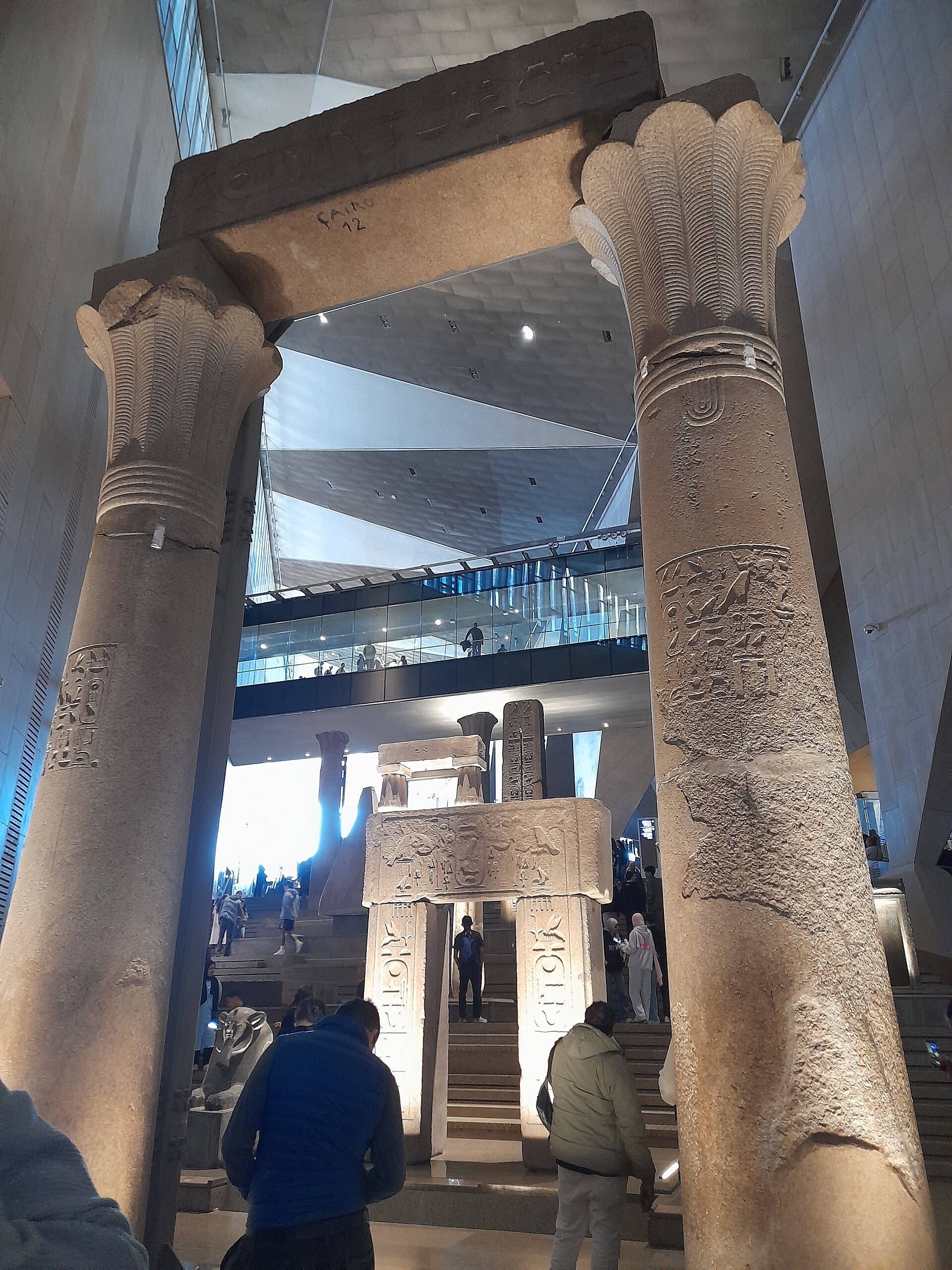
- The window at the top — 10 minutes, and the pyramids you were standing under this morning are framed in it.
- Tutankhamun galleries — 75 minutes, and do them here rather than last.
- Two or three main galleries chosen by period — 40 minutes.
- Khufu’s solar boat — 20 minutes.
- Shop and out — 25 minutes.
The one adjustment worth making on a combined day: skip the twelve main galleries entirely if you are flagging, and spend the time on Tutankhamun instead. You will have been on your feet since eight in the morning, and a hurried lap of the chronological halls at four o’clock yields very little. Our breakdown of how long each section takes has the fuller version.
Eating, which matters more than it sounds
The lunch between the two halves is not optional on a ten-hour day, and where you take it changes the cost noticeably.
- On site at the museum. Convenient, inside the ticketed zone so you can eat and go back in, and priced at two to three times city rates — around EGP 350–600 for a main course. Our guide to the museum’s restaurants and facilities has the detail.
- In Giza town or on the plateau approach. Ordinary Cairo prices, better value, requires a short detour and a willingness to walk into somewhere with no English menu.
- Brought with you. Workable for snacks, not for a real meal — bags are screened and there is nowhere obvious to sit and eat your own food inside.
Whatever you choose, eat a proper Egyptian breakfast before you leave. Ful and taameya at seven in the morning will carry you through the plateau far better than a pastry will, and it is the cheapest meal of the day by a distance.
Versions of this day that do not work
Museum first, pyramids after. Covered above, and the single most consequential mistake available. If your museum slot is a morning one and cannot be changed, consider doing the plateau the following morning instead of the same afternoon.
Adding Saqqara or Memphis. Tour operators sell this combination constantly. The arithmetic does not work: you cannot give three hours to the plateau, three to the museum, and meaningful time to two further sites thirty minutes away, inside one day. What gets compressed is always the museum, and you will have paid EGP 1,450 for an hour.
The seven-stop coach tour. Packages promising the museum, the pyramids, the Sphinx, Saqqara, Memphis, a papyrus workshop and a perfume house are selling an itinerary that cannot fit into daylight. The two shops exist to pay commission — and if a tour includes a papyrus “institute”, our guide to what is actually sold there explains why that is a warning label.
Doing it on a layover. The airport is sixty to a hundred minutes from Giza each way. A six-hour layover leaves perhaps three usable hours, which is enough for one of the two sites and not both.
Squeezing in the Egyptian Museum at Tahrir. It is twenty kilometres back across the city and it deserves its own morning. Our comparison of the two museums explains why they belong on different days.
Season by season
October to April
The comfortable months, and this plan works exactly as written. Daytime highs of 18–24 °C in December and January make three hours on the plateau genuinely pleasant. Book the museum slot further ahead over Christmas and New Year, when both sites are at their busiest.
May and September
Hot but workable. Shift everything thirty minutes earlier and take the lunch break seriously.
June to August
The plan needs adjusting rather than abandoning. Be at the plateau gate for opening without exception, cut the plateau to two hours rather than three, and be indoors by eleven. The museum becomes the sanctuary in the middle of the day rather than the afternoon extra, and the trade is a good one — three hours of air conditioning while the desert is at its worst.
Wednesday and Saturday, any season
These are the days the museum galleries stay open until 21:00, and they unlock a much more humane shape for the day: plateau at opening, a long lunch and a real rest through the afternoon heat, then the museum from five with the crowds gone and the building lit from within. If your dates allow it, this is the best version of the combined day. Our guide to museum opening hours and the quietest times covers the late sessions.
What to carry
- Water, sealed, more than you think. Buy it before you get to the plateau; it costs several times more inside either site.
- Sun protection for the morning. Hat, sunglasses, sunscreen, covered shoulders. There is no shade at Giza worth the name.
- Comfortable shoes. Sand and broken stone in the morning, polished stone in the afternoon, and about ten kilometres between them.
- Cash in small notes for the plateau, the taxi hop and any tipping. Cards work at the museum but not much else.
- Your museum QR code as a screenshot, at full brightness, before you reach the scanners.
- A power bank. A ten-hour day with a camera in constant use will finish a phone.
Is it better to split them over two days?
Yes, if you have the days. This is the honest answer and most guides will not give it to you because the combined day is the one people search for.
Two half-days beats one full day for the same reason two three-hour museum visits beat one six-hour one: nobody looks well in hour eight. Splitting also lets you take the plateau at sunrise on one day and the museum’s late Wednesday opening on another, which are the two best versions of each experience and cannot both happen in twenty-four hours.
The combined day exists because most people visiting Cairo have three or four days and a long list. If that is you, do it, do it in the right order, and accept that it will be tiring. If you have a week, spread it out — our thoughts on how many days Cairo actually needs set out where the extra time is best spent.
Doing it with a guide, or without
The combined day is the one Cairo itinerary where a guide genuinely earns their fee, and also the one where a bad guide does the most damage. Worth thinking through rather than defaulting either way.
What a good guide adds on this particular day is friction removal. They handle the plateau ticketing, they know which pyramid interior is worth the supplement on the day, they deflect the touts without rudeness, they arrange the hop between the sites, and they impose a schedule that keeps the museum half from being eaten by the morning. On a day with two sites, two ticketing systems and a hard timed slot in the middle, that is worth real money.
What a bad guide does is march you past what you wanted to see in order to deliver a fixed script, and steer you into a papyrus shop and a perfume house because those pay commission. The plateau in particular attracts freelancers who attach themselves to visitors at the gate and negotiate afterwards, which is a situation with no good outcomes.
Our practical position: if you want a guide, book a named Egyptologist through an operator with a reputation to lose, agree the route and the stops in writing beforehand, and state explicitly that you do not want shopping stops. If you would rather go alone, the plateau is navigable with a map and the museum’s labelling is strong enough to carry a visit unaided — most independent travellers manage both without difficulty.
Accessibility on a combined day
The two halves of this day are wildly different in how demanding they are, and it is worth knowing that before booking.
The museum is the most accessible major site in Egypt — step-free throughout, lifts to every level, wide ramps, wheelchairs at the entrance, level polished surfaces and seating at intervals. The plateau is close to the opposite: sand, broken stone, uneven ground, long distances and very little shade, with the pyramid interiors involving a steep, low, cramped climb that is unsuitable for most people with mobility limitations.
There is a workable compromise. The plateau has paved viewpoints and the Sphinx area is reachable by car, so a shortened morning of ninety minutes covering the accessible viewpoints, followed by a full afternoon at the museum, gives you both sites without the punishing parts of the first. Arrange a driver who will move between the plateau’s stops rather than parking once, which turns most of the walking into short hops.
Frequently asked questions
Can you visit the Grand Egyptian Museum and the pyramids in one day?
Yes, comfortably. They are about two kilometres apart. Do the plateau at opening and the museum in the afternoon on a pre-booked slot, and allow around ten hours door to door from central Cairo.
Which should I do first?
The pyramids, always. The plateau is exposed and gets hotter, busier and more tout-heavy as the day goes on; the museum is air-conditioned and open later.
Is there a combined ticket?
No, despite what many tour listings imply. The two sites are priced and booked separately, and the museum additionally requires a timed slot purchased online in advance.
How do I get between the two?
Ten to fifteen minutes by car, EGP 80–150. Taxis wait at the plateau exit and are usually quicker than a ride-hail there. It is not walkable — no pavement, full sun.
How much should I budget for the day?
For two adults: two museum tickets at EGP 1,450–1,590 each, plateau entry and any inner-chamber supplements, EGP 500–800 in transport, and EGP 700–1,200 for lunch. Eating before you come and skipping the pyramid interior are the two largest savings available.
Can I add Saqqara or Memphis?
Not to this day. Operators sell it; the timings do not work, and the museum is always what gets cut to an hour.
How long do I need at each?
Three hours at the plateau and three to three and a half at the museum, plus an hour for lunch and travel between them.
Is it too much for children?
For most under-tens, yes as written. Cut the plateau to two hours, cut the museum’s main galleries entirely, build in a long food break, and expect to be finished by mid-afternoon.
What if my museum slot is in the morning?
Do the plateau on a different morning rather than the same afternoon. An exposed desert site at two o’clock is a poor reward for a good museum visit.
Is the sunrise really worth the early start?
The first hour after the plateau opens is the best hour of the Giza day by a wide margin — cooler, clearer, quieter and better for photographs. It is the single highest-return decision on this itinerary.
Related Cairo Guides
- Grand Egyptian Museum: the complete visitor guide
- Giza pyramid complex: map and layout
- How long to allow at the museum
- Getting to the museum from Cairo
- Inside the Great Pyramid: is it worth it?
- Giza hotels near the pyramids
- How many days to spend in Cairo
Photo Credits
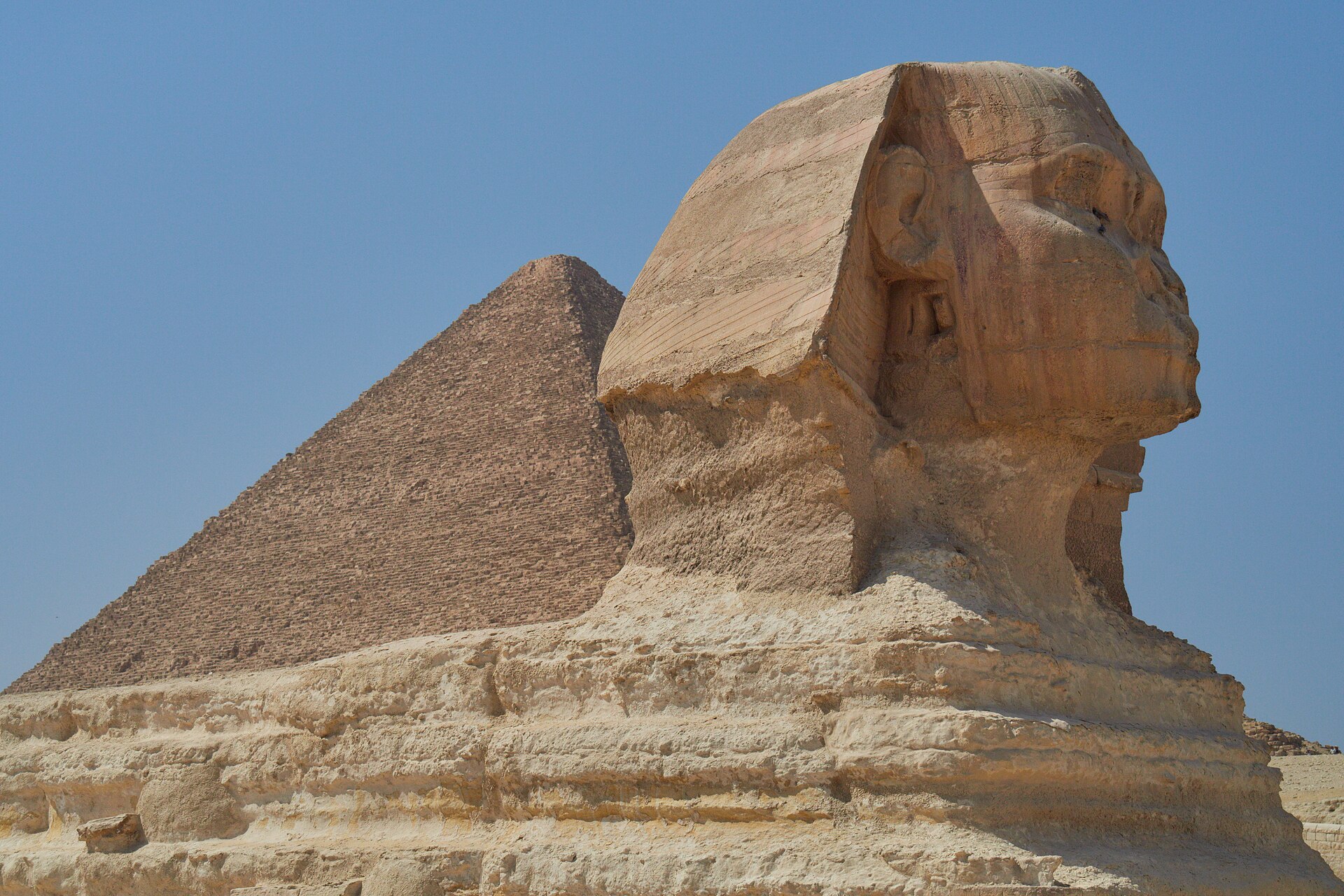
Sphinx and the Great Pyramid: photo by lumoplank, via Wikimedia Commons (CC0).
Columns framing the Grand Staircase: photo by Amr F.Nagy, via Wikimedia Commons (Public domain).