This article contains advertising. Our booking links are routed through a partner that adds commission tracking automatically, so if you book through one we earn a commission from the provider, at no extra cost to you. It never affects what we recommend. Affiliate disclosure
The Royal Mummies Hall is entered down a ramp, in near darkness, and the first thing you notice is that nobody is talking. Twenty-two kings and queens lie in individual climate-controlled cases, each lit only enough to see, with the deliberate air of a burial chamber rather than a display. Whatever you expect from a room full of mummies, this is not the Victorian freak show the phrase suggests — and it is the single best reason to make the trip out to the National Museum of Egyptian Civilization in Fustat.
This page covers what NMEC holds, what a ticket costs, how to get there, how it differs from the two better-known museums, and whether it deserves a slot in a short Cairo trip. Prices and hours were checked against the Ministry of Tourism and Antiquities in September 2026.
Prices checked September 2026. Note the ticket window closes an hour before the museum does, in both the day and evening sessions — an easy way to arrive at 16:15 and be turned away.
The three-way split, settled
More visitors get this wrong than get it right, so before anything else:
- The royal mummies are here — at NMEC, in Fustat. Twenty-two of them, including Ramses II, Seti I and Hatshepsut. They moved from Tahrir in April 2021.
- Tutankhamun’s treasures are not here. The mask, the shrines, the chariots and the rest of the five thousand objects are at the Grand Egyptian Museum, out at Giza.
- Tutankhamun’s own mummy is at neither. It has never left the Valley of the Kings, and lies in tomb KV62 near Luxor in a climate-controlled case.
If what you want is to stand in front of the actual body of a pharaoh, Fustat is where you go, and no amount of choosing between the other two museums will substitute. Our comparison of the GEM and the Tahrir museum deals with the other half of the decision.
The Royal Mummies Hall
It sits below the main level, reached by a descending ramp, and the architecture does the work before any object does: the light drops, the temperature drops, the noise drops, and you arrive somewhere that feels like a tomb rather than a gallery.
Each mummy has its own case, its own name, and its own panel. That individuation is the point. At Tahrir the mummies shared a room and read collectively as a category of thing; here they read as people, with reigns and families and causes of death, several of which are grim.
Who is in there
- Ramses II, who reigned more than sixty years and died in his nineties — the white hair is still visible.
- Seti I, his father, widely considered the best-preserved royal mummy in existence and startlingly lifelike.
- Hatshepsut, the female pharaoh whose successors tried to erase her from the record.
- Thutmose III, the general-king who took Egypt to its greatest territorial extent.
- Ramses III, whose throat wound — evidence of the harem conspiracy that killed him — was identified by CT scanning.
- Queen Tiye, Ahmose-Nefertari, Meritamun and others; eighteen kings and four queens in total.
Alongside them, the displays explain mummification itself and the CT and DNA work that has been done on these bodies over the past two decades. That research is not decoration — it is how the family relationships in the Amarna period were reconstructed, and how several long-standing arguments about who was related to whom were settled.
How it is handled
Respectfully, and rather better than at Tahrir. Photography is not permitted in the mummies hall; the rest of the museum allows it without flash. Visitors are quiet, and staff enforce it gently. There are no gimmicks.
Whether displaying human remains at all is defensible is a live question, and worth thinking about before you go rather than in the room. Our view is that the presentation here does about as well as such a display can — individual, named, contextualised, with the science explained and the theatrics absent. But if the idea troubles you, the rest of NMEC is worth the ticket on its own and nobody makes you go down the ramp.
What else is in the museum
This is the part visitors do not expect, and the reason NMEC is more than a mummy hall with a building attached.
It is the first museum in the Arab world to cover the entire span of Egyptian civilisation rather than stopping where the pharaohs do. The main hall runs chronologically — prehistoric, Pharaonic, Greco-Roman, Coptic, Islamic, modern and contemporary — and the effect is to make a point that the other museums cannot: that Egypt did not end in 30 BC.
Around that spine sit thematic galleries covering the Nile, writing, the state, society, beliefs and material culture. The Coptic and Islamic material in particular is stronger than anything at Giza, and the modern sections take the story through to the twentieth century.
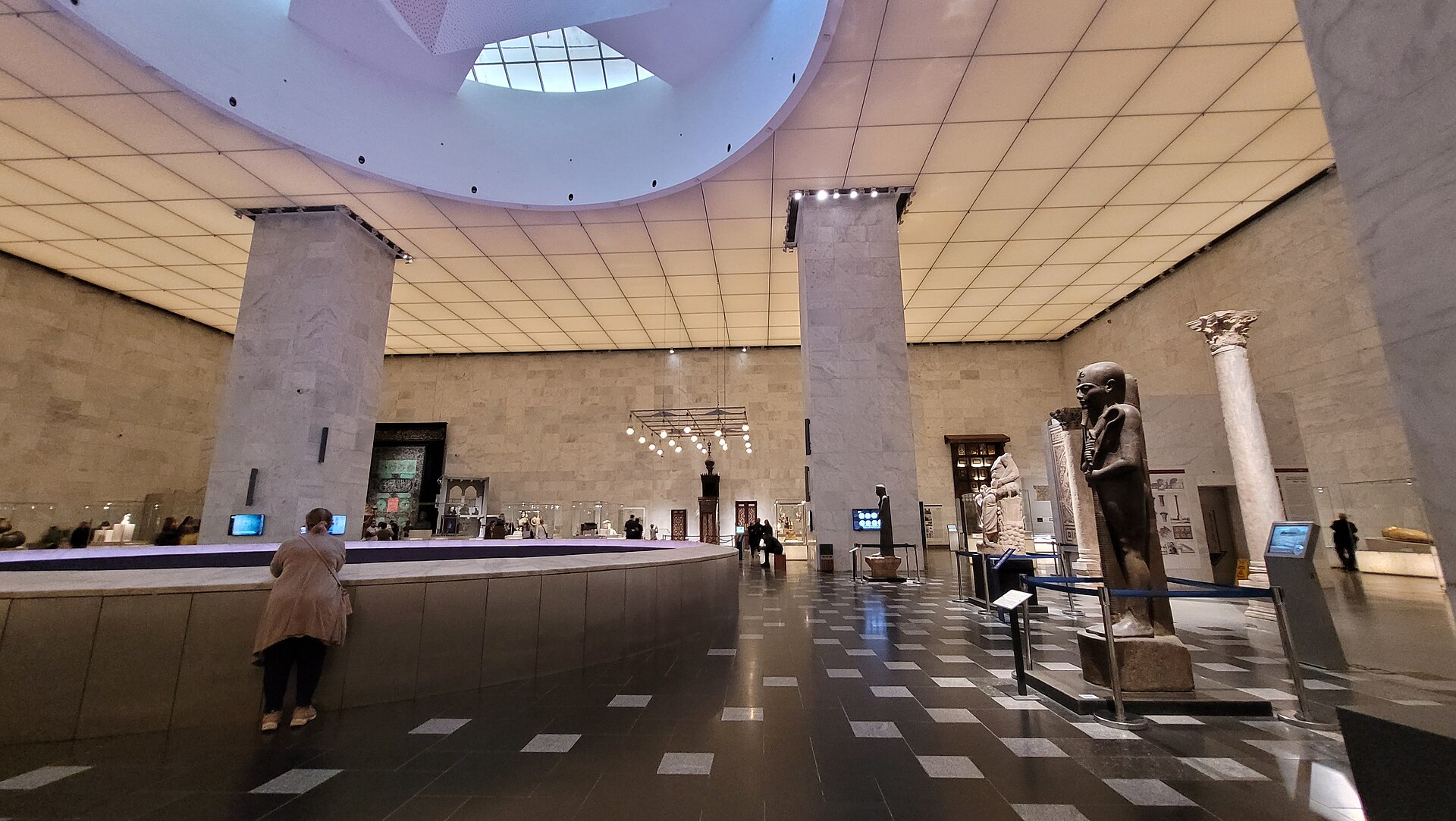
The labelling is bilingual and good. The building — a low, restrained modern structure with a circular oculus over the central hall — is not the architectural event that the GEM is, but it is calm, comfortable and well lit, and it is never crowded in the way Giza can be.
The 2021 parade, and why the mummies moved
The transfer was not a quiet logistical exercise. On the evening of 3 April 2021, twenty-two mummies were carried through central Cairo from Tahrir to Fustat in individually numbered, nitrogen-filled cases, mounted on decorated vehicles, in chronological order of reign, with a military escort, a twenty-one-gun salute and a broadcast watched around the world. It was called the Pharaohs’ Golden Parade, and it shut the city for a night.
The spectacle drew some eye-rolling at the time, and the criticism was not unreasonable — it was, transparently, a piece of tourism promotion staged during a pandemic that had emptied Egypt of visitors. But the underlying reason for the move was sound. At Tahrir the mummies were in a crowded upper room in a building from 1902, in conditions no modern institution would accept for organic remains of that importance. Fustat gave them purpose-built environmental control, individual cases and a designed space.
Ramses II went first in the procession, by reign order rather than fame, and the whole thing took about forty minutes to travel five kilometres. If you saw the footage and assumed the mummies ended up at the shiny new museum by the pyramids, this is where the confusion started: they did not, and they were never going to.
What the science has found
One of the better things NMEC does is treat these bodies as evidence rather than curiosities, and the displays carry a fair amount of what CT scanning and DNA analysis have established over the past twenty years.
- Ramses III was murdered. Scanning revealed a deep cut across the throat, hidden under the wrappings, confirming the harem conspiracy described in an ancient trial document.
- Seti I was embalmed exceptionally well, which is why his face is the most lifelike of the group and has been reproduced in books for over a century.
- Hatshepsut was identified in part by matching a tooth found in a canopic box bearing her name to a gap in the jaw of an unidentified female mummy.
- Family relationships in the Amarna period were reconstructed through DNA work on this group, which is how several long-running arguments about Tutankhamun’s parentage were finally settled.
- Ordinary illness shows up too — arterial disease, dental abscesses, arthritis. These were not people spared by their status.
None of it is presented as sensation, and that restraint is a large part of why the hall works.
Fustat, and what else is nearby
The museum sits in Fustat — the site of Egypt’s first Islamic capital, founded in the seventh century — beside Ain al-Sira lake, in a part of Cairo most visitors pass through rather than stop in.
That location is an argument for combining it with Coptic Cairo, which is a short hop away and holds the Hanging Church, the Coptic Museum, Ben Ezra Synagogue and the Church of St Sergius and Bacchus. Half a day covering both is a genuinely good use of Cairo time, and a very different experience from a day out at Giza.
Our guide to the Coptic Museum and Christian Cairo covers what is worth seeing on that side of the city, and it pairs with NMEC far more naturally than any museum-plus-pyramids plan does.

Getting there
| From | Method | Cost | Time |
|---|---|---|---|
| Downtown / Tahrir | Metro Line 1 to El Malek El Saleh | EGP 8–15 | 15–20 min |
| Downtown / Tahrir | Uber or Careem | EGP 120–200 (~USD 2–4) | 20–35 min |
| Zamalek | Uber or Careem | EGP 150–250 (~USD 3–5) | 25–40 min |
| Coptic Cairo (Mar Girgis) | One metro stop, or a short car hop | EGP 8 / EGP 60–100 | 5–10 min |
| Giza / the pyramids | Uber or Careem | EGP 300–450 (~USD 6–9) | 45–75 min |
| Cairo airport | Uber or Careem | EGP 350–550 (~USD 7–11) | 45–70 min |
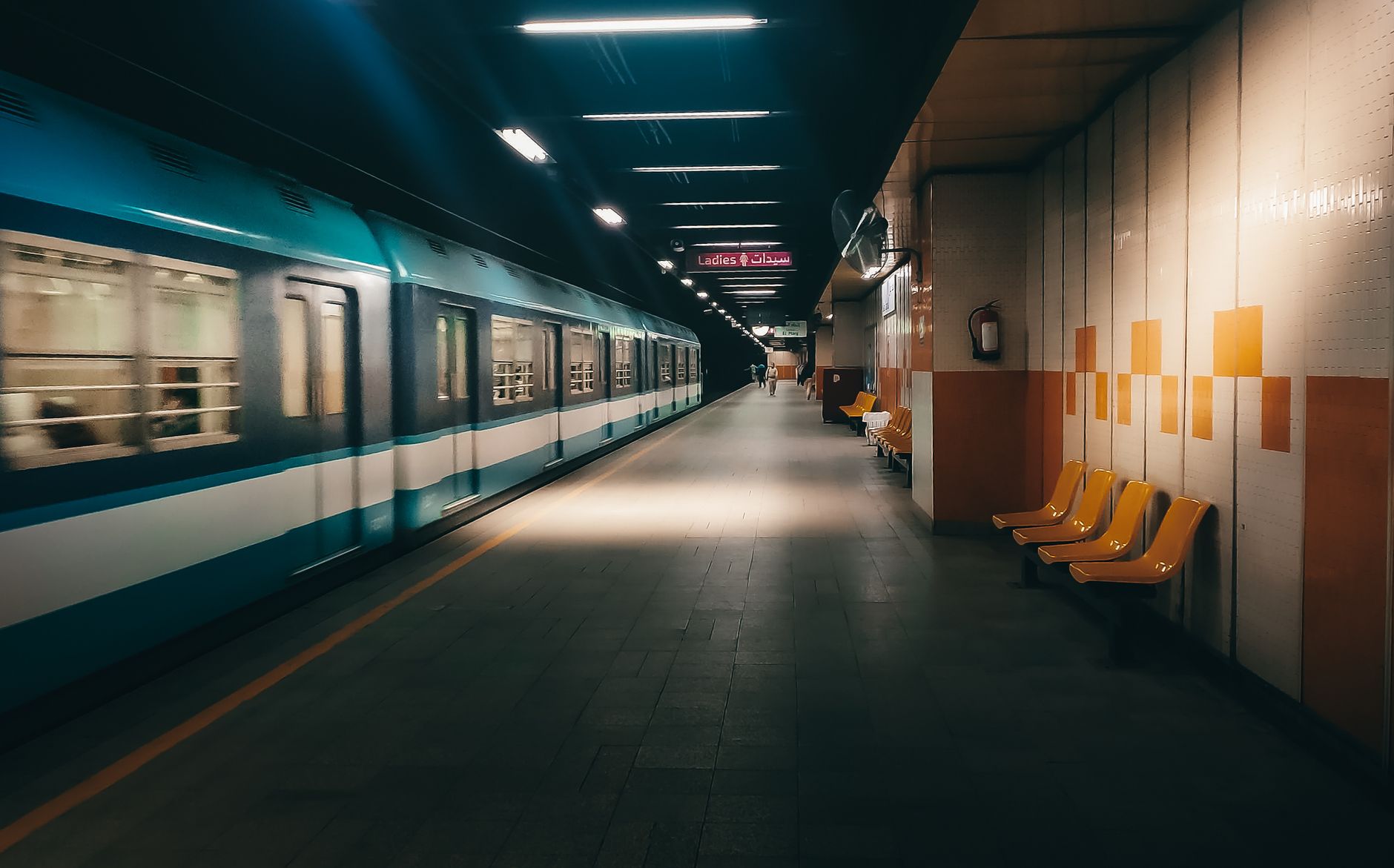
Fares checked September 2026. Unlike the museum out at Giza, this one is genuinely on the metro — El Malek El Saleh is on Line 1, and it is a short walk from there. That makes NMEC one of the easiest major attractions in Cairo to reach independently and cheaply, and our guide to using the Cairo metro covers the practicalities.
If you are driving, access is via the Giza road and Abbas Bridge, and parking on site costs EGP 20 for a private car.
How long to allow
Two to three hours covers it properly, which makes NMEC the most manageable of Cairo’s three big museums. An hour and a half is enough if the mummies are your priority and you are willing to move briskly through the chronological hall.
A workable shape for a first visit: forty-five minutes on the chronological main hall, forty-five in the Royal Mummies Hall, thirty minutes on the thematic galleries that interest you, and a coffee. Do the mummies second rather than first — the chronological hall gives you the framework that makes the individual kings mean something.
Compared with its neighbours, that is a modest commitment. The Grand Egyptian Museum needs three to four hours minimum, and Tahrir wants two to three of its own. NMEC fits into half a day without dominating it.
Should it be your third museum, or your second?
Here is the honest ranking for a visitor with limited days.
- One museum day: the Grand Egyptian Museum. Tutankhamun, the boat, the building.
- Two museum days: add Tahrir if you want depth and atmosphere, or NMEC if you want the mummies and the wider sweep of Egyptian history. This is a genuine fork rather than an obvious ordering.
- Three museum days: all three, spread out, ideally with something else between them.
The case for putting NMEC second, ahead of Tahrir, is stronger than most itineraries allow. It holds something neither other museum has, it is cheaper than the GEM, it is easier to reach than either, it takes less time, and it is far less crowded. The case against is that Tahrir’s Old Kingdom sculpture is extraordinary and the building is a period piece in its own right.
What settles it for most people is what they actually want. If the phrase “royal mummies” is why you came to Egypt, go to Fustat. If it is “ancient Egyptian art”, go to Tahrir. Our overview of Cairo’s museums takes in the smaller collections that get squeezed out of this argument entirely.
The evening session, which almost nobody uses
The 18:00 to 21:00 slot is the quietest three hours the museum has, and it barely appears in any itinerary because tour operators finish their days by five.
It suits two kinds of visitor particularly well. The first is anyone who has spent the day at Giza and does not want to waste the evening — the crosstown journey is easier after dark than at five o’clock, and two hours at NMEC is a genuinely satisfying way to end a day rather than a rushed addition. The second is anyone staying downtown who wants a low-effort evening: it is fifteen minutes on the metro, the ticket is cheap, and the galleries are close to empty.
The Royal Mummies Hall in particular benefits. It is dark and quiet at the best of times; at half past seven with a dozen people in the building, it is genuinely atmospheric in a way the middle of the afternoon cannot match.
The one thing to watch is the ticket window, which closes at 20:00. Arriving at 20:15 for a session that runs until 21:00 will not work, and there is nobody to appeal to.
Common misconceptions
Worth clearing up, because each of these sends visitors to the wrong side of the city.
- “The mummies moved to the new museum.” They moved to a new museum, but not that one. NMEC opened its main galleries in 2021; the Grand Egyptian Museum opened fully in 2025. Different buildings, different sides of Cairo, twenty kilometres apart.
- “NMEC is where Tutankhamun is.” No — his treasures are at Giza and his body is at Luxor. Nothing of Tutankhamun’s is in Fustat.
- “It is just the mummy hall.” The mummies are the headline, but the chronological sweep from prehistory to the modern era is the thing that makes NMEC distinct, and no other Egyptian museum attempts it.
- “You need to book ahead.” Unlike the GEM, there is no timed-slot system. Buy at the door, any day.
- “It is out of the way.” It is on the metro, fifteen minutes from Tahrir. The museum genuinely out of the way is the one at Giza.
Facilities
- Café on site, and a gift shop.
- Lifts and a ramped entrance — the museum is accessible, though not to the exceptional standard of the newer building at Giza.
- ATM and an information desk.
- A library, which is unusual and useful if you have a specialist interest.
- Toilets and parking.
- Photography: permitted without flash in most of the museum; not permitted in the Royal Mummies Hall. Tripods and monopods are prohibited throughout without prior permission.
What is not worth it
Rushing it as a bolt-on to a Giza day. Fustat and Giza are on opposite sides of the city and the crosstown journey in the middle of a day is forty-five minutes to over an hour each way. Doing the pyramids, the GEM and NMEC in one day is a plan that produces three unsatisfying visits.
A guided tour, for most people. The labelling here is good, the museum is small enough to navigate unaided, and the mummies hall explains itself. Save the guide budget for Giza, where the scale genuinely defeats people.
Buying tickets anywhere other than the door. Unlike the GEM, NMEC sells at the ticket office and there is no timed-slot system to work around. Resellers offering “skip the line” access are selling something that does not exist.
Arriving after 16:00 on a day session. The ticket window shuts an hour before the museum, and staff will not make an exception. If you are running late, aim for the 18:00 evening session instead.
Frequently asked questions
Where are the royal mummies in Cairo?
At the National Museum of Egyptian Civilization in Fustat. Twenty-two of them, moved from the Egyptian Museum at Tahrir in the April 2021 Pharaohs’ Golden Parade, and this is their permanent home.
Is Tutankhamun’s mummy here?
No. It remains in tomb KV62 in the Valley of the Kings near Luxor. His treasures are at the Grand Egyptian Museum in Giza. Three different locations, and this is the most confused fact in Cairo travel.
How much does NMEC cost?
EGP 550 for a foreign adult and EGP 300 for a foreign student, around USD 11 and USD 6. Egyptians pay EGP 90 and EGP 45. Under-sixes, over-sixties and visitors with special needs go free.
Is the Royal Mummies Hall included in the ticket?
Yes, with no supplement. That is a change from the old arrangement at Tahrir, where the mummy room was a paid extra.
What are the opening hours?
09:00 to 17:00 daily, with an evening session from 18:00 to 21:00. Ticket windows close an hour before each session ends. Ramadan hours are 09:00 to 16:00.
Can I take photographs?
In most of the museum, yes, without flash. Not in the Royal Mummies Hall. Tripods and monopods are prohibited throughout unless you have prior permission.
How do I get there on the metro?
Line 1 to El Malek El Saleh, then a short walk. It is one of the easiest major Cairo attractions to reach independently — considerably easier than the Grand Egyptian Museum, which has no metro at all.
How long should I spend there?
Two to three hours does it properly; ninety minutes if the mummies are your priority. It is the least time-hungry of Cairo’s three big museums.
Is it suitable for children?
The chronological hall and the thematic galleries are fine. The Royal Mummies Hall is a judgement call — it is dark, quiet and unmistakably about death, and it unsettles some children while fascinating others. You know yours.
Can I combine it with Coptic Cairo?
Yes, and you should. They are minutes apart, and half a day covering the Hanging Church, the Coptic Museum and NMEC is one of the better-shaped mornings in Cairo.
Related Cairo Guides
- Grand Egyptian Museum: the complete visitor guide
- GEM or Tahrir: which to choose
- The Egyptian Museum at Tahrir
- Coptic Cairo and the Coptic Museum
- Every museum in Cairo worth your time
- Using the Cairo metro
Photo Credits
NMEC central hall: photo by Nabbegat, via Wikimedia Commons (CC BY 4.0).
Bronze figurines and cippus of Horus: photo by Nabbegat, via Wikimedia Commons (CC BY 4.0).