This article contains advertising. Our booking links are routed through a partner that adds commission tracking automatically, so if you book through one we earn a commission from the provider, at no extra cost to you. It never affects what we recommend. Affiliate disclosure
You will land at Cairo Airport, pull 4,000 EGP out of the arrivals-hall ATM, and receive it as twenty crisp 200-pound notes. Ten minutes later a porter will wheel your bag forty metres to a taxi and stand there expectantly, and you will discover that the smallest thing in your wallet is worth roughly four dollars — about a day and a half of Egypt’s minimum wage. That gap, between the money you have and the money you need, is the actual problem with tipping in Cairo. It is not that the customs are mysterious. It is that nobody has change, and the sums are so small in dollar terms that visitors routinely hand over five times what a local would and then feel virtuous about it.
So this guide does two things the usual lists don’t. It gives 2026 amounts in Egyptian pounds with the dollar conversion attached, because at roughly 50 EGP to the dollar a generous tip and an absurd one are separated by about the price of a coffee back home. And it explains the mechanics — the 12% service charge, the 14% VAT, the note denominations, the script for when someone insists they have no change — so you can stop doing arithmetic in doorways.
The at-a-glance tipping table for Cairo in 2026
These are amounts that read as normal-to-slightly-generous from a foreign visitor. Locals often pay less; package tourists routinely pay far more. Conversions use the mid-2026 rate of about 50 EGP to $1, which held in a band of roughly 49.5–51.5 through July and August 2026.
| Situation | 2026 amount | ≈ USD | Honest verdict |
|---|---|---|---|
| Restaurant, no service charge | 10% of the bill | varies | Do it. Cash, into the server’s hand. |
| Restaurant with 12% service charge | 5–10% extra, in cash | varies | Yes — the 12% mostly isn’t reaching them. |
| Cafe, ahwa, koshary counter | £E 10–20 | $0.20–0.40 | Round up. Nothing more expected. |
| Uber / Careem | £E 20–30 cash | $0.40–0.60 | Optional but noticed. Cash beats app. |
| Street taxi, fare agreed up front | Round up to next £E 10–20 | $0.20–0.40 | Only if the fare was fair to start with. |
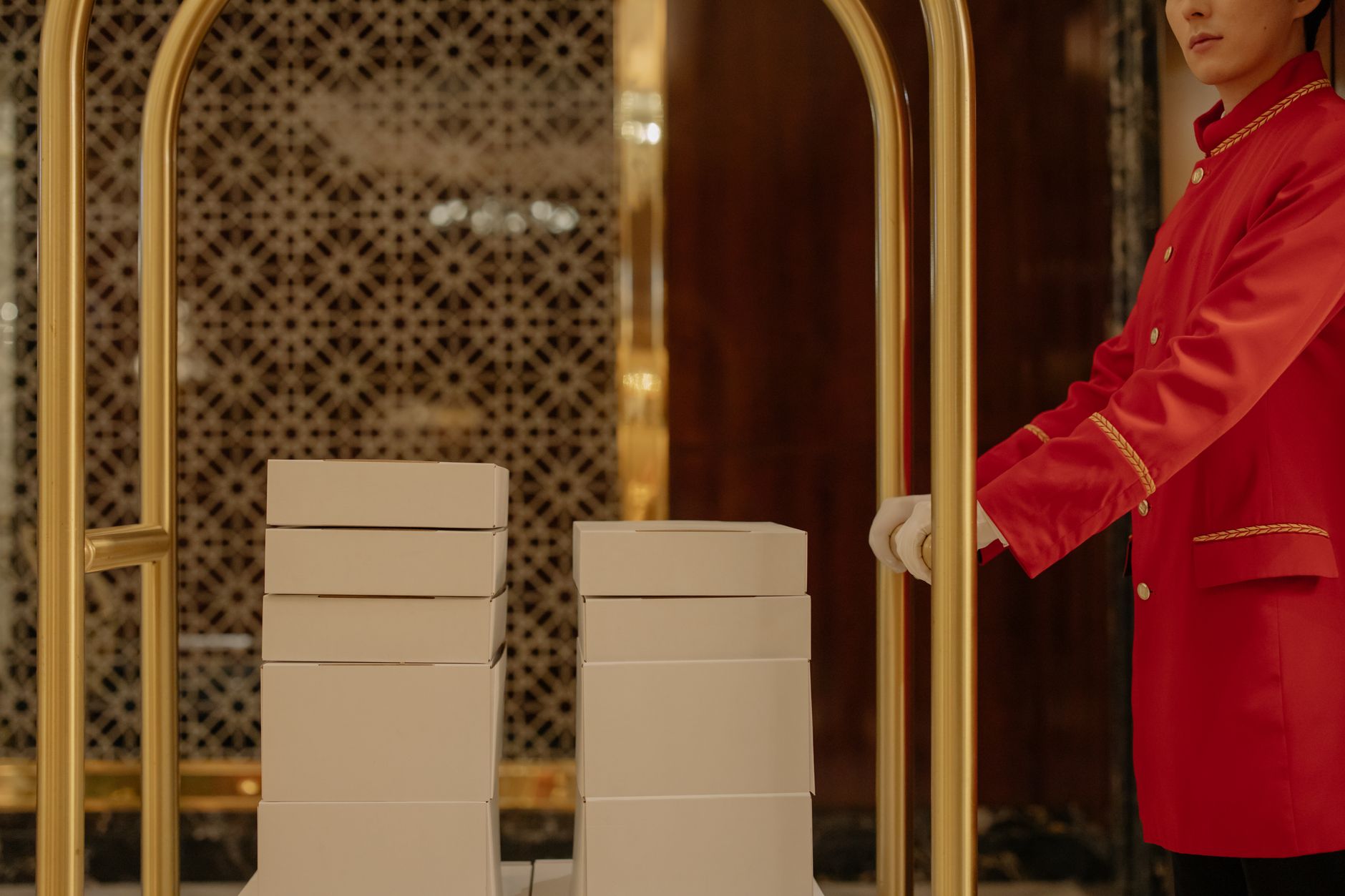
| Hotel porter, per bag | £E 20–50 | $0.40–1.00 | £E 20 mid-range, £E 50 five-star. |
| Housekeeping, per day | £E 30–75 | $0.60–1.50 | Leave it daily, not at checkout. |
| Concierge who actually fixes something | £E 100–300 | $2–6 | For real effort, not directions. |
| Private guide, full day | £E 500–1,000 | $10–20 | Per couple, not per person. Ignore the $50 advice. |
| Private driver, full day | £E 250–500 | $5–10 | Half the guide. Give it separately. |
| Nile cruise crew, per person per night | $8–12 into the box | $8–12 | The one place operator guidance is fair. |
| Felucca captain, one hour | £E 50–100 | $1–2 | On top of an already-haggled fare. |
| Bathroom attendant | £E 5–10 | $0.10–0.20 | Pay it. It buys the paper you’re using. |
| Mosque shoe minder | £E 10–20 | $0.20–0.40 | Pay on the way out, not going in. |
| Site guard who “opens” something | £E 20–50 | $0.40–1.00 | Grey area. Often he shouldn’t be doing it. |
| Stranger who “helped” uninvited | £E 10–20 or nothing | $0.20–0.40 | Not a tip. A toll. Decide fast and walk. |
What baksheesh actually is, and what it isn’t
Baksheesh (بقشيش) gets translated as “tip”, which is about a third right. The word covers three different transactions that happen to use the same currency. There is gratuity, payment for service rendered, the thing you already understand. There is charity — the small giving that has a formal place in Islamic practice, and which explains why a man on a corner may ask you directly without embarrassment. And there is lubrication: the payment that makes an obstacle go away, the reason a rope drops or a barrier lifts.
Visitors get into trouble because they read all three as the first one. When someone materialises to point at a doorway you were already walking through and then asks for money, that is not a failed tip transaction; it is a small toll levied on a person who looks like they can afford it. You are allowed to decline. Working out which of the three you are standing in is most of the skill, and it is worth reading beside the broader everyday etiquette governing these interactions, because the same rules about eye contact, right hands and firm politeness apply.
The economic backdrop is stark, and it is not an argument for emptying your wallet. Egypt’s private-sector minimum wage has stood at EGP 7,000 a month since March 2025 — about $140 — with a rise to EGP 8,000 announced in April 2026 for July implementation but not confirmed by the National Wages Council as of mid-July. A part-time floor of 28 EGP an hour was set at the same time. Hotel and restaurant staff often sit close to that floor, which is why tips are not decoration; they are the variable part of a wage. It is also why £E 20 means something real to a porter while £E 500 does not mean twenty-five times more. It means you have marked yourself.
The 2026 exchange rate rewrites half the standard advice
Almost every tipping article written before 2024 tells you to tip in US dollars. That was correct when the pound was collapsing and dollars were a store of value people queued for. It is now mostly wrong, and following it costs the recipient money.
Through 2026 the pound has traded in a narrow band around 50 to the dollar — roughly 49.5 at the strong end, 51.5 at the weak end, averaging about 50.5 across July and August. It floats, so it moves, but it is not in freefall the way it was. Meanwhile the parallel-market premium that once made dollars worth hoarding has largely closed. A waiter handed a $5 bill now has to find a bureau, queue, show ID and accept whatever spread he is given. A waiter handed £E 250 can buy dinner on the way home.
Two exceptions survive. Nile cruise tip boxes are still denominated in dollars because operators price everything that way, and guides working through international agencies are used to dollars for larger sums. For everyone else — porters, drivers, servers, attendants — Egyptian pounds are strictly better for the person receiving them. Foreign coins are worse than useless: no Egyptian bank will change a euro coin or a US quarter, so they are worthless metal. For the mechanics of getting pounds at a decent rate, our notes on where to change money and which ATMs behave cover spreads and withdrawal caps.
Restaurant bills: 12% service, 14% VAT, and where that money goes
Here is the structure that confuses everyone. A bill at a mid-range or upscale Cairo restaurant shows the food and drink subtotal, then a service charge of around 12%, then VAT at the national rate of 14%. Both are added on top, not carved out of the menu price. A £E 1,000 dinner therefore arrives as roughly £E 1,260 before you have tipped anything.
The service charge is not a tip. In classified tourist establishments it is effectively obligatory, and it is collected by the business, which distributes some portion through an internal formula — more for guest-contact staff, less for kitchen and back-of-house, with a slice retained against basic salaries and operating costs. What reaches the individual who served you is a fraction of a fraction, arriving weeks later, pooled with everybody else’s. Ask any server in Cairo and you get the same answer: the 12% is the house’s money.
So 5–10% in cash, handed over directly, is still appropriate where service is charged, and 10% is the norm where no service line appears. Not 20%. American percentages imported into a market where a very good local meal costs £E 150 produce tips that exceed the server’s hourly wage several times over, which is exactly how expectations get ratcheted for everyone behind you.
Scale matters more than percentage. At a koshary counter the bill might be £E 40 and nobody is computing a percentage; leave £E 10 or don’t, and see our guide to eating extremely well in Cairo for very little for what those bills look like. At the other end, the restaurants where a service line appears automatically are also where card payment is normal — and card tips are pooled and delayed. Carry cash for the tip even when you settle the bill by card.
The small-change problem, which is the real skill
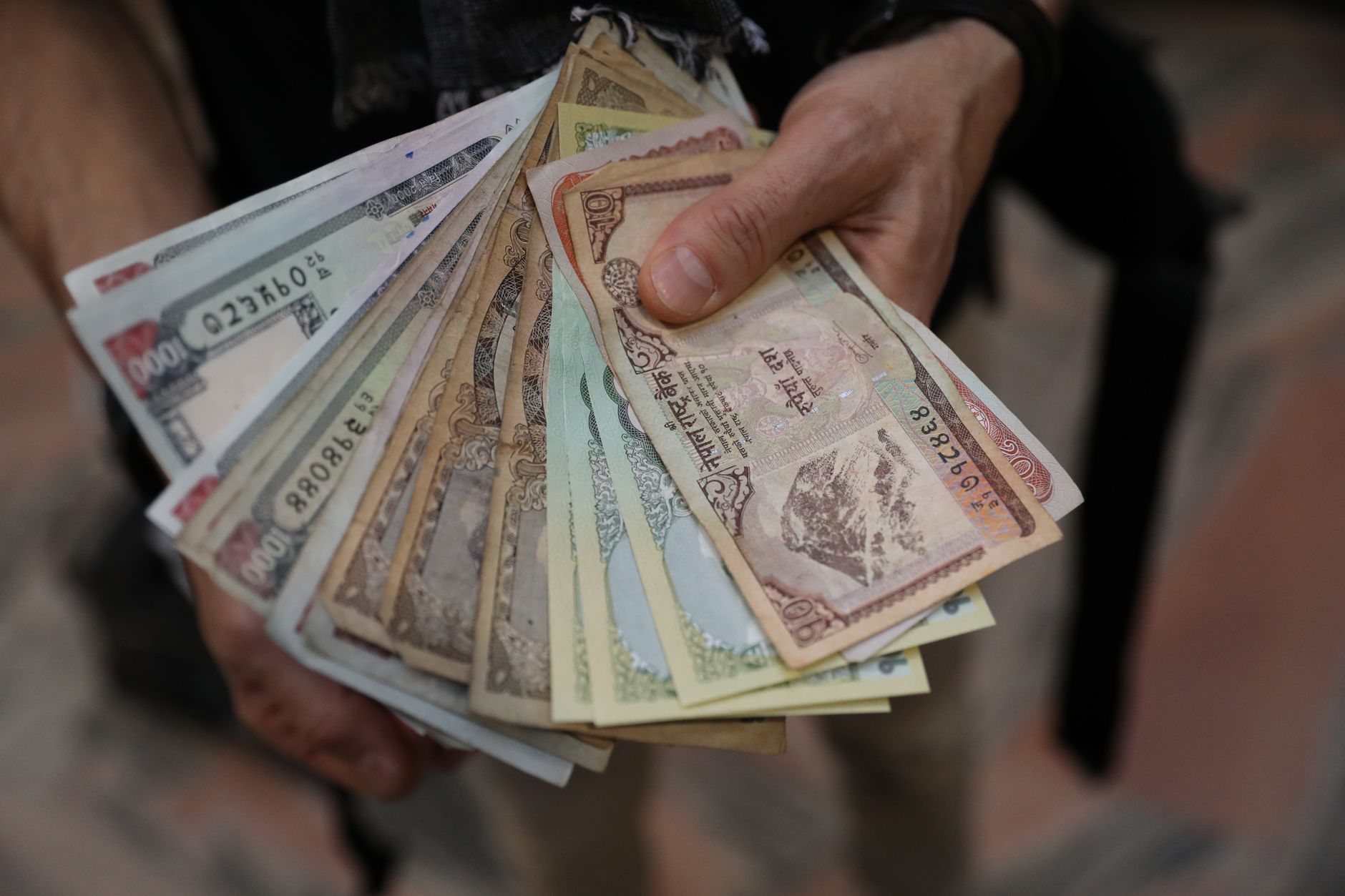
Egyptian banknotes run 5, 10, 20, 50, 100 and 200 pounds, with the 10 and 20 circulating in both paper and polymer versions — the polymer notes launched in 2022 and 2023 and both are legal tender, so don’t be thrown when handed a plastic twenty. The 200 is the largest note in everyday circulation, and it is what ATMs dispense almost exclusively.
This creates a daily logistical problem no amount of cultural understanding will solve. You need 10s and 20s constantly and the machines will not give them to you. Worse, “I have no change” is a genuine constraint about eighty per cent of the time and a technique the other twenty. Hand over a 200 for a £E 60 fare and there is a decent chance the change arrives as £E 100, with a shrug.
| Note | What it is for | How many to carry |
|---|---|---|
| £E 5 | Bathroom attendants; the absolute floor | 5–10 |
| £E 10 | Shoe minders, parking, cafe rounding | 10–15 |
| £E 20 | The workhorse — porters, small helps, taxi rounding | 10–15 |
| £E 50 | Housekeeping, felucca captain, bigger favours | 5–8 |
| £E 100 | Restaurant tips, concierge, drivers | 4–6 |
| £E 200 | What the ATM gives you. Break these constantly. | as few as possible |
Four tactics work. When you change money at a bureau, ask explicitly for part of it small — “five hundred in small bills, the rest large” — and they will do it without comment. Break 200s deliberately at supermarkets, pharmacies and station ticket windows, which always have change. Keep tip money in a pocket separate from your wallet, so reaching for £E 20 does not involve fanning out £E 3,000 in a stairwell. And when a driver claims no change, produce the exact fare from that pocket and let the tip be the rounding, rather than negotiating downward from a 200. Negotiating downward from a 200 never works.
Taxis, Uber and Careem behave completely differently
Ride-hailing has changed Cairo tipping more than anything else in the past decade. On Uber and Careem the fare is fixed by the app, there is nothing to argue about, and the driver’s incentive to inflate has gone. Careem offers an in-app tip; Uber’s Egypt setup does not let you raise the fare after the fact, whatever a driver suggests mid-journey. Drivers prefer cash anyway, because in-app payouts take time to clear. Twenty to thirty pounds at the end of a normal cross-town ride is a good tip; fifty for a long airport run with luggage handling. Our breakdown of how the two apps actually perform in Cairo traffic covers surge behaviour and the cash-payment option.
Street taxis are a different game. The white cabs have meters and a good share of drivers decline to use them for foreigners, which means you are agreeing a fare up front — and a fare you agreed to is a fare with the tip already inside it. Do not agree £E 150 for a £E 70 journey and then add twenty pounds on principle; you have already tipped, twice over. Round up to the next tidy number if the driver was decent, and no more. The tactics for getting a meter switched on are in our guide to handling Cairo’s street cabs without a fare argument. The same logic applies to pre-booked airport transfers, where the driver’s fee is already paid and £E 50–100 is a courtesy rather than an expectation.
Hotels, floor by floor
Hotel tipping scales with the property, and the common mistake is applying five-star amounts in a guesthouse or budget amounts in a palace on the Nile. The other mistake is saving everything for checkout. Housekeeping rotates, and whoever cleaned your room on Tuesday may not be working Saturday. Leave it daily, on the desk with a scrawled note rather than on the bed, where it reads as forgotten cash nobody dares touch.
| Staff member | Hostel / budget | Mid-range | Five-star |
|---|---|---|---|
| Porter, per bag | £E 10–20 | £E 20–30 | £E 50 |
| Housekeeping, per day | £E 20–30 | £E 30–50 | £E 50–100 |
| Doorman hailing a cab | — | £E 10–20 | £E 20–50 |
| Breakfast server | £E 10 | £E 20 | £E 30–50 |
| Room service delivery | — | £E 20–30 | £E 50 |
| Concierge, real problem solved | — | £E 100–200 | £E 200–500 |
The concierge line is the one people get wrong in both directions. A restaurant recommendation is not a tip event; it is the job. A concierge who gets you into a fully booked table on a Thursday, retrieves a passport left in a taxi, or rebuilds your driver arrangements at 6am is doing something worth real money. At the five-star properties strung along the river that role is thoroughly professionalised and the amounts above are unremarkable. In a twelve-room boutique place the same favour is often done by the owner, who will be faintly embarrassed by cash and would much rather have a review with his name in it.
Guides and drivers: why every source you read disagrees
Search “tipping in Egypt” and you will find full-day private guide figures ranging from about £E 250 to $50 per person per day. That is a tenfold spread on the same question, and it is not because anyone is lying. The sources have different interests.
Tour-operator blogs, which dominate page one for this search, publish the high numbers. Their clients are on $4,000 packages, their guides’ livelihoods depend on gratuities, and a well-tipped guide is an operational asset. Traveller forums publish the low numbers, sometimes indignantly; a recurring complaint on the Egypt boards is that suggested daily tips now exceed the guide’s own day rate. Both describe something real. The resolution is that the right number depends on what you booked and how much of your payment the guide already sees.
My working figures for 2026: a private guide for a full day in Cairo, booked directly and costing you perhaps £E 2,500–4,000, deserves £E 500–1,000 ($10–20) from a couple, not from each person. A guide supplied through an expensive international package, whose share of your payment is small, deserves more — $20–30 per couple per day is defensible there. A shared group guide gets $5–10 per person. On multi-day tours, tip at the end rather than nightly, and hand it over privately rather than in front of the group.
Drivers are consistently underpaid inside this system and almost always forgotten. A driver who sits in Cairo traffic for nine hours, waits outside three sites in 38-degree heat and gets you home alive should receive roughly half the guide’s amount, in his own envelope, from your own hand. Tour companies frequently neglect to mention him. If you are building your own day out to the Giza plateau and back, budget for both and hand the money over separately so neither is guessing.
Giza, camels, and the tip that is really a toll
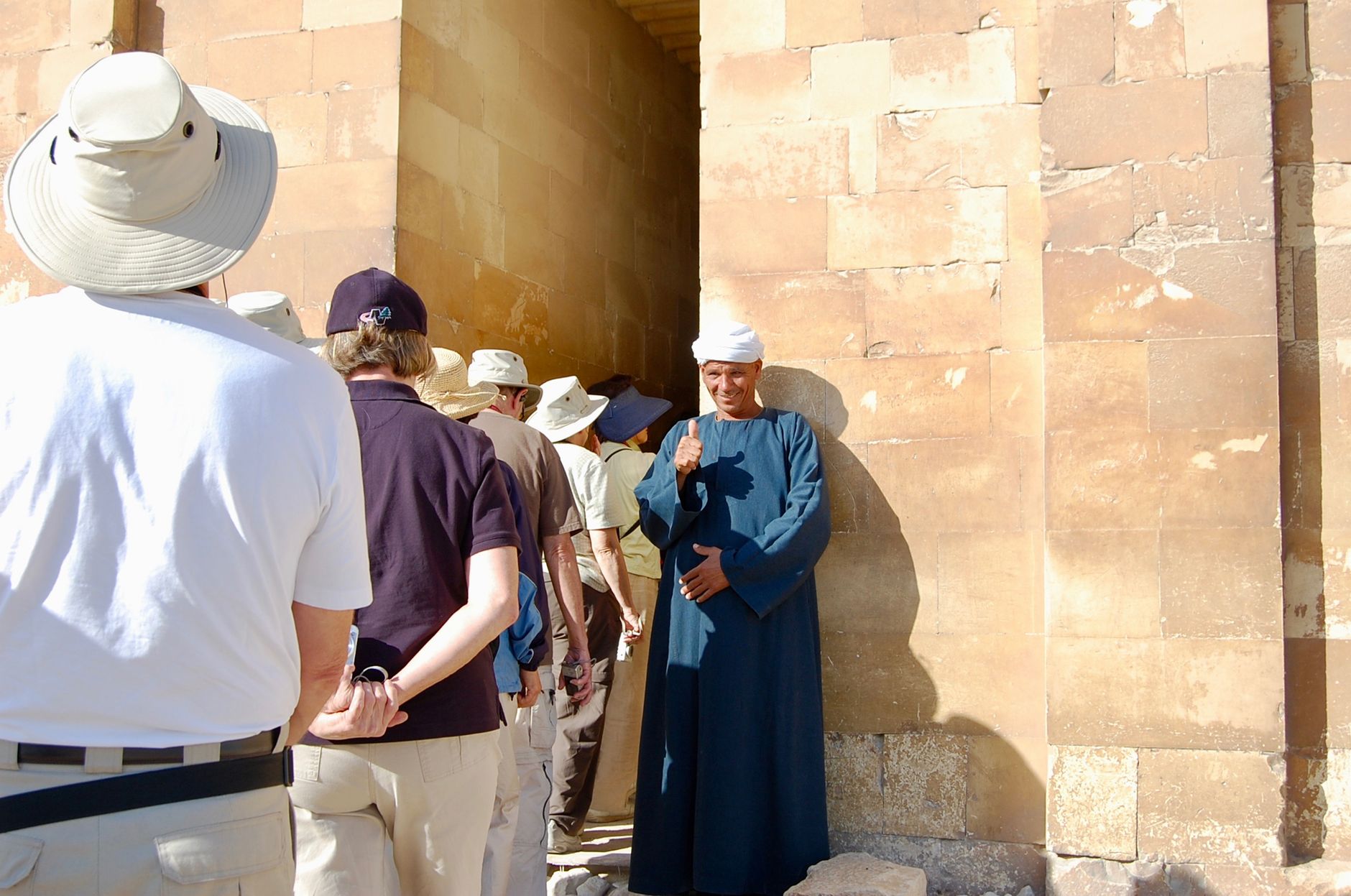
The pyramids concentrate every difficult version of baksheesh into two square kilometres, which is why most bad tipping stories start there. The patterns are consistent enough to name in advance.
The photo ambush: a handler walks a camel, horse or costumed figure into your frame unprompted, or offers to take a “special” shot from a clever angle, then holds your phone until money appears. The counter is simple. Do not hand your phone to anyone you did not approach first, and if an animal walks into your photo uninvited, no payment is owed. The price switch: a ride is quoted at £E 200, and at the far end you learn the quote was per person, or one way only, or excluded the return. Agree a total, for your whole party, for a return trip, and say the number back out loud before anyone mounts anything. Our piece on booking a camel ride at Giza without the theatrics goes through the going rates.
Then there are the site guards. A man in uniform beckons you behind a rope, points at a carving with a torch, and expects £E 50. Sometimes he is genuinely knowledgeable and it is the best thirty seconds of your morning. Often he is doing something he is not supposed to do, somewhere access or photography is restricted, and the tip is really the price of the transgression. I pay £E 20–50 when I have accepted the favour, and decline politely before it starts when I have not. The decline that works is a smile, “la, shukran” (no, thank you), and continuous walking. Stopping is consent.
The same dynamic runs at lower temperature through Khan el-Khalili’s crowded lanes, where someone will offer to show you a shop, a rooftop or the “real” workshop round the back. That is a commission arrangement, not a tip — the price you are later quoted has his cut inside it. And in the souks generally, a haggled price already contains the gratuity: the entire point of negotiating properly in Cairo’s markets is that you and the seller have agreed what the transaction is worth, and adding money afterwards quietly undoes the agreement.
Nile cruises, feluccas and dinner boats
Multi-day Nile cruises run a collective tip box, opened at the end and split among cabin stewards, waiters, deck crew and kitchen staff. Operator guidance clusters around $10–12 per person per night; traveller consensus sits a little lower at $8–10. Either is defensible, and this is the one category where the operators’ figure is basically honest, because the money genuinely spreads across thirty or forty people you never meet. On a four-night cruise that is $40–50 a head. Dahabiyas, with far higher crew-to-guest ratios, run to $15–20 per person per night. Shore excursions come with separate local guides and drivers at each stop who are not covered by the box.
Cairo’s short river experiences work on different rules. A dinner cruise is a restaurant that floats: tip the server who looked after your table £E 100–150 rather than dropping a lump sum at the desk on the way out, where it vanishes into the operation. A felucca is a haggled ride, usually £E 400–600 for an hour, and £E 50–100 to the captain afterwards is a real gesture at that scale rather than a token. Our guide to what is actually available on the water in Cairo lays out the fare ranges before you start negotiating on the Corniche.
The small stuff — and what a day of tipping really costs
The daily micro-tips are where visitors either over-engineer or quietly panic. Bathroom attendants get £E 5–10, and yes, pay it: the attendant is frequently supplying the paper out of pocket. Mosque shoe minders get £E 10–20 on the way out. Petrol pump attendants get £E 10. Informal parking attendants — the men who materialise the instant you park anywhere in Cairo — get £E 10–20, which is closer to a protection arrangement than a service, but it is universal and locals pay it without complaint. Delivery riders get £E 20. Supermarket baggers get £E 10 if you feel like it, and nobody minds if you don’t.
| Travel style | Daily tipping | ≈ USD/day | What is in it |
|---|---|---|---|
| Backpacker — hostel, metro, street food | £E 100–200 | $2–4 | Cafe rounding, one attendant, the odd porter |
| Independent mid-range — own transport, sit-down meals | £E 300–600 | $6–12 | Housekeeping, two restaurant tips, rides, small stuff |
| Private guide day at Giza or Saqqara | £E 800–1,500 | $16–30 | Guide, driver, site attendants, lunch, camel handler |
| Five-star with concierge and full service | £E 1,000–2,000 | $20–40 | Full hotel tier, drivers, fine-dining service |
Even the bottom row is modest against the cost of the trip that brought you here. For most independent visitors, tipping lands near 5–8% of daily spend — worth planning for, but not enough to move you into a different budget bracket. Set it against our full breakdown of what a week in Cairo costs, and cross-reference the money and daily-costs pillar for how it sits beside transport, tickets and accommodation.
Getting it wrong in both directions
Under-tipping in Cairo is a genuine unkindness in an economy where the variable portion of a wage is the portion that buys food. Almost every guide says so, and they are right. But over-tipping is not the safe error people assume, and this is the part almost nobody will tell you.
Handing a porter £E 500 does not read as generosity. It reads as somebody who does not know what money is worth, which is precisely the read that shapes your next six interactions — and word travels through a hotel faster than you will walk to the lift. Over-tipping also distorts the local market in ways that outlast your visit by years. When tourist-facing work pays several multiples of local-facing work, staff compete for foreign guests and Egyptian customers get the slower service; in small operations it pulls the best people out of jobs serving locals entirely. And every inflated tip ratchets the expectation for the traveller behind you. That is, mechanically, how the harassment at Giza got as persistent as it is: enough visitors have paid £E 500 for an unwanted photograph that asking has become worth the effort.
There is a third failure mode, too: tipping to buy your way out of discomfort. Paying someone to stop following you is understandable, and it works exactly once, for you, at the cost of teaching the behaviour to everyone watching. A firm “la, shukran” and a steady walking pace is more useful to everybody, including the next visitor down the path.
What nobody tells you about tipping in Cairo
The physical state of the notes matters: badly torn currency is often refused outright in Egypt, so keep tip notes flat and reasonably clean, and don’t pass on the shredded fiver someone gave you as change. Tips given in front of a manager can create problems for the recipient rather than credit, so pass money discreetly, folded, in a handshake. Nobody expects a tip in a fixed-price shop, a pharmacy, a mall food court or at a supermarket checkout, and offering one there is mildly odd rather than generous. Tipping is not customary for a doctor or a pharmacist — and offering money to a police officer or government official is a completely different transaction, one to stay well clear of.
During Ramadan, patience is worth more than cash to someone fasting since before dawn, though tips are still expected and often more needed than usual. Two Arabic words do a surprising amount of work: shukran (thank you) and khalas (enough, finished — delivered kindly, it ends a negotiation without rudeness). Learning a handful more before you fly changes the tone of these exchanges far more than the amounts do. And one practical point: card and mobile payment have spread fast across Cairo, so the more you tap, the less cash you carry, and the more often you get caught out at exactly the wrong moment. Withdraw with tipping in mind, not just spending.
Frequently asked questions
Should I tip in dollars or Egyptian pounds?
Pounds, for almost everything. With the pound stable at around 50 to the dollar through 2026 and the parallel-market premium largely gone, dollars now cost the recipient a trip to a bureau, a queue and a poor spread. The exceptions are Nile cruise tip boxes and guides working through international agencies, who are accustomed to dollars for larger sums. Never tip in foreign coins — Egyptian banks will not exchange them.
Do I still tip if the bill already shows a 12% service charge?
Yes, 5–10% in cash. The service charge is collected by the business and distributed through an internal formula, with a portion retained against salaries and costs. What reaches your individual server is a delayed fraction, pooled with everyone else’s. Cash handed over directly is the only tip that reliably reaches the person who served you. The 14% VAT on the same bill is national tax, and no member of staff sees any of it.
How much should I tip a private guide for a full day in Cairo?
Roughly £E 500–1,000 ($10–20) per couple for a directly-booked private day, and $20–30 per couple where the guide came through an expensive international package and sees only a small share of what you paid. Shared group tours run $5–10 per person. The much higher figures quoted online come mostly from tour-operator blogs whose guides depend on gratuities. Tip the driver separately, at around half the guide’s amount.
What do I do when someone says they have no change?
Assume it is true, because usually it is. The fix is preparation rather than confrontation: keep a separate pocket of 10s and 20s and produce the exact amount. If you are already stuck holding a 200-pound note for a £E 60 fare, offer to walk to a nearby shop and break it, which almost always produces change that was unavailable a moment earlier. Never hand over a large note expecting change to be found for you.
Is it rude to refuse to tip someone who demanded it?
No. Baksheesh for unsolicited help — a stranger who points at a doorway, walks into your photograph, or grabs your bag without being asked — is a toll rather than a gratuity, and declining is ordinary behaviour Egyptians engage in constantly. Say “la, shukran” with a smile and keep walking. Stopping to argue reads as the opening of a negotiation, and paying to end the encounter only teaches the behaviour.
How much cash should I carry each day for tips?
For a typical independent mid-range day, £E 300–600 ($6–12) covers everything, held mostly in 10s, 20s and 50s. A full private-guide day at the pyramids pushes it to £E 800–1,500. Withdraw more than you think you need on arrival, because ATMs dispense 200-pound notes and you will spend the first day converting them into usable denominations at supermarkets and pharmacies.
Do I tip Uber and Careem drivers in Cairo?
Optional and appreciated. Careem has an in-app tip; Uber in Egypt does not let you raise the fare after the trip, whatever a driver may suggest. Cash is preferred either way, because in-app payouts take time to clear. Twenty to thirty pounds on a normal cross-town ride is right, and £E 50 for a long airport run with luggage handling. Since the fare is fixed there is nothing to negotiate, which makes it far less fraught than a street taxi.
What is the minimum tip that is not insulting?
Five pounds — about ten US cents — for the smallest services, such as a bathroom attendant. Ten pounds is the practical floor for anything involving real effort. Below that, give nothing rather than passing over coins; Egyptian coins are barely used in daily life and handing over a few is received worse than a polite refusal. Small and frequent beats large and occasional, for you and for the wider economy.
Should I give money to children asking for baksheesh?
A judgement call, and most long-term residents say no. Giving cash to children at tourist sites keeps them out of school and in the trade, which is precisely why the practice persists year after year. If you want to give, give to an adult providing an actual service, or to a recognised charity. Pens and sweets, which older guidebooks used to suggest, carry the same problem in a different wrapper.
Where I would land on all of this
Carry £E 400 a day in 10s, 20s and 50s, in a pocket that is not your wallet. Tip 10% in cash at restaurants regardless of what the service line says, £E 20 for most small helps, £E 50 a day for housekeeping, and £E 500–1,000 to a guide who gave you a genuinely good day. Pay in pounds, pay discreetly, and always pay the bathroom attendant. Then decline everything unsolicited without a flicker of guilt, because the person who helped without being asked was not, in fact, helping you. Get those five habits right and the whole business stops being a source of low-grade anxiety and turns back into what it is meant to be — a small, ordinary courtesy in a city that runs on them.