
This article contains advertising. Our booking links are routed through a partner that adds commission tracking automatically, so if you book through one we earn a commission from the provider, at no extra cost to you. It never affects what we recommend. Affiliate disclosure
Nine hours sounds like plenty. The pyramids are only an hour or so away, the plane lands at seven in the morning, and surely that leaves most of the day for Giza. Then you do the arithmetic properly — the walk from the aircraft, the visa desk, passport control, the drive across Cairo, the drive back, and the three hours you need at the airport before your onward flight — and the “most of the day” shrinks to about two hours on the plateau. That is still worth doing. But it is the difference between a good cairo airport layover and a missed connection, and it is why this page starts with a calculator rather than a list of things to see.
Here we cover the layover maths step by step, the rules for staying airside, the three ways to leave the airport legally — including Egypt’s free 96-hour transit visa for passengers on Egyptian airlines — what happens to your bags, when EgyptAir will put you up in a hotel for free, and what is realistic for layovers of every length. Rules and prices were checked in September 2026. For the terminals themselves, see our guide to Cairo’s three airport terminals, and for everything else about the airport, our complete Cairo airport guide.
The short answer: how long is long enough?
| Layover | Leave the airport? | What is realistic |
|---|---|---|
| Under 3 hours | No | Make your connection. If it involves a terminal change or separate tickets, this may be too tight already |
| 3–6 hours | No | Eat, rest, a lounge or a sleep pod |
| 6–9 hours | Only for somewhere close, in daylight | Heliopolis at a push; the pyramids are too far to be safe |
| 9–12 hours, daytime | Yes, with a visa and a pre-booked driver | The pyramids and the Sphinx, or the Grand Egyptian Museum — one, not both |
| 12–24 hours | Yes | Giza and the museum together, or a hotel night and a morning at the pyramids |
| 24–96 hours | Yes, and it may cost nothing if you are on an Egyptian airline | A proper short stay in Cairo |
Two things matter as much as the number of hours: the time of day you land, and whether both of your flights are on one ticket. An eleven-hour layover from 22:00 to 09:00 is a night in a sleep pod, because nothing is open. A ten-hour layover on separate tickets is closer to six usable hours, because you have to collect and re-check your bags.
The layover maths, step by step
This is where the time goes when you leave the airport. The left-hand column is a smooth daytime run; the right-hand column is what happens at night, at peak times or when things go slightly wrong.
| Step | Good run | Bad run |
|---|---|---|
| Off the aircraft and to the visa desk (bus from a remote stand is common) | 15–20 min | 30–45 min |
| Visa: transit desk, visa-on-arrival booth, or e-Visa check | 10–20 min | 30–45 min |
| Passport control | 10–15 min | 30–60 min |
| Find your driver and reach the car | 10 min | 20 min |
| Drive to Giza | 60–70 min | 90 min or more |
| Drive back to the airport | 60–70 min | 90 min or more |
| Back at the airport before departure: terminal-door security, check-in, exit immigration, gate security | 3 hours | 3 hours |
| Overhead before you see anything | About 6.5 hours | 8.5 hours or more |
Subtract the overhead from your layover and what is left is your sightseeing time. On a nine-hour layover with a good run, that is about two and a half hours in Giza — enough for the Panorama Point, the Great Pyramid and the Sphinx at a steady pace. On eight hours it is barely an hour and a half, and a bad run wipes it out entirely, which is why we draw the line at nine. The three-hour return buffer is not excessive caution: the security check at the terminal entrance, the check-in queue for evening long-haul departures and exit immigration can each take half an hour or more on their own.
Two worked examples
Ten hours, landing at 07:00, leaving at 17:00. You clear the airport by about 08:00 and reach Giza around 09:15. To be back at the airport by 14:00 you must leave Giza by about 12:30, before the afternoon traffic builds. That gives you three hours and a bit: the pyramids and the Sphinx comfortably, or the Grand Egyptian Museum on its own. Trying to do both in that window means rushing each and leaving no margin for traffic. Pick one.
Twelve hours, landing at 07:00, leaving at 19:00. Now you can be at the plateau when it opens, move on to the museum, two kilometres away, for late morning, eat lunch there, and leave Giza at around 14:30 to be back by 16:00. The catch is that you are driving back into the start of the weekday afternoon rush, so leave earlier rather than later. The way to sequence the two sights on the same day is set out in our plan for the GEM and the pyramids in one day.
Time of day matters as much as length
The Giza plateau opens at 07:00 on its current official hours and closes around 17:00, with last entry about an hour earlier. The Grand Egyptian Museum’s galleries open from 09:00 to 18:00 on Sundays, Mondays, Tuesdays, Thursdays and Fridays, and until 21:00 on Wednesdays and Saturdays, with last entry an hour before closing. Cairo’s traffic is at its worst on weekday afternoons and early evenings. Put those together and a layover’s shape becomes clear.
| You land | What works |
|---|---|
| Before 08:00 | The ideal slot. Reach Giza for the cool, quiet first hours |
| 08:00–12:00 | Fine for the museum, which is air-conditioned; the plateau will be hotter and busier |
| 12:00–16:00 | Possible on a long layover, but you meet the afternoon traffic in both directions |
| 16:00–22:00 | The museum’s late opening on Wednesdays and Saturdays, or the sound and light show at Giza; otherwise rest |
| 22:00–06:00 | Nothing is open. Sleep, and sightsee in the morning if your layover runs on |
Staying airside: the transit rules
If both flights are on one ticket and you are not leaving the airport, you are a transit passenger. Follow the signs for flight connections rather than for arrivals, go through transfer security, and head for your departure gate or the transfer desk if you do not yet have a boarding pass. You do not pass through immigration, and for most nationalities you do not need a visa while you remain in the international transit area.
The complications are terminal changes and separate tickets. A connection between Terminals 2 and 3 can usually be made within the complex, since the two are joined by an airbridge. A connection to or from Terminal 1, which is a separate building, is more involved, so ask at your first check-in desk or the transfer desk in Cairo how your transfer works, and allow extra time. Our terminals guide gives realistic buffers for each combination.
On an airside layover of several hours, the airport has more to offer than it used to. Sleep pods have been available in all three terminals since 2025, rentable by the hour. Terminal 3, EgyptAir’s hub, has the widest range of food and shopping, and the Le Méridien Cairo Airport hotel is linked directly to it by a bridge.

Leaving the airport: your three visa routes
To leave the airport at all, you have to enter Egypt, which means passing immigration with a valid visa. There are three ways to do that, and one of them is free.
1. The free 96-hour transit visa
Egypt offers a free transit visa that lets you leave the airport and travel in the country for up to four days. The conditions are specific:
- Your layover must be at least 8 hours and no more than 96 hours.
- Both your inbound and your outbound flights must be on an Egyptian airline: EgyptAir, Air Cairo or Nile Air. Passengers on foreign airlines do not qualify.
- It applies at Cairo and at five other international airports: Luxor, Aswan, Hurghada, Sharm el-Sheikh and Borg El Arab in Alexandria.
- It is open to nationalities that are eligible for Egypt’s visa on arrival, which includes the US, the UK, Canada, Australia and the EU countries, among others.
- There is no advance application. At the airport desk you fill in a form and show your passport, which needs at least six months’ validity, and your onward boarding pass or ticket. Reports put the process at around 15–20 minutes, depending on queues.
The scheme began as a trial and has been extended more than once; the latest extension, announced in late December 2025, runs until April 2027. Because it is time-limited, confirm it is still running before you plan a layover around it. If you qualify, it is the single best deal in Egyptian travel: a free visa and a free day at the pyramids, minus the driver.
2. Visa on arrival
Travellers from eligible countries who are not on an Egyptian airline, or whose layover falls outside the 8-to-96-hour window, can get a single-entry tourist visa on arrival, which has cost USD 30 since March 2026. At Cairo there are two versions. The digital QR visa, piloted since August 2026, costs USD 36 including a service charge, is paid by card and can be bought online in the week before you fly — which removes the visa queue from your layover entirely — or at kiosks in the arrivals halls. The paper sticker is still sold at the bank counters before passport control, traditionally for cash, with clean US dollar notes the safest; on a busy night those counters can be the slowest part of leaving the airport.
3. An e-Visa in advance
The e-Visa is applied for online before you travel (check the current fee on the official portal), is valid for 90 days from issue for a stay of up to 30 days, and lets you walk straight past the visa counters — worth a great deal on a tight layover. Nationalities that cannot get a visa on arrival should apply in advance or stay airside. Eligibility by nationality, and the edge cases, are covered in our guide to Egypt visa requirements.
| Route | Cost | Who it suits | Catch |
|---|---|---|---|
| Free transit visa | Free | EgyptAir, Air Cairo or Nile Air passengers with 8–96 hours | Both flights must be on an Egyptian airline; time-limited scheme |
| Visa on arrival | USD 30 paper sticker; USD 36 digital QR | Eligible nationalities on any airline | Buy the QR online to skip the queue; the sticker is traditionally paid in cash |
| e-Visa | Check the official portal | Anyone eligible who plans ahead | Apply before you fly; carry the approval |
What happens to your bags
This is the question that decides how much of your layover you actually get.
One ticket, bags checked through
If your flights are on a single booking, your checked bags are normally sent through to your final destination and you never see them in Cairo. Confirm it at your first check-in desk: look at the bag tag, which should show your final airport’s three-letter code, not CAI. If it does, you can leave the airport on a visa with just your hand luggage, come back through departures security and go to your gate. If you did not get your onward boarding pass at your origin, collect it from the transfer desk or your airline’s check-in counter when you return.
On longer stopovers — typically anything over 24 hours — airlines may check bags only as far as Cairo, so you collect them on arrival. Ask when you check in rather than finding out at the belt.
Separate tickets
If you booked two flights separately, Cairo is not a connection in the airlines’ eyes; it is two unrelated journeys. You have to enter Egypt (so you need a visa even if you had no intention of leaving the airport), collect your bags from the belt, go through customs, make your way to the right departures terminal, and check in again with your second airline. Two cautions. Check-in counters usually open around three hours before departure, so if you arrive very early you may have to wait landside with your bags. And if your first flight is late and you miss the second, the second airline owes you nothing. Allow at least four hours for a separate-ticket change at Cairo, and more at night.
Sightseeing with bags
If you do have to collect your bags and want to see something, the simplest option is a private driver or layover tour that keeps your luggage in the car while you visit. Agree it in writing when you book, and do not leave valuables or passports in the vehicle.
When EgyptAir pays for your hotel
EgyptAir publishes conditions under which it may provide a hotel, meals and transport for passengers with a long connection in Cairo. The main points:
- The connection must be at least six hours for business class and full-fare economy (fare classes Y and B), or at least eight hours for other economy fares.
- It covers a maximum of 24 hours, and only when you arrive on the last available flight and leave on the first available connection — in other words, when a long wait is unavoidable rather than chosen.
- It does not apply to separate tickets, heavily discounted fares, some interline tickets or group bookings.
- Arrange it with EgyptAir customer service before you travel, or at the transfer desk in Cairo, where you are given a voucher.
Check the conditions for your specific fare before counting on it. If you qualify, the hotel stay also means you need to enter Egypt, so you will need a visa — and if you are on EgyptAir both ways with a connection of eight hours or more, the free transit visa may cover that.
What to do with your layover
Three to six hours: stay put
Eat, stretch, charge everything, and if it is late, rent a sleep pod for a few hours. This is not a layover for leaving the airport, however close the pyramids feel.
Six to nine hours: rest, or stay close
The pyramids are out of reach with a safe margin. If you have a visa and it is daytime, the nearest worthwhile outing is in Heliopolis, the airport’s own district: the Baron Empain Palace, a Belgian industrialist’s Hindu-temple-inspired mansion, is a short drive away and makes a memorable hour; our guide to the Baron Empain Palace has the details. Honest verdict: unless you are on the free transit visa, paying for a visa to see one building is marginal value. A sleep pod may do you more good.
Nine to twelve hours: one big sight
The pyramids and the Sphinx, or the Grand Egyptian Museum. For the plateau, our guide to visiting the Pyramids of Giza covers the new entrance, the shuttle and what to prioritise. For the museum, remember that tickets are sold online only in timed slots, so book before you fly using our GEM ticket booking guide. Plateau entry is EGP 700 (about USD 15) for a foreign adult, card only; the museum is EGP 1,450 (about USD 30).
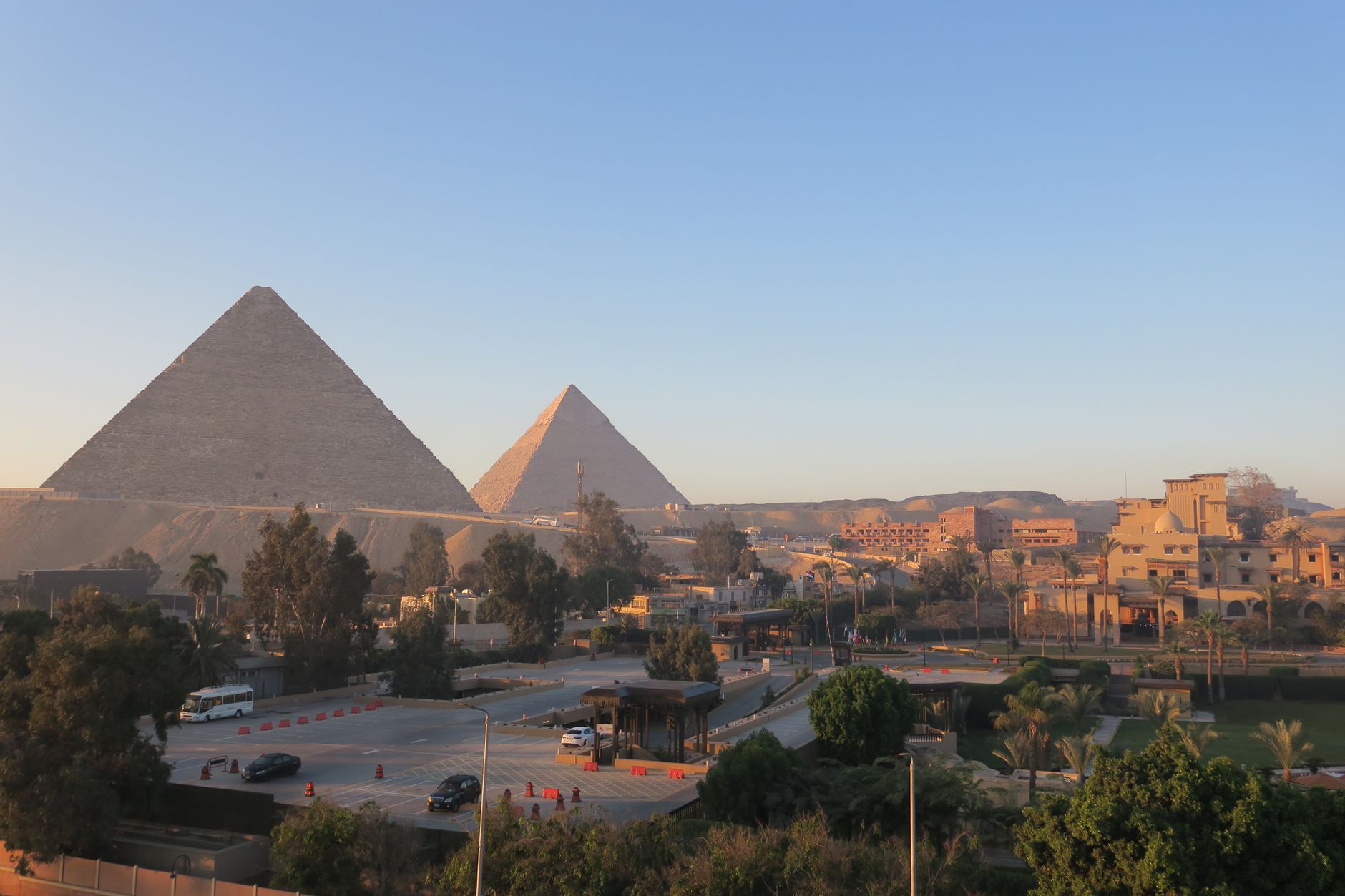
Twelve to twenty-four hours: Giza properly
Both sights, with lunch in between, or a night in a hotel and the pyramids at opening time the next morning. For an overnight layover, the Le Méridien’s bridge to Terminal 3 makes it the least stressful bed, though hotels in Giza put you ten minutes from the plateau for a dawn start.
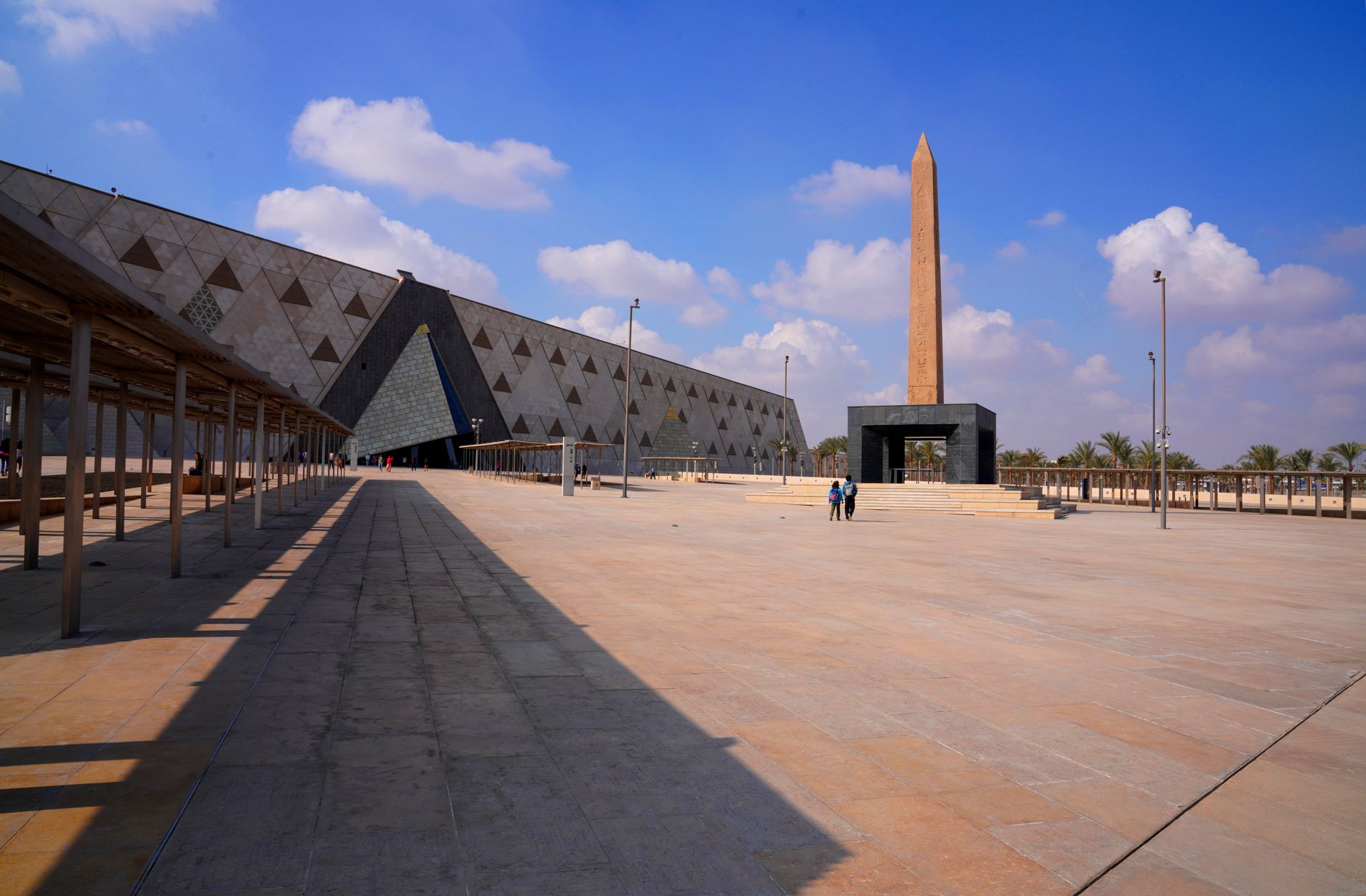
One to four days: a short stay
With a day or more, you are no longer doing a layover so much as a mini-break, and on an Egyptian airline the free transit visa may make it cost nothing extra. Our plans for one day in Cairo and two days are built for exactly this.
Getting to Giza and back
On a layover, pre-book. A private driver or a dedicated layover tour will meet you at arrivals, keep an eye on the clock and, crucially, have a reason to get you back on time. Ride-hailing apps work well from the airport if you have data, and are much cheaper, but you are then managing the timing yourself, including finding a car back in the afternoon rush. Whatever you choose, give your driver your onward departure time, not just your pickup time, and ask them to plan backwards from it.
Honest verdict on layover tours: most are well run. But an operator who does not ask for your departure time, or who happily books a pyramids tour on a seven-hour layover, is telling you something important about how they will handle the return. Walk away.
A layover checklist
Run through this before you board the flight into Cairo, not after you land:
- Visa route decided. Free transit visa (both flights on an Egyptian airline, 8–96 hours), the digital visa-on-arrival QR code bought online (or clean US dollars for the paper sticker), or an e-Visa approval saved on your phone and printed.
- Onward boarding pass in hand, or a clear plan for where you will collect it when you come back.
- Bag tag checked for your final destination code.
- Driver or tour booked, with your onward departure time in the booking, not just the pickup time.
- Museum ticket booked online if the Grand Egyptian Museum is the plan.
- A payment card that works abroad, because the ticket windows at the pyramids are card-only, plus some small Egyptian pounds for tips and water.
- Data on your phone — an eSIM set up before you fly saves a queue at the arrivals kiosks.
- Hat, sun cream and water for the plateau, and nothing in your day bag you would mind carrying for six hours.
Mistakes that turn layovers into missed flights
- Counting the layover from landing to take-off. Take off at least three hours for the airport at the end and an hour or more for the airport at the start.
- Assuming you qualify for the free transit visa. Both flights must be on EgyptAir, Air Cairo or Nile Air, the layover must be 8–96 hours, and your nationality must be eligible for a visa on arrival.
- Forgetting that separate tickets mean immigration. Even if you never planned to leave the airport, you have to enter Egypt to collect and re-check your bags.
- Trying to do the pyramids and the museum on nine hours. Choose one.
- Leaving Giza in the afternoon rush. Leave earlier than feels necessary; the traffic back to Heliopolis is the least predictable part of the day.
- Turning up at the museum without a booking. Tickets are online only, in timed slots.
- Not checking your bag tag. If it says CAI rather than your final destination, your bag is waiting for you in Cairo.
- Relying on a free hotel you have not confirmed. EgyptAir’s accommodation depends on your fare and your flight times.
Frequently asked questions
Can I leave Cairo airport during a layover?
Yes, if you have a valid visa and enough time. You can use Egypt’s free transit visa if both your flights are on EgyptAir, Air Cairo or Nile Air and your layover is 8–96 hours; otherwise eligible nationalities can get a visa on arrival (USD 30 as a paper sticker, or USD 36 as a digital QR code bought online or at the airport kiosks) or an e-Visa in advance. Allow at least nine hours if you want to see the pyramids.
Do I need a visa for a layover in Cairo?
Not if you stay airside on a single ticket; for most nationalities, transit passengers who remain in the international area do not need one. You do need a visa if you leave the airport, stay in a hotel outside the terminals, or have separate tickets that require you to collect and re-check your bags.
How long a layover do I need to see the pyramids?
Nine hours is the practical minimum, and ten to twelve is comfortable. Getting out of the airport, driving to Giza and back, and being at the airport three hours before your next flight takes about six and a half hours on a good day, before you have seen anything. Landing early in the morning helps enormously.
What is Egypt’s free transit visa?
A free visa, issued at the airport, that lets transit passengers leave the airport and travel in Egypt for up to 96 hours. You qualify if both flights are on EgyptAir, Air Cairo or Nile Air, your layover is between 8 and 96 hours, and your nationality is eligible for a visa on arrival. The scheme has been extended until April 2027; confirm it is still running before you travel.
Do I have to collect my bags during a layover in Cairo?
On a single ticket, usually not: bags are normally checked through to your final destination, though airlines may check them only to Cairo on stopovers of more than about 24 hours. On separate tickets, yes — you must enter Egypt, collect them, clear customs and check in again, so allow at least four hours.
Does EgyptAir give free hotels for layovers in Cairo?
Sometimes. EgyptAir’s published conditions offer accommodation, meals and transport for connections of six hours or more on business and full-fare economy, or eight hours or more on other economy fares, up to 24 hours, when no earlier connection exists. Separate tickets and heavily discounted fares are excluded. Arrange it in advance or at the transfer desk.
Is a three-hour connection enough at Cairo?
On a single ticket within the same terminal, or between Terminals 2 and 3, usually yes. Between Terminal 1 and the other terminals it is tighter, and on separate tickets it is not enough at all, because you have to clear immigration, collect your bags and check in again. For separate tickets, allow at least four hours.
If you would rather hand the timing to someone else, a private layover tour is the least stressful way to see Giza between flights. Our guide to the best Cairo layover tours compares the types, 2026 price bands and the questions to ask an operator before you pay.
If your layover runs overnight, where you sleep depends on whether you can clear immigration. The pods, the lounges and the shuttle hotels are compared in our guide to sleep pods and hotels at Cairo airport.
On an airside layover of three to six hours, a lounge is often the most comfortable place to spend it. Which lounges are in which terminal, who gets in free with a card or status, and what walk-up entry costs are all in our Cairo airport lounge guide.
On a tight layover, buying the digital visa-on-arrival QR code online in the week before you fly takes the visa queue out of the equation entirely. How it works, what it costs and what to do if the kiosks or your card let you down are covered in our guide to getting a visa on arrival at Cairo airport.
Related Cairo Guides
- The Grand Egyptian Museum: the complete visitor guide
- Getting from the airport into Cairo
- Uber and Careem in Cairo
- Getting online in Cairo
Photo Credits
An EgyptAir airliner on final approach to Cairo International Airport at sunset (featured image): photo by Azizofegypt, via Wikimedia Commons (CC BY-SA 4.0).
The Food Village food court in Terminal 3: photo by Roland Unger, via Wikimedia Commons (CC BY-SA 3.0).
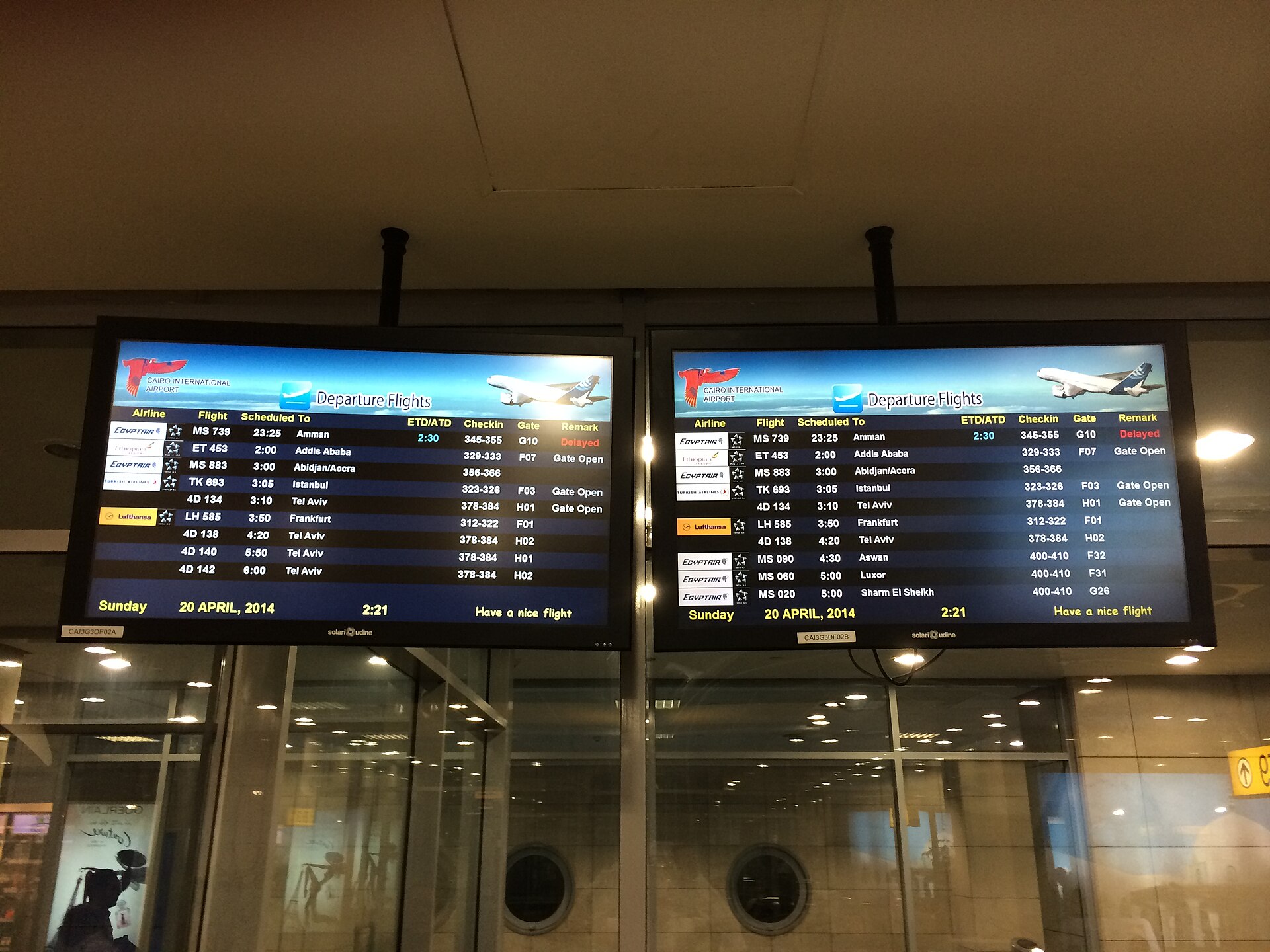
Departures screens at Cairo International Airport: photo by Eassa, via Wikimedia Commons (CC BY-SA 3.0).