This article contains advertising. Our booking links are routed through a partner that adds commission tracking automatically, so if you book through one we earn a commission from the provider, at no extra cost to you. It never affects what we recommend. Affiliate disclosure
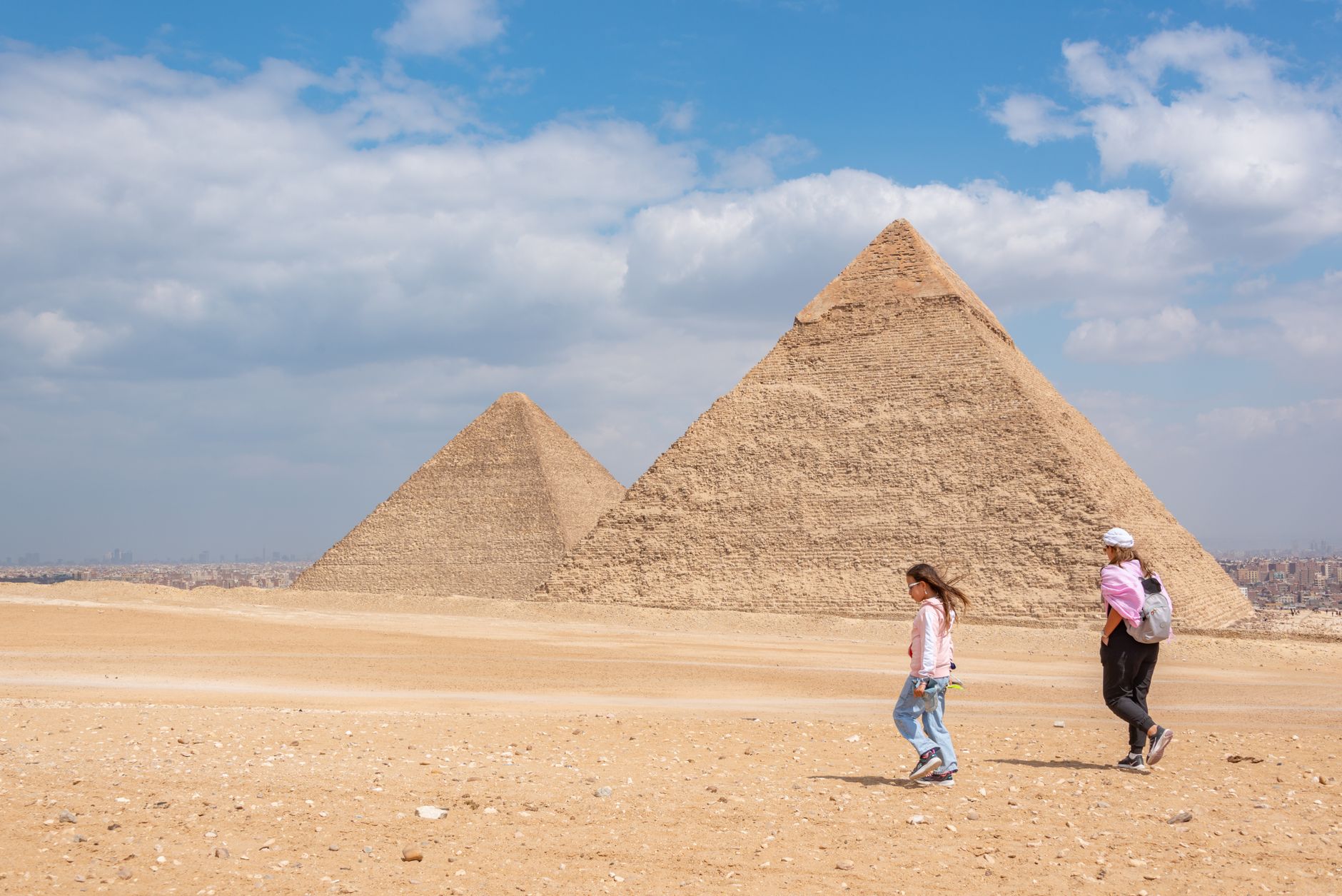
At ten past seven on a February morning, the electric shuttle drops you at the Panorama Point on the Giza plateau and there is almost nobody there. The pyramids line up across the sand, the air is cool enough for a jumper, and a six-year-old can run fifty metres in a straight line without colliding with anyone. Come back at half past eleven and the same spot is hot, loud and packed with people who arrived by the shuttle-load for the same photograph. Nearly every decision in a good cairo itinerary with kids comes back to that contrast: do the big thing first, be finished before the heat and the crowds peak, and never stack two big things on one day.
This page is the plan itself — five days, hour by hour, built for a family with children somewhere between four and twelve, with swaps for toddlers and teenagers, a three-day squeeze and a seven-day stretch. It deliberately does not repeat the general family advice (what children will eat, what to pack, health, and how to handle the vendors), which lives in our guide to Cairo with kids. Prices were checked in September 2026 and are given in Egyptian pounds with a US dollar equivalent at roughly EGP 48 to the dollar. The pound has repriced sharply several times in recent years, so treat them as the right order of magnitude rather than a quotation.
The five-day family plan at a glance
The shape is simple. Two days in Giza for the two headline sights, one day in the medieval city, one flexible day chosen by the ages of your children, and an arrival day with nothing in it. Costs are for two adults and two children aged six to twelve, and cover entry tickets only.
| Day | Morning (the big thing) | Afternoon | Evening | Tickets, family of four |
|---|---|---|---|---|
| 1 | Arrive, transfer to the hotel | Sleep, then the pool | Early dinner, early night | Nil |
| 2 | Pyramids and Sphinx from opening time | Lunch, pool, nap | Sound and light show, or a rooftop view of it | EGP 2,100 (~USD 44) plateau entry |
| 3 | Grand Egyptian Museum, 09:00 slot | Lunch on site, then rest | Free | EGP 4,360 (~USD 90) |
| 4 | Al-Muizz Street, Khan el-Khalili, Bab Zuweila | Al-Azhar Park | Dinner in the park or back at base | Small per-site fees |
| 5 | Flex: Pharaonic Village, Saqqara, the mummies at NMEC or a theme park | Rest | Felucca at sunset | Varies by choice |
If that looks thin, good. Every family that has come back from Cairo exhausted and arguing has done the opposite: museum in the morning, pyramids after lunch, souk in the evening, and a child asleep face-down in a plate of koshary by nine. The city is loud, hot, slow to cross and endlessly stimulating. One big thing a day is not a compromise. It is the whole trick.
The four rules the plan is built on
One big thing a day
The pyramids, the Grand Egyptian Museum and the medieval city each deserve a fresh child. Adults with stamina can combine Giza and the museum — we lay out how in the GEM and the pyramids in a single day — but with children under ten the second half of that day is reliably the worst part of the holiday. Split them, and both become the best part.
Out the door by eight, finished by one
Cairo’s heat is the enemy of small people, and even in winter the midday sun on the plateau is fierce. The plan front-loads every outdoor sight into the morning and keeps the afternoons for pools, naps, parks and air-conditioned interiors. In December and January you can stretch this, since highs sit around 18–24 °C; from June to September, when the thermometer climbs into the mid-thirties and beyond, treat 11:00 as a hard stop for anything outdoors.
One base, with a pool
Moving hotels with children costs you half a day every time, and Cairo traffic makes a cross-city move feel longer than a flight. Pick one base and commute from it. A pool is not a luxury on this trip; it is the reward that makes the early mornings negotiable, and it is where the afternoons are spent.
A car and driver on the big days
The metro is cheap and fine for adults, but it does not reach Giza’s new plateau entrance or the museum’s front door, the stations have stairs, and rush-hour carriages are no place for a pushchair. For days two to five, book a car and driver through your hotel or a reputable local operator. Expect roughly USD 35–60 for a full day depending on hours and distance, and agree the price, the hours and “no shopping stops” before you set off. Short hops in between work well on Uber or Careem, at around EGP 150–350 (USD 3–7) for a cross-city ride, more at rush hour.
Where to base yourselves
For a four- or five-day family trip, Giza wins. Two of your four sightseeing days are there, the pyramids and the museum are ten or fifteen minutes from the hotels around the plateau, and several of those hotels have big gardens and pools with the pyramids in view — which, for a child, turns breakfast into a sighting. The medieval city is then a single car day, forty-five minutes to well over an hour each way depending on traffic.
The case for a central base — Zamalek, Garden City or a Nile-side hotel downtown — is stronger with teenagers, who will get more out of evenings in the city, and on trips of a week or more. Either way, the specific properties, room configurations and which ones actually welcome children are covered in our round-up of family-friendly hotels in Cairo. The one thing to confirm before booking, whatever the star rating, is whether the pool is heated in winter; many are not, and a December swim in an unheated pool is a short one.
Day 1: Land, sleep, swim
Do nothing today. That is the plan.
Cairo International Airport sits on the north-eastern edge of the city, and Giza is on the far south-western side, so the transfer can run anywhere from an hour to an hour and a half. Pre-book it. Ordinary taxis and ride-hailing cars almost never have child seats, and after a long flight you do not want to be negotiating in the arrivals hall with a tired four-year-old on your hip. The options, and what each costs, are in our guide to getting from the airport into the city; if car seats matter to you, bring your own or ask the transfer company in writing whether they will supply them.
Once you are checked in, sleep if you need to, then swim. If your hotel has a view of the pyramids, take the children to see them lit by the late-afternoon sun from the garden or the terrace — it is a free preview that makes tomorrow’s early start an easy sell. Eat early. Egyptians dine late, and a family arriving at a restaurant at 18:30 will often have the place almost to themselves, with staff who have time to fuss over the children. Resist every temptation to squeeze in the sound and light show on night one.
Day 2: The pyramids and the Sphinx, done before lunch
The morning, hour by hour
- 06:30 — Early breakfast, or ask the hotel the night before for a packed one. Sun cream on before you leave, hats in the bag, and at least a litre of water per person.
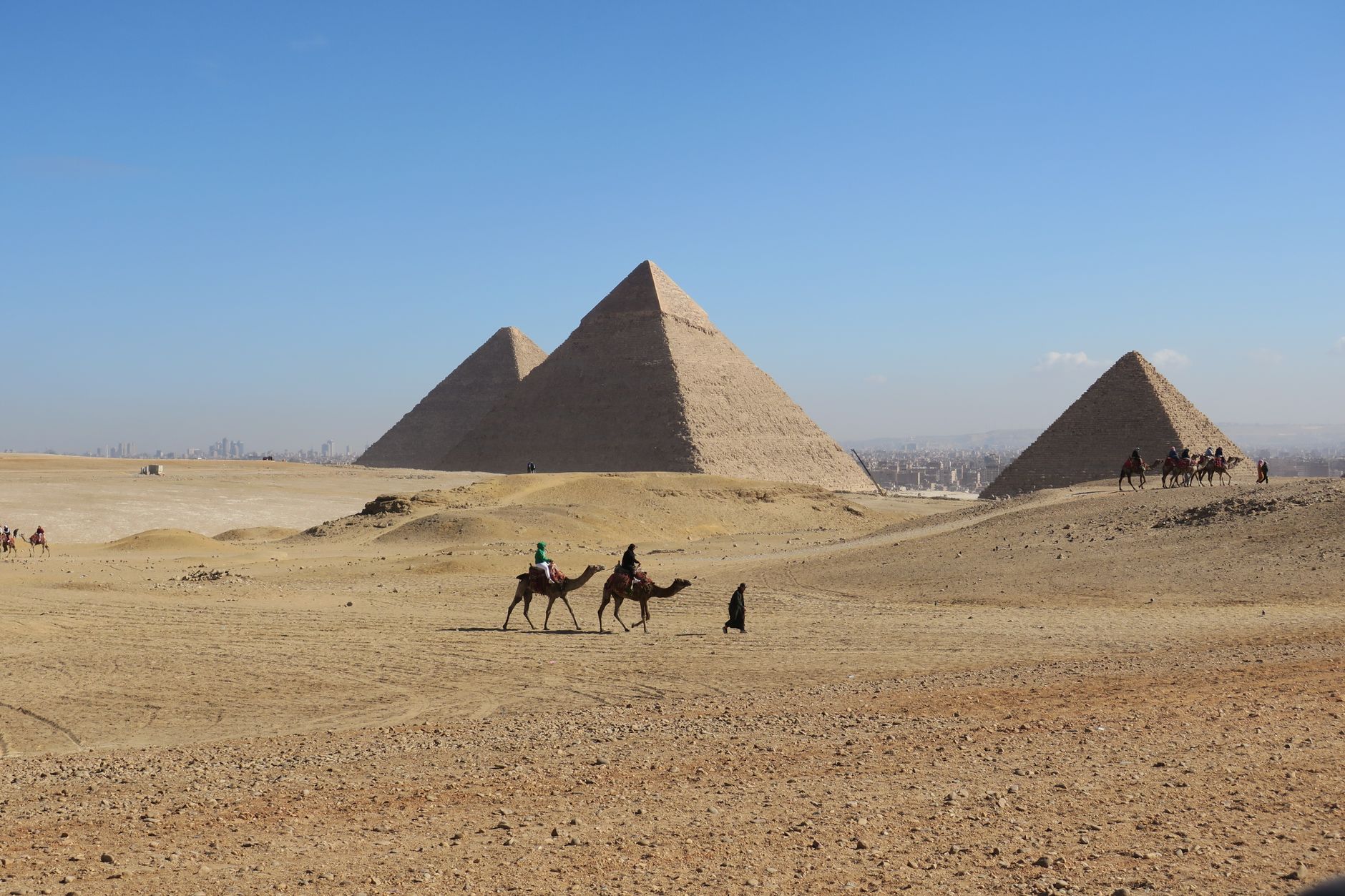
- 07:00 — Be at the gate for opening. The plateau’s official hours moved earlier and it now opens at 07:00, although plenty of guides still say 08:00; either way, first in is the point. The main entrance is the new visitor centre on the Fayoum road side, not the old gate beside the Sphinx. Ticket windows are card-only, so bring a Visa or Mastercard that works abroad.
- 07:15 — Take the electric shuttle, which is included in the ticket, to the Panorama Point first while it is still empty. This is the classic view of all the pyramids in a row, and the only stop where children can genuinely run about.
- 08:00 — Shuttle back to the Great Pyramid. Children can touch the enormous limestone blocks at the base, which is more memorable than any museum label. Climbing is not allowed, and guards whistle at anyone heading higher than the first course or two.
- 09:00 — Khafre’s pyramid, which still has a patch of its original smooth casing near the top; point it out and ask the children why the rest has gone.
- 09:45 — The Sphinx, last, because it is the stop nearest the exit and because the approach along the causeway gives children something to walk towards.
- 10:30–11:00 — Out. Back to the hotel for an early lunch, the pool and, for the youngest, a sleep.
For a family of four with two children aged six to twelve, plateau entry comes to EGP 2,100 (about USD 44): EGP 700 per foreign adult, EGP 350 per child from six to twelve, and free for under-sixes. Our dedicated guide to the pyramids with children goes deeper on the shuttle stops, shade and pushchairs; this plan simply fixes the order and the clock.
Inside the Great Pyramid? Honestly, not with under-eights
The Great Pyramid’s interior costs EGP 1,500 (about USD 31) on top of plateau entry for an adult and EGP 750 for a student, and daily numbers are capped, so tickets can sell out in the busy winter months. What you get for that is a long, steep, stooping climb up a narrow passage and the Grand Gallery, in hot and humid air, to a bare granite chamber with an empty sarcophagus. Many adults find it thrilling; a lot of small children find it frightening or dull, and there is no easy turning round once you are in the passage. For keen children of about nine and up it can be the highlight of the trip. For younger ones, skip it, or try the smaller interiors of Khafre (around EGP 280) or Menkaure (around EGP 200), which are shorter, cheaper and far less crowded — check at the window which ones are open on the day, as they rotate.
The camel question
Children will ask. The answer can be yes, as long as the ride is short — ten to fifteen minutes is plenty — and the price, the duration and whether it is per person or per camel are agreed out loud before anyone climbs up. Ignore anyone who approaches before you reach the ticket office. Our full guide to camel rides at Giza covers fair prices, animal welfare and the dismount “fee” that suddenly appears halfway round.
The evening: the show, or a rooftop view of it
The sound and light show runs nightly at the foot of the plateau, with the Sphinx narrating in a booming voice while lasers and floodlights pick out the pyramids. A foreign adult pays around EGP 1,000 (about USD 21), with discounts for children. Honest verdict: the narration is dated and aimed at adults, and most children love the first twenty minutes and are asleep or restless by the end of the hour. The better family version is to eat dinner early at one of the rooftop cafés in Nazlet el-Samman that look straight at the Sphinx and watch the lights from there for the price of a juice. Ask your hotel which rooftops are currently open, because the area around the plateau has been heavily redeveloped.
Day 3: The Grand Egyptian Museum
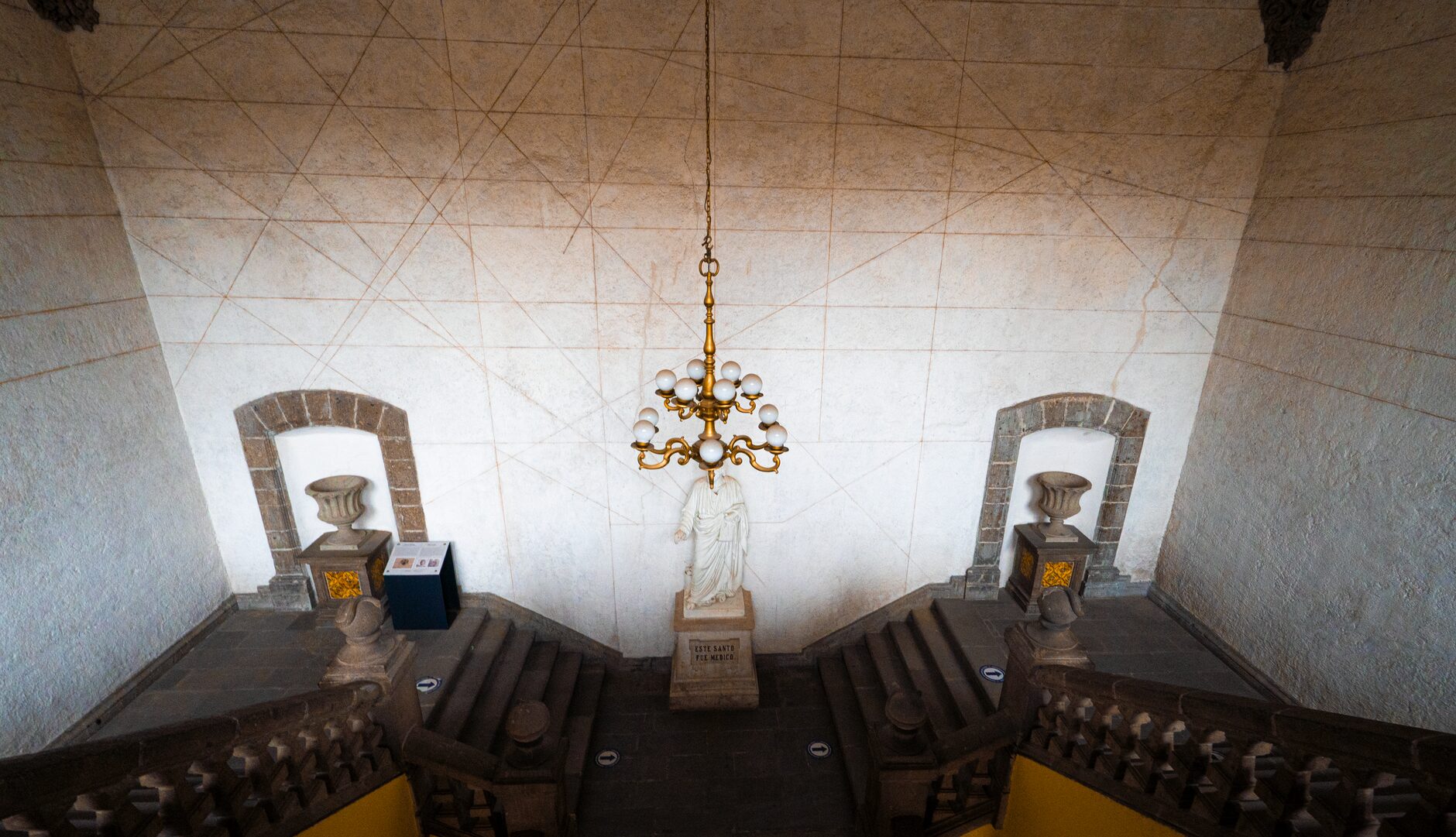
The Grand Egyptian Museum is around two kilometres from the plateau and, crucially for today, fully air-conditioned, with lifts, ramps, free lockers, baby-changing spaces and seating throughout. Book an early timed slot on the official website before you travel — on-site ticket sales are suspended, and turning up at the gate with two children and no booking is the one truly avoidable disaster on this trip. Foreign adults pay EGP 1,450 (about USD 30), children and students from six to twenty-five roughly EGP 730 (about USD 15), and under-sixes are free, which puts a family of four at about EGP 4,360 (roughly USD 90).
A route that finishes before the meltdown
- 09:00 — The Grand Hall and the eleven-metre Ramses II. Let the children run the length of the hall first; the space is so big it reads to a child as permission.
- 09:20 — Up the Grand Staircase, with the escalator as the escape hatch. At the top, a huge window frames the pyramids you walked round yesterday, which is the moment the two days click together for most children.
- 09:45 — The Tutankhamun galleries while they are still quiet: the golden mask, the gilded shrines, the chariots and the boy-king’s own sandals and board games. Children tend to stop for the chariots and the games rather than the gold.
- 11:00 — Khufu’s boat, the 4,500-year-old cedar ship that used to sit in a building beside the Great Pyramid and now lives here. “A very old boat that a king was buried with” is a story even a four-year-old can hold.
- 11:45 — Lunch on site, then leave while everyone still likes each other.
That is under three hours, which is about the limit for most children under ten. Our family guide to the Grand Egyptian Museum has the age-by-age detail, the pushchair routes and the scavenger-hunt ideas; for opening hours, the museum’s galleries open 09:00–18:00 on Sundays, Mondays, Tuesdays, Thursdays and Fridays, and until 21:00 on Wednesdays and Saturdays, with last entry an hour before they close.
The Children’s Museum
Inside the complex, the GEM Children’s Museum is a separate, separately ticketed space built around six themed areas with hands-on activities and trained staff. The price is not published anywhere we could verify, so check it when you book. For children of roughly four to ten, an hour here after the main galleries can buy you a calm lunch; for older children it is optional.
Spend the afternoon at the pool. If your children are older and still have energy, a late-afternoon walk around the Giza hotel gardens or a quiet dinner is plenty. Tomorrow is the long day.
Day 4: Medieval Cairo, then a park to run in
This is the day that surprises families. Children who have been told about pyramids all their lives often come home talking about the minarets, the tiny workshops and the man hammering copper in a doorway. The plan is to do the walking and climbing in the morning and to spend the afternoon in the one large, clean, safe green space in the old city. Avoid doing this day on a Friday morning, when the mosques close to visitors around the midday prayers and many shops open late.
Morning: Al-Muizz from north to south
Leave Giza by 08:30 and have the driver drop you at Bab al-Futuh, the northern gate. From there Al-Muizz Street runs about a kilometre south to Bab Zuweila, through the greatest concentration of medieval architecture in the Islamic world. It is largely pedestrianised, which makes it one of the easier old-city walks with children, and flat enough for a sturdy pushchair, although a carrier is easier for under-twos.
Stop at the Qalawun complex, a thirteenth-century mausoleum, madrasa and hospital; children tend to like hearing that this was a hospital more than seven hundred years ago, where patients were reputedly soothed with music. Halfway down, Khan el-Khalili is thirty seconds away along an alley. Give each child a small budget in their own pocket and one mission — a lantern, a scarab, a bag of spice — and let them try the bargaining themselves, with you standing well back; most stallholders play along delightedly. Our complete Khan el-Khalili guide maps the lanes and says which alleys are worth it. Stop at El Fishawy, the old mirrored café in the souk, for fresh juice for the children and mint tea for you.
Climbing Bab Zuweila
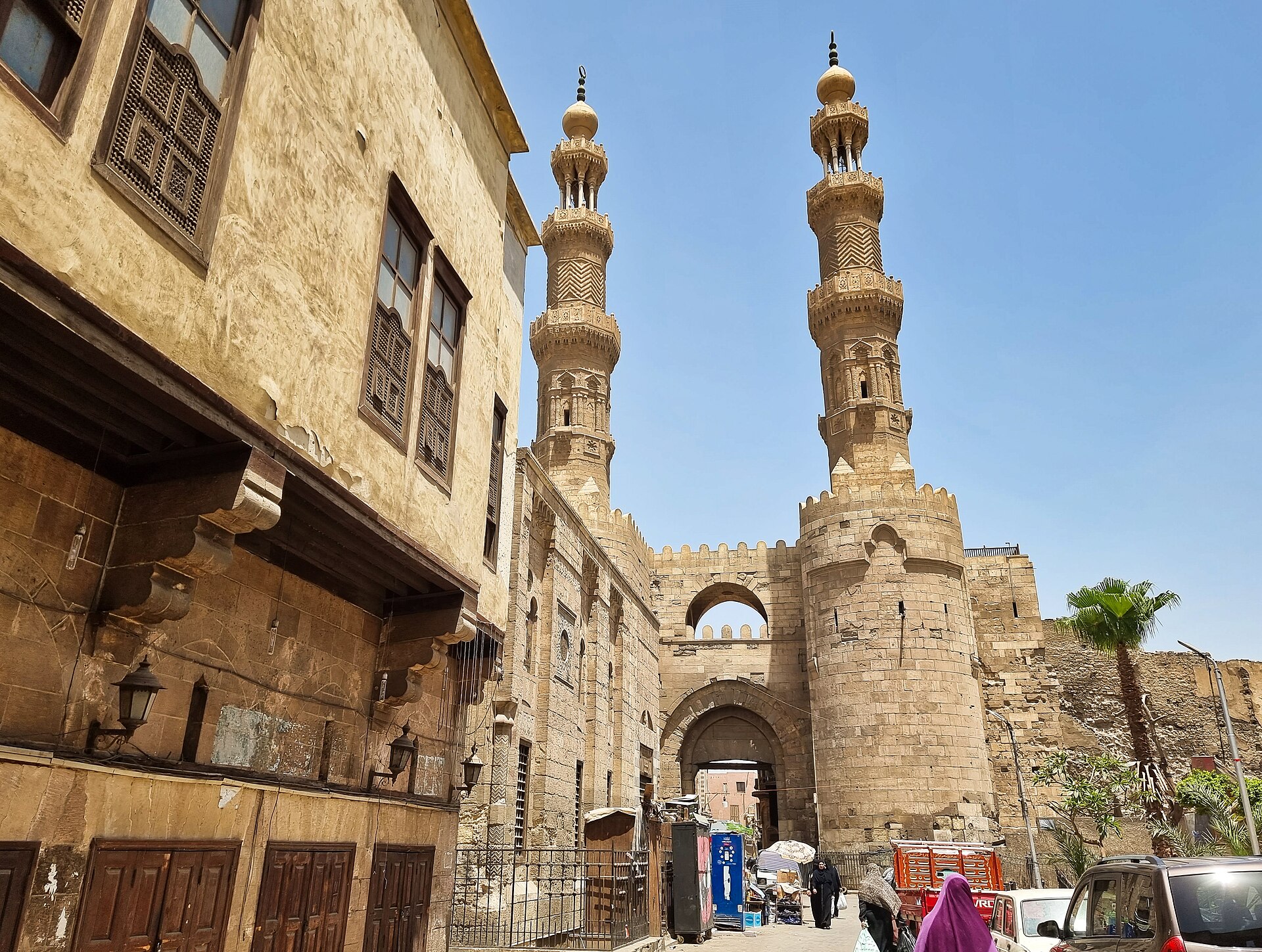
Finish the walk at Bab Zuweila, the southern gate, and climb its minarets. The stairs are narrow, steep and spiral, so hold small hands and leave toddlers below with one adult, but for children from about six upwards this is often the single best moment of the day: a 360-degree view over rooftops, satellite dishes, pigeons and dozens of minarets. It needs a ticket from the booth at the gate. Allow forty-five minutes including the climb.
Afternoon: Al-Azhar Park
After a late lunch, take a short taxi ride east to Al-Azhar Park. It is hard to overstate what this place is for a family: around thirty hectares of lawns, fountains, palm avenues and a lake, built by the Aga Khan Trust for Culture on what was, for centuries, a rubbish mound, and opened in 2005. There is a small entry fee, higher for foreigners than for Egyptians, and inside you will find a children’s play area, room to run, cafés and restaurants, and the best free view of the Citadel and the old city’s minarets. Stay for sunset, when the call to prayer rolls across the park from every direction, and either eat at one of the park’s restaurants or head back to base.
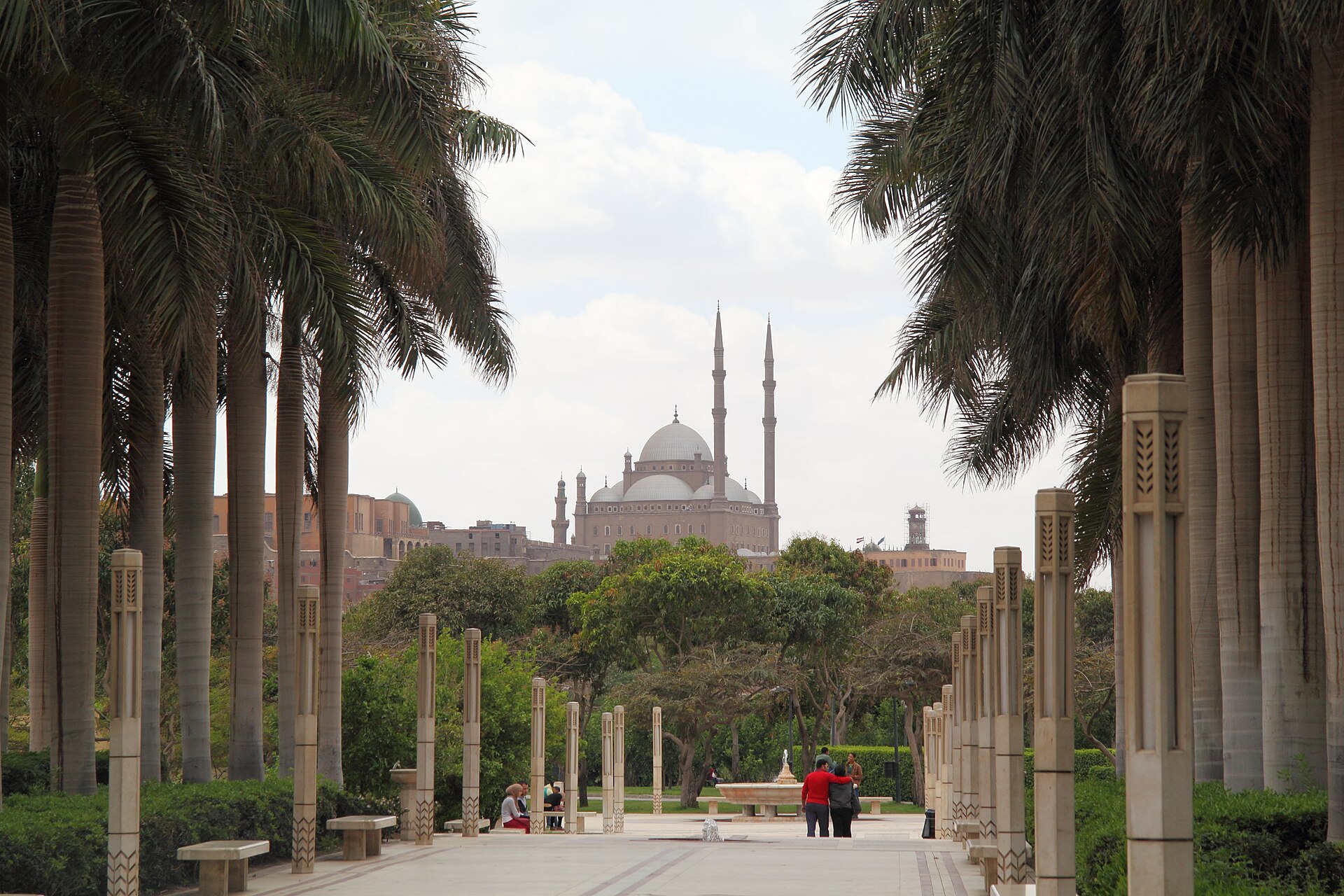
With older children who are still going strong, the Citadel of Saladin is right next door and can replace the park, or come back into Al-Muizz after dark, when the street is floodlit and full of Egyptian families out for the evening.
Day 5: The flex day — pick one
Day five is chosen by the ages and interests of your children rather than by the guidebook. Pick one of the mornings below and keep the afternoon free.
Ages four to nine: the Pharaonic Village
On Jacob Island, on the Nile at Giza, the Pharaonic Village is a living-history park where you sit on a barge that floats along canals past scenes of ancient Egyptian life: farmers ploughing, papyrus being made, boats being built, priests at a temple, with actors in costume doing the work. There are also small museums, including a reconstruction of Tutankhamun’s tomb as it looked when it was found. Honest verdict: it is kitsch, the costumes are tired, and anyone over about eleven will be rolling their eyes inside ten minutes. Younger children tend to love it precisely because it puts people back into the ancient world — the pyramids were built by someone, and here is someone. It opens at 09:00 and closes around 18:00 in winter and later in summer. Prices are sold as packages and quoted inconsistently everywhere, so check the official site or ask your hotel to phone ahead. Two to three hours is plenty.
Ages nine and up: Saqqara and Memphis
Under an hour south of Giza, Saqqara has the Step Pyramid of Djoser — the oldest of them all — and, crucially for families, a fraction of Giza’s crowds. The Old Kingdom tombs are carved with animals children can spot: hippos, crocodiles, cattle, fish and birds. If the Serapeum is open on your day, its underground galleries of colossal granite boxes, each weighing tens of tonnes, silence even teenagers; sites at Saqqara open on rotation, so check at the ticket office. Combine it with Memphis on the way back, where a colossal statue of Ramses II lies on its back in its own hall. Our guide to the Step Pyramid day trip has the logistics. Tell your driver clearly that you do not want the carpet school or the perfume “factory” stops that many Saqqara tours build in; children are bored by them and you will be sold to.
Ten and up: the royal mummies at NMEC
The National Museum of Egyptian Civilization in Fustat holds 22 royal mummies, including Ramses II, Seti I and Hatshepsut, in a dim, hushed hall. The ticket is EGP 550 (about USD 11) for a foreign adult and EGP 300 (about USD 6) at the reduced rate, with under-sixes free, and the Royal Mummies Hall is included. Some children are fascinated; some are genuinely upset. These are real people, and the hall is designed to feel like a tomb. Tell them beforehand exactly what they will see, and let any child who does not want to go in wait with a parent in the main galleries, which cover the whole span of Egyptian history from prehistory onwards. The museum has an evening session from 18:00 to 21:00, which can suit a day spent resting. Our guide to the Royal Mummies at NMEC explains the hall and the timings.
The heat-escape option: Dream Park or Ski Egypt
You did not fly to Cairo for a theme park. But in July, at 38 °C, after four days of monuments, a “normal kid day” can rescue a trip. Dream Park, on the Oasis Road in 6th of October City about eight kilometres from the pyramids, is a very large amusement park with seven themed areas. Ski Egypt, inside the Mall of Egypt in the same city, is the biggest indoor snow park in Africa, and the sight of an eight-year-old building a snowman while the desert bakes outside is its own kind of travel memory. Neither is cheap, so check current packages online before you go.
Every age: a felucca at sunset
Whatever the morning, end day five on the Nile. A felucca is a traditional wooden sailboat with a single tall sail, and an hour on one costs from around EGP 400 (about USD 8) for the whole boat — agree the price in pounds, not dollars, before anyone steps aboard. Children love the tilt of the boat and the quiet after a week of car horns. Life jackets are not always offered, so ask, and bring your own inflatable armbands for small children if that worries you. Our felucca guide says where the boats leave from and how the haggling works.

Summer, winter and Ramadan: shifting the clock
The same five days work year-round, but the clock moves. In winter you have far more slack in the afternoons, but it gets dark early and evenings on the Nile are cold. In summer the outdoor window closes by late morning and the plan leans on pools, the museum and the evenings. During Ramadan, which moves about eleven days earlier each year, opening hours shorten, the city goes quiet in the hour before sunset and then comes alive late into the night; children usually love the lanterns and the evening energy, but restaurants can be hard to book at iftar.
| Time | Winter (Nov–Mar) | Summer (Jun–Sep) |
|---|---|---|
| 07:00–11:00 | Main outdoor sight | Main outdoor sight — the only safe window |
| 11:00–15:00 | Lunch, a second light stop if wanted | Indoors: the museum, the hotel, a nap |
| 15:00–18:00 | Park, souk or felucca | Pool in the shade, rest |
| 18:00–21:00 | Early dinner; evenings are chilly | The best outing time: felucca, Al-Muizz, the Khan |
Adjusting the plan by age
The five days above assume children of roughly four to twelve. Here is what to swap in and out at either end.
| Age | Swap in | Swap out |
|---|---|---|
| Under 4 | Longer pool afternoons, Al-Azhar Park lawns, felucca, a carrier for Al-Muizz | Great Pyramid interior, Bab Zuweila climb, the mummies |
| 4–7 | Pharaonic Village, a short camel ride, the GEM Children’s Museum | Saqqara tombs, the full sound and light show |
| 8–12 | Bab Zuweila climb, Khafre or Menkaure interior, Saqqara | Pharaonic Village from about eleven |
| Teens | Great Pyramid interior, NMEC mummies, a late GEM visit on a Wednesday or Saturday, Al-Muizz after dark | Pharaonic Village, early nights |
What five days cost a family of four
These figures are for two adults and two children aged six to twelve, excluding flights, the hotel and food, and they assume the NMEC option on day five. Food is the most elastic line of all: koshary and fuul for the whole family can cost less than one adult’s lunch in a hotel restaurant.
| Item | Cost (checked Sept 2026) | Notes |
|---|---|---|
| Giza plateau entry | EGP 2,100 (~USD 44) | 2 × EGP 700 + 2 × EGP 350; shuttle included |
| Great Pyramid interior (optional) | EGP 1,500 (~USD 31) adult | EGP 750 student; worth it only for keen children of 9+ |
| Grand Egyptian Museum | EGP 4,360 (~USD 90) | 2 × EGP 1,450 + 2 × ~EGP 730 |
| GEM Children’s Museum | Separate ticket | Price not published; check when booking |
| NMEC and the Royal Mummies | ~EGP 1,700 (~USD 35) | 2 × EGP 550 + 2 × EGP 300 at the reduced rate; under-sixes free |
| Sound and light show (optional) | ~EGP 1,000 (~USD 21) per foreign adult | Discounts for children; or watch from a rooftop |
| Felucca, one hour | From ~EGP 400 (~USD 8) per boat | Agree in pounds before boarding |
| Car and driver, days 2–5 | ~USD 140–240 | USD 35–60 a day, agreed in writing |
| Uber or Careem hops | EGP 150–350 (~USD 3–7) a ride | More at rush hour |
Add it up and the sightseeing and transport come to roughly USD 350–450 for the family across five days, before food and the hotel. That is less than many families spend on a single theme-park day at home, which is one of the quiet arguments for Cairo as a family destination.
The three-day squeeze and the seven-day stretch
Three days
Arrive the night before day one, then do the pyramids on the first morning, the museum on the second and the medieval city with Al-Azhar Park on the third, with a felucca on whichever evening you have energy. You lose the flex day and all the slack, so this only works with children who are good travellers and a hotel that makes afternoons easy. The adult version of this route, with more stops per day, is in our three-day Cairo itinerary.
Seven days
Keep the five days as written and add two of these. Fayoum, around two hours south-west, has sand dunes, the small waterfalls at Wadi el-Rayan and the pottery village of Tunis, where children can try the wheel. Ain Sokhna, a similar drive east, gives you a Red Sea beach day. Alexandria, around three hours north, works as a long day trip for older children and is better with an overnight. The seventh day should always be empty, with the packing done the night before.
If you are going on to Luxor and Aswan, the choice between the sleeper train and a flight matters more with children than without. The sleeper sounds like an adventure and saves a hotel night, but it stops roughly hourly with a great deal of whistling, and trains can run hours late; the flight takes about seventy-five minutes and is often cheaper. The common family answer is train one way, fly the other.
Mistakes that wreck family days in Cairo
- Stacking two big sights. Pyramids and museum on one day, or museum and souk, is the single most common way to lose an afternoon to tears — yours or theirs.
- Arriving at Giza at eleven. By then the heat is building, the crowds are at their worst and the best light is gone. Every hour after opening costs you something.
- Talking to anyone before the ticket office. The men who approach you outside the plateau — “the entrance is closed”, “I am from the ministry”, “free camel photo” — are not there to help. Walk on and buy your tickets first.
- Letting a tour include the shopping stops. The papyrus “institute”, the perfume palace and the carpet school are commission stops. The papyrus demonstration is interesting for five minutes; the sales pitch that follows, often for banana-leaf prints sold as papyrus, is not. Our guide to real and fake papyrus explains the difference.
- Booking the hop-on hop-off bus. It sounds ideal for families and is not: Cairo is too spread out and too congested for it to cover the sights in any useful time, and the pyramids and the museum are nowhere near the medieval city.
- Doing the Khan at midday in summer. The lanes trap the heat, the shade is patchy and the crowds peak. Go in the morning or after dark.
- Turning up at the museum without a booking. On-site sales are suspended. Book the timed slot online before you fly.
- Relying on cash at the ticket window. The major sites are card-only. Keep cash for taxis, tips, juice and the felucca.
The one-line version
If you remember nothing else: one big sight a day, in the morning, from a single base with a pool, with a driver on the busy days and an empty first day. Cairo rewards families who go slowly, and punishes the ones who try to see it all by Wednesday. Our Cairo itineraries hub has the adult versions of every length if you are planning a second trip once the children are older.
Frequently asked questions
How many days do you need in Cairo with kids?
Four to five days is the sweet spot. That gives one day each for the pyramids, the Grand Egyptian Museum and the medieval city, one flexible day chosen by your children’s ages, and an arrival day with nothing in it. Three days works with good travellers but removes all the slack; more than five is best spent on a day at the Red Sea, in Fayoum or in Alexandria rather than more Cairo sights.
Can we see the pyramids and the Grand Egyptian Museum on the same day with children?
You can, since they are about two kilometres apart, but with children under ten we would not. Each needs two to four hours, both are tiring, and the second one gets the worst version of your family. Split them across two mornings and use the afternoons for the pool. Teenagers with stamina can manage both, ideally with the museum’s late opening on a Wednesday or Saturday.
Is it better to stay in Giza or central Cairo with kids?
Giza, for most family trips of five days or fewer. Two of the four sightseeing days are there, the pyramids and the museum are minutes from the hotels, and many Giza hotels have large gardens and pools. Central Cairo — Zamalek or the Nile-side hotels — suits teenagers and longer stays better, since evenings in the city become part of the trip.
What do we do in the afternoons when it is too hot?
Plan for it rather than fighting it. The hotel pool, a nap and a late lunch fill most afternoons. For indoor outings, the Grand Egyptian Museum and NMEC are fully air-conditioned, and in extreme heat Ski Egypt at the Mall of Egypt is a genuine escape. Save the Nile, the souk and Al-Muizz for the evening, when the city cools down and fills with Egyptian families.
Should we hire a guide or just a driver?
A driver for every big day; a guide for one or two of them. An Egyptologist guide at Giza or the museum turns stones into stories for children aged about eight and up — published rates for a guide with a car run around USD 25 per person for a six-hour day. For toddlers a guide is wasted money, because you will spend the day following the child rather than the commentary.
Is the inside of the Great Pyramid suitable for children?
For keen, fit children of about nine and up who are not claustrophobic, yes, and they will talk about it for years. For younger children, usually not: the passage is long, steep, low and humid, the chamber at the top is bare, and there is no easy way back once you have started. The smaller interiors of Khafre or Menkaure are a cheaper, shorter taster.
Pharaonic Village or Saqqara — which is better for children?
It depends almost entirely on age. The Pharaonic Village is built for children of roughly four to nine: a boat ride past actors in costume, short and easy. Saqqara suits nine-year-olds and up, who can appreciate the oldest pyramid in Egypt, the animal carvings in the tombs and, if it is open, the vast underground Serapeum. Teenagers will find the village embarrassing and Saqqara brilliant.
Will the royal mummies frighten my child?
Possibly. The Royal Mummies Hall at NMEC displays real bodies in a dim, quiet setting designed to feel like a tomb, and reactions range from fascination to real distress. Explain beforehand exactly what they will see, let them choose, and have one adult ready to wait outside with anyone who changes their mind. The rest of the museum is excellent without the hall.
Related Cairo Guides
- Giza pyramid tickets and prices for 2026
- How to book Grand Egyptian Museum tickets online
- The best time of year to visit Cairo
- A day trip to Fayoum Oasis
- Ain Sokhna: a Red Sea beach day from Cairo
- Indoor things to do in Cairo
Photo Credits
Bab Zuweila, the southern gate of Fatimid Cairo: photo by Richard Mortel from Riyadh, Saudi Arabia, via Wikimedia Commons (CC BY 2.0).
The main promenade of Al-Azhar Park with the Citadel beyond: photo by Djehouty, via Wikimedia Commons (CC BY-SA 4.0).