This article contains advertising. Our booking links are routed through a partner that adds commission tracking automatically, so if you book through one we earn a commission from the provider, at no extra cost to you. It never affects what we recommend. Affiliate disclosure
The couple ahead of us in the plaza had a car booked for two hours after their entry slot. They had come from a Nile cruise, they had a flight that evening, and they wanted to know whether that was enough. It is not, and the honest answer to how long Grand Egyptian Museum visits actually take is longer than almost anyone budgets: three to four hours for an ordinary visitor who wants to enjoy it rather than survive it.
This page is about the time, specifically. How long each part of the museum takes, what happens if you only have two hours, what a full day looks like, what to cut, and the sequencing mistakes that turn a good visit into a forced march. Details were checked in September 2026.
The short answer, by visitor type
| You are | Allow | What you will see |
|---|---|---|
| On a tight layover or cruise stop | 2 hours | Staircase, Tutankhamun, boat. No main galleries. |
| An ordinary interested visitor | 3–4 hours | Everything above plus a selective pass at the main galleries, and lunch. |
| A label-reader | 5–6 hours | The whole museum properly, with breaks. |
| Here because of Egyptology | Two days | You will still leave wanting a third. |
| With young children | 2.5–3 hours | Highlights, the Children’s Museum, and a long food break. |
| Combining with the pyramids | 3 hours here | Plateau in the morning, museum from about one o’clock. |
Two hours is the practical floor. Below that you are not visiting the museum, you are photographing the mask, and it is a great deal of money for a photograph you could take of a postcard.
How long each part actually takes
Measured on the ground rather than estimated from a floor plan. These are the times an unhurried visitor takes, not the minimums.
| Section | Quick | Proper |
|---|---|---|
| Plaza, security, walk to the Grand Hall | 15 min | 20 min |
| Grand Hall and the Ramses colossus | 10 min | 15 min |
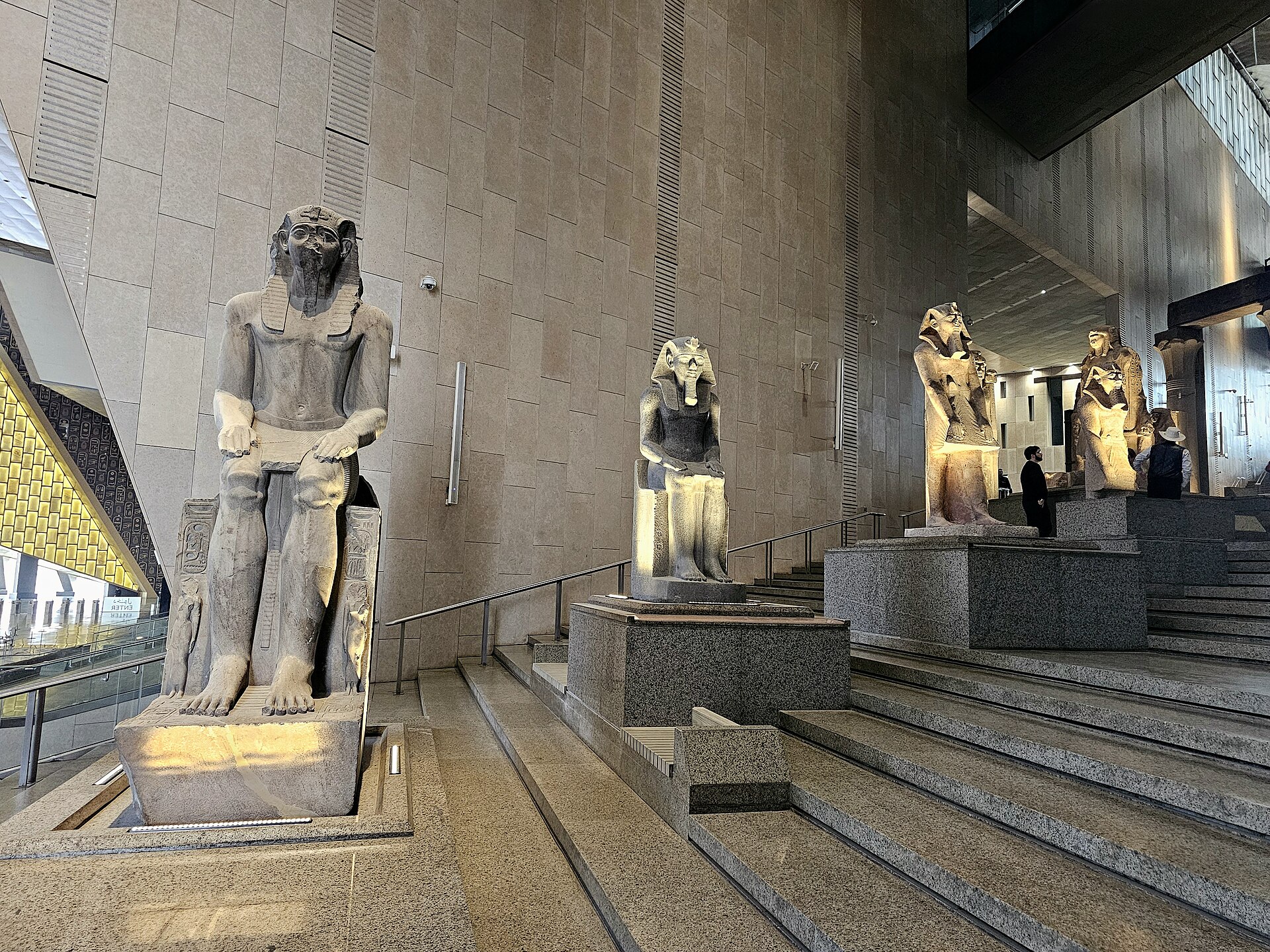
| Grand Staircase | 15 min | 35 min |
| Pyramid window at the top | 5 min | 15 min |
| Tutankhamun galleries | 60 min | 90–120 min |
| Twelve main galleries | 40 min (selective) | 120 min+ |
| Khufu boat building | 20 min | 30 min |
| Food, shop, gardens | 20 min | 60 min |
Add those up and the “proper” column lands somewhere past six hours, which is why five to six is the honest figure for a thorough visit and why nobody should feel they have failed by skipping things.
The two things that consume time unexpectedly
The walk itself
The distance from the entrance plaza to the first gallery is substantial and it is uphill by design — the building sits on a fifty-metre slope and uses it. Add security scanning, bag lockers and orientation, and twenty minutes can pass before you have looked at anything. Budget it rather than being surprised by it.
The Grand Staircase
Almost everyone underestimates this, in both directions. Some people take it as a corridor and are up in six minutes, which wastes one of the best things in the museum. Others start reading and find they have spent forty minutes and are only halfway. Thirty to thirty-five minutes is the right allowance: enough to stop at the New Kingdom sculpture and reach the window at the top without having spent your attention before the galleries begin.
Three plans that work
Two hours: the triage route
- Grand Hall — 8 minutes. Look at the colossus, do not linger.
- Staircase — 12 minutes, walking, stopping twice.
- The window at the top — 5 minutes.
- Tutankhamun galleries — 55 minutes. Non-negotiable.
- Khufu boat — 15 minutes.
- Walk out — 15 minutes, because it is further than you think.
Skip the twelve main galleries entirely. This feels wrong and it is correct: a hurried lap of them yields nothing but tiredness, and everything memorable in a two-hour visit is in the sequence above.
Three and a half hours: the standard visit
- Grand Hall and staircase, unhurried — 45 minutes.
- Tutankhamun galleries — 75 minutes, done second while you are fresh.
- Coffee and a sit — 20 minutes. Genuinely improves what follows.
- Two or three main galleries, chosen by period — 45 minutes.
- Khufu boat — 20 minutes.
- Shop and out — 25 minutes.
A full day: six hours
- Grand Hall, staircase and the window — 60 minutes.
- Tutankhamun galleries — 2 hours, properly.
- Lunch on site — 60 minutes.
- Main galleries, all twelve at a steady pace — 2 hours.
- Khufu boat and the gardens — 45 minutes.
A day here is a real option and not an eccentric one, particularly if you have booked a Wednesday or Saturday when the galleries stay open until 21:00. Arriving at midday and leaving at seven is a considerably more civilised day than cramming the same museum into a morning.
Sequencing: the mistake almost everyone makes
Doing the twelve main galleries first, in order, thoroughly — and reaching the Tutankhamun rooms with ninety minutes of accumulated fatigue.
The main galleries are excellent. They are also, like every large chronological display anywhere, relentless: four periods crossed by three themes, hall after hall of superb material that begins to blur once your legs have gone. Arrive at Tutankhamun in that state and you will walk past a child’s chair from a palace nursery without registering it.
So: Tutankhamun second, after the staircase, before anything else. The main galleries will still be there and they suffer far less from being seen tired than the tomb assemblage does.
What to skip, honestly
- Completeness. Nobody sees all twelve main galleries properly in a single visit and nobody should try. Pick two or three periods that interest you and do those.
- The second lap. Going back through a gallery to check you did not miss anything is how visits collapse. If you want to return to something, return to one object.
- Photographing everything. The single largest hidden time cost. A visitor stopping to frame each case moves at roughly half the pace of one who is looking.
- The audio-visual material, if you are short. Good, but the objects are better and the films will not run away.
- Eating on site, if you have under three hours. Museum pricing and a queue you do not have time for. Eat before you come.
How the timed slot affects your planning
A point that confuses a lot of people: your entry window governs when you arrive, not how long you stay. Book the 09:00 slot and you may stay until the galleries close. There is no clock running against you once you are through the scanners.
That makes the earliest slot the best value in the building. You get the quietest galleries of the day and the longest possible visit from a single ticket. Booking a late-afternoon slot on a normal day, by contrast, leaves you two hours before closing whether you wanted them or not.
The exception is Wednesday and Saturday, when galleries run to 21:00 and the complex to 22:00. A one o’clock arrival on one of those days gives you eight hours if you want them, and the evening atmosphere is the most underrated thing the museum offers. Last entry is one hour before the galleries close, so the latest useful arrival is 20:00 on those two days and 17:00 otherwise. Full booking mechanics are in our guide to GEM tickets and timed slots.
Combining it with the pyramids in one day
Entirely doable, and the order matters more than the timings.
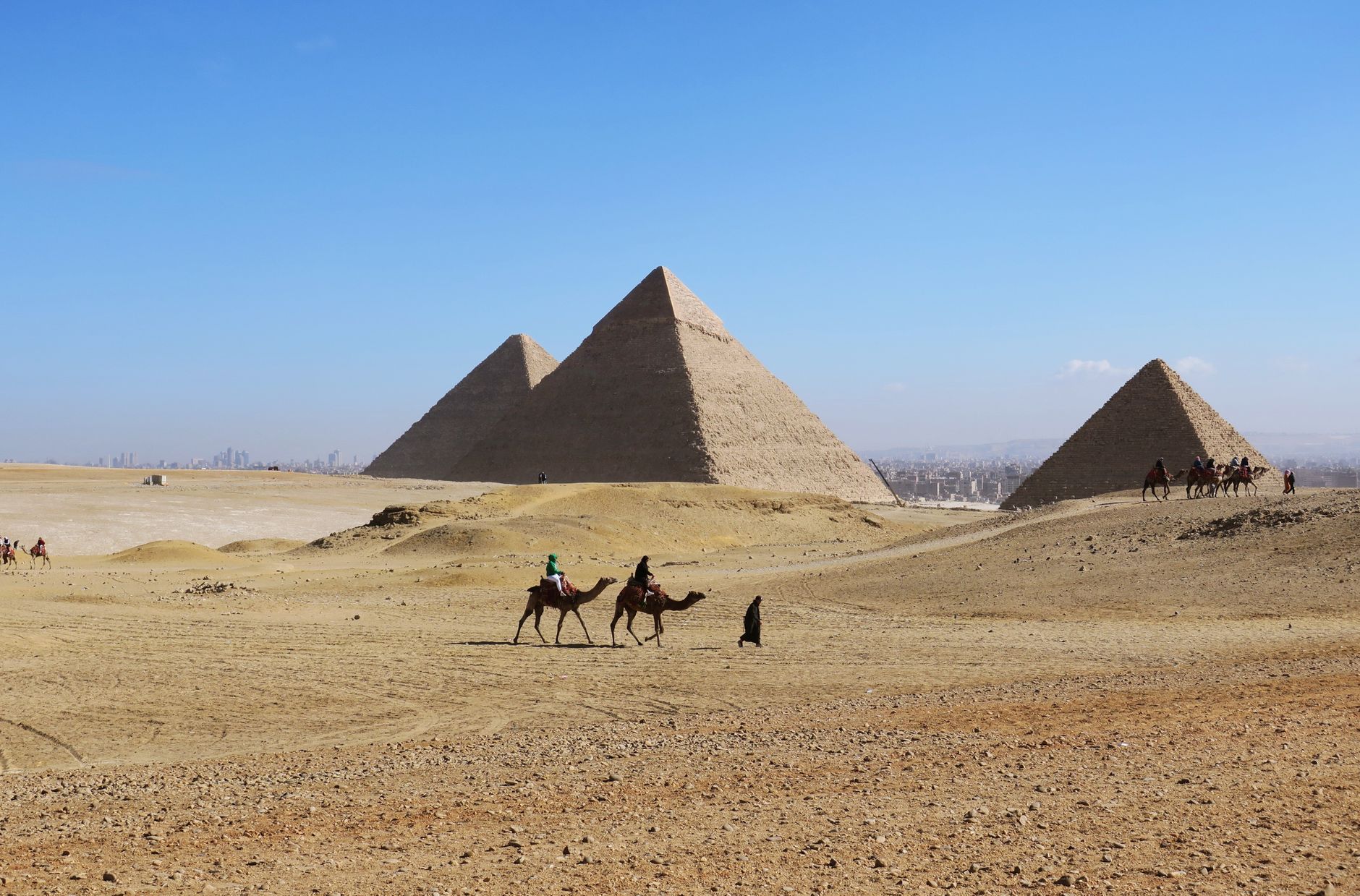
Plateau first, at opening, for three hours — the light is better, the heat is lower and the touts have not yet warmed up. Then the ten-minute drive, lunch, and the museum from around one o’clock on a booked afternoon slot with three hours in hand.
Do it the other way round and you finish four hours of air-conditioned galleries by walking out into the worst of the afternoon at an exposed desert site. It is the same two attractions and a materially worse day. Our guide to visiting the museum covers the combined day in more detail, and the plateau layout will help you use those three morning hours well.
What does not fit: adding Saqqara or Memphis. Operators sell it; the arithmetic does not work, and the museum is always the part that gets compressed.
If you are on a layover or a cruise stop
Be realistic about the travel time either side. From the airport the museum is sixty to a hundred minutes each way depending on traffic, and from the Alexandria cruise berths it is a long coach run. A four-hour window on paper can leave ninety minutes on the ground.
Our advice, and it is not the advice a tour desk will give you: if you have under two hours at the museum itself, consider skipping it and doing the pyramids instead. The plateau tolerates a short visit in a way the museum does not — you can see the three pyramids and the Sphinx meaningfully in ninety minutes. Rushing a hundred thousand objects is a poor use of an expensive ticket.
If you are set on the museum regardless, run the two-hour triage route above, book the earliest slot your schedule allows, and arrange transport that waits rather than something you have to find afterwards. The options are covered in our notes on reaching Giza from the city.
When you arrive changes how long you need
Two visits of identical length can feel entirely different depending on the hour, because crowding here is concentrated rather than constant.
The galleries open at 09:00 and the earliest arrivals get something close to an empty museum for the first hour. That hour is worth roughly ninety minutes of a busier one — you walk at your own pace, you stand where you like in front of the mask, and nobody is reading the label you are trying to read. If your schedule allows only one adjustment to this plan, make it this one.
From about 10:30 to 12:30 the picture changes. Tour groups arrive, coach parties from the Alexandria cruise berths come through, and the Tutankhamun rooms in particular fill up. Nothing becomes intolerable — the timed-slot system prevents genuine crushes — but you move more slowly and you will queue for the headline objects. Add thirty minutes to any plan that runs through this window.
Afternoons thin out again. And on Wednesdays and Saturdays, when galleries run to 21:00, the last two hours are the quietest of the day by some distance. The building is lit from within, the pyramids through the staircase window are silhouettes, and a two-hour visit at that hour delivers more than a three-hour one at midday.
Friday and Saturday are the Egyptian weekend, and both days are busier with domestic visitors and families. That is a good thing to be among and a slow thing to walk through. A weekday morning is the fastest-moving combination available.
How long with children
Shorter than you would like and longer than you fear, depending almost entirely on how you structure it.
Two and a half to three hours is the realistic ceiling for most children under about ten, and that includes a substantial food break rather than treating one as optional. Push past three hours without a proper sit-down and you will spend the last hour negotiating rather than looking.
What holds young attention here, in rough order: the chariots, the board games and the model boats from the tomb; the Ramses colossus, purely on scale; the animal-sided couches; the solar boat; and the Children’s Museum, which is a genuine facility rather than a corner with crayons. What does not: twelve galleries of chronologically arranged statuary, however good.
The practical shape that works is the staircase, then Tutankhamun, then food, then the boat and the Children’s Museum, and out. Skip the main galleries entirely and do not feel bad about it. The building’s real advantage with children is that it is step-free, buggy-friendly and air-conditioned, which removes most of what makes Egyptian sightseeing hard with a small family — as our guide to Cairo with children sets out, that is not a small thing here.
If you are moving slowly
Anyone with limited mobility, or simply not inclined to walk five kilometres of polished stone, should plan on the same content taking about a third longer — and should know that this is the one major Egyptian site where that plan will actually hold.
Lifts reach every level, the ramps are wide and properly graded, wheelchairs are available at the entrance, and there is nothing on the route that requires stairs. The staircase itself has a lift alternative, so the sculpture sequence is not lost. Seating is reasonably frequent, which is more than can be said for most museums of this size.
The realistic adjustment is not to the route but to the rest breaks: build in two proper stops rather than one, and treat four hours as the equivalent of somebody else’s three. Booking an early slot helps disproportionately here, because moving at your own pace through quiet galleries is far easier than doing it around tour groups.
What a guided tour does to your timings
A guided route is faster than an unguided one for the same coverage, and less flexible. That trade is worth understanding before you book.
The museum’s own Guided Tour Ticket imposes a shape on the visit — it gets you to the important material in a sensible order and prevents the drift that costs unstructured visitors an hour. If you have three hours and want them used efficiently, that is a genuine advantage.
The cost is that you cannot stop. If something catches you in the third main gallery, the group moves on regardless, and the objects that reward lingering are precisely the ones a fixed route cannot accommodate. Visitors who like to double back should stay independent.
Our rule of thumb: take the guided route if it is your first serious encounter with Egyptian antiquity or you are short of time, and go alone if you already know roughly what you want to see. Either way, avoid guides picked up outside the complex — a weak one costs you the visit as well as the fee, as we set out in our notes on what is and is not worth paying for here.
Managing energy, not just time
Three hours in this building is more tiring than three hours in most museums, for reasons that have nothing to do with the collection.
- It is uphill. The whole design climbs, and you feel it in the last hour.
- The distances are long. Generous spacing between objects is good curation and a lot of walking.
- The light shifts. Bright plaza, bright hall, dark Tutankhamun galleries, bright again. Your eyes work harder than you notice.
- The scale is relentless. Colossal statuary demands attention in a way small objects do not.
Practical countermeasures: sit down before you think you need to, take the food break in the middle rather than at the end, drink more water than feels necessary, and wear shoes you would walk a city in. The floors are polished stone and unforgiving.
Two visits, if you have the days
Barely anyone considers this and it is quietly the best answer for people staying in Giza or nearby.
Because the ticket is timed rather than time-limited, and because the museum is large enough to defeat a single visit, splitting it across two shorter mornings works better than one long day for many visitors. Two three-hour visits deliver more than one six-hour visit, for the simple reason that nobody looks well in hour five.
The obvious objection is the second ticket, and at EGP 1,450–1,590 a head it is a real one. This is not advice for a couple on a tight budget. But if you are staying out by the plateau for several nights, if you have a genuine interest in the material, or if you are travelling with children whose ceiling is three hours anyway, the second admission buys you a considerably better experience than a long single day does.
The natural split is Tutankhamun and the staircase on the first visit, the twelve main galleries and the boat on the second. Do them on non-consecutive days if you can, with the pyramids or something in the city in between, so that the second visit starts fresh rather than as a continuation.
Frequently asked questions
Is two hours enough?
It is enough to see the Grand Hall, the staircase, the Tutankhamun galleries and the solar boat, and nothing else. Most people find that unsatisfying for the price of the ticket, but it is a coherent visit if the alternative is not coming at all.
How long do most visitors actually stay?
Three to four hours, including a break. That is the figure the museum itself suggests and it matches what people report.
Can you see it in a day?
Yes, comfortably, and a full day is a genuinely good way to do it — especially on a Wednesday or Saturday when the galleries stay open to 21:00.
Does my ticket slot limit how long I can stay?
No. The slot controls your arrival time only. Once inside you may stay until the galleries close, so the earliest slot gives you the longest visit.
How long do the Tutankhamun galleries take?
An hour at an absolute minimum, ninety minutes comfortably, two hours if you read labels. Do them early in your visit rather than late.
What should I cut if I am running short?
The twelve main galleries, in that order. Keep the staircase, Tutankhamun and the boat.
Can I leave and come back?
The commercial area is inside the paid zone, so you can step out of the galleries to eat and return without difficulty. Leaving the complex entirely and re-entering on the same ticket is not something to count on.
How much time do I need for the museum and pyramids together?
A full day. Three hours on the plateau at opening, an hour for travel and lunch, three hours at the museum. Anything less compresses one of them badly.
Is it worth going if I only have ninety minutes?
Honestly, no. At that point the pyramids are the better use of the time, and they tolerate a short visit far better.
How long you need and when you arrive are the same question in disguise. Three hours at nine in the morning covers more ground than four at midday, because the crowding here is concentrated into a narrow mid-morning window rather than spread through the day. Our companion guide to opening hours and the quietest times to visit has the day-by-day and hour-by-hour detail.
Where the food break falls in your visit matters as much as how long you allow overall — take it after the Tutankhamun galleries and before the twelve main halls, not as a recovery measure on the way out. Knowing what is available, and what it costs, makes that easier to plan. Our guide to eating and the other facilities at the museum has the prices and the practicalities.
Related Cairo Guides
- Grand Egyptian Museum: the complete visitor guide
- Inside the Tutankhamun galleries
- Tickets, prices and timed slots
- GEM or Tahrir: choosing between them
- Giza pyramid complex: map and layout
- How many days to spend in Cairo
Photo Credits
Grand Staircase statues: photo by Richard Mortel, via Wikimedia Commons (CC BY 2.0).
Illuminated funerary papyrus display: photo by Amr F.Nagy, via Wikimedia Commons (Public domain).