This article contains advertising. Our booking links are routed through a partner that adds commission tracking automatically, so if you book through one we earn a commission from the provider, at no extra cost to you. It never affects what we recommend. Affiliate disclosure
A single-traveller policy covering a seven-day trip to Egypt cost a median of £15.79 through MoneySuperMarket in mid-2026. An air ambulance out of Cairo with a doctor on board starts around $25,000 and, for an evacuation to North America, routinely lands between $90,000 and $220,000. That gap — two figures against six — is the entire argument, and it’s the only part of the pitch that isn’t marketing.
What the gap doesn’t tell you is the part that actually goes wrong. Most Egypt claims are not medevacs. They’re a stomach bug that turns into two nights on a drip, a phone lifted in Khan el-Khalili, a wrist broken falling off a camel. And the reason people get refused isn’t fraud — it’s that they did an activity their certificate quietly excluded, or couldn’t produce a police report with a stamp on it.
This guide covers the Egypt-specific parts: whether cover is legally required in 2026, what premiums run, which activities your policy probably doesn’t include, what Egyptian hospitals will and won’t do without money up front, and how to file a claim where paperwork works differently. Our companion piece on choosing a policy for a Cairo-only trip handles the buying decision; this one handles the fine print and the aftermath.
A plain caveat first: this is general information for travellers, not financial or insurance advice. Policy wordings differ enormously between insurers, products, and even two policies from the same brand. Nothing here describes what your policy covers. Read your own certificate and wording, and if something matters, ring the insurer and get the answer in writing.
The benefits that matter in Egypt, and the ones that don’t
Every comparison site lists the same benefit headings, which makes policies look interchangeable. In Egypt, two of them do almost all the work and the rest are decoration.
| Coverage type | What it actually pays for | Typical limit | Worth it in Egypt? |
|---|---|---|---|
| Emergency medical | Admission, surgery, drugs, diagnostics, ambulance, emergency dental. Can pay the hospital directly via a guarantee of payment. | £5m–£10m (UK) / $100k–$500k (US) | Essential. The reason you buy. |
| Repatriation & medical evacuation | Air ambulance or medical-escort flight home, ground transfers both ends, return of remains. | Bundled with medical, or a separate lower cap | Essential. Check it isn’t capped separately at something small. |
| Cancellation & curtailment | Non-refundable flights, hotels, cruise deposits and tour prepayments. | £1,500–£10,000 | Useful. Matters most if you’ve prepaid a cruise or private guide. |
| Baggage & personal effects | Lost or stolen luggage, subject to per-item sub-limits far below the headline. | £1,500–£3,000 total; £200–£500 per item | Overrated. Your camera is worth more than the single-item limit. |
| Travel delay & missed departure | Fixed cash after a threshold, often 12 hours. | £20–£30 per 12 hours, capped | Minor. Nice, not decisive. |
| Personal liability | If you injure someone or damage property and are held legally responsible. | £1m–£2m | Quietly valuable — but often excluded for the exact activities you’ll do here. |
Read that fourth row again. “£3,000 baggage cover” on a comparison table is not a promise to replace a £2,200 camera body; the single-article limit does that job and it’s frequently £300. If you’re carrying real kit, specified-item cover or a home contents extension does more than assuming the travel policy has it handled — worth settling before you finalise the pre-departure admin list.
Is travel insurance legally required to enter Egypt in 2026?
No. As of August 2026, Egypt does not require proof of travel or medical insurance as a condition of entry, for any nationality, on either the e-visa or the visa-on-arrival route. You need a passport with the required validity and a visa. Nobody at Cairo International will ask to see a certificate.
You’ll find pages insisting otherwise, usually with a line about “medical emergencies and COVID-19 related costs”. That requirement circulated in the region during the pandemic era, was never implemented in Egypt as an entry condition, and those pages simply haven’t been updated. Treat any site calling it mandatory as one that hasn’t checked in five years.
There is a real proposal, which is probably where the confusion began. A mandatory tourist insurance scheme — covering personal accident, permanent disability, death and medical treatment — went before Egypt’s Senate committee on culture, tourism and antiquities, on the argument that too many visitors arrive uninsured and operators bundle in accident cover with derisory limits. It has not become law, and if it ever does, expect a small levy at visa purchase rather than a substitute for a proper policy.
Two related traps. British travellers: the GHIC and old EHIC are worthless in Egypt, no matter how many insurers price Egypt as a “Europe” destination. And most policies void cover if you travel somewhere your own government advises against — the FCDO advises against all travel to North Sinai and within 20km of the Libyan border, and against all but essential travel to parts of the Western Desert and some border zones. Check the current advisory against your actual route, not just the country name.

What a policy costs in 2026
Egypt usually sits in the “worldwide excluding USA” band, though a handful of insurers still price it as Europe because of the Mediterranean coastline — which normally makes it cheaper and is worth checking. The UK figures below are median prices actually paid by MoneySuperMarket customers for single-trip Egypt policies in mid-2026, not headline “from” prices.
| Traveller | 7 days (UK median) | 14 days (UK median) | Rough USD, 7 days |
|---|---|---|---|
| One adult | £15.79 | £30.95 | $20–$25 |
| Couple | £29.81 | £62.88 | $38–$45 |
| Family | £39.37 | £63.60 | $50–$60 |
| Group | £51.75 | £87.75 | $65–$80 |
Age is the biggest multiplier. US market data puts a 30-year-old at roughly $197 for a comprehensive policy on a $5,000 trip, a 65-year-old at about $394, and a 75-year-old at about $552 — double at 65, before any pre-existing condition loading.
| Age band | Premium direction | What changes |
|---|---|---|
| Under 40 | Baseline | Standard screening; adventure add-ons cheap |
| 40–64 | 1.3–1.8× baseline | More questions; blood pressure and cholesterol start mattering |
| 65–74 | ~2× baseline | Full medical screening; some mainstream insurers begin declining |
| 75+ | 2.5–3× baseline | Specialist insurers in many cases; activity age caps kick in |
Annual multi-trip policies often cover marginally more adventure activity as standard, and are cheaper if you travel twice a year — weigh that against the per-trip cap, typically 31 days. Either way it’s a small line inside the full breakdown of what a Cairo trip costs.
The activity exclusions that actually bite in Egypt
This is where claims die, and it’s the section thin affiliate pages skip. A Defaqto comparison of roughly 890 UK single-trip policies found that some very ordinary-sounding holiday activities are covered as standard by a startlingly small minority. Egypt is a country where you’ll be offered nearly all of them on the spot, by someone charming.
| Activity | Covered as standard (UK single-trip) | Where you meet it in Egypt | What to do |
|---|---|---|---|
| Quad biking / ATV | 3% | Giza plateau perimeter, Bahariya, Sinai, Hurghada dune runs | Assume no cover. Buy the add-on or skip it. |
| Horse and camel riding | 70% (13% exclude outright, 17% sell it as an extra) | Giza, Saqqara, Luxor west bank | Supervision by an experienced handler is often a condition. |
| Hot air ballooning (passenger) | 81% (2% exclude outright, 17% optional extra) | Luxor west bank at dawn | Confirm before booking. One in five won’t have you. |
| Scuba diving | 93%, hedged with depth and certification conditions | Ain Sokhna, Hurghada, Sharm, Marsa Alam | Read the depth cap and qualification clause. |
| Snorkelling | 98% | Every Red Sea day trip | Fine. Just don’t freedive deep. |
| Jet ski | 50% | Red Sea resorts | Coin flip — and liability is often excluded even when injury isn’t. |
| Desert 4×4 / dune bashing | Rarely named; falls under off-road motorised exclusions | White Desert, Bahariya, Fayoum, Siwa | Ask specifically. “Organised excursion” wording sometimes saves it. |
| Sandboarding | Rarely named | Western Desert oases, Fayoum | Ask. Often lumped with “boarding sports”. |
| Motorbike or scooter passenger | Usually excluded without helmet and correct licence | Everywhere, informally | Helmet or nothing; licence conditions can apply to passengers. |
Three per cent. That number is the whole point. Quad biking is sold on the sand behind the pyramids as a casual add-on, and on the overwhelming majority of standard policies you’re riding uninsured. Same logic for the dune-bashing leg of a White Desert overnight camping trip, where the driving is the experience and nobody mentions seatbelts.
Camel riding is more nuanced. Seventy per cent of policies include it, but many attach conditions: supervision by someone experienced, no racing, no riding under the influence. A camel stands about two metres to the ground and gets up back-legs-first, which is how most tourists come off. If you’re planning the classic camel ride at the pyramids, checking the clause costs nothing.
Diving in the Red Sea deserves its own reading
Scuba appears on 93% of policies, which sounds reassuring and isn’t. Cover is almost always fenced by three conditions, any one of which voids a claim:
- A depth cap. Basic wordings commonly stop at 18m — fine for a resort discover-scuba dive, useless for most Red Sea reef diving. Better policies reach 30m; beyond that you need an upgrade or a dedicated dive policy.
- A qualification clause. Many policies cover you only to your existing certification. An Open Water diver taken to 30m because the guide said it was fine is outside their qualification and outside the policy.
- A supervision requirement. Solo diving, cave and wreck penetration, and decompression diving are near-universally excluded regardless of certification.
This matters more here than in the Mediterranean because of the hyperbaric bill. Recompression treatment runs roughly $5,000–$15,000 per patient depending on how many chamber sessions you need, and the Red Sea has chambers precisely because it generates cases. Serious divers usually carry dedicated dive accident cover on top of a travel policy, and some Red Sea chambers sell short-term diving assistance memberships for a few euros covering chamber treatment — a cheap extra layer if you’re spending a week off the stretch of Red Sea coast within reach of Cairo.
The Luxor balloon question
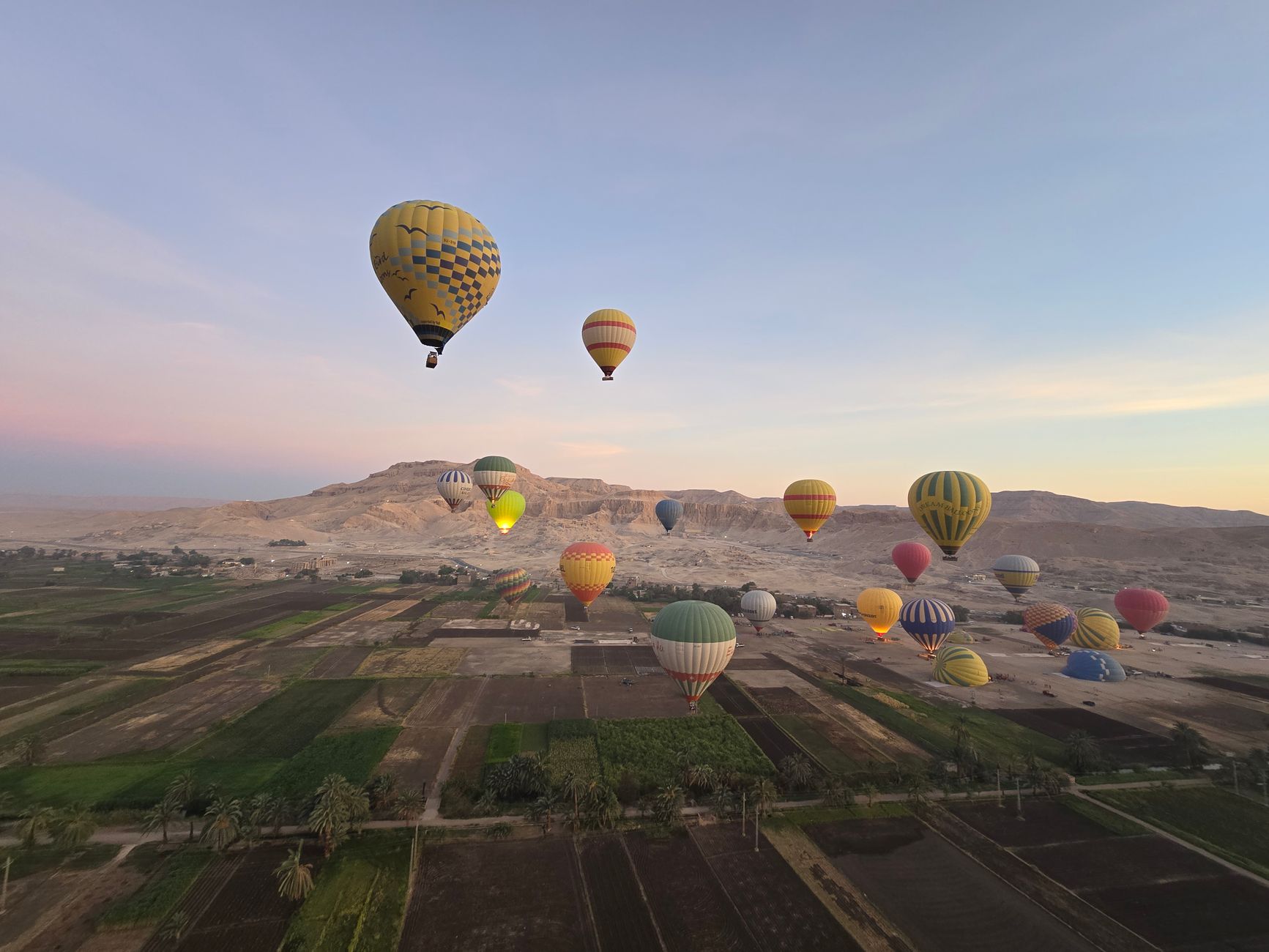
Dawn ballooning over the Theban necropolis is one of the great things you can do in Egypt and one of the most frequently mis-insured: 19% of single-trip policies don’t include it as standard, and a slice exclude it outright. The sector operates under Civil Aviation Authority oversight and has had incidents, including a 2026 hard landing that injured more than twenty passengers and triggered an official investigation. That isn’t a reason to skip the flight — it’s a reason to establish in writing that your policy pays if the basket comes down badly. Fold the check into planning a Luxor leg from Cairo.
What actually happens if you get ill in Cairo
Egypt runs a two-tier system. Public hospitals are free or near-free for Egyptians, chronically underfunded, and not where a foreign traveller with a serious problem wants to end up — though for a cut needing stitches they’ll handle it competently and cheaply. Private hospitals in Cairo are another world: modern equipment, English-speaking consultants often trained in Europe or the Gulf, and international patient departments built for exactly your situation.
The names that recur for foreigners are As-Salam International in Maadi, Cleopatra Hospital in Heliopolis, and Dar Al Fouad in 6th of October City. All three have international patient teams, hold contracts with major international insurers, and will approach your insurer directly for a guarantee of payment rather than making you settle the whole bill — if, and only if, the insurer engages. Your embassy also keeps a list of vetted English-speaking providers, a better starting point than a hotel doctor: hotel doctors have a documented reputation for overcharging, and a pharmacy two streets away sells the same medication for a fraction.
Budget for a deposit regardless. Private hospitals routinely want money on the card before non-emergency treatment starts, then reconcile with the insurer afterwards, and that deposit can run to several thousand pounds for an admission. It’s the most practical reason to carry a credit card with real headroom — and not the one you’ve maxed out at Khan el-Khalili, so plan the card and cash side of the trip with that scenario in mind.
Costs as of 2026, with the pound floating near 48 EGP to the dollar: a private consultation runs 500–1,500 EGP ($10–$30); a private ER attendance with basic imaging sits in the low thousands of EGP; an inpatient bed runs from roughly 3,000 EGP a night to 5,000–10,000 EGP a day in intensive care ($60–$210). Those look cheap because they’re priced for residents. The bills that break people are surgery, long ICU stays, and the flight home.
Insurance pays the bill, but you still have to pick a hospital at 2am with a fever and no local doctor. Our rundown of which Cairo hospitals treat foreigners well names the main private options and the pharmacy shortcuts that handle minor problems.
Medical evacuation: the number that decides your policy
If you take one thing from this guide, take this. The medical limit isn’t the number that matters most — the evacuation and repatriation limit is, because it’s the only line that runs to six figures.
A stable patient flown home on a commercial flight with a nurse escort and a row of seats might cost $10,000–$25,000; a stretcher configuration sits higher. A dedicated air ambulance — a jet fitted as a flying ICU with doctor and paramedic, plus ground ambulances at both ends and overflight permits — runs roughly $30,000–$70,000 from Cairo to Western Europe and can reach $90,000–$220,000 to North America. Industry-wide, repatriation is quoted from $5,000 to over $500,000 depending on condition and distance.
Insurers also apply a test worth knowing: they pay for evacuation that is medically necessary, not merely preferable. If a Cairo private hospital can competently treat you, an insurer can decline to fly you home just because you’d rather be treated at home. That call belongs to the insurer’s medical team in consultation with the treating physician — which is exactly why you ring the assistance line before authorising anything expensive.
Practical minimum: medical cover of at least £2m or $250,000, with evacuation either inside that figure or carrying its own limit of at least $250,000. A £10m UK limit sounds absurd until you price a transatlantic air ambulance.
The four claims Egypt actually generates
Egypt sits inside the top ten destinations by volume of medical emergency claims in UK insurer data, and its single most common claim type is diarrhoea and gastroenteritis — not injury or fractures, which top the list nearly everywhere else. That tells you something specific about the risk profile.
- Gastrointestinal illness. The most common Egypt claim by a distance. Most cases are 48 hours of misery; the ones that generate claims involve dehydration bad enough to need IV fluids, meaning a clinic visit or overnight admission. Cut the odds with bottled water, no ice from unknown sources, no tap-washed salads, and by eating street food from busy stalls with high turnover rather than quiet ones.
- Theft and pickpocketing. Phones and wallets, mostly in crowds — Khan el-Khalili, the metro at rush hour, the crush at ticket gates. Rarely violent, often expensive, always dependent on a police report. Our read on the current security picture for visitors separates real risks from imagined ones.
- Road traffic accidents. Egypt has one of the higher road death rates in the world — official statistics record around 6,000 deaths a year, WHO-modelled estimates run higher — and long-distance night transfers are the multiplier. Use the ride-hailing apps rather than flagging cars, and note that several insurers apply extra conditions to self-drive claims.
- Flight and trip disruption. Cancelled connections, delayed departures, the knock-on of missing a prepaid cruise sailing. Boring, common, and the one category where keeping every boarding pass and receipt turns a shrug into a payout.
How to file a claim from Egypt, step by step
Claims are won and lost in the first 24 hours, in-country, not months later at a desk at home. This is the sequence that works.
- Call the 24/7 assistance number before you spend anything significant. It’s on your certificate. Save it to your phone and write it on paper before you fly. Most policies require pre-authorisation for inpatient treatment, and an unauthorised admission is the easiest claim in the world to reduce.
- Get the insurer talking to the hospital. Ask the international patient office to liaise directly with your assistance company for a guarantee of payment. If they get one, you may pay nothing beyond the excess.
- Collect documents in English. Discharge summary, itemised bill, diagnosis, and the treating doctor’s name and registration. Cairo private hospitals produce English paperwork on request — ask before you leave the building, not after.
- For theft, report to police within 24 hours. Most policies impose this deadline explicitly. Get a written report with a stamp and a reference number.
- Photograph everything — receipts, bills, prescriptions, the police report, damaged luggage, delay confirmations — then email the images to yourself so they exist somewhere other than the phone you might lose.
- Keep every original. Insurers still ask for original receipts on baggage and expense claims. One envelope, all of it.
- Submit promptly and expect four to twelve weeks. Chase in writing, keep a claim reference, and escalate through the insurer’s complaints process — and in the UK, the Financial Ombudsman Service after eight weeks — if you’re stonewalled.
The police report problem, specifically
This is where Egypt differs from Europe and where travellers get stuck. To report theft, call 122 or go to the nearest station and ask for the Tourism and Antiquities Police, who deal with foreigners and understand insurance paperwork; major sites, Khan el-Khalili, the airport and the main tourist districts all have a presence.
Three things to know. Take an Arabic speaker if you possibly can — hotels near the main sites send someone routinely. Insist on a stamped document with a case reference; travellers have reported being handed an unstamped sheet of copy paper, which insurers can and do reject. And report accurately: inflating what was taken, or seeking a report for cash that simply went missing, is a criminal matter here and people have got themselves into real trouble trying it. If your passport is gone, the same report is what your embassy needs for an emergency document and what the Egyptian authorities need to transfer your visa stamp — so do it the same day, and keep an offline photo of your data page and policy certificate.
What nobody tells you about insuring an Egypt trip
- Cancellation cover starts the day you buy, not the day you fly. Buying the week before departure throws that benefit away entirely. If you’ve prepaid a cruise or private tour, buy when you book.
- Undeclared conditions are the commonest reason UK claims get refused. Not exotic ones — blood pressure, cholesterol, an old back problem, something you were investigated for and forgot. Declaring usually costs less than you fear, and it’s the difference between a claim and a letter.
- “Adventure sports cover” is not one product. Insurers band activities into tiers, and a tier including hot air ballooning may still exclude quad biking. Check the named list, not the marketing.
- The excess applies per person and per section. A family of four sharing one food-poisoning incident can face four excesses; an excess waiver costs a few pounds and can pay for itself.
- Alcohol clauses are broader than “drunk”. Many wordings exclude claims where alcohol was a contributing factor — arguable about a poolside fall after two beers.
- Travelling against government advice can void the whole policy, not merely the claim arising from that detour.
- Credit card and bank-account travel cover is real but thin — low medical limits, hard age caps, and usually a requirement that you paid for the trip on that card.
- Heat is its own claim category. Egypt in July and August regularly passes 40°C, and heat exhaustion at the Giza plateau is a routine call-out — so choosing a cooler month to visit is a genuine risk-reduction measure.
- Mobility equipment needs declaring. Wheelchairs and aids often require specific cover; our guide to travelling in Cairo with mobility needs handles the ground side.
The questions to ask before you buy
Rather than pointing you at a product, here’s the list to take to a comparison site, broker or insurer’s phone line. Get answers you can point at later.
- What is the emergency medical limit, and is evacuation inside it or capped separately?
- Does it cover the activities I’ve named — quad biking, camel riding, ballooning, diving to X metres, desert 4×4 — and if not, what’s the add-on?
- What is the maximum diving depth, and does cover follow my certification?
- What is the single-article limit for valuables, and can I schedule a camera specifically?
- What is the excess, and does it apply per person and per section?
- Does the policy pay hospitals directly, or must I pay and reclaim?
- What’s the deadline for reporting theft, and what documents are required?
- How are pre-existing conditions handled, and does cover lapse if travel advice for my route changes?
All of it sits inside the wider money picture, which our Cairo budget and money guide maps from flights down to daily spend.
Frequently asked questions
Do I need travel insurance to enter Egypt in 2026?
No. Egypt does not require proof of insurance for entry on either the e-visa or visa-on-arrival, for any nationality. A mandatory scheme has been proposed in the Egyptian Senate but not enacted; sites claiming otherwise are recycling pandemic-era information. The FCDO and US State Department nonetheless advise carrying cover including treatment and evacuation.
How much does travel insurance for Egypt cost?
UK median prices in 2026 were about £15.79 for one adult on a seven-day single trip and £30.95 for fourteen days, with the average single-trip Egypt policy around £41.82. US comprehensive policies for a $5,000 trip average roughly $227, rising to about $394 at age 65 and $552 at 75. Adventure add-ons and declared conditions push all of these higher.
Is camel riding at the pyramids covered?
Roughly seven in ten UK single-trip policies include horse and camel riding as standard, but a meaningful minority exclude it outright or charge for it — and cover is often conditional on supervision by an experienced handler and on you not racing. Check the named activity list rather than assuming.
What about quad biking in the desert?
Assume you’re not covered unless you’ve bought an add-on: analysis of nearly 900 UK single-trip policies found only 3% include quad biking as standard. Where cover exists it typically requires a helmet, an organised group or licensed guide, and no racing — and personal liability is frequently excluded even where injury is covered.
Does travel insurance cover scuba diving in the Red Sea?
Most policies include recreational scuba, but with a depth limit — commonly 18m on basic wordings, 30m on better ones — and a requirement that you dive within your certification and with a buddy or instructor. Solo, cave, wreck-penetration and decompression diving are typically excluded. Divers doing a serious week often add dedicated dive accident cover, since hyperbaric treatment can run $5,000–$15,000 per patient.
Will an Egyptian hospital treat me before my insurer pays?
Cairo private hospitals will usually stabilise you first and ask questions second, but routinely require a deposit before non-emergency treatment proceeds. As-Salam International, Cleopatra and Dar Al Fouad have international patient teams that approach insurers directly for a guarantee of payment. Carry a credit card with headroom regardless.
How much does medical evacuation from Egypt cost?
A commercial flight with a medical escort might run $10,000–$25,000. A dedicated air ambulance to Western Europe typically lands in the $30,000–$70,000 range; to North America it can reach $90,000–$220,000. Insurers pay for evacuation that is medically necessary rather than merely preferable, and that judgement is theirs — which is why calling the assistance line early matters.
What do I need for a theft claim in Egypt?
A police report, usually filed within 24 hours, carrying a stamp and a case reference. Call 122 or go to the nearest station and ask for the Tourism and Antiquities Police. Take an Arabic speaker if you can, and add photographs, purchase receipts or bank records for the stolen items plus your policy certificate.
The short version
Buy when you book, not the week you fly. Set the medical and evacuation limits high enough that a six-figure air ambulance wouldn’t break them. Then spend ten minutes with the wording, find the activity list, and check it against what you actually intend to do — because the quad bike behind the pyramids, the balloon over Luxor and the 30-metre reef dive are all things a standard certificate may quietly leave out. The premium is a rounding error on an Egypt trip; the exclusions are not. Read your own wording, ask the insurer about anything ambiguous, and get the answer in writing before you get on the camel.