This article contains advertising. Our booking links are routed through a partner that adds commission tracking automatically, so if you book through one we earn a commission from the provider, at no extra cost to you. It never affects what we recommend. Affiliate disclosure
The best way to see central Cairo is on your own two feet. The medieval lanes off Al-Muizz Street, the church-packed alleys of Coptic Cairo, and downtown’s faded Belle Epoque boulevards were all laid out long before cars, and a taxi just skids you past everything worth seeing. This is my field-tested rundown of the four self-guided Cairo walking tours I send friends on, with start and end points, distances, timings, what to pay, and where a guide actually earns their fee.
I’ve walked all of these more than once, in winter sun and in May heat that nearly finished me off. None of them are hard. What trips people up is the small stuff: the monuments now take card only, Friday timings shift around prayers, and “two hours” turns into four the moment you start ducking into courtyards. Plan loosely, start early, and let the city slow you down.
The four best Cairo walking tours, at a glance
Here’s how the routes stack up before you pick one. Times assume you actually stop and look, not march through.
| Route | Distance | Time | Best for | Guide? |
|---|---|---|---|---|
| Al-Muizz Street / Islamic Cairo | ~3 km | 3–4 hrs | Architecture, history, atmosphere | Worth it first time |
| Coptic / Old Cairo | ~2 km | 2–3 hrs | Early Christian heritage | Optional |
| Downtown khedival walk | ~2.5 km | 2 hrs | Belle Epoque streets, cafes | Skip it |
| Khan el-Khalili souk loop | ~1.5 km | 1.5–2 hrs | Shopping, tea, people-watching | Skip it |
One thing that applies to every route: as of 2026, ticketed monuments across Cairo take card only. No cash at the booth. Bring a working Visa or Mastercard, and still keep small EGP notes on you for tea, tips, and the bathroom attendant who guards the toilet paper.
Route 1: Al-Muizz Street and Islamic Cairo
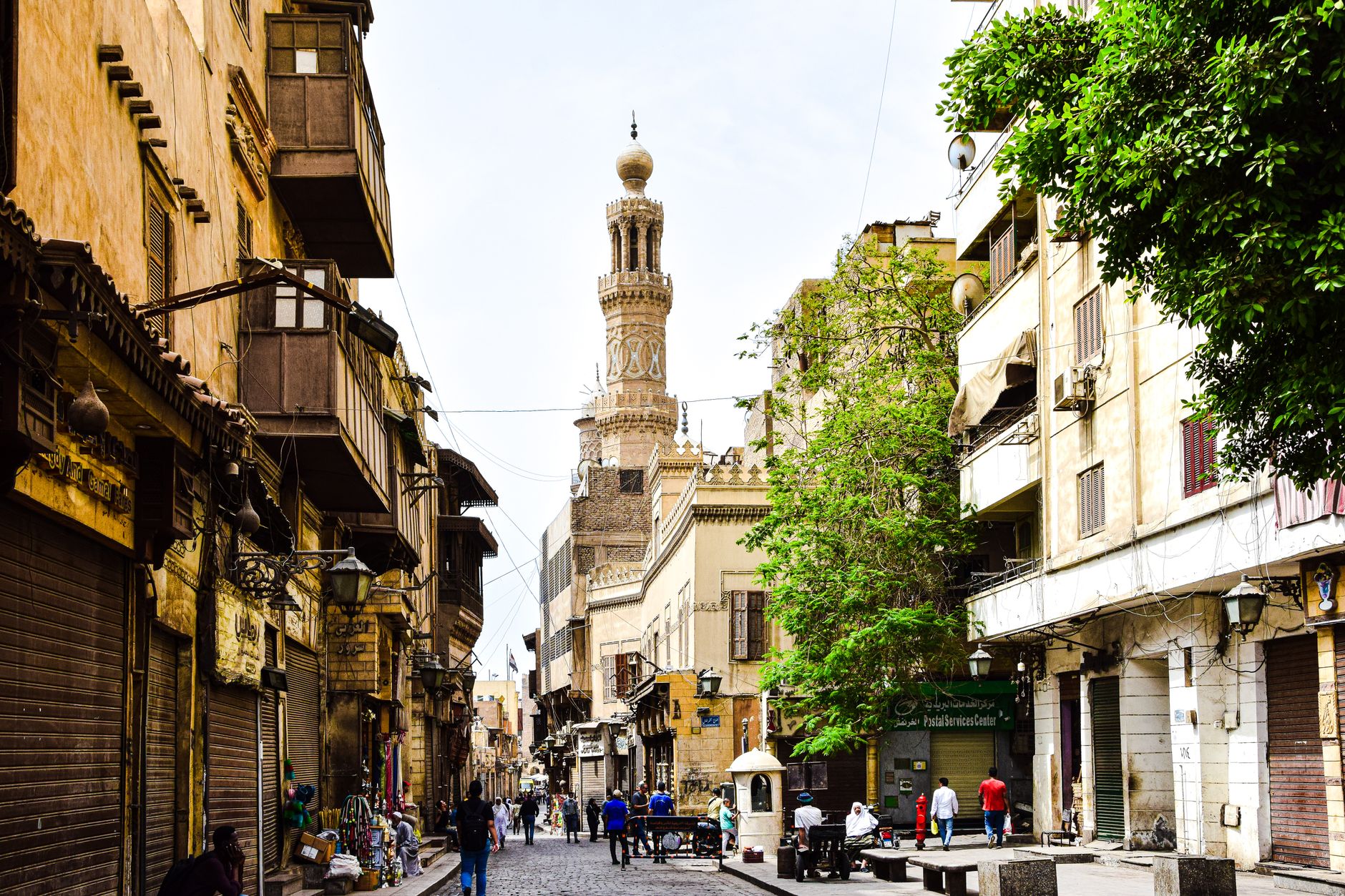
If you only do one walk in Cairo, do this one. Al-Muizz Street holds the densest run of medieval Islamic architecture anywhere in the world, and the best part is that the street itself is free and pedestrianised. You pay only when you step inside a monument.
Start: Bab al-Futuh, the great northern gate (built 1087). End: Bab Zuwayla, the southern gate. Distance: roughly 3 km. Time: 3 to 4 hours with stops.
From Bab al-Futuh, walk south with the Mosque of Al-Hakim on your left, then follow your nose down the spine of the old city. A few hundred metres in, duck off into the narrow alley called Darb al-Asfar to find Beit al-Suhaymi, a gorgeous 17th-century merchant’s house wrapped around a cool, plant-filled courtyard. It is hands-down my favourite stop on the route and the best escape from the sun. Note that it has its own ticket bought at its own door (around 180 EGP, card only) and is not covered by the main Al-Muizz pass.
Back on the main street, the Qalawun Complex (1284) is the showstopper, a mosque, madrasa and mausoleum with Mamluk stonework that stops people mid-stride. The general Al-Muizz ticket runs about 220 EGP for foreign adults (roughly 4.50 USD) and covers the Qalawun group, the Sultan Barquq complex, the Bishtak Palace and several smaller sites. Keep going past the carved wooden ceilings of the Sabil-Kuttab of Abdel Rahman Katkhuda, then let the lane spill you into the edge of Khan el-Khalili. Stop at El Fishawy for a mint tea, it has been pouring glasses for over two centuries and the chaos is half the charm.
The home stretch passes Al-Hussein and the great Al-Azhar Mosque, then the 15th-century caravanserai of Wikala al-Ghuri (some evenings there’s a free Sufi Tannoura whirling performance, worth checking). Finish by climbing the twin minarets of Bab Zuwayla for the best rooftop view in Islamic Cairo, a tight spiral staircase that costs around 100 EGP and rewards you with the whole medieval skyline.
Should you hire a guide? First time, yes. The street rewards independent wandering, but without context most of these buildings blur into “old and beautiful.” A licensed Egyptologist for a half-day turns the stones into stories, and you can wander the rest of the trip on your own. A good private walk runs roughly 50 to 75 USD; group joins start lower. If you’d rather not pay, the trade is reading up first, or grabbing one of the tip-based GuruWalk introductions and going deeper solo afterward.
Route 2: Coptic Cairo (Old Cairo)
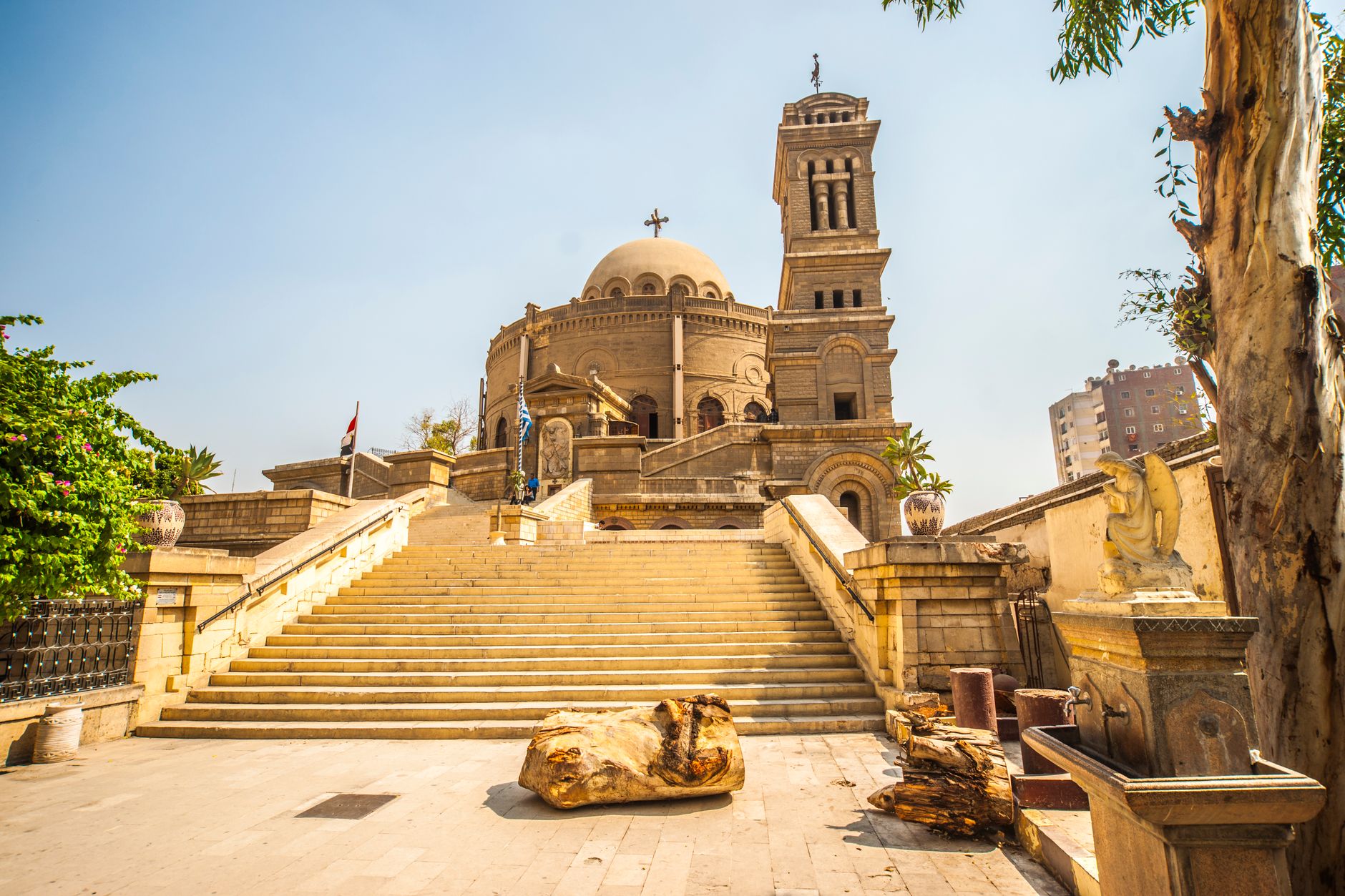
This is the gentle one. Coptic Cairo crams Egypt’s early Christian heritage into a walled, mostly traffic-free pocket you can cross in ten minutes, which makes it perfect for a hot day or tired legs. Almost everything here is free, so it pairs naturally with our roundup of free things to do in Cairo.
Start and end: Mar Girgis metro station (line 1, the easiest arrival in the city). Distance: about 2 km of gentle looping. Time: 2 to 3 hours.
Drop down the stone steps opposite the station and you’re straight into the old quarter. The Hanging Church (Saint Virgin Mary) is the headline act, suspended above a Roman gatehouse and reached by a steep marble staircase, its interior all dark wood and inlaid screens. It’s free to enter, open daily roughly 9am to 5pm, though it closes to sightseers during services, so go mid-morning on a weekday if you can.
From there the lanes thread between the Coptic Museum (the one paid stop, with a superb collection of Christian art, around 230–300 EGP), the cave-like Church of Saints Sergius and Bacchus, said to shelter the spot where the Holy Family rested, and the quiet Ben Ezra Synagogue, Egypt’s oldest, free to enter and usually open daily until about 5pm. The whole circuit is shaded, walled and calm, a genuine break from Cairo’s volume.
Should you hire a guide? Optional. The area is small and well-signposted, and a good guidebook covers it. A guide helps if you want the dense layers of religious history explained, but plenty of people self-guide this happily. For the wider context of Cairo’s collections, our guide to the Egyptian Museum and beyond is a useful companion.
Route 3: Downtown Cairo’s khedival quarter
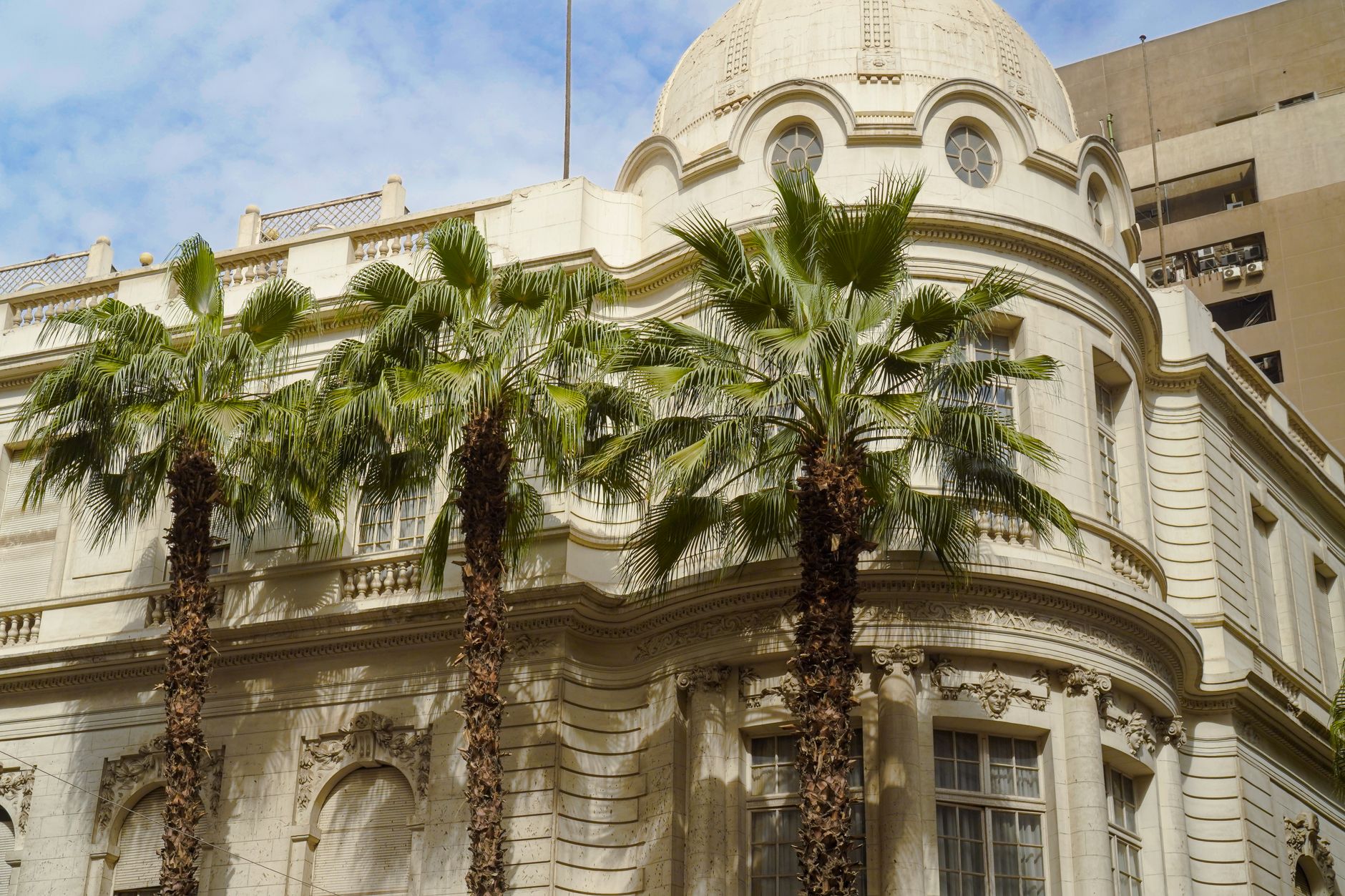
Downtown is Cairo’s Belle Epoque time capsule, the grand European-styled district that the khedives built to be “Paris on the Nile” in the late 1800s. The facades are peeling now, which is exactly the point, and it’s the most underrated walk in the city. No tickets, no queues, just streets.
Start: Tahrir Square. End: Talaat Harb Square (or drift to the river at Qasr al-Nil Bridge). Distance: roughly 2.5 km. Time: 2 hours, longer if you sit for coffee.
Begin with the pink bulk of the old Egyptian Museum on the square. You don’t need to go in, the headline pharaonic collection has largely moved to the Grand Egyptian Museum out by the pyramids, which is open and spectacular if you’ve got a separate day for it. Cut up Talaat Harb Street toward Talaat Harb Square, the downtown’s beating centre, ringed by 1920s apartment blocks with elaborate stonework above the shopfronts. Look up constantly here; the detail lives on the second and third storeys.
Built into the route are the great old cafes: Cafe Riche, open since 1908 and thick with the ghosts of writers and revolutionaries, and Groppi’s, the once-glamorous patisserie on the square. Wander the Art Nouveau facades of Champollion Street, find the hand-painted ceiling of the Cap d’Or bar if you fancy a cold Stella, and end at the river. This is also the heart of literary Cairo, the world of Naguib Mahfouz’s novels, so it folds neatly into the kind of off-the-beaten-path Cairo experiences that most tour buses never touch.
Should you hire a guide? Skip it. This is a self-guide walk through and through, low-stakes, well-policed, and best done at your own drifting pace with a coffee in hand. Downtown is also where Cairo’s evening comes alive, so if you linger till dusk, our Cairo nightlife guide picks up where this walk leaves off.
Sleeping inside this quarter turns the whole walk into a ten-minute stroll before breakfast, and Downtown holds the widest price spread in the city, from hostel bunks to Nile-view suites. Our look at where to stay around Tahrir weighs that against the street noise.
Route 4: Khan el-Khalili souk loop
Khan el-Khalili isn’t really a route so much as a controlled wander, and that’s fine. The great medieval bazaar has been trading since the 14th century, and the point is to get pleasantly lost in its lantern-hung alleys, haggle a little, and drink a lot of tea.
Start and end: the open square between Al-Hussein Mosque and the souk’s main gate. Distance: maybe 1.5 km of zigzagging. Time: 1.5 to 2 hours, or all afternoon if you’re shopping.
Plunge in off the square and the main tourist lane will funnel you past brassware, lanterns, spices, papyrus and a thousand “good price, my friend” pitches. Don’t be shy about saying no, a smile and a firm “la, shukran” works fine, and the vendors aren’t offended. The real reward is going one alley deeper than the obvious drag, into the streets where Cairenes actually buy gold, fabric and copper. Stop at El Fishawy (yes, again, it’s right here) for tea under the antique mirrors. Haggling is expected; start at half the asking price and meet somewhere in the middle.
The souk runs into the bottom of Al-Muizz Street, so on a long, cool day you can stitch routes 1 and 4 together into one epic Islamic Cairo loop. If you’d rather eat your way through, the lanes here are also prime hunting ground for the dishes in our roundup of Egyptian street classics, from fresh sugarcane juice to a plate of koshari nearby.
Should you hire a guide? Skip it for the shopping. A guide can be handy if you want help spotting quality and negotiating real antiques, but for tea and lanterns you don’t need one.
When to go: heat is the real obstacle
Cairo’s enemy isn’t crime, it’s the sun. From May through September the city sits at 32 to 40°C, and walking the streets between roughly 11am and 4pm is genuinely punishing. Plan around it:
- October to April is prime walking season, comfortable enough to walk all day. November and March are the sweet spot.
- In summer, walk early (a 6:30 to 9am start) or late (5 to 7:30pm), and spend the brutal midday inside a museum, a mosque interior, or the shaded Khan el-Khalili.
- The khamsin season (mid-March to mid-May) can throw sandstorms at you with little warning, so keep your outdoor days flexible.
- Al-Muizz Street after dark is a different walk entirely, the monuments lit up and the heat gone. Genuinely one of the best free evenings in the city.
Whatever the season, carry water, wear closed-toe shoes with real tread (the pavements are uneven and sandals get shredded), and bring something to cover shoulders and, for women, a scarf for mosque entries.
Season shapes more than the temperature here, since Al-Muizz during Ramadan is strung with lanterns and at its liveliest well after dark, so look at what’s happening in the city each season before you fix your walking dates.
Guided versus self-guided: my honest take
Here’s the short version. Pay a guide once, for Islamic Cairo, on your first day, because the context unlocks everything you’ll walk past for the rest of the trip. After that, self-guide freely. Coptic Cairo, downtown and Khan el-Khalili are all comfortable to do alone with a decent map and this article. Self-guided costs you nothing but entry fees; a group walking tour runs about 50 to 75 USD per person, a private guide 80 to 150 USD per group. The middle path, a tip-based GuruWalk introduction followed by your own wandering, gives you context on a budget.
Going it alone also caps the day at zero on most of these routes, because the streets themselves are the attraction. We keep a longer list of things in Cairo that cost nothing, including the Corniche at sunset, Al-Muizz Street after dark, and several markets that easily fill an afternoon.
Cairo walking tours FAQ
Are Cairo walking tours safe?
Yes, in the tourist districts, by day. Islamic Cairo, Coptic Cairo, downtown and Khan el-Khalili all have a steady tourist-police presence and locals used to visitors. Keep your phone in a front pocket, your bag zipped and worn in front in crowds, and use a ride-hail like Uber or Careem to move between neighbourhoods after dark rather than walking empty side streets.
Do I need cash for the monuments?
No, the opposite. As of 2026, ticketed sites across Cairo are card only at the booth, so bring a working Visa or Mastercard. Keep small EGP notes for tea, tips, baksheesh and bathroom attendants, none of whom take cards.
Can I walk Al-Muizz Street alone?
Absolutely. The street is pedestrianised, well-policed and made for wandering. A guidebook or a guided introduction first just helps the buildings make sense.
How much do the entry tickets cost?
Walking the streets is free. The general Al-Muizz ticket is around 220 EGP for foreign adults; Beit al-Suhaymi (about 180 EGP) and the Bab Zuwayla climb (about 100 EGP) are separate. Coptic Cairo’s churches and the Ben Ezra Synagogue are free; only the Coptic Museum charges. Prices shift, so treat these as a guide.
Can I combine routes in one day?
Khan el-Khalili and Al-Muizz Street connect directly, so those two stitch into one long Islamic Cairo day in cooler months. Coptic Cairo and downtown are better as their own shorter half-days.
Walk it, don’t ride it
Cairo gives up its best self to people on foot. Pick the route that fits your day, start before the heat, bring a card for the gates and cash for the tea, and let the medieval lanes and faded boulevards reveal themselves block by block. For more ways to fill your days, our complete guide to things to do in Cairo maps out where each of these walks fits into a wider trip.
The Al-Muizz walk from Bab al-Futuh south to Bab Zuweila is the backbone of any self-guided day in the medieval city, and it slots naturally into a weekend trip — see how we build the second day around it in our two-day Cairo itinerary.