This article contains advertising. Our booking links are routed through a partner that adds commission tracking automatically, so if you book through one we earn a commission from the provider, at no extra cost to you. It never affects what we recommend. Affiliate disclosure
Al-Azhar Mosque was completed on 24 June 972 CE, which makes the building older than almost any university on Earth — and the school that grew inside its walls is still teaching. It sits in Islamic Cairo, a two-minute walk from Khan el-Khalili, and you can step inside most of the day for a small fee. This Al-Azhar Mosque history and visit guide covers the founding, what to actually look at, how to dress, and when non-Muslims can go in.
I’ll be honest: a lot of visitors rush past Al-Azhar on the way to the bazaar, glance at the minarets, and never go through the door. That’s a mistake. The courtyard alone is one of the calmest, most quietly impressive spaces in the whole city — and unlike the Pyramids or the Grand Egyptian Museum, you’ll often have it half to yourself. It anchors our wider Cairo museums and cultural attractions guide, and it pairs naturally with a morning spent wandering the medieval streets nearby.
What Is Al-Azhar Mosque?
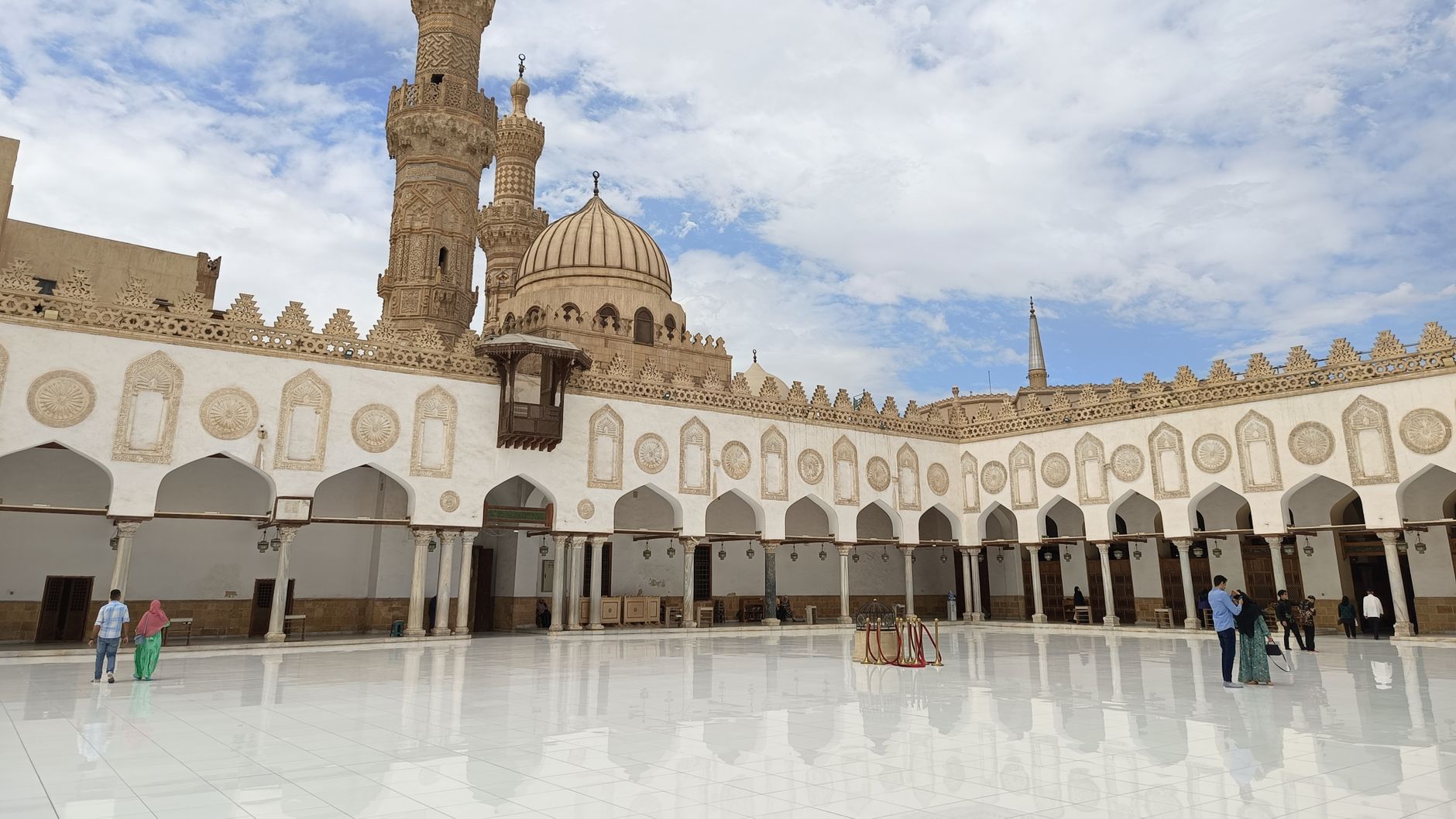
Al-Azhar is two things at once: an active mosque and the university attached to it. Both were founded around 970 CE in the brand-new Fatimid capital that would become Cairo. The Fatimid commander Jawhar al-Siqilli laid it out on the order of Caliph Al-Mu’izz li-Din Allah, which makes it the first mosque built in the city. The name — “the most resplendent” — is usually traced to Fatimah al-Zahra, the Prophet Muhammad’s daughter and the dynasty’s namesake.
The teaching came later but not by much. Fatimid caliphs encouraged scholars to hold study circles in the mosque, and those circles hardened into a permanent institution — formally organised as a centre of learning by 988. That’s the basis for Al-Azhar’s claim to be the second-oldest continuously operating university in the world, after Al-Qarawiyyin in Fes, Morocco. The distinction worth understanding: plenty of older buildings survive, but very few institutions have actually kept functioning, without a real break, for this long. Al-Azhar has. Today it plays three roles at once:
- An active mosque for Cairo’s Muslim community, busy at every prayer.
- The leading religious authority on Sunni Islamic doctrine, with global weight.
- A full modern university — re-established as a state institution in 1961 under President Nasser — that now teaches medicine, engineering and the sciences alongside Islamic law.
So when you walk in, you’re not visiting a museum piece. You’re stepping into a working institution that has run more or less without a break for over a thousand years. The students in the corners aren’t reenactors.
Planning Your Al-Azhar Visit: Hours, Dress, Entry
Here’s the practical box first, because that’s what most people are searching for. A few of these figures shifted recently — entry used to be free for everyone, but as of 2026 foreign visitors pay a small fee at the door, so budget for it.
| Detail | Information (2026) |
|---|---|
| Entry | Small fee for foreign visitors — roughly 60 EGP (about $4); Egyptians pay much less. Free for worshippers. Bring cash; fees can change. |
| Hours | Roughly 9 AM – 9 PM daily, closed to visitors during the five daily prayers |
| Dress code | Modest — covered shoulders and knees; women cover their hair. Robes are loaned at the door if you’re underdressed. |
| Shoes | Removed at the entrance; bags or a rack are provided |
| Shoe keeper tip | 5–20 EGP, customary not compulsory |
| Photography | Fine outside prayer times; ask before photographing worshippers |
On the dress code, don’t stress too much. If you turn up in shorts, the shoe keeper or an attendant will hand you a robe to throw on — this happens constantly and nobody bats an eye. Women should carry a light scarf anyway; it’s useful across Islamic Cairo. For the broader picture on covering up, greetings and mosque manners, our Cairo culture and etiquette guide is worth a skim before you go.
The one timing rule that genuinely matters: avoid Friday around midday. The Friday congregational prayer (roughly noon to 1:30 PM) is the big one, the mosque fills, and visitor access is closed for a longer stretch. Any weekday morning is ideal — soft light in the courtyard, fewer people, scholars settling into their day.
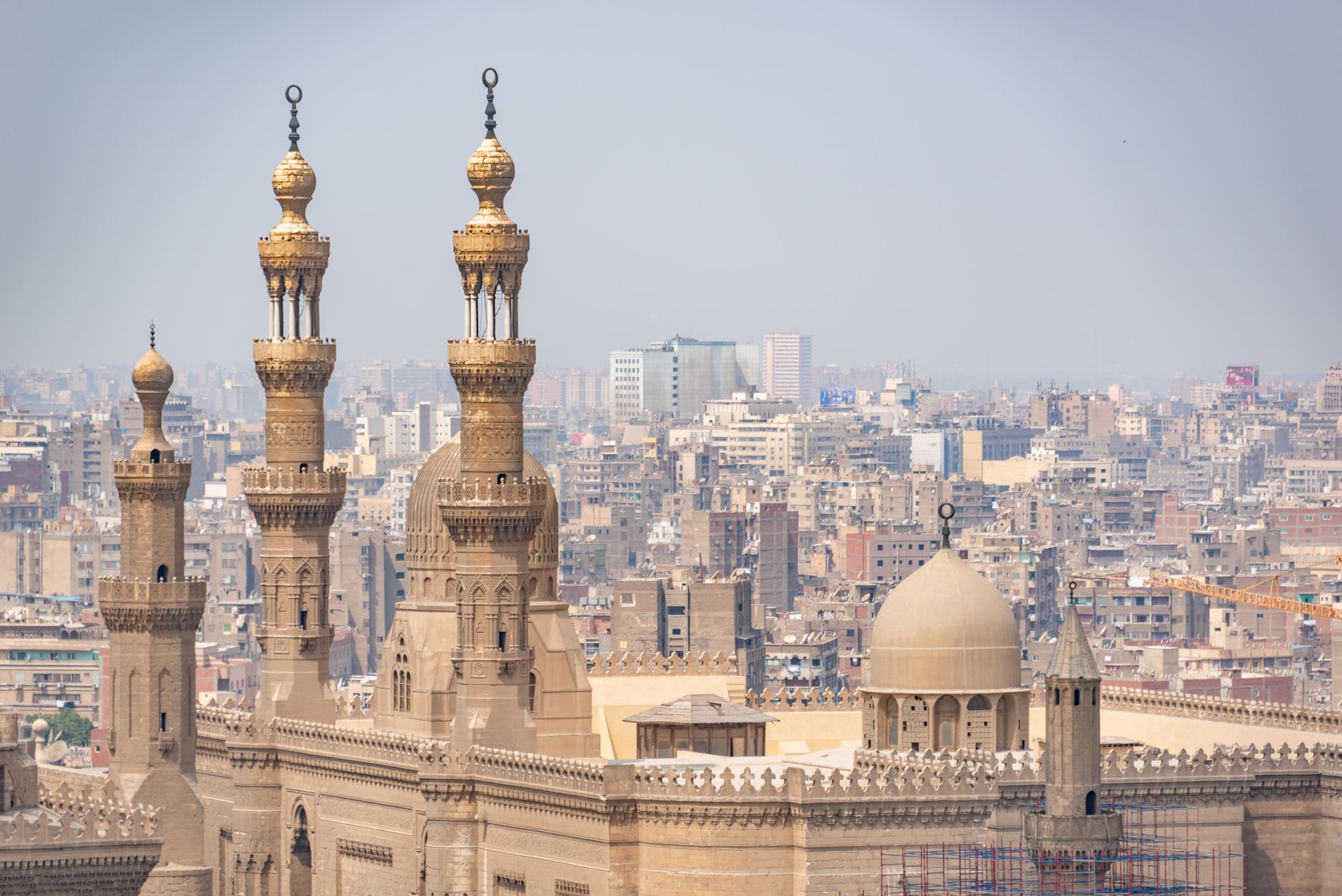
Ramadan rewrites all of the above: daytime visits run quieter and shorter, prayer times shift the access windows, and the lanes outside turn into the best free theatre in Cairo after sunset. Plan around what the fasting month does to opening hours if your dates overlap it.
The History of Al-Azhar, Layer by Layer
What makes the place so visually strange — in a good way — is that nobody ever knocked it down to rebuild. Every dynasty just added to it. You’re looking at over 1,050 years of stacked architecture in one footprint.
Founding: the Fatimid era (970–972 CE)
Construction began around March or April 970 and finished on 24 June 972. It opened as Cairo’s first mosque and the spiritual centre of the new Fatimid city. The original stucco decoration from this period still survives in places — worth looking for, since genuine 10th-century surface detail is rare anywhere.
The Mamluk era (1250–1517)
Under Sultan Baybars and his successors, Al-Azhar was expanded heavily and cemented its status as the dominant centre of Sunni learning. Most of the grandest additions — including two of the famous minarets — date from this stretch.
The Ottoman era (1517–1798)
More expansion, more minarets, more architectural styles layered in. By now the complex had stopped being one coherent building and become a patchwork of eras, which is exactly its charm.
The modern period
In 1961 President Nasser formally reorganised Al-Azhar into a modern university under government control. It now runs multiple campuses across Egypt teaching everything from theology to dentistry. The mosque at the centre, though, is still the same one Jawhar built.
The Architecture: What to Look For
Because of all that layering, Al-Azhar rewards slow looking. The headline features:
- The original Fatimid core — 10th-century stucco still in situ.
- Three main minarets from three different centuries — the Mu’ayyad (1340), the Qaitbay (1469) and the Qansuh al-Ghuri (1510). Standing in the courtyard you can see all three at once, which is essentially a free lesson in how Islamic minaret design evolved.
- Multiple courtyards added in different periods.
- The original Fatimid mihrab — the prayer niche oriented toward Mecca, over a thousand years old.
- Mamluk decorative work and Ottoman additions, with restoration ongoing.
What to See During Your Visit
If you’ve only got 30 minutes, here’s where to point your attention.
- The main courtyard. Open-air, ringed by Fatimid-era arcades, genuinely serene. This is the photo and the moment.
- The three minarets. Pick out the differences between the 1340, 1469 and 1510 towers.
- The mihrab. The original Fatimid prayer niche — the oldest single feature.
- The prayer hall. A vast hypostyle space, rows and rows of columns, carpeted underfoot. Step in quietly outside prayer times.
- The madrasas and iwans. Teaching alcoves where study circles still gather.
- The students and scholars themselves. Real scholarship in progress. Observe, don’t interrupt — this is the part you can’t get at any museum.
There’s also a historic library of Islamic manuscripts on site, though it isn’t routinely open to casual visitors, so don’t count on it.
One small thing that changes how the place feels: the acoustics. In the prayer hall, the rows of columns and the high ceiling swallow sound, so even when there are a dozen people around it stays hushed. Stand still near the mihrab for a minute and you’ll catch the low murmur of recitation drifting from a study circle across the hall. It’s the sort of atmosphere you can’t manufacture, and it’s the single best argument for going inside rather than just admiring the minarets from the street.
Etiquette: Reading the Room
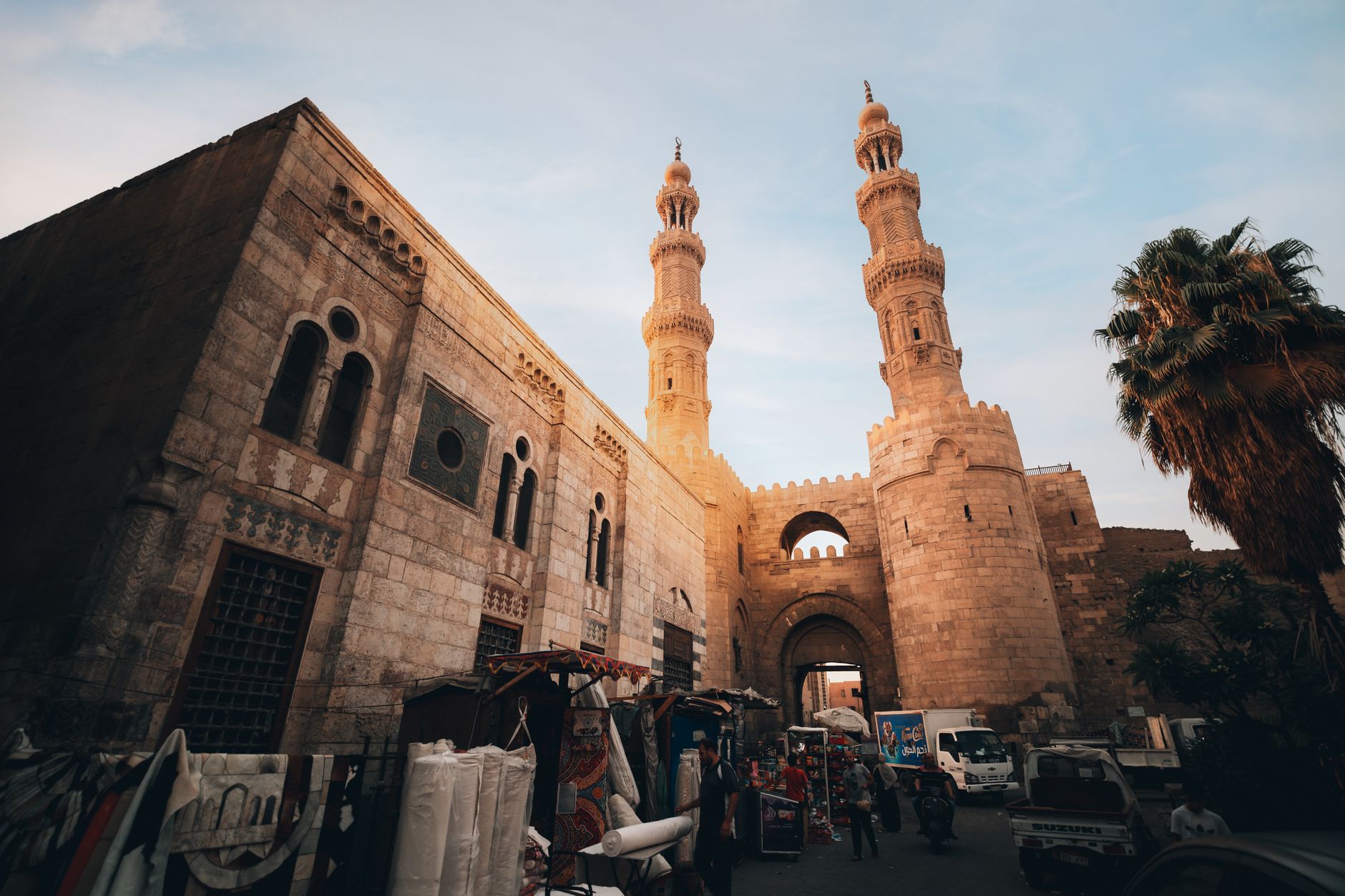
Al-Azhar is welcoming to visitors of every faith — non-Muslims included — but it is first and foremost a place of worship and study, so the basics matter:
- Dress modestly; borrow a robe if needed.
- Remove shoes at the entrance and tip the keeper a few pounds.
- Keep your voice down and your phone on silent.
- Photograph the architecture freely outside prayer times, but ask before pointing a lens at anyone praying.
- If you’re not sure whether it’s an okay moment to enter, ask the shoe keeper — they’ll wave you in or signal to wait.
- Don’t wander into sections marked for worshippers only.
Mosque manners are one slice of a much larger code: right hand for food and greetings, how to handle photographs of strangers, when a refusal is really an invitation. We cover the broader rules of Egyptian social life separately, including the ones that catch visitors out on day one.
How Long to Budget
- Quick look: 20–30 minutes for the courtyard and prayer hall.
- Proper visit: 45–60 minutes, longer with a guide who can decode what you’re seeing.
- Al-Azhar plus Khan el-Khalili: 2–3 hours, which is how I’d actually do it.
Getting There and Combining with Islamic Cairo
Al-Azhar sits in the Al-Hussein Square area, right in the dense old core of Islamic Cairo. Getting in is easy:
- Uber or Careem: about 15–25 minutes from central Cairo and the simplest option. Have the app drop you at Al-Hussein Square.
- Metro: Mohamed Naguib station (Line 2), then a 15–20 minute walk into the old quarter.
The real reason to come, though, is everything within a few minutes’ walk. The mosque is the natural hinge of a half-day in medieval Cairo:
- Al-Hussein Mosque — right across the square, an important Shia pilgrimage site.
- Khan el-Khalili — the great bazaar, literally next door, plus El Fishawy for mint tea.
- Al-Muizz Street — a five-minute walk and one of the densest open-air collections of medieval Islamic architecture anywhere.
- Wikala al-Ghuri — for Sufi Tannoura (whirling) performances on certain evenings.
- Ibn Tulun Mosque and Sultan Hassan Mosque — a little further out, both spectacular.
A clean half-day route: start early at the Citadel, drop down to Sultan Hassan, walk Al-Muizz Street north, reach Al-Azhar by early afternoon, then dissolve into Khan el-Khalili for lunch, shopping and tea as the light goes gold. For more itineraries like this, the things to do in Cairo guide lays out how the pieces fit together. And if you want the wider museum context — Pharaonic, Coptic and Islamic in one trip — the new Grand Egyptian Museum guide, the Egyptian Museum at Tahrir Square and the Coptic Museum guide round out the picture.
The addition most visitors miss sits a walk west along Port Said Street, where the Museum of Islamic Art keeps twelve centuries of Fatimid and Mamluk craftsmanship under one roof, putting names and dates to the carved wood, enamelled lamps and stucco you have just spent an hour squinting at here.
Al-Azhar Mosque FAQ
Is Al-Azhar Mosque free to visit?
For worshippers, yes. As of 2026 foreign visitors pay a small entry fee — around 60 EGP (roughly $4), with Egyptians paying much less. Bring cash, and tip the shoe keeper 5–20 EGP.
Can non-Muslims visit Al-Azhar?
Yes. Visitors of all faiths are welcome outside the five daily prayer times. Dress modestly and behave as you would in any active place of worship.
When was Al-Azhar founded?
Construction began around 970 CE and the mosque was completed on 24 June 972 CE, built by the Fatimid commander Jawhar al-Siqilli for Caliph Al-Mu’izz li-Din Allah.
Is Al-Azhar really the oldest university?
It’s the second-oldest continuously operating university in the world, after Al-Qarawiyyin in Fes, Morocco — and it’s still very much active today.
What should I wear?
Long trousers or a long skirt, covered shoulders, and a headscarf for women. If your clothes don’t qualify, a robe is loaned at the entrance. Shoes come off at the door.
What’s the best time to go?
A weekday morning — quiet, well-lit, scholars at work. Avoid Friday around midday, when the congregational prayer closes the mosque to visitors for an extended window.
Pulling It Together
Plan the rest of your trip
Use these guides to round out your Cairo plans: