This article contains advertising. Our booking links are routed through a partner that adds commission tracking automatically, so if you book through one we earn a commission from the provider, at no extra cost to you. It never affects what we recommend. Affiliate disclosure
Baron Empain Palace is the building in Cairo that makes people stop on the pavement and ask what on earth they’re looking at. It’s a pink, Hindu-temple-style mansion sitting in a leafy suburb of villas and cafés, carved with snakes, elephants and Indian deities, built between 1907 and 1911 by a Belgian railway baron who fell hard for the temples of India and Cambodia. Abandoned for decades, then restored and reopened as a museum in 2020, it’s now one of the strangest and most photogenic stops in the whole city.
This is my full guide to visiting in 2026 — the history and the ghost stories, the restoration, what the architecture is actually doing, what you’ll see inside, how long to give it, and how to fold it into a half-day in Heliopolis. It’s the part of Cairo that has nothing to do with pharaohs, and it’s all the better for it. It pairs naturally with our Cairo museums and cultural attractions guide if you’re building a culture-heavy trip.
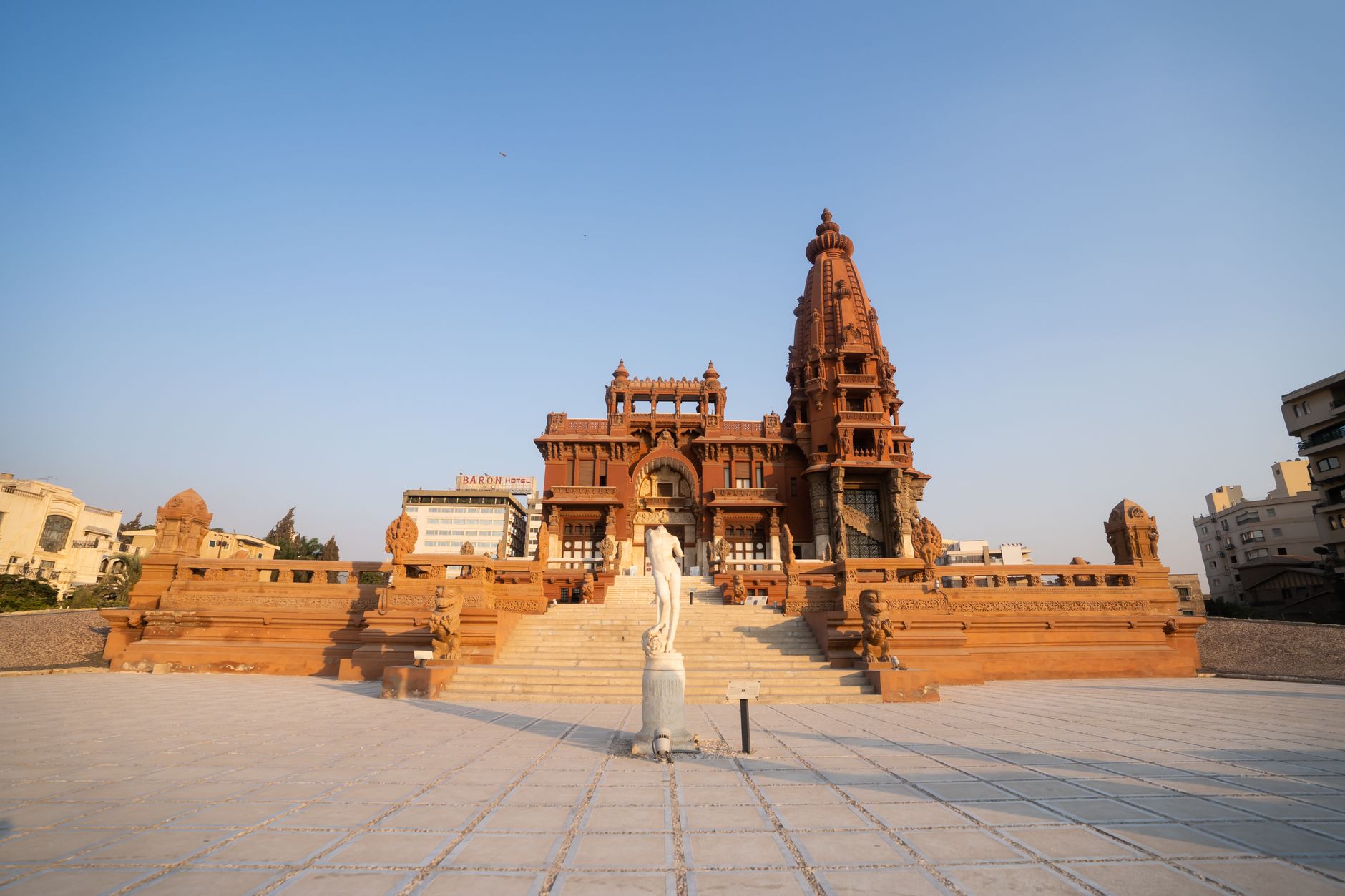
What exactly is Baron Empain Palace?
It’s a two-storey mansion in the planned suburb of Heliopolis, in northeast Cairo, built as the private residence of Édouard Empain — a Belgian industrialist and railway magnate who, frankly, had taste that ran a long way from anything else in Egypt. Locals have always called it “Le Palais Hindou,” the Hindu Palace, and once you’ve seen it you’ll understand why.
The design came from French architect Alexandre Marcel, who leaned into a mix of references that shouldn’t work together but somehow do: the great Khmer temple of Angkor Wat in Cambodia for the massing and the stepped central tower, and the Hindu temples of Orissa in eastern India for the carved figures and ornament. You get Vishnu and Shiva motifs, dancing deities, and snake-naga figures slithering along railings and capitals. Under all that exotic decoration sits something quietly modern for its day — reinforced concrete, a cutting-edge building material in 1907. Marcel essentially dressed a forward-looking structure in the costume of an Asian temple, and the result is unlike anything else in Cairo.
The story of Baron Édouard Empain
Édouard Louis Joseph Empain (1852–1929) made his fortune laying railway and tram lines across Europe and the Middle East. He arrived in Egypt in 1904 with a much bigger plan than a single house: he wanted to build an entire suburb from scratch in the desert northeast of central Cairo. That suburb became Heliopolis, a model town of wide avenues, arcaded apartment blocks and its own tram network — a piece of Belle Époque town planning that still defines the district today.
The palace was Empain’s personal statement inside that project: part home, part architectural showpiece. Construction ran four years, from 1907 to 1911, and the Baron used it as his Cairo residence through the 1910s and 1920s. He died in 1929 and, by his own wish, was buried in the Heliopolis Basilica he had also commissioned a short walk away.
Then things went quiet. After the 1952 revolution and the social upheavals that followed, the palace was left empty. It sat that way for the better part of seven decades — shuttered, stripped, slowly crumbling. Which is exactly when the legends started.
The ghost stories
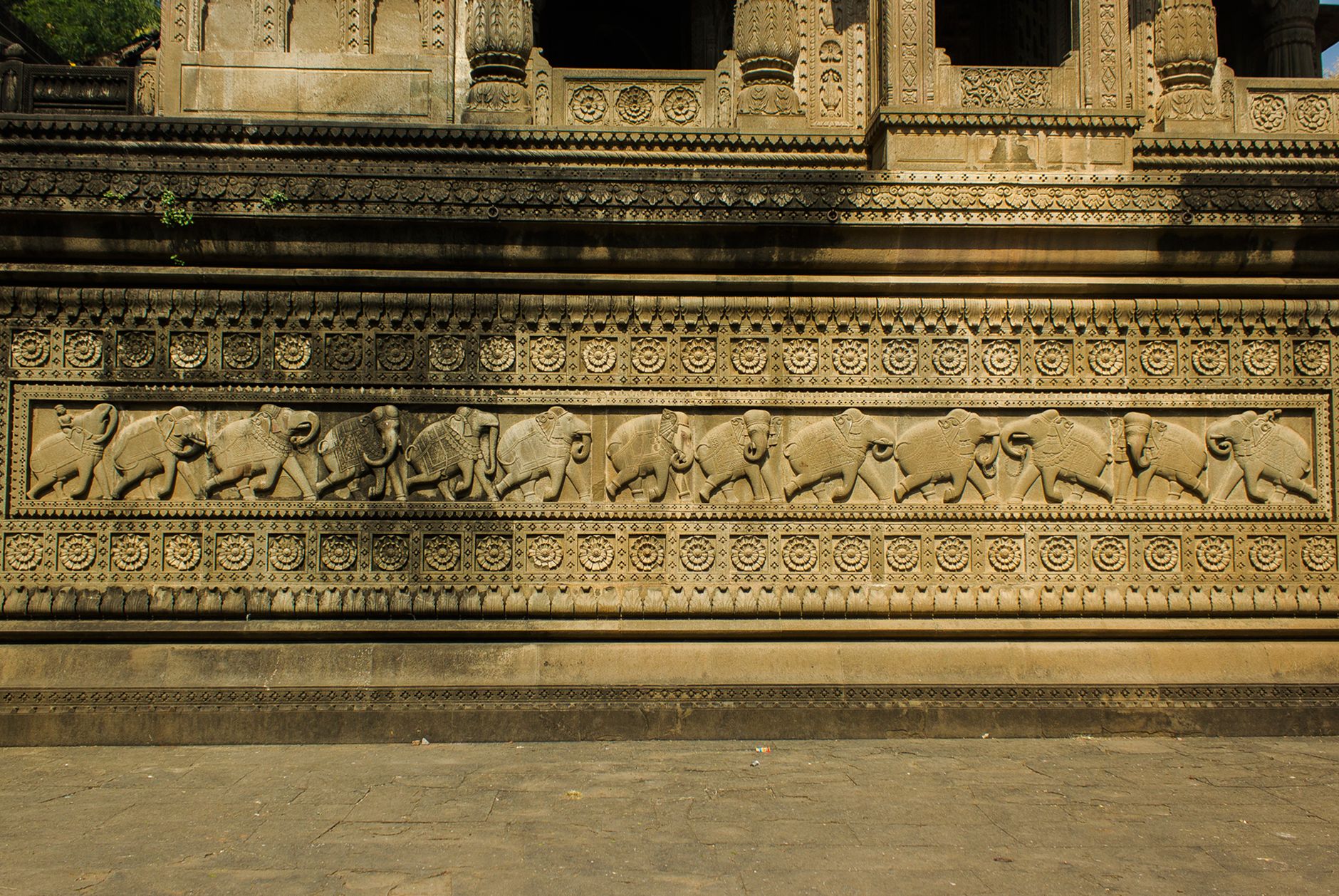
An abandoned mansion covered in snake carvings, locked up for generations in the middle of a busy suburb? Cairo’s imagination did the rest. For years the palace was the city’s go-to haunted house: tales of a sister who fell to her death from the upper floors, of rooms that rotated to follow the sun, of lights and screams behind the boarded windows, of cults and séances. None of it holds up to scrutiny, but the stories became so embedded that the place turned up in 1990s Egyptian horror films and a whole subgenre of local Gothic storytelling.
I’ll be honest — the building genuinely is atmospheric, even now that it’s swept, lit and ticketed. But the haunting is folklore, not fact. What you’re really seeing is what happens when a beautiful, eccentric building is left alone too long. If you like Cairo’s quieter, less-trodden corners, it pairs well with somewhere like the Coptic Museum in Old Cairo — another atmospheric site most first-timers skip.
The restoration and the museum today
The Egyptian government bought the palace in 2005, the centenary of Heliopolis’s founding, and the Supreme Council of Antiquities listed it as a protected monument in 2007. What followed was a long, careful restoration — reinforcing the concrete structure, cleaning and repairing the carved facades, restoring interiors, landscaping the grounds, and adding an architectural lighting scheme that makes the place glow after dark. Egyptian and international press put the bill at around six million dollars.
The palace finally reopened to the public as a museum on 29 June 2020, after almost 70 years shut away. Inside, it’s not stuffed with antiquities — the real exhibit is the building itself, supported by a permanent display on the history of Heliopolis and the life of the Baron: vintage photographs, original architectural drawings, and period detail. It’s a museum about a place and a man, set inside the most theatrical house in the city.
Tickets and hours (2026)
This is the one thing the older guides online get wrong, so here are the current figures. Tickets are tiered by nationality, and the rooftop “Panorama” terrace is sold as a separate add-on.
| Ticket | Price (approx.) |
|---|---|
| Adult, foreign | 220 EGP (~$4.50) |
| Student, foreign (with ISIC) | 110 EGP |
| Adult, Egyptian | 60 EGP |
| Rooftop / Panorama (foreigners, extra) | 120 EGP |
| Mobile-phone photography | Free |
| Professional DSLR camera | ~50 EGP (+ ~20 EGP tripod) |
Opening hours run roughly 9 AM to 4 PM daily. Mondays have historically been the standard closure day for Egyptian monuments, so if you’re planning around a single day, treat Monday as the risky one and double-check before you go. Hours and prices at Egyptian monuments change without much warning, so confirm current details at egymonuments.gov.eg the week of your visit.
One practical note that catches people out across Cairo: most monuments now want card payment rather than cash at the ticket window, so bring a card you trust for international transactions. The rooftop is worth the extra few dollars for the view over Heliopolis’s rooftops, but note children generally aren’t allowed up there.
The architecture, up close
Give yourself time to actually look at this building, because the detail is the whole point. On the outside you’ve got the stepped, pyramidal central tower that nods to Angkor Wat, a facade washed in that distinctive pink, and an astonishing density of carving — snakes, dragons, elephants and Hindu deities crawling over the railings, columns and cornices. Half the fun is spotting figures you missed the first time round.
Inside, the restored rooms include grand reception halls decorated in the same Indian-temple idiom, the Baron’s private chambers returned to something close to their early-1900s look, a library and study, lower-level service quarters, spiral staircases, and roof terraces. Some of the chandeliers and decorative pieces are original; others are faithful replicas made during the restoration. It reads less like a normal house and more like a stage set someone decided to actually live in.
What to make sure you see
- The main facade and entrance — the signature temple-style frontage, and the best photo of the trip.
- The central tower — the Angkor-inspired stepped feature that gives the silhouette its drama.
- The reception halls — the largest interior spaces, dripping with Hindu motifs.
- The Baron’s private rooms and library — restored with period furniture and books.
- The rooftop / Panorama terrace — paid add-on, with views across Heliopolis.
- The Heliopolis history exhibition — vintage photographs and the original architectural drawings.
- The carved detail — get close to the railings and column capitals; the small sculptures are the best bit.
How long to give it
It’s not a huge site, and the pleasure is in lingering rather than racing. A quick look takes about 45 minutes. An unhurried visit with the interiors and the exhibition runs around 1 to 1.5 hours. Add the rooftop and some time in the gardens and you’re closer to 2 hours. I’d plan for 1.5 hours and not feel rushed.
Getting to Heliopolis
The palace sits in Heliopolis, specifically near the Korba district, in the northeast of the city — well away from the Giza and Downtown clusters most visitors stick to. The easy answer is a ride-hail app: Uber or Careem from central Cairo or Zamalek takes roughly 25 to 40 minutes depending on traffic, and costs a fraction of what a hotel taxi will quote. Heliopolis also has its historic tram lines, and Cairo Metro Line 3 reaches the area, but for a first visit the app is by far the least stressful option. If you’d rather get the lay of the land before you arrive, our Cairo culture and etiquette guide covers tipping, dress and the small social rules worth knowing.
The big advantage of the location is everything around it. Within walking distance you’ve got the arcaded Belle Époque streets Empain built, the El-Korba shopping district, and the Heliopolis Basilica where the Baron is buried. The palace really wants to be the anchor of a half-day rather than a quick in-and-out.
Building it into a Heliopolis half-day
Here’s the itinerary I’d actually run: start at the palace (1.5 hours), then walk the Belle Époque streets of Korba (about an hour, more if you like architecture), drop into the Heliopolis Basilica (30 minutes), browse the shops, and finish with lunch or coffee at one of the old Heliopolis cafés. It’s a calm, walkable, distinctly local slice of Cairo that almost no first-timers see. For ideas on where else to point a half-day in the city, our roundup of things to do in Cairo is a good companion.
If the half-day leaves you with an evening free, the natural next move is back across town to the river, where a concert or ballet on Gezira Island rounds off a day spent on Cairo’s more unexpected architecture.
Photography
This is, hands down, a photographer’s building. Shooting is allowed throughout the palace and grounds, and the carved figures reward a slow, detail-hunting approach. The best light is late afternoon, when the low sun warms the pink facade and throws the carvings into relief. Mobile photography is free; bring a proper camera if you have one, but be aware professional gear and tripods carry a small fee, and night photography is usually only possible during special events. Get close to the railings and column capitals — the small naga figures and deities are easy to walk straight past, and they make the most interesting frames.
Frequently asked questions
What is Baron Empain Palace?
A Hindu-temple-style mansion built between 1907 and 1911 by Belgian baron Édouard Empain in the Heliopolis suburb of Cairo. It reopened as a museum in 2020.
How much are tickets in 2026?
Around 220 EGP (about $4.50) for foreign adults, 110 EGP for foreign students, and 60 EGP for Egyptians. The rooftop terrace is an extra 120 EGP for foreigners. Confirm current rates at egymonuments.gov.eg.
What are the opening hours?
Roughly 9 AM to 4 PM daily. Monday is the traditional closure day for Egyptian monuments, so check before planning a Monday visit.
Why is it called the Hindu Palace?
From its nickname “Le Palais Hindou” — a reference to the Hindu temple sculptures, deities and motifs covering the building, inspired by Angkor Wat in Cambodia and the temples of Orissa in India.
Is the palace really haunted?
No. The ghost stories are extensive local folklore tied to its decades of abandonment, but none are substantiated. The building is genuinely atmospheric all the same.
How long should I spend there?
About 1.5 hours for a relaxed visit, or up to 2 hours if you add the rooftop and the gardens.
How do I get there?
It’s in Heliopolis (Korba district), northeast Cairo. An Uber or Careem from central Cairo takes about 25 to 40 minutes; Metro Line 3 and the local tram also serve the area.
The bottom line
Baron Empain Palace is the off-script Cairo experience — a Hindu temple dropped into an Egyptian suburb, locked away for 70 years, and now one of the most photogenic museums in the city. Give it about 1.5 hours, build a half-day around the surrounding Heliopolis streets, and go late in the afternoon for the light. It’s the visit that gives you a story none of your fellow travellers will have.
Keep planning with our Cairo museums guide, and if you’re mapping out the cultural side of your trip, the Grand Egyptian Museum guide and the Egyptian Museum at Tahrir Square are the two big-ticket institutions worth pairing with this little gem of a palace.