This article contains advertising. Our booking links are routed through a partner that adds commission tracking automatically, so if you book through one we earn a commission from the provider, at no extra cost to you. It never affects what we recommend. Affiliate disclosure
There is a moment on any single day in Cairo when you have to admit you are not going to see it all, and the sooner it arrives the better the day goes. Twenty million people, four separate clusters of world-class sights, and traffic that can turn a nine-kilometre hop into fifty minutes: a workable 1 day in cairo itinerary is not a compressed version of a three-day trip, it is a completely different plan built on a single decision made before you leave the hotel. Choose Giza and the Grand Egyptian Museum, or choose Islamic and Coptic Cairo. Choose both and you will spend your day in a car.
This page gives you the two viable one-day routes, hour by hour, with the timings that actually hold up, plus a separate short version for airport layovers. Prices were checked in September 2026 and should be read as the right order of magnitude rather than a quotation — Egyptian entry fees move with the pound, and the pound has moved a great deal. For the longer plans, and the reasoning behind the one-cluster-per-half-day rule, see the Cairo itineraries hub.
What a single day costs
| Item | Price (checked Sept 2026) | Notes |
|---|---|---|
| Giza plateau entry | EGP 700–800 (~USD 15–17) | Interior pyramid access is extra |
| Grand Egyptian Museum, adult | EGP 1,450 (~USD 30) | Timed slot, online only |
| Egyptian Museum, Tahrir | EGP 550 (~USD 11) | Buy at the gate |
| National Museum of Egyptian Civilization | EGP 550 (~USD 11) | Royal Mummies Hall included |
| Ibn Tulun Mosque | Free | Modest dress, shoes off |
| Uber or Careem, cross-city | EGP 150–350 (~USD 3–7) | Doubles at rush hour |
| Metro single | EGP 8–15 (~USD 0.20–0.30) | By distance banding |
| Koshari lunch | EGP 50–90 (~USD 1–2) | At a proper koshari house |
| Felucca, one hour, whole boat | EGP 400–600 (~USD 8–12) | Agree before boarding |
| Realistic total, one person | ~EGP 3,000 (~USD 62) | Route A, no guide, no tour |
Route A: the pyramids and the Grand Egyptian Museum
For a first visit this is almost always the right choice. The two sights sit within minutes of each other on the western edge of the city, which means you spend the day in one cluster instead of crossing Cairo twice. The pyramids are the reason most people come, and the museum is the best air-conditioned building in Egypt to be standing in at two in the afternoon.
08:00 — At the Giza gate
Be at the entrance when it opens. This is not enthusiasm, it is arithmetic: the plateau is exposed, there is almost no shade, and by eleven in summer the walk between the Great Pyramid and the Sphinx becomes genuinely unpleasant. The light is also better — low, raking, and much kinder to photographs than the flat overhead glare of noon.
The other reason is the coaches. Organised tours arrive from about half past nine, and the difference between the plateau at eight and at ten is the difference between a monument and a car park.
08:15–09:30 — The Great Pyramid and the panorama
Start at Khufu’s pyramid, walk its base — it takes longer than you think, which is rather the point — and then head up to the panorama viewpoint where all three pyramids line up. This is the classic shot and it is worth the short climb.
Interior access is a separate ticket. Our honest view: go inside once, if you are not claustrophobic and your knees are cooperative. The Grand Gallery is genuinely extraordinary as an engineering space. The burial chamber, though, is a bare granite room with an empty sarcophagus, and a fair number of people come out feeling they paid for a hot, crowded, stooping climb to see nothing. Know that going in and you will enjoy it more.
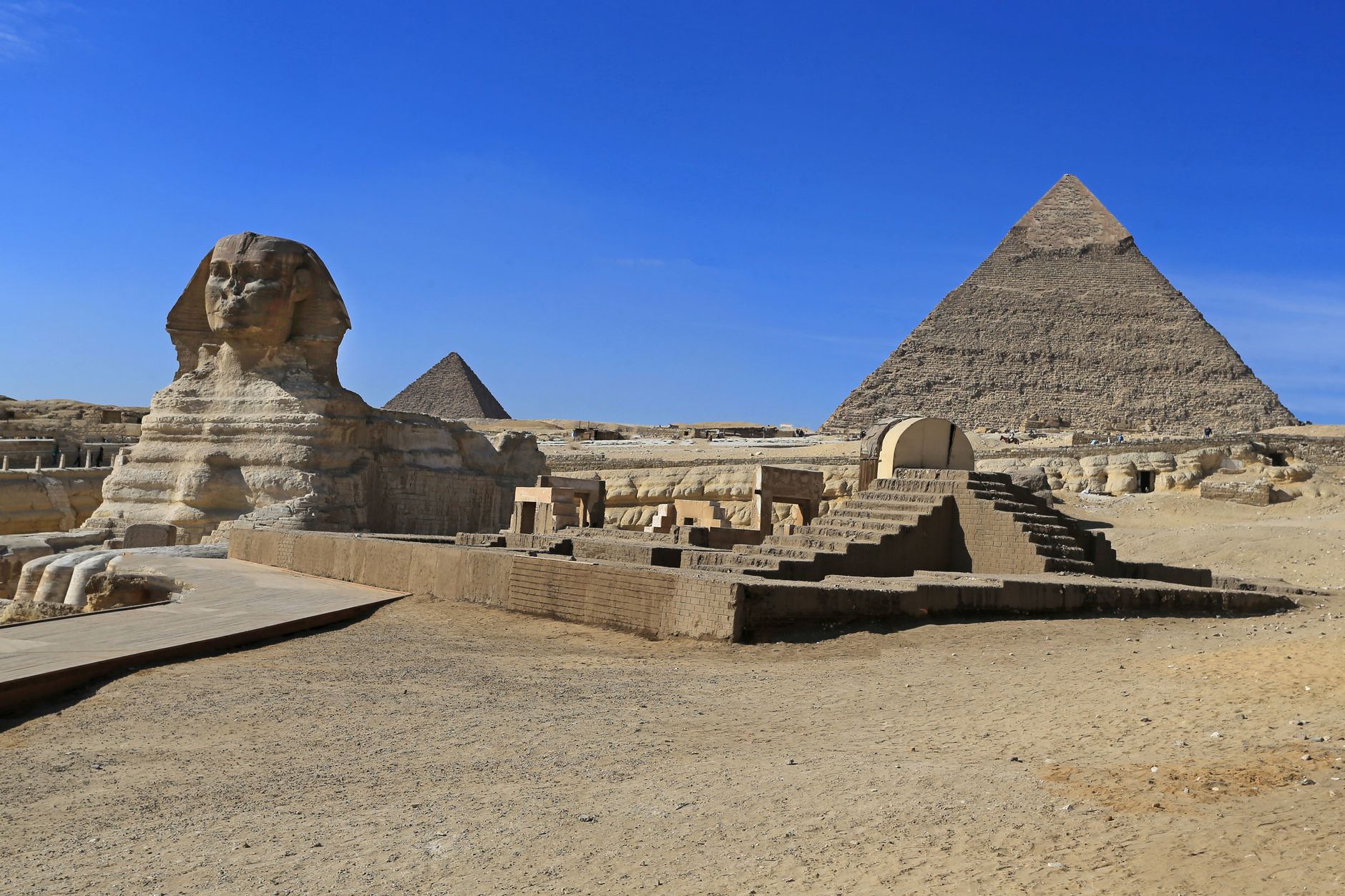
09:30–10:30 — The Sphinx and the valley temple
Walk down to the Sphinx enclosure. The valley temple beside it is easy to walk past and shouldn’t be — the massive granite-cased limestone blocks are among the most impressive stonework on the site, and it is where the causeway from Khafre’s pyramid comes down.
The touts: a plain warning
Giza’s hassle is concentrated at the gates and along the sand tracks, and it is persistent rather than dangerous. The standard camel and horse routine is to quote a price for the ride up and then negotiate the price down again once you are on the animal at the top of the ridge. If you want a camel ride — and it is a good photograph — agree the total, the duration and the return in advance, ideally typed into a phone and shown to both parties. If you do not, “no thank you” repeated calmly and without stopping works better than argument. The same applies to anyone offering to take your photo, hand you a headdress, or tell you the site is closed and they know another entrance. It is not closed.
11:00–12:30 — Lunch, away from the gate
The restaurants immediately outside the Giza entrance are priced for people who have no other option. Ride ten minutes into Giza town or towards the museum and you will eat better for a third of the money. This is also the hour to sit down properly, because the afternoon is a long one on your feet.
13:00–16:00 — The Grand Egyptian Museum
Book your timed slot before you travel. On-site ticket sales are suspended and the museum works entirely on pre-booked, timed entry, so this is the one fixed point in your day and everything else should be arranged around it.
Three hours is a comfortable highlights visit. Go to the Tutankhamun galleries first — the complete collection is here now, some five thousand objects, the golden mask included — then the Grand Staircase with its tiers of colossal statues and the window at the top that frames the pyramids you were standing under this morning. Khufu’s solar boat, a reassembled cedar ship buried beside the Great Pyramid, is the other unmissable thing. The main galleries you can walk in whatever direction the day has left you.
One thing to get straight before you arrive: Tutankhamun’s treasures are here, but his mummy is not. It remains in his tomb in the Valley of the Kings at Luxor. The twenty-two royal mummies of other pharaohs are across the city at the National Museum of Egyptian Civilization. This three-way split confuses more visitors than anything else in Egypt. The full GEM visitor guide covers the layout in detail.
Evening — the Nile, or an early night
If you are flying on, go back and sleep. If you have the evening, get to the river. A felucca for an hour at sunset costs a fraction of a dinner cruise and is the better hour on the water: no buffet, no amplified band, just a lateen sail and the city going past. Dinner cruises have their place, and the Tanoura and belly dance shows they bundle are genuinely entertaining, but they are a two-and-a-half-hour commitment on a day that has already been long.

Route B: Islamic and Coptic Cairo
The alternative day, and the right one if you have seen the pyramids before, if it is high summer and you would rather be in shaded stone lanes than on open sand, or if what draws you to Cairo is the medieval city rather than the pharaonic one. It is also, unarguably, the cheaper day.
08:30–11:30 — Al-Muizz Street, north to south
Start at Bab al-Futuh, the northern gate, and walk south. Al-Muizz is about a kilometre long and holds the greatest concentration of medieval Islamic architecture anywhere in the world — the Qalawun complex with its madrasa, mausoleum and hospital, the Khanqah of Barquq, the Sabil al-Selehdar, Hamam Inal, one façade after another. Walking it north to south means the morning sun is behind you and the street opens up ahead.
Finish at Bab Zuweila, the southern gate, and climb the minarets. The view over the rooftops and the forest of minarets is the best in the medieval city and almost nobody does it.
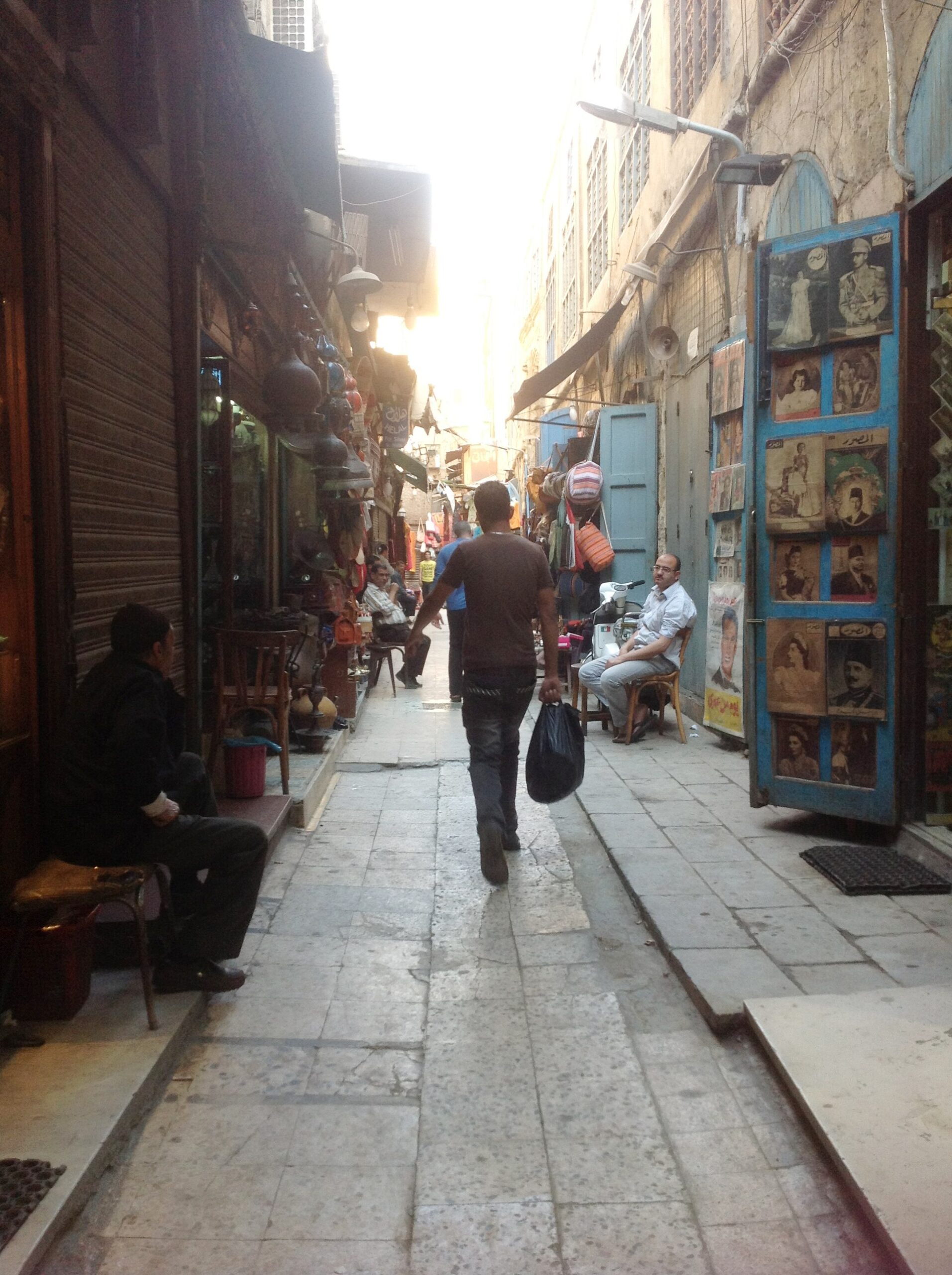
11:30–13:00 — Khan el-Khalili
Khan el-Khalili is not on Al-Muizz, which surprises people. It is immediately beside it — thirty seconds down an alley. The souk proper is a warren of lanes selling brass, glass, textiles, spice and a very great deal of tourist tat, and the pleasure of it is the walking rather than the buying.
If you do buy, haggle, expect the opening price to be several times the real one, and be relaxed about it — this is a normal transaction here, not a confrontation. Coffee at El Fishawy, the café that has been open in one form or another for a couple of centuries, is a tourist ritual and none the worse for it.
13:00–15:00 — Ibn Tulun and Gayer-Anderson
A short ride south-west takes you to the Mosque of Ibn Tulun, built between AD 876 and 879 by an Abbasid governor sent from Baghdad. It is the oldest mosque in Egypt surviving largely in its original form, and after the density of Al-Muizz its vast, plain courtyard is a genuine relief. Entry is free. Allow an hour, and climb the spiral minaret, which is unlike anything else in the city.
The Gayer-Anderson Museum shares a wall — two Ottoman houses knocked together and filled with the collection of a British army officer who lived there in the 1930s. It is small, eccentric and one of the most enjoyable half-hours in Cairo.
15:30–17:00 — Coptic Cairo
Metro Line 1 to Mar Girgis drops you at the door of Coptic Cairo, which is compact enough to walk in an hour and a half. The Hanging Church, suspended over the gatehouse of the Roman fortress of Babylon, holds more than a hundred icons and over 1,500 years of continuous worship. Ben Ezra Synagogue and the Church of St Sergius and Bacchus are a few minutes’ walk away, and the Coptic Museum is on the same site.
If you would rather see the royal mummies, the National Museum of Egyptian Civilization is ten minutes away at Fustat, near El Malek El Saleh station, and the Royal Mummies Hall is included in the standard ticket with no supplement.
Which route should you take?
If it is your first time in Egypt, take Route A. The pyramids are the reason the trip exists, the Grand Egyptian Museum is the single best new cultural attraction to open anywhere in years, and the two sit close enough together to be one day rather than two half-days separated by an hour of ring road.
Take Route B if any of these apply. You have seen Giza before and did not love it. It is July or August, when three hours on an unshaded plateau is genuinely punishing and a shaded medieval lane is not. You are travelling on a tight budget — Route B costs a fraction of Route A, and Ibn Tulun is free. Or the thing that draws you to Cairo is the living city rather than the pharaonic one, in which case Al-Muizz at eight in the morning, with the shutters going up and the bread being delivered, will stay with you longer than the Sphinx.
There is a third option that people rarely consider and probably should: split the day at the river rather than by cluster. Giza in the morning, back into town for a late lunch, the Egyptian Museum at Tahrir for two hours in the afternoon because it is downtown and costs you almost no travel time, then the Corniche in the evening. You trade the GEM for Tahrir, which is a real loss, but you gain a day that never leaves the same axis of the city and never fights the traffic. On a very hot day or a very tight schedule it is the calmest version of a single day here.
How the day changes by season
The same route is a materially different day depending on when you come, and a one-day trip has no slack to absorb a bad weather call.
- December to February. Highs of 18–24 °C (65–75 °F) and cool evenings around 10–15 °C. The best walking weather of the year, which makes Route B genuinely pleasant and Route A comfortable all day. Rain is rare. Crowds and prices spike hard over Christmas and New Year, so book the museum slot early.
- March to May. Warm and bright, the best all-round compromise. The khamsin winds can throw dust across the plateau for a day or two in spring, which flattens both the light and the views.
- June to August. Route A only works if you finish at Giza by eleven and spend the afternoon inside. Route B is the better choice, and even then the middle of the day belongs indoors.
- September to November. Cooling steadily, still bright, few crowds by late autumn. Arguably the best month-for-month time to do either route.
Ramadan shifts roughly eleven days earlier each Gregorian year and changes opening hours across the city, including at the museums. The atmosphere in the evenings is wonderful and the daytime rhythm is slower; if your one day falls inside it, check every opening time individually rather than assuming.
The layover version
If your day in Cairo is a connection rather than a stay, the arithmetic is unforgiving and worth doing before you book anything.
Cairo International is north-east of the city. Giza is on the far south-western edge. In bad traffic that is ninety minutes each way. You should be back at the terminal roughly three hours before departure, and a good operator will build the whole day backwards from your boarding time rather than forwards from your landing.
- Under 6 hours. Stay airside. There are sleep pods in all three terminals now and an automated people mover between them. Leaving is not worth the risk.
- 6 to 8 hours. The pyramids, and nothing else. No museum, no bazaar. Prebook a driver who knows the timing.
- 8 to 12 hours. Pyramids plus either the GEM or a short Islamic Cairo walk. Still not both.
- 12 hours or more. Effectively Route A, with a real lunch.
Anyone selling you a layover tour that includes the pyramids, the Grand Egyptian Museum, Khan el-Khalili and the Citadel on a seven-hour connection is selling you a missed flight. Say no.
Practical notes for a single day
Book the museum slot first
The GEM is the only genuinely time-critical booking in Cairo. Everything else — Giza, Tahrir, the NMEC, the Citadel — you can buy at the gate on the day. Fix the museum slot, then build the rest of the day around it.
Take cash, in small notes
Cards work in hotels and larger restaurants. Almost nothing else. Entry fees, taxis, tips and street food all want cash, and small notes specifically — nobody at a koshari counter is going to break a large bill at nine in the morning. Baksheesh, the small tipping that runs through daily life here, is not a scam, though it is occasionally used as one.
Dress for stone and sun
Shoulders and knees covered, for everyone; women should carry a scarf for mosque visits, where hair must be covered and shoes come off at the door. Proper shoes matter more than most people expect — the plateau is sand and broken limestone, and Al-Muizz is uneven medieval paving.
Water and air
Tap water is not recommended for drinking, so buy sealed bottles and buy more than you think you need. Cairo also has regularly high dust and air pollution, and official advice for anyone with a lung condition is to take medical advice before travelling.
Getting between things
Ride-hailing through Uber or Careem is the default: metered, cheap and no negotiation. The metro is genuinely excellent on the north–south spine and beats the roads outright at rush hour, but it does not serve the Giza plateau or the GEM. The full picture is in getting around Cairo.
What not to do with one day
Do not book a hop-on hop-off bus. The format needs a compact city and Cairo is not one. The stops are far from the sights, the traffic makes the timetable fictional, and a day of ride-hailing costs less and is faster.
Do not accept the papyrus or perfume stop. Nearly every organised day tour includes one. They are commission stops, the “papyrus institute” is usually selling banana leaf, and the half-hour they cost you is a half-hour you do not have.
Do not add the Citadel to Route A. It is on the wrong side of the city and it will cost you the museum.
Do not try three museums. The GEM, Tahrir and the NMEC in a day is a plan that looks efficient on a map and feels like punishment by four o’clock.
Do not schedule the sound and light show on a one-day trip. It is fine, it is not essential, and it turns an already long day into a very long one.
Frequently asked questions
Is one day in Cairo enough?
It is enough to see one half of the city properly — either the pyramids and the Grand Egyptian Museum, or the medieval and Coptic quarters. It is not enough to see both, and attempting both is the commonest way a single day gets wasted. If you can stretch to two days, the return on that second day is larger than on any other day of a Cairo trip.
Can you see the pyramids and the Grand Egyptian Museum in one day?
Yes, comfortably — they are minutes apart. Start at the plateau at 08:00, take lunch away from the gate at around 11:30, and take a museum slot from about 13:00. Three hours at the GEM covers the highlights without rushing.
Should you book a guide for a single day?
For Giza, a guide is worth it: the plateau does not explain itself and a good Egyptologist changes the day. For the GEM, much less so — it is well labelled and easy to navigate. A guided morning and a self-guided afternoon is the split most people are happiest with. A private full-day Cairo tour of roughly ten hours runs to about USD 110 per person, with group tours nearer USD 80.
What time do the pyramids open?
Early — you want to be at the gate at 08:00. Check the current opening time before you travel, because seasonal and Ramadan hours vary, and the last-entry time is earlier than the closing time.
Is Cairo safe to walk around for a day?
Yes, with ordinary city sense. The main issue for visitors is persistent commercial hassle at the tourist sites rather than crime, and it is best handled by not stopping. Traffic is the genuine hazard: crossing a Cairo road is a skill, and the technique is to walk steadily and predictably rather than to dart.
What should you eat on a one-day trip?
Koshari — lentils, rice, pasta, chickpeas, fried onion and tomato sauce, a couple of dollars a bowl, and the national dish. It is fast, filling and vegetarian, which makes it close to a perfect sightseeing lunch.
Is the Egyptian Museum at Tahrir still worth visiting?
Yes, though not on a one-day trip that includes the GEM. It lost Tutankhamun and the royal mummies but kept around 120,000 objects, and the old neoclassical building is part of the pleasure. On a two-day or longer trip it earns its place easily.
If you can find a second day, take it — the return on it is larger than on any other day of a Cairo trip, because it lets you do Giza and the medieval city properly instead of choosing between them. Our two-day Cairo weekend itinerary sets out the split.
Related Cairo Guides
- All Cairo itineraries, one to fourteen days
- How many days do you need in Cairo?
- Visiting the Pyramids of Giza
- Giza tickets and entry prices
- Khan el-Khalili: the complete souk guide
- Using the Cairo metro
- Where to eat koshari
- Safety and scam awareness
Photo Credits
The Great Sphinx of Giza: photo by Petar Milošević, via Wikimedia Commons (CC BY-SA 4.0).
Lane in Khan el-Khalili: photo by The Erica Chang, via Wikimedia Commons (CC BY 3.0).