This article contains advertising. Our booking links are routed through a partner that adds commission tracking automatically, so if you book through one we earn a commission from the provider, at no extra cost to you. It never affects what we recommend. Affiliate disclosure
The good Pyramids of Giza photography shots come down to three things: where you stand, what time you’re standing there, and whether you’ve learned to ignore the man trying to put you on a camel. Get those right and your phone will out-shoot the tripod tourist next to you. The honey-coloured light lasts roughly 45 minutes after sunrise and again before sunset — plan the day around those two windows and the rest is composition.
I’ve watched people spend a fortune on gear and then shoot the plateau at noon, when the haze flattens everything and the limestone goes grey. Light beats kit here, every time. Below is how to get the classic frames — the three pyramids in a row, the Sphinx with Khafre rising behind it, the golden-hour silhouette — plus the practical stuff nobody mentions: the real tripod rule, why your drone gets confiscated, and how the camel-photo hustle actually works so it doesn’t work on you. This is a companion to our full guide to planning a Giza visit; if you’ve already got your tickets sorted, skip straight to the vantage points.
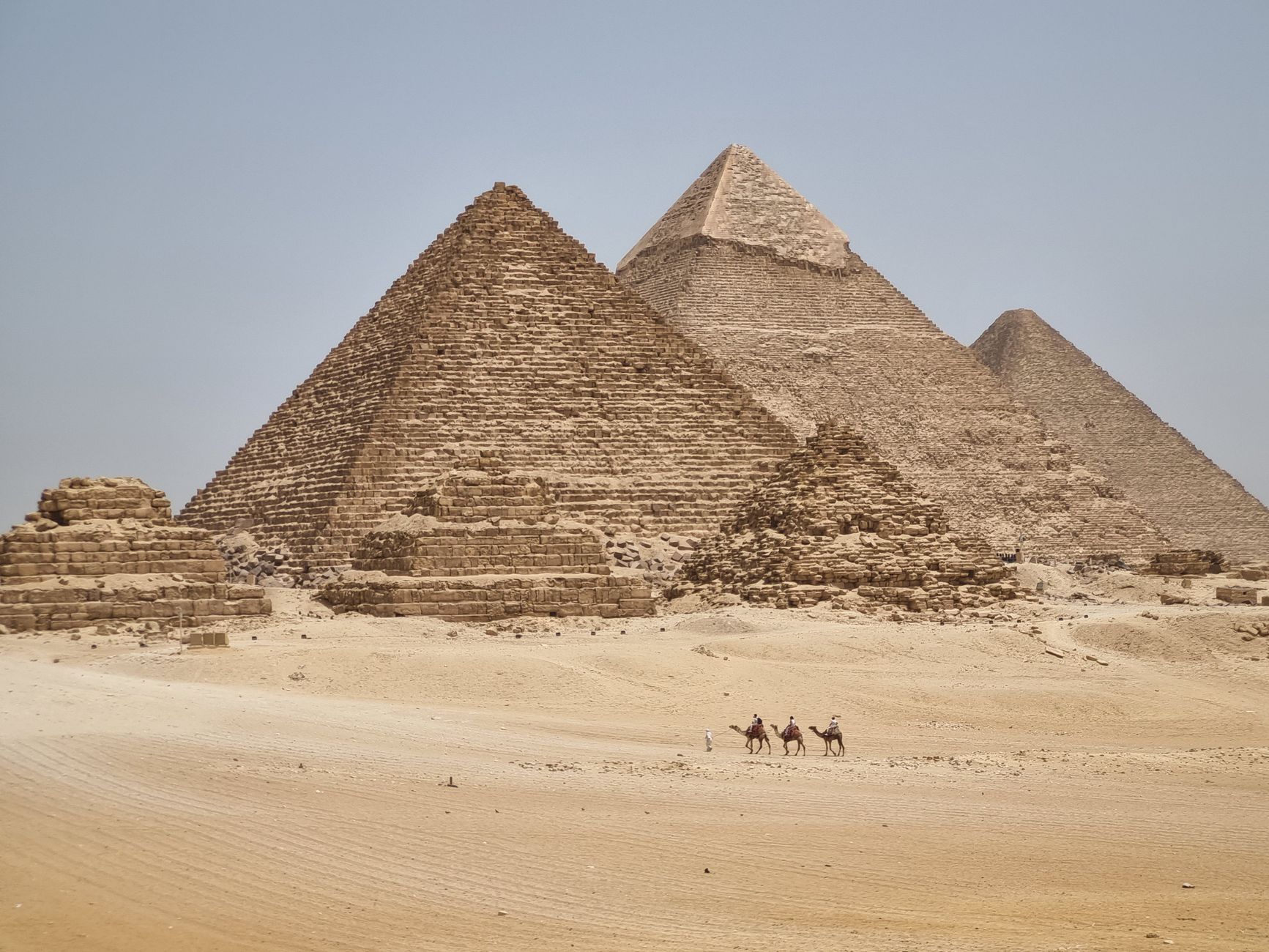
The shots worth chasing (and where to stand for them)
You don’t need ten frames. You need about five that you’ll actually print or post, and they each have a spot and an hour. Here’s the short list, ranked by how much they reward the effort.
1. The three pyramids in a row
The Instagram classic — Khufu, Khafre and Menkaure stretching across the frame in descending order. The spot is the panorama viewpoint on the desert side, south of the three pyramids. You reach it on a camel or horse, or you walk the ring road that loops around the plateau (it’s a long, hot walk — figure 30–40 minutes from the Sphinx gate). Late afternoon, roughly 4 to 6 PM in summer, throws long shadows down the slopes and lines up the descending sizes beautifully. A wide lens (16–35mm) gets the sweep; a standard 35–50mm tightens it if you want the pyramids to feel monumental rather than distant.
2. The Sphinx with the Great Pyramid behind
The single most-photographed view on the plateau, and for good reason — the Sphinx in front, Khafre’s pyramid rising directly behind its head. Shoot it from the Sphinx viewing terrace on the eastern descent, near the valley temple. Be there at opening, 7 AM in summer or 8 AM in winter, for two reasons: the morning sun lights the Sphinx’s face, and you get a clean frame before the tour buses disgorge. A wide lens gives you the whole scene with context; a 70–200mm compresses the Sphinx and pyramid together so they read as one stacked silhouette.

3. The golden-hour silhouette
The pyramids as black triangles against a pink-and-orange sky. Here’s the catch the guidebooks gloss over: the plateau opens too late for sunrise and closes before full sunset, so the best silhouette shots come from outside the gate. Your hotel rooftop if you’re staying in Giza, the Pizza Hut/KFC terrace across from the Sphinx entrance (yes, really — it’s a legitimately great free vantage point), or any high point with a clear western or eastern line of sight. Get into position 30 minutes before the sun does. A telephoto compresses the pyramids into clean stacked shapes; a wide lens lets the sky do the work.
4. Camel and pyramid
A camel and rider in the foreground, a pyramid towering behind, raked in low gold light. The dunes south of the three pyramids near the panorama point are where this works, at sunset. A standard zoom or a short telephoto (70–200mm) compresses the camel against the stone nicely. Getting this shot without getting fleeced is its own section below — read it before you negotiate anything.
5. The stones up close
Forget the whole pyramid for a minute and shoot the base of the Great Pyramid — those limestone blocks are taller than a person, and a tight frame of the texture with a human for scale tells the size story better than any wide shot. Any time of day works; side light rakes across the joints and brings out the surface. This is the easy one, and it’s often the keeper nobody expected.
The vantage points, inside the gate and out
The plateau gives you several positions, and the area around it gives you a few more that cost nothing. Knowing them in advance saves you wandering in the heat.
| Vantage point | What you get | Access |
|---|---|---|
| Great Pyramid base | Scale and texture shots | Walk-up, free with entry |
| Between Khufu and Khafre | Two pyramids aligned, dramatic | Walk-up, free with entry |
| Sphinx terrace (east) | The classic Sphinx + Khafre frame | Walk-up, free with entry |
| Panorama viewpoint (south) | The three-in-a-row shot | Camel/horse, 4×4, or long walk |
| 9 Pyramids Lounge terrace | Same panorama, with a cold drink | Restaurant, meals from ~$20pp |
| Pizza Hut Giza rooftop | Sphinx + Khufu, the cultural-juxtaposition shot | Outside gate, free with a snack |
| Marriott Mena House gardens | Pyramid framed by palace grounds | Hotel guests / restaurant booking |
| Eastern roadside near Sphinx gate | Free Sphinx + Khufu view | Public street, free |
If you only have time for one off-plateau spot, make it the Pizza Hut terrace at sunset. It’s become a genuine photography destination precisely because the contrast — fast food in the foreground, 4,500-year-old tombs behind — is the most honest picture of what visiting Giza actually feels like. For the desert-side angles, the panorama viewpoint is unbeatable, and the trick few tourists know is that the less-visited southern and western sides give you compositions almost nobody else has, especially if you reach them by camel or 4×4 rather than fighting for space at the main terrace.
The Sphinx terrace is the one vantage point where knowing the object changes how you frame it, because the missing nose, the broken beard and the stele between the paws all read differently once you know what you are actually looking at.
The plateau is only one of the city’s great vantage points. If you are building a shot list for the rest of the trip, our guide to the corners of Cairo worth photographing maps the rooftops, bridges and lanes that reward a camera.
Golden hour: the only timing that matters
Egyptian desert light is warm and directional, and at the two ends of the day it turns the limestone the colour of honey. The working windows are roughly 6:30 to 8:30 AM and 4:30 to 6:30 PM, shifting with the season — the prime golden glow really only lasts about 45 minutes after sunrise and the same before sunset. Midday is the enemy: the sun is straight overhead, shadows vanish, heat haze shimmers off the sand, and the pyramids photograph flat and lifeless. In summer that haze is brutal by 11 AM.
So the play is simple. Sunrise silhouettes from outside the gate, then be first through the turnstile at opening for the empty-plateau and Sphinx frames while the light is still soft. Shoot details and texture through the middle of the day if you must, or go have lunch and a cold drink. Come back to the panorama viewpoint for the last two hours of light, and finish with the camel-and-pyramid silhouette as the sun drops. Winter — November through February — gives you the cleanest skies of the year, which is half the reason it’s peak season. Our guide to the museums and cultural attractions of Cairo is the natural indoor plan for the haze-heavy middle of a summer day.

Gear and settings: bring less, clean it more
You can shoot a brilliant Giza portfolio on a phone. Modern handsets — an iPhone 14 or newer, a Pixel 7 or newer, a recent Galaxy — handle the dynamic range fine if you light them right. If you’re carrying a camera, a single body and two lenses cover everything: a wide zoom (16–35mm) for the architecture and the sweeping desert frames, and a telephoto (70–200mm) to compress distant silhouettes and crop crowds out of the shot. A 24–105mm standard zoom is the lazy one-lens answer if you don’t want to swap.
A few settings and habits that matter more than the kit:
- Lock exposure on the stone, not the sky. Meter for the limestone or the pyramids blow out the highlights or go to silhouette by accident. On a phone, tap the pyramid and slide the exposure down a touch.
- Shoot RAW (or HEIF on a phone) if you’ll edit. Desert light is high-contrast; RAW lets you pull back blown skies and lift shadowed pyramid faces afterwards.
- A polariser is the one filter worth packing. It cuts haze and deepens that blue sky over the stone more than any edit can fake.
- Wipe the lens. Then wipe it again. Sand smears photos worse than you’d believe, and you won’t notice until you’re back at the hotel. A microfibre cloth and a blower live in the bag.
- Carry a spare battery. Cold desert mornings drain them fast, and there’s nowhere to charge on the plateau.
For people shots, neutrals — white, beige, black — blend into the desert tones, while a single bold colour like red or green pops hard against the pale stone. Skip busy patterns; they fight the monuments. And the oldest trick in the book still works: have your companion walk you back 50 metres and shoot you small in the frame, with the pyramid huge behind. Scale is the whole point. A photo of you filling the frame in front of a pyramid could be a pyramid the size of a garden shed.
The drone ban and the tripod reality
Two pieces of gear admin trip people up, and getting them wrong costs real money or a confiscated device.
Drones: don’t. They’re banned across Egypt for tourists without a Ministry of Defence permit that is, for practical purposes, impossible to get for a holiday. Security spots them within minutes, confiscation is permanent, and the fines run roughly 30,000–50,000 EGP (about $600–$1,000). They’re often seized at the airport on arrival. There is no aerial pyramid shot worth that. If you want a bird’s-eye perspective, the legal route is a helicopter tour — pricey, but real.
Tripods: allowed, with a cheap permit. Since a 2022 rule change, handheld cameras and phones shoot free — you can take as many photos as you like for personal use without paying a thing. A tripod, though, needs a separate permit, a nominal fee in the region of 20 EGP, bought at the gate, and it can be restricted in crowded spots for safety. A monopod draws less attention and is a fair compromise if you want stability for low light without the hassle. Carbon fibre handles the sand better than aluminium. One firm rule: no tripod inside the Great Pyramid — the passages are far too narrow, and you’d be a hazard to everyone behind you. Commercial shoots (anything for sale or advertising) and wedding photography need their own permits through the Ministry of Tourism and Antiquities, arranged in advance.
The drone rule is not a plateau quirk; it is national, and the same logic governs tripods, military subjects and pointing a lens at strangers. What is permitted inside museums and mosques, and where a paid professional permit kicks in, is set out in the countrywide rules on cameras.
Don’t get played by the camel-photo hustle
This is where good photographers lose their cool and their cash. The camel-and-pyramid shot is genuinely worth getting — but the freelance handlers who roam the plateau have turned it into a practised trap, and you need to know the moves before you walk over.
The classic version: a handler quotes something absurdly cheap, like 50 EGP, “to get on.” You climb up, he walks you out into the dunes, and when you want down the camel mysteriously won’t kneel — until you pay another 500 EGP for the privilege. You’re effectively stuck eight feet up while the price gets renegotiated. Other variations layer on charges for “helping you mount,” a “special route,” or the “photo stop,” or they claim the price you agreed was per person, per hour, not total.
How to stay ahead of it:
- Agree the full price out loud before you touch the animal — total cost, number of people, how long, whether the photo stop is included, and which currency. If it’s not nailed down before you’re up there, it’s not nailed down.
- Pay at the end, never upfront. Your money is your only leverage for getting back down at the agreed price.
- Know the going rate. A short circuit on the plateau runs roughly 200–400 EGP per person. Anything quoted in dollars is tourist pricing — push back or walk.
- Decline the unsolicited “help.” The man who grabs your phone to “take a great photo for you,” or offers to “hold the camel for free,” is opening a tab for baksheesh. A polite, firm “La, shukran” — no, thank you — is the most useful phrase you’ll learn.
- Book it properly if you want zero stress. Arranging the ride through a reputable operator or your hotel removes the haggling entirely.
For the full breakdown of routes, fair prices and which operators are worth booking, our guide to the camel ride at the Giza pyramids goes deep. The same agree-the-price-first rule applies to the horse-and-cart touts. Treat every “free” offer on the plateau as the opening line of a negotiation, because it is.
Getting the shot without the crowd
Giza gets busy, but the crowds are predictable, which means you can shoot around them. The single biggest lever is arriving at opening — the first 90 minutes are genuinely thin, and you’ll get the empty-plateau and clean Sphinx frames before the tour groups arrive. Staying until the last hour before close works almost as well, as the buses clear out.
Beyond timing, a few tactics:
- Go on a weekday, in shoulder season. Fewer people, gentler light, lower prices on everything else too. Our guide to Giza pyramids tickets and prices for 2026 covers entry costs and the interior add-ons if you’re budgeting the day.
- Shoot long. A telephoto crops the crowds out of the frame and isolates the monument — the easiest way to make a busy plateau look deserted.
- Wait for the gap. Crowds move in waves. Stand still, watch the rhythm, and there will be a 10-second window where your frame clears. Patience out-photographs everything.
- Stack frames in post. Shoot the same composition five or six times and use median stacking in Photoshop to erase the moving people entirely. It’s the pro trick for an impossibly clean shot.
If you want a different angle on the whole monument, the after-dark Sound and Light Show at the pyramids (temporarily suspended as of October 2026; check soundandlight.show) lights the stones in colour and is a fun tripod opportunity — bring one and meter for the projection rather than the dark sky. A photo-first day, roughly: sunrise silhouettes from outside the gate, first through the turnstile for the Sphinx terrace and empty plateau, a camel out to the panorama point mid-morning while the light’s still soft, texture shots and the Great Pyramid interior late morning, lunch and a cold drink at Mena House through the harsh midday, then back to the dunes for golden hour and the camel silhouette. You won’t hit all of it. Pick the two or three frames you actually care about and build the day around their light.
Frequently asked questions
Where is the spot for the three-pyramids-in-a-row photo?
The panorama viewpoint on the desert side, south of the three pyramids. Reach it by camel or horse, by 4×4, or on foot via the ring road — it’s a 30–40 minute walk. The 9 Pyramids Lounge terrace overlooks the same scene if you’d rather sit down for it.
Can I bring a tripod to the pyramids?
Yes, with a cheap permit — a nominal fee around 20 EGP at the gate since the 2022 rule change. Handheld cameras and phones are free for personal use. No tripod inside the Great Pyramid; the passages are too narrow. A monopod attracts less fuss.
Are drones allowed at Giza?
No. Drones are banned for tourists across Egypt, security confiscates them on sight, and fines run roughly 30,000–50,000 EGP. They’re frequently seized at the airport. For an aerial view, take a helicopter tour instead.
What’s the best time of day for pyramid photos?
Golden hour — roughly 6:30–8:30 AM and 4:30–6:30 PM, with the prime glow in the 45 minutes around sunrise and sunset. Avoid midday, when haze and overhead sun flatten everything. Be first through the gate at opening for crowd-free frames.
How do I avoid the camel-photo scam?
Agree the full total price, headcount, duration and currency out loud before you get on, pay only at the end, and know that a short ride runs about 200–400 EGP per person. Decline unsolicited “help” with a firm “La, shukran,” or book through a reputable operator and skip the haggling.
Are smartphone photos good enough here?
Yes. A recent phone shoots an excellent Giza portfolio in good light. Lock exposure on the stone, use the wide lens for scale and 2x–3x zoom for compression, shoot in Night Mode at sunrise and sunset, and wipe the sand off the lens constantly.
What clothing colours photograph best?
Neutrals — white, beige, black — blend into the desert palette, while a single bold colour like red or green contrasts dramatically against the pale limestone. Avoid busy patterns that compete with the monuments.
The one thing to remember
The pyramids have been photographed millions of times, and yours will still be worth taking — because the good ones come from light, position and intention, not from the price of your camera. Be at the gate when it opens, come back at golden hour, learn the Sphinx-and-Khafre frame and the three-in-a-row, include something for scale, and don’t let anyone put you on a camel without a price agreed first. If you’re still mapping out the wider trip, our roundup of day trips and excursions from Cairo pairs the pyramids with Saqqara, Memphis and the rest of the plateau’s lesser-shot ruins, where you’ll have the desert almost to yourself.