This article contains advertising. Our booking links are routed through a partner that adds commission tracking automatically, so if you book through one we earn a commission from the provider, at no extra cost to you. It never affects what we recommend. Affiliate disclosure
The Sphinx is the lion-bodied, human-faced colossus crouched at the eastern edge of the Giza Plateau — roughly 73 metres long and 20 metres high, carved from a single ridge of limestone around 2500 BCE, most likely under the pharaoh Khafre. You can’t climb it or touch it; you view it from a fenced terrace below its paws, and entry is covered by your plateau ticket.
Here’s the thing nobody tells you before you go: it’s smaller than the photos suggest, and that doesn’t matter at all. What gets you is the face. Battered, noseless, beardless, stained by 4,500 years of sun and sand — and still, somehow, watching the sunrise the way it has every single morning since the Old Kingdom. I’ve stood at that railing three times now and the effect never wears off. This is the complete, honest guide to the Sphinx: what it is, who built it, the mysteries worth caring about (and the ones that are nonsense), and exactly how to see it without wasting your morning.
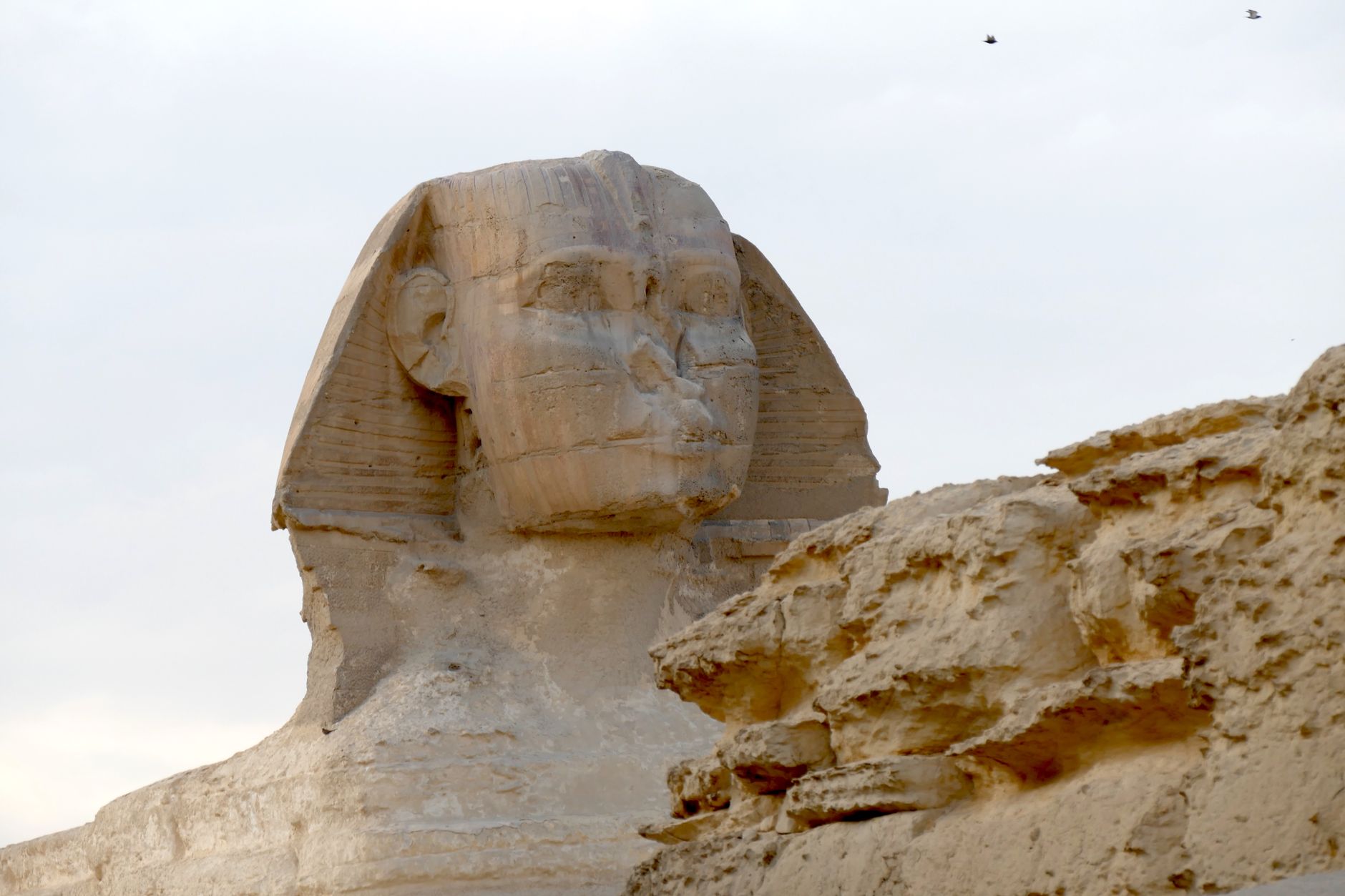
What the Sphinx Actually Is
Strip away the mystique and the Sphinx is a statue: the recumbent body of a lion with the head of a man wearing the nemes, the striped royal headdress every pharaoh wore. It was hewn directly out of the bedrock — they didn’t haul blocks in and assemble it, they carved down into a natural limestone knoll and shaped what was left. That makes it the largest monolithic statue on the planet, and it’s the reason the body has weathered so dramatically while the harder stone of the head has held its shape.
A few numbers worth carrying in your head:
- Length: about 73 m (240 ft), nose to tail
- Height: about 20 m (66 ft) at the head
- Age: roughly 4,500 years, dated to around 2500 BCE
- Material: a single outcrop of soft Giza limestone
- Faces: due east, straight at the rising sun
One detail that surprises people: it was painted. Look closely on a bright morning and you can still pick out faint patches of pigment — traces of red on the face, residue of yellow and blue on the headdress. The thing we think of as bare grey stone once stood in full, gaudy colour. Picture that next time you’re squinting at it.
Who Built the Sphinx?
The mainstream answer, and the one I’d put money on, is Khafre — the pharaoh who built the second-largest pyramid at Giza, the one that still wears a cap of original casing stone at its peak. He ruled somewhere around 2558–2532 BCE, and the Sphinx sits squarely inside his patch of the necropolis.
The case for Khafre is mostly about geography and stone. The Sphinx crouches at the eastern end of Khafre’s causeway, lined up with his pyramid. The temple beside it is built from the same massive limestone blocks, quarried from the very ditch dug around the statue, in the same masonry style as Khafre’s Valley Temple. And the face — battered as it is — resembles surviving statues of him. None of that is a smoking gun on its own, but together it’s a strong circumstantial case, and it’s why Egyptologists like Mark Lehner and Zahi Hawass land on Khafre.
You’ll read alternative theories online claiming it’s thousands of years older. They make for fun late-night reading and they are not taken seriously by anyone doing the actual archaeology. More on that below, because the “water erosion” argument deserves a fair hearing before you dismiss it.
The Missing Nose (and Why Napoleon Didn’t Do It)
Everyone asks about the nose. It was once roughly 1.6 m wide — a metre and a half of stone, gone. The story you’ve probably heard is that Napoleon’s soldiers blew it off with a cannon during the 1798 French campaign, maybe for target practice.
It’s a great story and it’s flatly untrue. There are drawings of the Sphinx made decades before Napoleon ever set foot in Egypt, and the nose is already missing in every one of them. The Danish traveller Frederic Norden sketched it noseless in the 1730s. You can’t shoot off something that was already gone.
The likeliest culprit is a man named Muhammad Sa’im al-Dahr. According to the 15th-century Arab historian al-Maqrizi, this Sufi was so appalled to find local farmers leaving offerings at the Sphinx’s feet — making offerings to a graven idol, as he saw it — that he defaced it in 1378 CE as an act of iconoclasm. He was, the account says, executed for it. The break itself backs up the human-hands version: surveyors have found marks consistent with iron rods or chisels driven into the bridge of the nose to lever it off, not the spalling you’d expect from erosion or a cannonball. Mark Lehner, who has studied the statue as closely as anyone alive, concluded the nose was deliberately broken with tools somewhere between the 3rd and 10th centuries CE — and the 1378 attack is simply the best-documented incident in that long window.

The Beard, and the Stele Between the Paws
The nose isn’t the only thing missing. The Sphinx originally wore a long ceremonial beard, which broke off — most likely from plain erosion, centuries before the nose came down. The fragments didn’t vanish into the desert: a large chunk sits in the British Museum in London, with smaller pieces in the Egyptian Museum in Cairo. There’s a long-running, slightly testy conversation between Egypt and the British Museum about returning that piece, which you can think about while you stare at the gap where it used to be.
The detail I find most moving sits between the front paws: the Dream Stele, a slab of pink granite erected by the pharaoh Thutmose IV around 1400 BCE. The inscription tells a story. Thutmose, then just a prince, was out hunting and fell asleep in the shadow of the Sphinx, which by his day was buried up to its neck in sand. In a dream the Sphinx — worshipped then as the sun-god Hor-em-akhet, “Horus of the Horizon” — promised him the throne of Egypt if he’d clear away the sand smothering it. He woke, dug it out, became pharaoh, and put up the stele to brag about it. The slab itself may be a recycled door lintel from one of Khafre’s temples. The point that gives me chills: by 1400 BCE the Sphinx was already over a thousand years old and so revered that a king built his legitimacy on a dream about it. It was ancient to people we call ancient.
The “Water Erosion” Debate
This is the one alternative theory worth understanding rather than just waving away. In the early 1990s, geologist Robert Schoch argued that the deep vertical channels weathered into the Sphinx enclosure look less like wind-and-sand erosion and more like the work of prolonged, heavy rainfall. Since Egypt hasn’t had that kind of climate for many thousands of years, the implication is explosive: the Sphinx would have to be far older than 2500 BCE — possibly 9,000 or 10,000 years old.
It’s a genuinely interesting observation and mainstream Egyptology doesn’t buy it. The standard rebuttals: the Sphinx is carved from notably soft, porous limestone that weathers fast and unevenly; it spent most of its existence buried in sand, which traps moisture and creates exactly these kinds of patterns; and there’s no trace anywhere on the plateau of the advanced 10,000-year-old civilisation such an early Sphinx would require. The geology is debated; the archaeology isn’t. I’d file it under “fascinating to argue about over a beer, not something to repeat as fact.”
How to Visit — What It’s Actually Like
The single most common disappointment I hear: people expect to walk up and stand beside the paws, hand on the stone. You can’t. The Sphinx is fenced, and you view it from a raised viewing terrace near the eastern entrance to the plateau, looking down and across at it. You’ll be maybe thirty or forty metres back at the closest. That’s it — no climbing, no touching, no walking into the enclosure. Make peace with this before you arrive and you’ll enjoy it far more.
The good news: you do not need a separate ticket. Access to the Sphinx terrace is included in the general Giza Plateau entry ticket — around 700 EGP (roughly 23 USD) in 2026. There’s no extra Sphinx-only fee. For the full breakdown of what each ticket covers, including the optional pyramid-interior add-ons, see our Giza pyramids tickets and prices guide. And bring a card — the plateau ticket office and most monument counters in Egypt have moved to card-only payment, so don’t count on settling up in cash.
From the terrace you’ll actually see more than just the statue:
- The Sphinx itself — face, body and paws, from the front and slightly above
- The Sphinx Temple, directly east of the statue, built from those colossal limestone blocks
- The Valley Temple of Khafre, just beside it — open to walk through, with gorgeous red-granite pillars and alabaster paving; this is where Khafre’s body was prepared before the journey up the causeway to his pyramid
- Khafre’s causeway, the ramp running west from the Sphinx up toward the pyramid
Do walk through the Valley Temple — most people photograph the Sphinx and leave, missing one of the best-preserved Old Kingdom buildings on the whole site, and it’s right there.
Best Time and Best Photo Angles
Get there at opening, around 8 AM. I cannot stress this enough. The plateau fills with tour coaches between 10 and 11, and an empty terrace versus a packed one is the difference between a magical visit and a scrum. Early morning also puts the sun on the Sphinx’s face — exactly the lighting it was carved to catch, since it faces due east at the sunrise.
For photos, a few angles reliably deliver:
- The main terrace, front-on: the classic shot, with Khafre’s pyramid rising directly behind the head. This is the postcard.
- Pull south and wide: step to the southern side and a wide lens stacks the Sphinx and the pyramids into one frame together.
- Late afternoon, around 3–5 PM: the sun drops behind the statue and you get dramatic silhouettes instead of lit detail. Different mood, equally good.
- The rooftop of the KFC/Pizza Hut across the road: yes, really. From outside the plateau, the fast-food terrace facing the Sphinx gives you a famously absurd, framed view — ancient guardian, modern fried chicken, all in one shot. It’s a Giza rite of passage.
Pack a telephoto if you want close detail on the face, and a wide lens for the Sphinx-plus-pyramid compositions. Phones and standard cameras are fine everywhere on the terrace; tripods can attract a request for a permit.

Getting the sun on the face at opening solves the Sphinx frame, though the rest of the plateau rewards more planning, from the three-in-a-row panorama to the golden hour windows worth building a day around.
Combining the Sphinx with the Pyramids
You’d never come to Giza for the Sphinx alone, and you shouldn’t — it’s one stop on the plateau, not a separate destination. The smart play is to fold it into the start of your pyramids morning, while the light is good and the crowds are thin. The Sphinx and its temples take 30 to 60 minutes; the rest of the plateau is your day.
A morning that works:
- Enter at 8 AM opening and walk straight to the Sphinx terrace while it’s empty.
- Drop down to the Sphinx Temple and Valley Temple of Khafre for context.
- Follow Khafre’s causeway up toward his pyramid.
- Spend the late morning on the Great Pyramid of Khufu and the panoramic viewpoint.
- Add a camel or horse at the viewpoint if you want the long desert-and-pyramids shot — just settle the price firmly in writing before you get on, because the haggling at Giza is relentless. Our camel ride at the pyramids guide covers the going rates and the scams to sidestep.
For the full plateau plan — gates, route, scams, what’s worth your money — start with the parent Pyramids of Giza complete visitor guide. If you want to compare the Sphinx’s face to other statues of Khafre afterward, head to the new roundup of the city’s major collections — the Egyptian Museum and the Grand Egyptian Museum both hold superb Khafre sculpture. And if Giza is part of a bigger Egypt loop, our day trips from Cairo guide maps out Saqqara, Dahshur and the rest. For a final flourish, the after-dark sound and light show at the pyramids, once it reopens after its current suspension, lights up the Sphinx and pyramids with narration — touristy, a little dated, and genuinely lovely on the right night.
The Sphinx FAQ
Is there a separate ticket for the Sphinx?
No. The Sphinx viewing terrace is included in the general Giza Plateau entry ticket (around 700 EGP / ~23 USD in 2026). There’s no Sphinx-only fee. Bring a card — most monument counters are card-only now.
Can I walk up to the Sphinx or touch it?
No. It’s fenced, and you view it from a terrace near the eastern entrance, set back from the paws. No climbing, no contact. You can photograph it freely from the platform.
Did Napoleon’s soldiers really shoot off the nose?
No — it’s a persistent myth. Drawings made before Napoleon’s 1798 arrival already show the Sphinx without a nose. It was most likely broken deliberately, with tools, long before — the best-documented incident being a 1378 act of iconoclasm by the Sufi Muhammad Sa’im al-Dahr.
Whose face is on the Sphinx?
Most likely Pharaoh Khafre’s, based on its resemblance to surviving statues of him and its physical alignment with his pyramid and causeway. It dates to around 2500 BCE.
What’s the slab between its paws?
The Dream Stele, a pink-granite tablet erected by Thutmose IV around 1400 BCE, recording his dream that the Sphinx would make him king if he cleared away the sand burying it. It’s visible from the terrace.
How long should I budget for the Sphinx?
Thirty minutes to an hour covers the statue plus the adjacent Sphinx Temple and Valley Temple of Khafre. Treat it as the opening act of your wider pyramids visit rather than a stop on its own.
One Last Thing
Don’t rush it. The instinct on the terrace is to fire off the postcard shot and move on to the pyramids — and most people do exactly that. Give it ten quiet minutes instead. Notice the chisel scars where the nose used to be, the faint colour on the headdress, the gap where the beard hung, the granite stele tucked between the paws. Every one of those marks is a scar from a different century. After 4,500 years of being buried, dug out, defaced, restored, mythologised and photographed half to death, the Sphinx is still there at dawn, looking east, waiting for the sun. Stand still long enough and you’ll feel why it’s outlasted everything else.