This article contains advertising. Our booking links are routed through a partner that adds commission tracking automatically, so if you book through one we earn a commission from the provider, at no extra cost to you. It never affects what we recommend. Affiliate disclosure
Here is the thing nobody tells you before you go: the Giza plateau is bigger than it looks in photos, and the way you get around it changed completely in the last couple of years. The old gate by the Mena House is gone as the main way in. Today you enter at the new Great Gate on the Cairo–Fayoum road, ride an electric shuttle between the monuments, and walk the short hops in between. Get the layout straight first and you will see everything that matters in about half a day, without trudging across sand in circles.
I have walked this site more times than I can count, in every season and at every hour the gate is open. This is the honest version of how the Giza pyramid complex is laid out in 2026 — where each pyramid stands, where the Sphinx hides at the eastern edge, where the panorama point is, how the new shuttle actually works, and the exact order I would do it in. For the bigger picture on the whole site, start with our complete Pyramids of Giza visitor guide.

The Giza Pyramid Complex Layout, in Plain Terms
Picture the plateau as a gentle slope of desert covering roughly 200 acres on the southwestern edge of Cairo, where the city stops and the Sahara begins. Almost everything lines up on a diagonal that runs southwest to northeast. Once that clicks, the rest is easy.
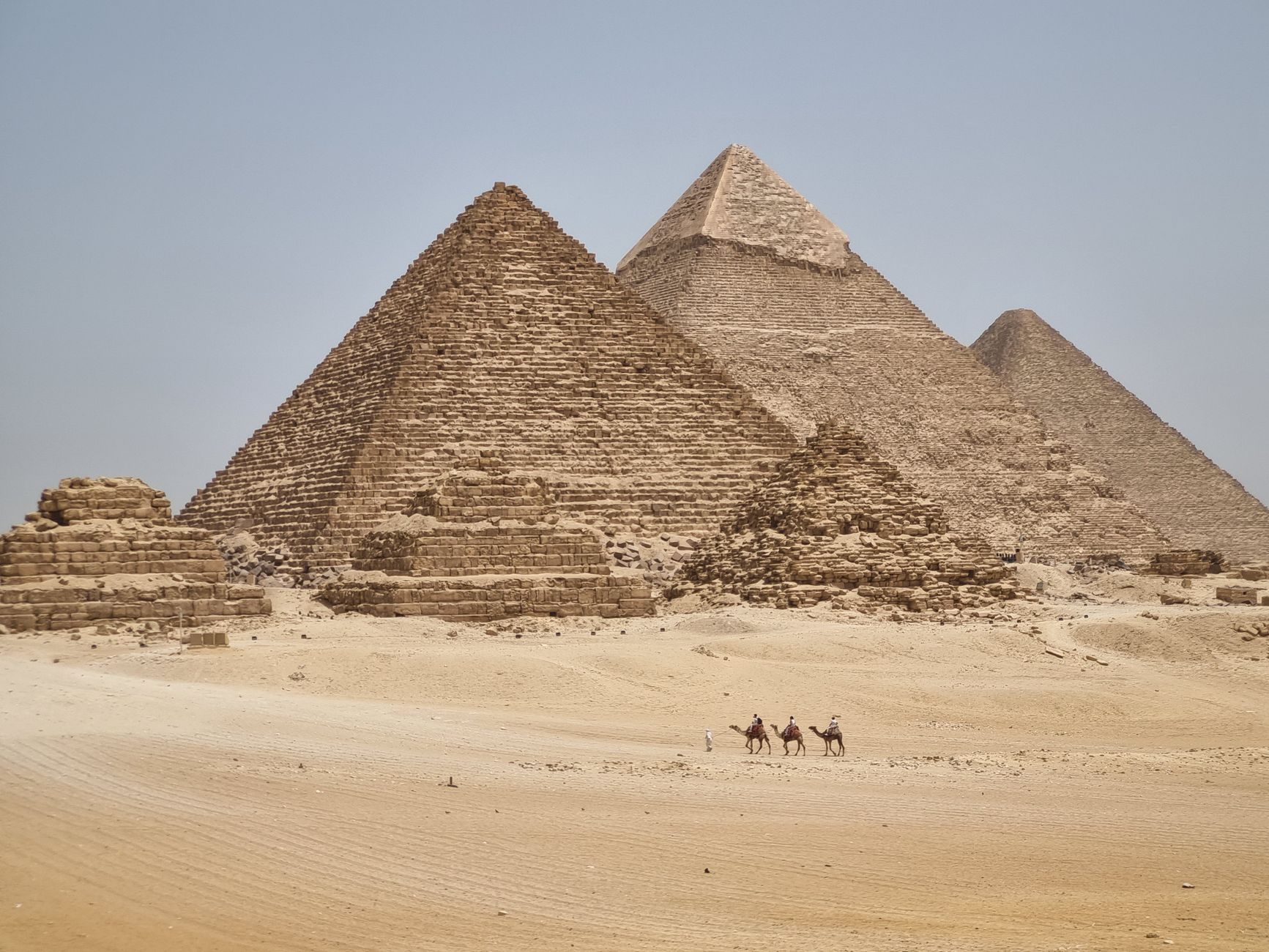
The three big pyramids sit in a rough line from north to south. Khufu — the Great Pyramid — is the northernmost and the largest. Khafre is in the middle and looks the tallest because it stands on higher ground and still wears a cap of the original smooth limestone casing. Menkaure is the southernmost and the smallest of the three. Cluster the little ones around them: three queens’ pyramids east of Khufu, two east of Khafre, and three more south of Menkaure.
The Great Sphinx is not up among the pyramids where people expect it. It crouches down at the eastern edge of the plateau, below the others, directly in front of Khafre’s pyramid and facing the sunrise. Right beside it sits the Valley Temple of Khafre — the best-preserved building on the whole site and, in my opinion, the most underrated thing here. A causeway once ran in a straight ramp from that valley temple uphill to Khafre’s pyramid; you can still trace most of it.
And then there is the panorama point: a rise of open desert out to the southwest, beyond and behind the pyramids, where you can finally get all three lined up in a single frame with nothing but sand in front of them. It is the shot everyone wants, and it is the one spot first-timers most often miss.
The New 2026 Entrance and Visitor Center
This is the part of any older guidebook that is now out of date, so read it carefully. For years there were two gates — a main one near the Mena House hotel and a smaller Sphinx gate to the east. That model is finished. The plateau now has one principal entrance: the Great Gate, on the Cairo–Fayoum road along the southern side of the site.
You arrive at a proper visitor center — a modern, wheelchair-accessible building with self-service ticket machines, security screening, clean restrooms, and an exhibition hall with artifact replicas, infographics, and a short heritage film. It is a real welcome rather than the chaotic scrum the old gate used to be. Buy your ticket from a machine or a counter, clear security, and you are in.
The biggest change to wrap your head around: private cars and tour buses are no longer allowed onto the plateau itself. Your taxi or driver drops you at the Great Gate and waits outside, or comes back for you. Inside, you move by electric shuttle and on foot. It feels strange if you visited years ago, but it has made the site quieter, cleaner, and far less hassled by traffic. For ticket prices and exactly what each option covers, see our Giza pyramids tickets and prices guide — and note that monuments here are card-friendly now, with machines and many booths taking cards, though I still carry some cash for small things like restroom fees.

The Electric Shuttle: Stops and Route
The shuttle is the spine of a modern Giza visit, and the good news is it is included with your admission — no separate fare. It runs as a hop-on, hop-off loop with electric buses arriving at short intervals, so you rarely wait long. It links the visitor center to the key points on the plateau, and you get on and off as you please.
The stops people care about are the panorama viewpoint, the Great Pyramid of Khufu, Khafre, Menkaure, and the Sphinx. A useful quirk to know: the loop reaches a point near the Sphinx that is also the exit — if you are not finished, do not step off there by mistake. Stay on for the stop that puts you at the Sphinx viewing area itself, then exit afterward.
My honest take: use the shuttle for the long, hot, dull stretches — getting out to the panorama point and back, and the haul down to the Sphinx — and walk the short, interesting hops between the three main pyramids, where every few steps changes the view. Walking those gives you the sense of scale that a bus window flattens. There is a café (Coffee Island) and toilets out at the panorama stop, and a couple of restaurant terraces on the plateau with knockout views if you want to sit down.
| Shuttle stop | What’s there | Worth getting off? |
|---|---|---|
| Panorama viewpoint | All-three-pyramids view, café, toilets | Yes — the classic photo |
| Great Pyramid (Khufu) | Largest pyramid, interior entrance, base shots | Yes — the headline monument |
| Khafre | Casing-capped pyramid, causeway start | Yes, briefly |
| Menkaure | Smallest pyramid, its three queens’ pyramids | Optional |
| Sphinx | The Sphinx, Valley Temple of Khafre, exit | Yes — save for last |
The Three Pyramids, North to South
Great Pyramid of Khufu
The northernmost and the giant — originally about 146 metres (481 ft) tall, and still the thing your eye goes to first. The interior entrance is on the north face, via the so-called Robbers’ Tunnel, and going inside is a separate paid add-on that is worth it if your knees and your nerves are up for a hot, low, crouching climb. The boats that were once displayed beside it have largely moved to the Grand Egyptian Museum nearby. For the full rundown on going inside, see our main Pyramids guide.
Pyramid of Khafre
The middle one, about 136 metres (448 ft), and the most photogenic because it keeps a cap of the original Tura limestone casing at its summit — the only one of the three that still shows how smooth and bright these monuments once were. Its interior entrance is on the north face too. The causeway running down its eastern side toward the Sphinx is the clearest of the three.
Pyramid of Menkaure
The southernmost and smallest, around 65 metres (213 ft), with lower courses faced in red granite. You will spot a long vertical gash on its north face — the scar of a medieval attempt to dismantle it that, thankfully, gave up. Three small queens’ pyramids stand at its eastern base, and from down here you get a lovely staggered view of all three big pyramids stepping up to the north.
The Sphinx and the Valley Temple
Down at the eastern edge, the Sphinx faces east toward the rising sun, roughly 73 metres (240 ft) long and 20 metres (66 ft) high, sitting in its own carved hollow in front of Khafre’s pyramid. The viewing platform lines it up beautifully with the pyramid behind, which is the photo most people came for.
Do not skip the Valley Temple of Khafre right next door. It is where the king’s body was prepared, and its bare red-granite pillars and pale alabaster floors are astonishing precisely because there is no decoration to distract you — just colossal, perfectly fitted stone. It is the one building here that lets you stand inside Old Kingdom architecture rather than only looking up at it. There is a separate, more detailed walk-through in our complete visitor guide, but on the plateau itself, just give it ten unhurried minutes.
The viewing terrace hands you the postcard angle and almost nothing else — no sense of why the thing was carved, or what the missing nose really means. Our full account of the Sphinx and its restorations covers the enclosure route, the best light, and the Sound and Light question.
A Route Plan That Actually Works
Here is the order I would do it in, assuming you arrive when the gate opens (early — for why that matters, see our notes on the best time to go further down):
- Enter at the Great Gate, buy tickets, use the visitor center, hit the restroom before you go in.
- Shuttle out to the panorama point first. The light is best early and the crowds are thinnest. Get your three-in-a-line photo while the air is cool.
- Shuttle or short walk to the Great Pyramid of Khufu. Walk its base for scale, go inside if you bought the add-on.
- Walk south to Khafre, then Menkaure. These hops are short and the changing angles are the whole point — this is where walking beats the bus.
- Shuttle down to the Sphinx last. See the Sphinx from the platform, then the Valley Temple of Khafre beside it.
- Exit by the Sphinx. You will be near the eastern edge and close to the GEM and the Mena House side for lunch.
Done at a comfortable pace with the shuttle doing the long legs, that is a four to five hour visit and you will have seen everything most people remember. If you are tight on time, do panorama point, Khufu, and the Sphinx and skip the rest — call it two and a half hours. If a camel or horse appeals for the open desert stretch out to the panorama, agree the price clearly and in writing before you mount; our camel ride at the Pyramids guide covers the going rates and the scams to sidestep.
Distances and Timing
Nothing here is far in a straight line, but sand and heat stretch every step. Rough on-foot times: Khufu to Khafre is about ten minutes; Khafre to Menkaure about fifteen; and the open desert out to the panorama point is another fifteen or so from Menkaure — which is exactly why most people take the shuttle for that part. End to end, a full walking circuit is in the range of three to four kilometres. Budget four hours for a relaxed look at the exteriors, and add an hour or more if you are going inside Khufu.
Two practical truths: there is very little shade anywhere on the plateau, and restrooms are concentrated at the entrance, the panorama stop, and the Sphinx area rather than scattered evenly. Carry water, plan your stops around those facilities, and do not underestimate how the sun ramps up by late morning. For a deeper look at hours and the calmest windows, our guide to the best time to visit the Pyramids is the one to read before you set an alarm.
Where the Photo Spots Are
- Three pyramids in a line: the panorama point to the southwest. The shuttle’s first major stop, and the only place you get all three cleanly framed.
- Sphinx with Khafre’s pyramid behind it: the Sphinx viewing platform at the eastern edge — the iconic pairing.
- Sense of scale: stand a person at the base of Khufu’s north side and shoot up. Nothing conveys the size better.
- Casing detail: the top of Khafre, the only pyramid still wearing its original smooth stone.
- Staggered three: from south of Menkaure, with its little queens’ pyramids in the foreground.
- Terrace shots: the restaurant terraces on and around the plateau give you a sit-down panorama with a cold drink in hand.
Golden hour and early morning do the heavy lifting here; harsh midday light flattens everything. If photography is your main reason for coming, the panorama point at opening time is non-negotiable.
Combine It With the Grand Egyptian Museum
The smartest move in 2026 is to pair the plateau with the Grand Egyptian Museum, which sits right beside it — there is now a dedicated walkway connecting the museum directly to the Giza site, so the two genuinely work as one long day. I would do the pyramids in the cool of the morning and the air-conditioned galleries in the heat of the afternoon. If you are building a wider day around it, our day trips and excursions from Cairo guide shows how Giza, the museum, and a stop like Saqqara or Memphis can string together, and our Cairo museums guide covers what to prioritise inside the GEM.
Giza Pyramid Complex Map FAQ
Where do you enter the Giza plateau now?
At the Great Gate on the Cairo–Fayoum road, on the southern side, where the new visitor center is. The old main gate by the Mena House is no longer the principal entrance, and private cars and tour buses can’t drive onto the plateau anymore.
Is the shuttle bus free?
Yes — the electric hop-on, hop-off shuttle is included with your admission ticket. It loops between the visitor center, the panorama point, the three pyramids, and the Sphinx at short intervals.
Are the pyramids in a straight line?
Roughly. Khufu (north), Khafre (middle), and Menkaure (south) sit on a southwest-to-northeast diagonal. They are not perfectly aligned, but from the right angle they read as a clean line.
How long does it take to walk between the pyramids?
About ten minutes from Khufu to Khafre, and around fifteen from Khafre to Menkaure. The panorama point is a further fifteen-minute walk or a quick shuttle ride from Menkaure.
Where exactly is the Sphinx?
At the eastern, lower edge of the plateau, directly in front of Khafre’s pyramid and facing east. Reach it on the shuttle loop — and stay on past the exit stop so you get off at the Sphinx itself.
Can I see the whole complex in one day?
Easily. Four to five hours covers all the exteriors, the Sphinx, and the Valley Temple at a relaxed pace, with the shuttle handling the long legs. Add the Grand Egyptian Museum next door in the afternoon for a full, satisfying day.
Do I still need a printed map?
Less than you used to, now that the shuttle does the navigating for you. Grab one at the visitor center if you like, and download an offline map of Giza on your phone as backup — signal is generally fine, but it is good insurance.
Pulling It Together
Once you understand the shape of the place — three pyramids on a diagonal, the Sphinx and its valley temple down at the eastern edge, the panorama point out to the southwest — Giza stops being overwhelming and becomes a simple loop. Enter at the Great Gate, shuttle out to the panorama for your photo first thing, walk the three pyramids in the cool morning, then ride down to the Sphinx and the Valley Temple before you leave. With the new shuttle doing the long stretches and a clear plan in your head, you will see more in half a day than most visitors manage in a full one.
Related reading: the complete Pyramids of Giza visitor guide, tickets and prices, the camel ride guide, best time to visit, day trips from Cairo, and the rundown of Cairo’s major collections for the GEM next door.
Since the museum opened two kilometres up the road, three hours has become the standard allowance for the plateau rather than a whole day — which makes prioritising what you see here more important than it used to be. Getting the running order right across both sites is the difference between a great day and an exhausting one. Our plan for combining the pyramids and the Grand Egyptian Museum in a single day sets out the timeline hour by hour.