This article contains advertising. Our booking links are routed through a partner that adds commission tracking automatically, so if you book through one we earn a commission from the provider, at no extra cost to you. It never affects what we recommend. Affiliate disclosure
Stand at the base of the Great Pyramid and the first thing that breaks your brain isn’t the height — it’s the age. These stones were already 2,000 years old when Cleopatra was born. Older to her than she is to us. The Pyramids of Giza history that actually matters is the part the postcards skip: who built them, how, and why a project this insane got finished at all. Three pharaohs, roughly 2600 to 2490 BCE, a workforce of paid Egyptians, and about 2.3 million limestone blocks stacked so precisely the whole thing still points at true north four and a half thousand years later.
That’s the short version. Here’s everything worth knowing before you go — the real story, the leading theories on construction, the recent discoveries that made headlines, the myths I’d love to put a stake through, and what’s genuinely still a mystery. For the practical side of a visit, our on-the-ground guide to the plateau covers tickets, timing and how to dodge the worst of the hassle.
The fast facts (so you can sound smart at the base)
- Where: Giza Plateau, west bank of the Nile, about 20 km (12 miles) southwest of central Cairo.
- When: Built across roughly 2600–2490 BCE, the height of Egypt’s Old Kingdom, Fourth Dynasty.
- Who: Khufu (the Great Pyramid), his son Khafre (the middle one), and grandson Menkaure (the small one).
- Great Pyramid, original height: 146.6 m (481 ft). It held the title of tallest structure on Earth for more than 3,800 years.
- Great Pyramid, height today: about 138.5 m (454 ft) — it lost its top and its smooth outer skin over the centuries.
- Blocks: roughly 2.3 million in the Great Pyramid alone, totalling around 5.75 million tons.
- Workforce: an estimated 20,000–30,000 skilled, fed, paid workers. Not slaves. We’ll come back to this.
- Build time: roughly 20–27 years for the Great Pyramid, per the mainstream estimates.
- Alignment: the base is aligned to true north to within about a fifteenth of a degree. Tighter than most modern buildings manage.
- Status: the last of the Seven Wonders of the Ancient World still standing, and a UNESCO World Heritage Site since 1979.
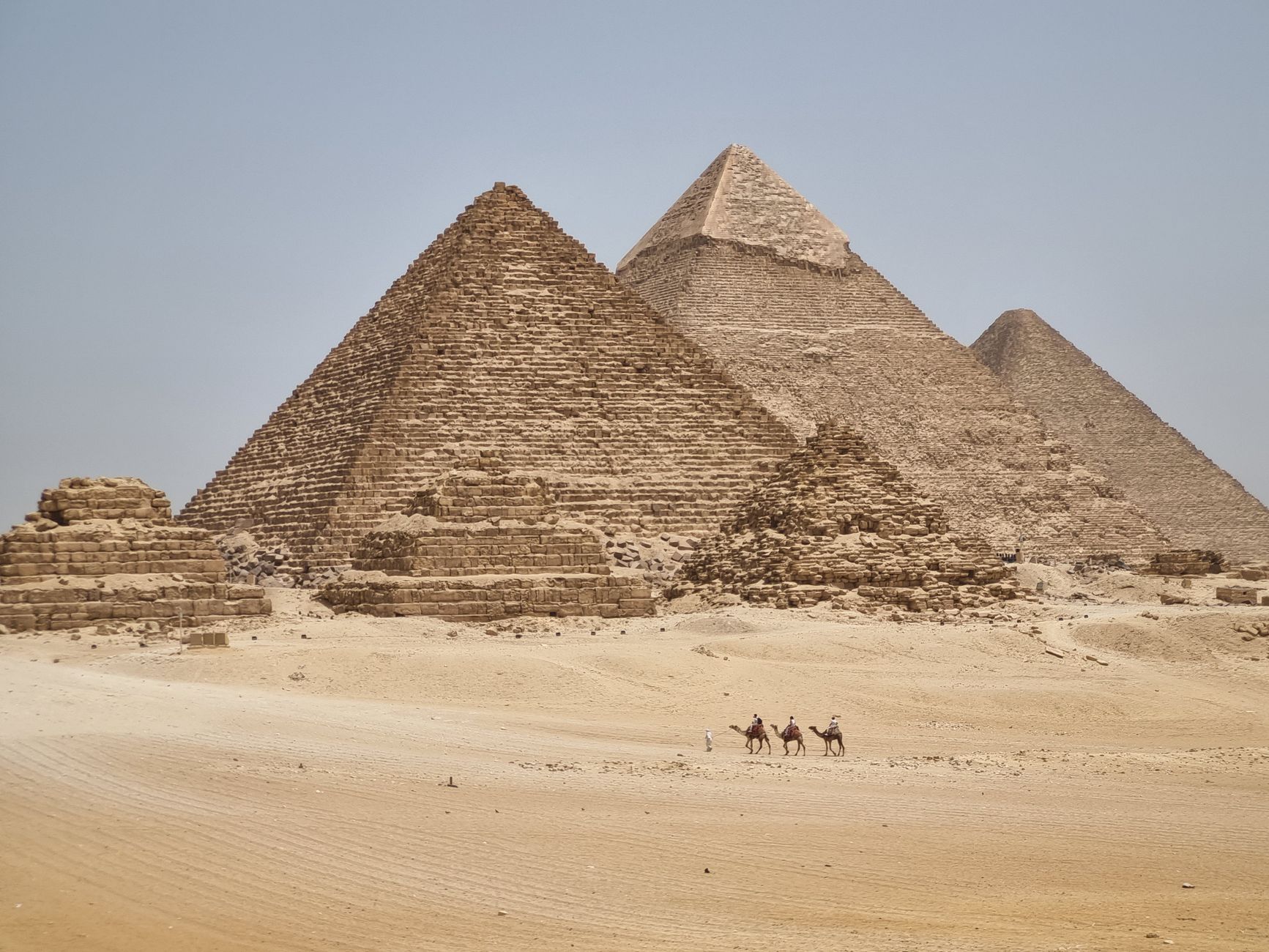
The three Pyramids of Giza, ranked by ego
People say “the Pyramids” as if they’re triplets. They’re not. They’re a dynasty showing off across three generations, and once you can tell them apart you’ll never un-see it.
Khufu’s Great Pyramid (c. 2560 BCE)
The big one, and the oldest. Khufu — the Greeks called him Cheops — was the second pharaoh of the Fourth Dynasty, and he built the largest stone monument any human civilisation has ever attempted. Original height 146.6 m, base a touch over 230 m on each side, faces sloping up at a near-perfect 51°52′. Here’s the irony that never gets old: the man who built the most colossal tomb in history left us exactly one confirmed image of himself — a 7.5 cm ivory figurine, smaller than your hand, found at Abydos. The biggest monument, the tiniest portrait.
Inside there’s the King’s Chamber, the so-called Queen’s Chamber, a subterranean chamber, and the Grand Gallery — a 49 m corbelled passage that’s one of the great architectural spaces of the ancient world. If you want to actually go in, read our guide to visiting the plateau first; the interior is a separate ticket and it’s not for everyone.
Khafre’s Pyramid (c. 2540 BCE)
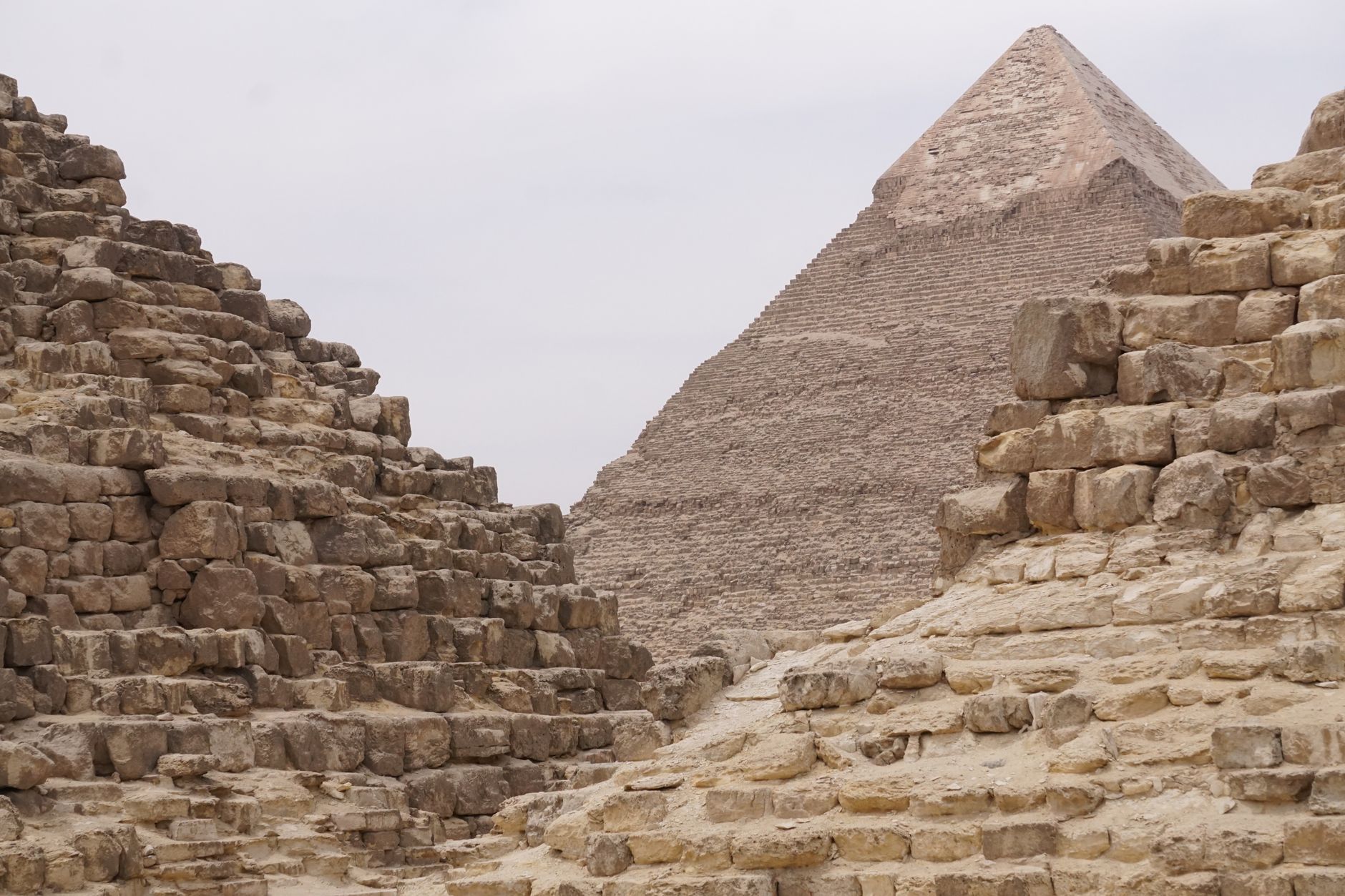
Khufu’s son. This is the one most people photograph thinking it’s the Great Pyramid, because it looks taller — it isn’t, it just sits on higher bedrock. Khafre’s real party trick is the cap of original limestone casing still clinging near the summit. That polished grey-white band is the only surviving glimpse of how all three pyramids once looked: smooth, gleaming, blinding in the sun. Khafre is also the pharaoh most archaeologists tie to the Sphinx, which crouches at the end of his causeway.
Menkaure’s Pyramid (c. 2510 BCE)
The little one — Khafre’s son, and noticeably more modest, barely half Khufu’s height at around 65 m. Whether that’s shifting religious priorities, a shorter reign or a smaller budget, historians still argue. Its lowest courses are red Aswan granite rather than limestone, which gives the base a warm pinkish tone up close. The deep vertical gash on its north face is human vandalism: Sultan al-Aziz Uthman tried to demolish the thing in the late 12th century, gave up after months, and left the scar.
How were the Pyramids of Giza built?
This is the question, and the honest answer is: we know far more than the History Channel would have you believe, and slightly less than we’d like. Modern archaeology has nailed the big picture. The remaining gaps are details, not miracles.
Where the stone came from
The bulk core blocks were quarried right there on the Giza Plateau — you can still see the scars. The fine white casing was Tura limestone, cut from quarries across the Nile and floated over. The granite for the King’s Chamber and Menkaure’s lower courses came from Aswan, roughly 800 km south, dragged onto barges and shipped down the river. We’re not guessing about the logistics, either: a set of papyri found at Wadi al-Jarf — the diary of an overseer named Merer — actually logs his crew ferrying Tura limestone to Khufu’s pyramid. A 4,500-year-old delivery schedule.
Moving the blocks
The average block weighs about 2.5 tons. The granite beams roofing the King’s Chamber run up to 80 tons. So how? The leading ideas, none of which need a spaceship:
- Wet sand. The best-supported one. A wall painting in the tomb of Djehutihotep literally shows a worker pouring water onto the sand in front of a giant sledge. Dampening the sand cuts the friction dramatically — physics experiments have since confirmed it roughly halves the force needed to drag a load.
- Ramps. Some combination of straight, zigzagging, or wrapped ramps built up alongside the rising pyramid and dismantled afterward. A steep ramp with post holes found at a quarry in Hatnub suggests they used clever pulley-assisted systems on inclines.
- Internal ramps. Architect Jean-Pierre Houdin’s theory that a ramp spiralled up inside the pyramid. Unproven, but it would explain a few anomalies.
- Levers and sledges for the final placement, plus sheer organised muscle.
The exact recipe is still debated. The ingredients are not aliens.
Who actually built them — the slave myth, buried
Forget the cinematic image of whip-cracking and chained labour. It’s wrong, and we have the receipts. In 1990 a tourist’s horse stumbled into a hidden mud-brick wall southeast of the Sphinx, and the excavations that followed — led by Egyptologist Mark Lehner and his Ancient Egypt Research Associates team, with Zahi Hawass — uncovered an entire workers’ settlement now called Heit el-Ghurab, the “Lost City of the Pyramid Builders.”
What they found rewrites the story. Barracks that could house and feed around 1,400 workers at a time. Bakeries turning out bread by the thousands of loaves. Breweries. And the clincher — the animal bone. The builders were eating prime beef, mutton and goat, a high-protein diet better than most ordinary Egyptians of the era ate. Skeletons from the nearby workers’ cemetery show healed fractures, set surgically, evidence of real medical care. You don’t feed slaves choice cuts and mend their broken legs.
The picture now is a rotating national workforce: crews drafted for a few months at a time, organised into named gangs (graffiti inside the relieving chambers records crew names like “Friends of Khufu”), then sent home. Part conscription, part civic duty, part the largest public-works programme of the Bronze Age — and very much paid in food, lodging and provisions. For more on the people, places and culture behind monuments like this, our roundup of the city’s collections points you to where their statues and tools now live.
The precision that keeps engineers up at night
Here’s where the Great Pyramid genuinely outclasses things built millennia later. The four sides of the base are level and equal to within a few centimetres across hundreds of feet. The whole structure is aligned to true north to within roughly a fifteenth of a degree — about 3.4 arcminutes — without a compass, a satellite, or steel tools.
How? The strongest theory is astronomical: by tracking a pair of stars circling the celestial pole and marking the moment a line between them ran perfectly vertical, the builders could fix true north precisely. Another elegant idea points to the autumn equinox and the shadow cast by a vertical pole at midday. Either way, the takeaway is the same — these were not lucky guesses. This was a civilisation with serious surveying, mathematics and astronomy, doing it at a scale nobody would match for thousands of years.
You’ll also hear breathless claims about the pyramid encoding the speed of light, or pi, or the dimensions of the planet. Take those with a fistful of sand. The base-to-height proportions do produce a number close to pi, but whether that was intentional or just a by-product of how the Egyptians measured slope (using a unit called the seked) is genuinely unsettled. The “speed of light at the pyramid’s latitude” stuff is numerology, not archaeology.
The Great Sphinx
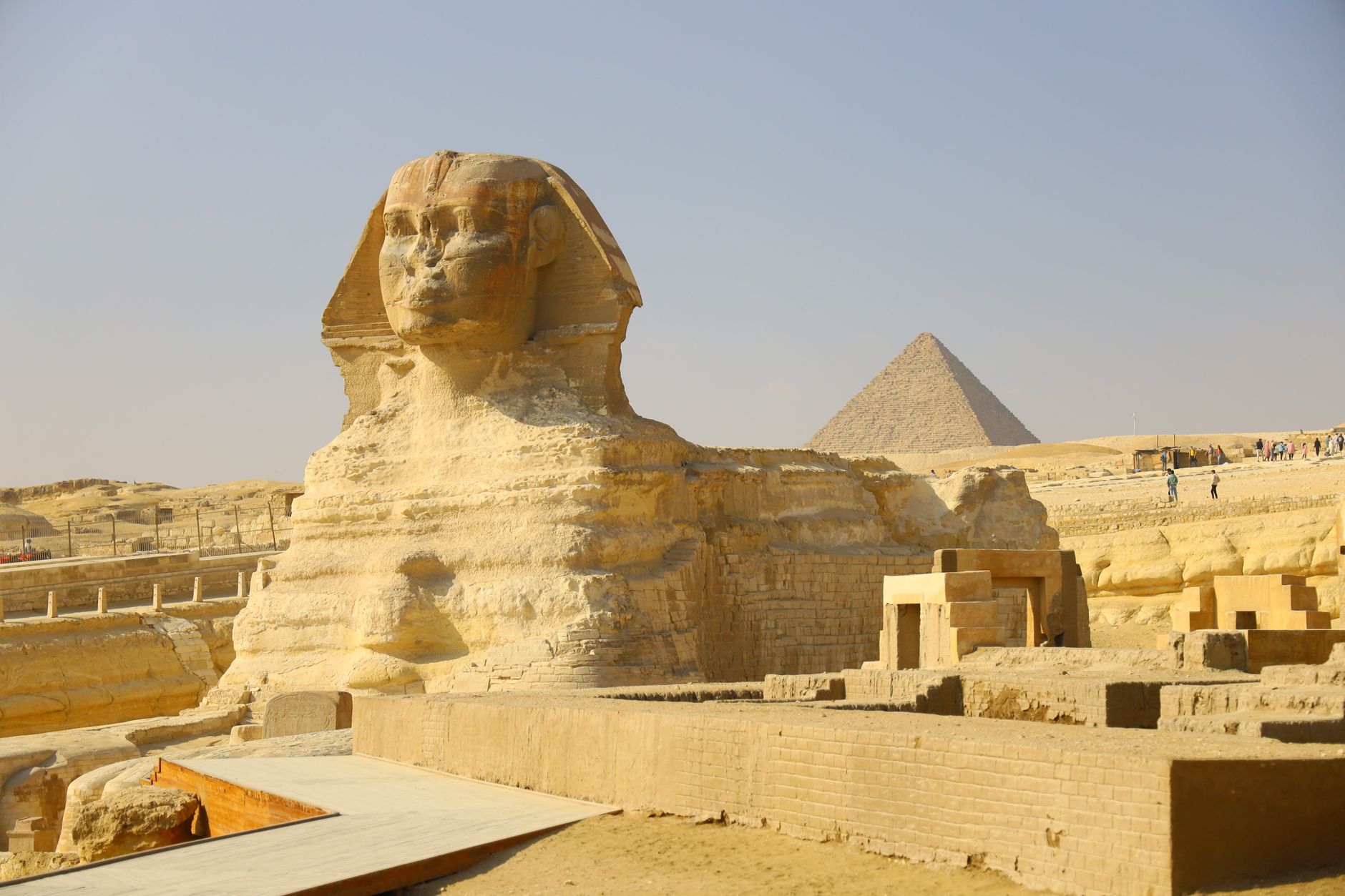
The Sphinx gets its own paragraph because it earns it. Carved from a single limestone outcrop at the eastern edge of the plateau, it’s about 73 m long and 20 m tall — the largest monolithic statue on the planet. Lion’s body, human face, almost certainly Khafre’s, based on where it sits and how the face matches his statues. It was probably cut around 2540 BCE.
And no, Napoleon’s troops did not shoot off the nose. That’s a stubborn myth. The nose was already long gone by Napoleon’s arrival in 1798 — sketches predating him show the damage — and the likeliest culprit is deliberate defacement by a 14th-century iconoclast offended by locals making offerings to it. Wind, salt and time finished the job.
The nose, the beard fragment now in the British Museum, and the water-erosion argument all deserve more room than they get here. We give the 73-metre monument its own walk-up guide to the lion-bodied colossus, including which viewing angles work and why nobody gets close enough to touch it.
Recent discoveries that actually made the news
The Pyramids are not a closed book. In the last decade, muon tomography — using cosmic-ray particles that rain through solid stone — has let researchers “X-ray” the Great Pyramid without touching it.
- The Big Void (2017). The international ScanPyramids team announced, in the journal Nature, a previously unknown cavity at least 30 m long sitting above the Grand Gallery. Its purpose is still unknown — a relieving space, a second gallery, a construction artefact? Nobody’s been inside.
- The North Face Corridor (2023). The same project confirmed a hidden chamber-like corridor just behind the pyramid’s original entrance, roughly 9 m long and about 2 by 2 m. An endoscope camera fed through a tiny gap got the first look inside in centuries. It may help relieve weight above the true entrance — or point somewhere we haven’t looked yet.
And on the ground, the Heit el-Ghurab workers’ city is still being excavated. Every season adds detail to the human story that, frankly, is more astonishing than any “lost technology” theory.
What’s still genuinely a mystery
Plenty, and it’s the good kind of mystery — solvable, not supernatural.
- Khufu’s body. Never found. The granite sarcophagus in the King’s Chamber is the only object ever recovered from inside, and it was empty when the first medieval explorers broke in. Robbed in antiquity, or buried elsewhere? Open question.
- What the Big Void is for. See above. The single most tantalising unknown in the building.
- Why the Queen’s Chamber was left unfinished. A design change mid-build is the leading guess.
- The “air shafts.” Narrow channels running from the chambers, some aimed at significant stars. Practical ventilation, a ritual path for the king’s soul, or both?
- The exact construction sequence. We know the methods; the precise choreography of how 2.3 million blocks went up in two decades is still reverse-engineered, not documented.
How to see all this for yourself
History hits differently when you’re standing in it. A few things that turn a hot, hassly morning into the trip of a lifetime:
- Do the museum first. The Grand Egyptian Museum at the edge of the plateau houses Khufu’s reconstructed cedar solar boat and the Old Kingdom artefacts that give the stones context. See it before the site and the pyramids stop being abstract.
- Hire a licensed Egyptologist. The difference between “big rock” and “this is where Merer’s crew docked their barge” is a good guide. Worth every pound.
- Walk the panorama point. The desert overlook southwest of the complex is where you get all three pyramids lined up. It’s also where the camel and horse touts work hardest — agree any price in writing, in EGP, before you mount anything.
- Stay after dark, or come back. The evening sound and light show, once it reopens after its current suspension, projects the whole story onto the monuments themselves — corny, yes, and genuinely moving anyway.
- Pair it with more of the old kingdom. Saqqara and Dahshur, where the pyramid was effectively invented and perfected, make a brilliant follow-up — see our day trips from Cairo guide.
And one rule with no flexibility: do not climb the pyramids. It’s illegal, it’s dangerous, and it carries real fines and jail time. People have died. Admire from the ground.
Pyramids of Giza history FAQ
When were the Pyramids of Giza built?
Across roughly 2600–2490 BCE, during Egypt’s Fourth Dynasty in the Old Kingdom — more than 4,500 years ago. Khufu’s Great Pyramid is the oldest of the three, finished around 2560 BCE.
Who built the Pyramids of Giza?
Three pharaohs across three generations: Khufu, his son Khafre, and his grandson Menkaure. The labour came from an estimated 20,000–30,000 skilled, paid Egyptian workers — not slaves — organised into rotating crews and housed in a purpose-built workers’ city near the plateau.
Were the Pyramids really built by slaves?
No. The discovery of the Heit el-Ghurab workers’ settlement — with its barracks, bakeries, beef-heavy diet and a cemetery showing skilled medical care — confirmed the builders were fed, housed and paid. The slave story comes from Herodotus and Hollywood, not the evidence.
How tall is the Great Pyramid?
About 138.5 m (454 ft) today. It originally stood 146.6 m (481 ft) and was the tallest human-made structure on Earth for over 3,800 years, until the spire of Lincoln Cathedral overtook it around 1311 CE. The smooth white Tura-limestone casing was stripped over the medieval centuries to build mosques and walls in Cairo.
How did they move blocks that heavy without machines?
The best-supported method is dragging sledges over wet sand to cut friction — a technique actually depicted in a contemporary tomb painting — combined with ramps, levers and a huge organised workforce. The largest granite beams, up to 80 tons, remain the hardest part to fully explain, but no theory requires anything more exotic than human ingenuity.
What’s the most recent discovery at the Pyramids?
Cosmic-ray muon scanning revealed a large hidden void above the Grand Gallery (announced in Nature in 2017) and confirmed a roughly 9-metre corridor behind the original entrance in 2023. Both were found without drilling a single hole, and their full purpose is still unknown.
Can you go inside the Pyramids?
Yes — Khufu’s interior is open for a separate ticket, and Khafre’s and Menkaure’s can usually be entered for less. It’s hot, steep and cramped, so it’s not for the claustrophobic. Our 2026 tickets and prices guide has the current fees and what each one includes.
Why is the Sphinx missing its nose?
Not Napoleon — the nose was already gone before he arrived. The likeliest cause is deliberate defacement by a 14th-century iconoclast, with weathering doing the rest.
Why it still stops you cold
Strip away the camel touts and the heat and the ticket queues, and what’s left is staggering. A society 4,500 years ago organised tens of thousands of fed, paid, well-cared-for people to quarry, float and stack 2.3 million stones into a monument so precise it still squares to the stars. No slaves. No aliens. Just an entire civilisation at the absolute top of its game, building something it knew would outlast everything. It has. Walk up to the base, put your hand on a block that a paid Egyptian named in some lost crew set in place during Khufu’s reign, and the 4,500 years collapse to nothing.
Related reading: the full Pyramids of Giza visitor guide, tickets and prices for 2026, the best of Cairo’s museum halls, camel rides at the pyramids, the evening sound and light show, and the best day trips from Cairo.
Sources
- Great Pyramid of Giza — Wikipedia (dimensions, height record, casing history)
- Britannica: Great Pyramid of Giza
- “Discovery of a big void in Khufu’s Pyramid by observation of cosmic-ray muons,” Nature (2017)
- ScanPyramids project — Big Void and 2023 North Face Corridor
- Ancient Egypt Research Associates (Mark Lehner) — the workers’ village and diet
- UNESCO World Heritage: Memphis and its Necropolis – the Pyramid Fields